Author: Jacob

  • How Death Valley’s ‘Sailing Stones’ Really Move

    How Death Valley’s ‘Sailing Stones’ Really Move

    Editorial illustration: Thin ice panels and shallow water create the unusual conditions that can move stones across Racetrack Playa.

    On the floor of Racetrack Playa in Death Valley National Park, dark stones can sit at the ends of long, looping grooves. The trails make the scene look as if someone dragged each rock through the mud with a rope. For decades, no one had watched the process happen. That gap invited a wonderfully strange label—“sailing stones”—and a long list of proposed explanations.

    The central fact is less supernatural and more remarkable: the stones can move. In the winter of 2013–14, researchers directly documented the process with GPS-equipped rocks, cameras, and a weather station. Their observations showed that a rare sequence of shallow water, overnight freezing, sunshine, and light wind can nudge many rocks at once.

    A dry lakebed that occasionally becomes a pond

    Racetrack Playa is a playa, or dry lakebed, in a remote part of Death Valley National Park. Rocks fall from the surrounding mountains onto its unusually level surface. Most of the time the bed is dry. After the right winter weather, however, a very shallow pond can form.

    That shallow depth matters. On a cold night, the water can freeze into a thin, nearly transparent sheet. In daylight, the sheet begins to melt and fracture into broad floating panels. The 2014 field study measured “windowpane” ice only about 3 to 6 millimeters thick—far too thin to lift a large rock like a raft. Instead, the panels act more like gentle, wide pushers.

    Editorial illustration of a thin floating ice panel pressing against a dark stone on a shallow muddy playa
    Editorial illustration: A floating ice panel can push a grounded stone across soft mud.

    What the researchers actually saw

    During the study period, light winds moved broken ice panels over the shallow pool. As those panels pressed against rocks, the rocks slid along the soft bed beneath the water and etched trails behind them. The researchers reported speeds of roughly 2 to 5 meters per minute—slow enough to be hard to notice without a fixed point of reference.

    That explains two of the playa’s eeriest details. First, multiple rocks can begin moving at nearly the same time because one large sheet or a set of panels can push across a broad area. Second, a trail can bend or stop because the direction of wind and water flow changes, the panel breaks apart, or the stone settles again.

    The study documented more than 60 rocks moving in one event and recorded individual instrumented rocks moving in multiple episodes. It did not establish that every trail ever seen at Racetrack Playa formed by one identical arrangement of ice and wind. Its conclusion is narrower and stronger: it directly observed a real mechanism capable of producing the phenomenon.

    Fact, older hypotheses, and the word “mystery”

    Documented fact: stones leave tracks on the playa, and researchers observed thin floating ice panels, shallow water, and light winds pushing stones across the muddy surface in 2013–14.

    Older hypotheses: before that direct observation, scientists considered strong winds, wet mud, ice, and other possibilities. The National Park Service notes that earlier explanations included hurricane-force winds, dust devils, slick biological films, and thicker ice. Those ideas belong to the history of the investigation; they should not be presented as equally supported explanations after the field observations.

    Folklore: this is not a local-legend story. “Sailing stones” and “moving rocks” are descriptive names for a documented natural process, not evidence that the rocks move by themselves without weather and water.

    Why the tracks need care

    The Park Service asks visitors not to move or remove rocks and to avoid the playa when it is wet. Footprints and tire marks can damage the delicate surface and remain visible for years. The Racetrack is also remote, with rough access roads and no cell service; the Park Service advises visitors to prepare for difficult conditions rather than treating the place as a quick roadside stop.

    Editorial illustration of a dark stone at the end of a curving trail on a dry cracked playa
    Editorial illustration: Once the water is gone, a stone’s path can remain etched in the playa surface.

    That combination—rare weather, a huge flat surface, and marks that persist after the pond disappears—is why the stones looked inexplicable for so long. The answer is not a single gust or a trick of the eye. It is a brief, quiet chain of conditions that turns an empty lakebed into a moving landscape.

    Sources

  • When a Desert Dune Starts to Sing

    When a Desert Dune Starts to Sing

    Some desert dunes can answer an avalanche with a low, sustained boom. It is a real acoustic phenomenon, not a campfire story: at the right dune, a small slide of very dry sand can produce a deep tone that people describe as a hum, a drone, or a distant aircraft.

    The National Park Service records “singing sands” at Colorado’s Great Sand Dunes National Park & Preserve and says the park is among the relatively few places where the deep humming or booming sound can be heard. California’s Eureka Dunes offer another carefully described example. There, the Park Service says the sound can accompany sand avalanching down the steepest face of the highest dune, and compares it with a pipe-organ bass note or a distant airplane.

    Editorial illustration of a small dry-sand avalanche on a pale-gold desert dune beneath a clear sky.
    Editorial illustration: a dry-sand avalanche on a steep dune face, the condition associated with a booming event.

    Not every dune—and not every day

    “Singing” is a useful name, but it can make the process sound more mystical than it is. The sound happens during a moving sheet of sand, especially when sand avalanches down a dune’s steep slip face. It is also fussy about conditions. The Eureka Dunes page says the sand must be completely dry; if the dune is damp, it may stay silent even when the moisture is not obvious to a hand on the surface.

    That selectiveness helps explain why a broad dune field is not automatically a concert hall. Researchers distinguish booming dunes from more familiar squeaking or crunching beach sands. A review in Annual Review of Earth and Planetary Sciences describes booming as a phenomenon found at dozens of sites worldwide, with a dominant audible frequency commonly reported around 70 to 110 hertz plus higher harmonics. The particular note can persist longer than an observer might expect from a brief sand slide.

    What scientists can say with confidence

    A 2004 Physical Review Letters study reported that an avalanche excites elastic waves at a dune’s surface and that the motion of the grains can partly synchronize with those waves. A later review in Reports on Progress in Physics similarly describes the audible emission as a vibration of the sand excited by granular shear flow—the sliding and rearranging of grains in the moving layer.

    Those findings give the phenomenon a solid physical footing: dry sand is moving, grains are interacting, and the dune is vibrating in a way that couples to the air as sound. They do not turn every detail into a closed case. The 2012 review evaluates several proposed mechanisms and says that some explanations have been rejected while amplification by guided elastic waves through friction still needed confirmation. In other words, the desert’s low note is documented; the most complete account of how a dune selects and sustains that note remains an active scientific question.

    Editorial cutaway illustration of a thin dry-sand avalanche sliding down a dune above layered sand.
    Editorial illustration: a conceptual cutaway of granular flow and subsurface vibration. It is an explanatory visual, not a measured map of a particular dune.

    Why the caution matters

    The audible result is so strange that it is easy to overstate it. Dunes are not producing a tune on command, and a visitor should not treat a fragile dune as an instrument to be tested. The Park Service’s descriptions are better read as an invitation to notice a rare natural process—and to follow site guidance that protects the dune and the habitat around it.

    That restraint also makes the truth more interesting. A dune can look silent and still hold the ingredients for a sudden bass note: suitably dry grains, a steep moving layer, and a landscape capable of transmitting a collective vibration. The weird part is not that the desert is hiding a supernatural voice. It is that ordinary grains of sand can briefly behave like one remarkably large, resonant system.

    Sources

  • Inside the U.S. Capitol’s ‘Crypt,’ Where No One Is Buried

    Inside the U.S. Capitol’s ‘Crypt,’ Where No One Is Buried

    The U.S. Capitol has a room called the Crypt. It is beneath the Rotunda, lined with stone columns, and it has never held a burial.

    That is not a modern irony attached to an old nickname. The name grew from the room’s church-like architecture: a vaulted space below a principal room. In churches, comparable spaces were often chapels or tombs. At the Capitol, the resemblance stuck. The burial itself never did.

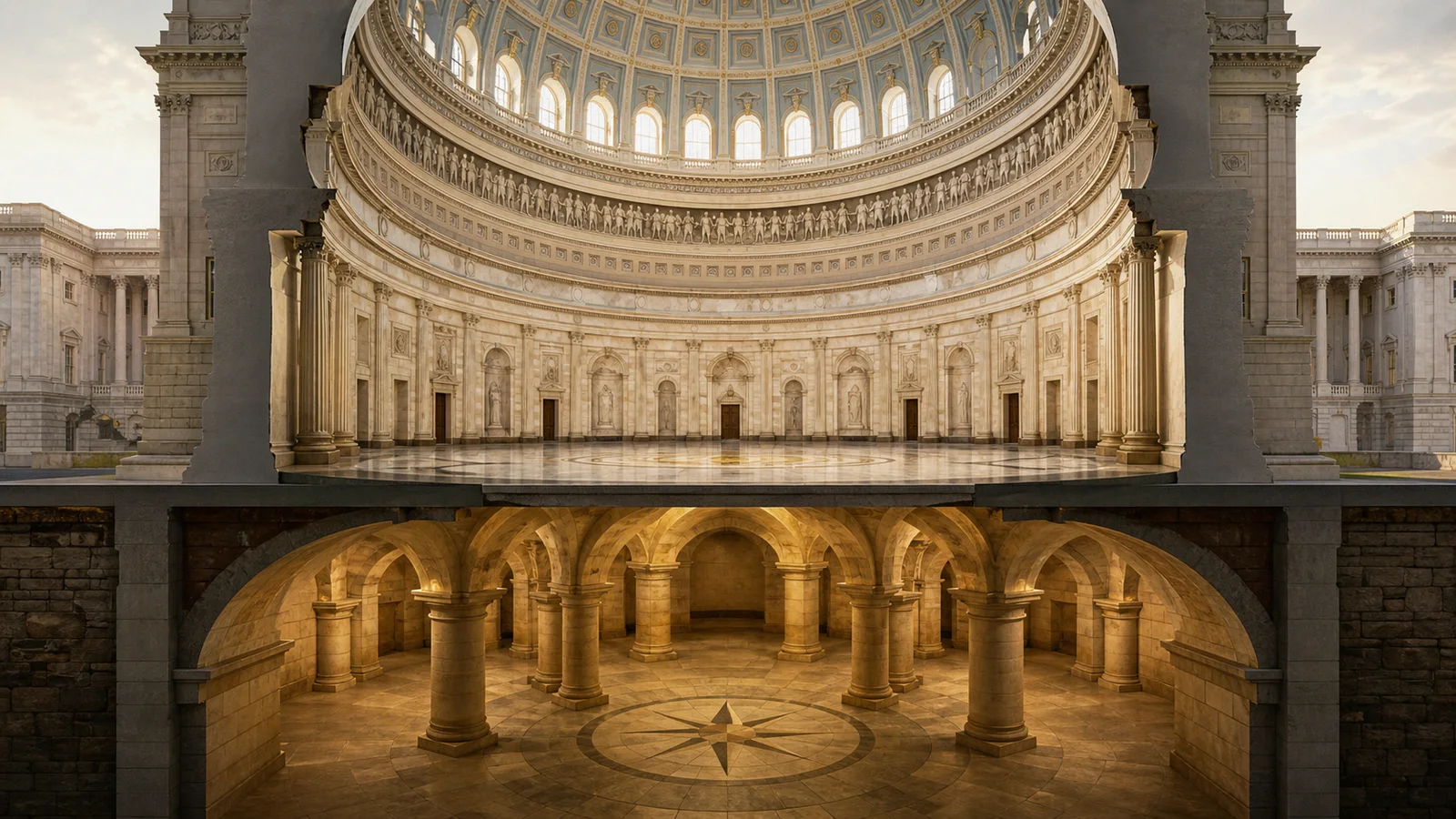
    Editorial illustration showing a cutaway of the U.S. Capitol Rotunda above the empty vaulted Crypt.
    Editorial illustration of the Rotunda and the vaulted Crypt beneath it.

    A tomb planned for the first president

    The unusual space is tied to the early plans for commemorating George Washington. After Washington died in 1799, Congress resolved that a monument should be erected at the new Capitol and sought permission to place his remains beneath it. Mount Vernon’s historical account says that Martha Washington’s consent was obtained and a crypt was provided below the Capitol dome, but the project was never completed.

    Washington’s own wishes pointed home. His will called for a new brick tomb at Mount Vernon to replace the deteriorating family vault. His remains, and later Martha Washington’s, were moved to the new tomb in 1831. The Architect of the Capitol says that a tomb area was built beneath the Crypt, but Washington’s descendants honored the burial wish in his will. The official answer to the building’s most morbid-sounding question is therefore wonderfully plain: no one is buried in the Capitol.

    What visitors actually find

    The Crypt is a working part of the Capitol’s historic interior, rather than an unused underground chamber. Its 40 smooth Doric columns of Aquia Creek sandstone support the arches and the Rotunda floor above. They were installed in the 1820s under Architect of the Capitol Charles Bulfinch, whose work completed the building’s central section in 1826.

    Look down, and the room has another civic trick: a white-marble compass star marks the Capitol’s center point, the reference point from which Washington is divided into northeast, northwest, southeast, and southwest quadrants. The original floor is paved with stone from Seneca, Maryland. The space also holds statues representing the 13 original colonies and a display centered on a replica of Magna Carta.

    Editorial illustration of the empty U.S. Capitol Crypt with sandstone columns and a white compass star set in the stone floor.
    Editorial illustration of the Crypt’s columned interior and central compass star.

    Why the name still works

    Calling the room a crypt can sound like an error until the architectural meaning comes into view. The name describes its form and the burial purpose once imagined for the space; it does not report an occupant. In that sense, the Capitol Crypt preserves an unusually visible historical near-miss: a national memorial plan that was built around a tomb, while the person meant for it remained at the estate he had chosen.

    It is also a useful reminder that the Capitol’s oddest details are often not hidden. Guided tours of the building include the Crypt, the Rotunda, and National Statuary Hall. Visitors walk through a room named for a burial chamber, supported by 40 columns, centered on a stone star—and leave knowing its most surprising fact: it has always been empty of graves.

    Sources

  • When Lightning Makes Glass: The Strange Story of Fulgurites

    When Lightning Makes Glass: The Strange Story of Fulgurites

    Editorial illustration

    A thunderstorm can leave behind something that looks more like a root, a burnt twig, or an artifact from a fantasy film than a mineral. It is called a fulgurite: a fragile tube or branching mass of natural glass made when lightning strikes suitable ground.

    The usual version begins in sand. A bolt delivers an enormous burst of energy along a narrow path, melting the grains around it. As that material cools, it can preserve the bolt’s underground route as a dark, rough-walled tube. At Great Sand Dunes National Park and Preserve, the National Park Service describes fulgurites as blackish glass tubes formed when lightning strikes the dunes.

    A lightning strike, preserved below the surface

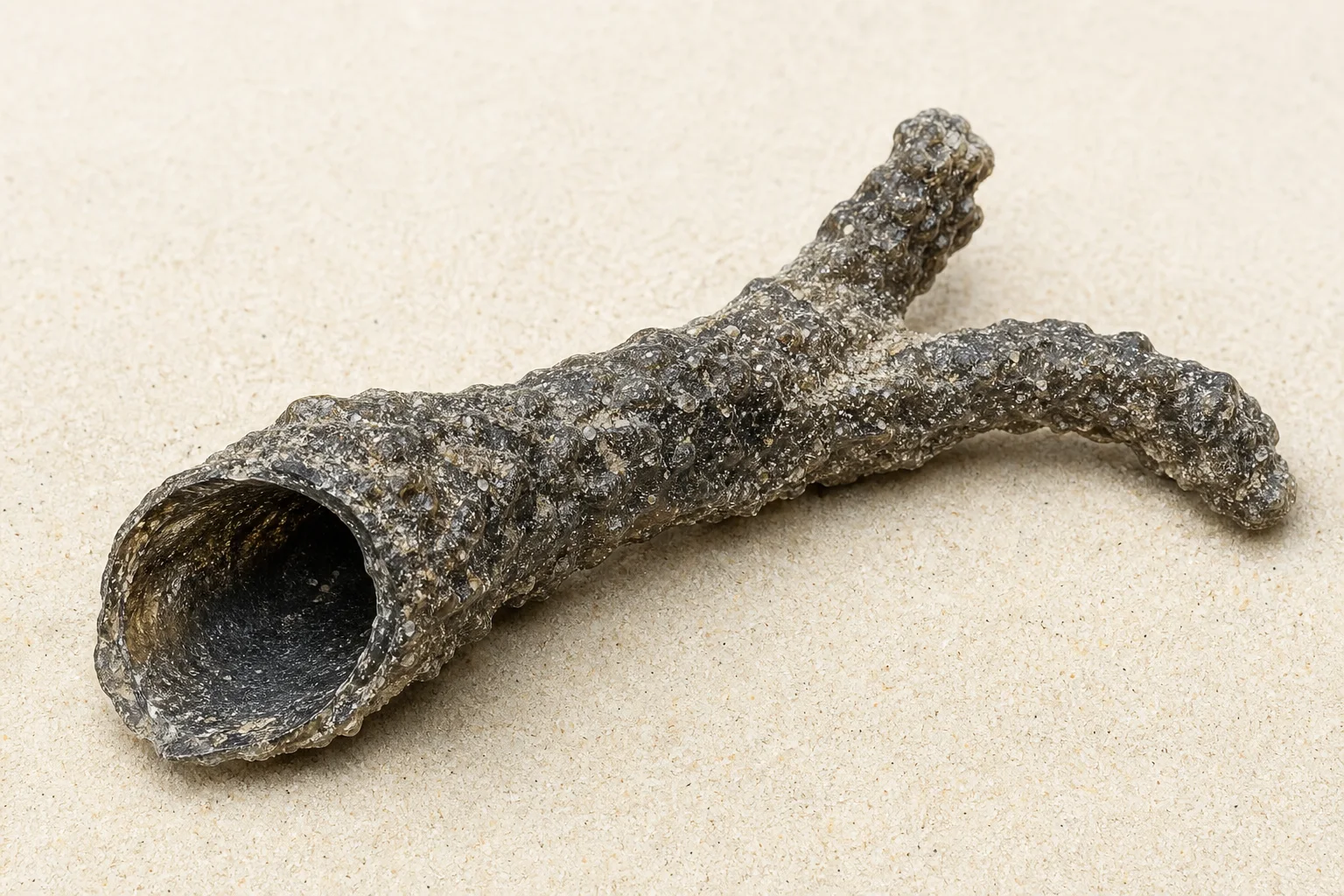
    Fulgurites are often found after erosion exposes them, which helps explain their odd silhouette. The central channel may be hollow, while the outside can retain grains of sand fused into a craggy skin. Some specimens branch. That is a visual echo of the way electrical paths can split through the ground, not evidence that the material grew there over time.

    Editorial illustration of a dark, hollow, branching glass tube resting on pale sand.
    Editorial illustration

    Sand is not the only starting material. The Smithsonian National Museum of Natural History maintains a fulgurite collection that includes both rock and sand specimens struck by lightning. Its collections overview also distinguishes pseudofulgurites: glassy material made by other intense heat sources, including burning coal seams and downed power lines. In other words, a dramatic-looking glassy tube needs context before it can be confidently identified as a lightning relic.

    Why they do not look like ordinary glass

    Window glass is manufactured from a carefully controlled melt. A fulgurite is the opposite: an instant, uneven melt of whatever mineral mixture was already present in one small patch of ground. That is why color, thickness, texture, and branching can vary so much from one specimen to another. A specimen formed in quartz-rich sand can look different from one made where lightning fused solid rock.

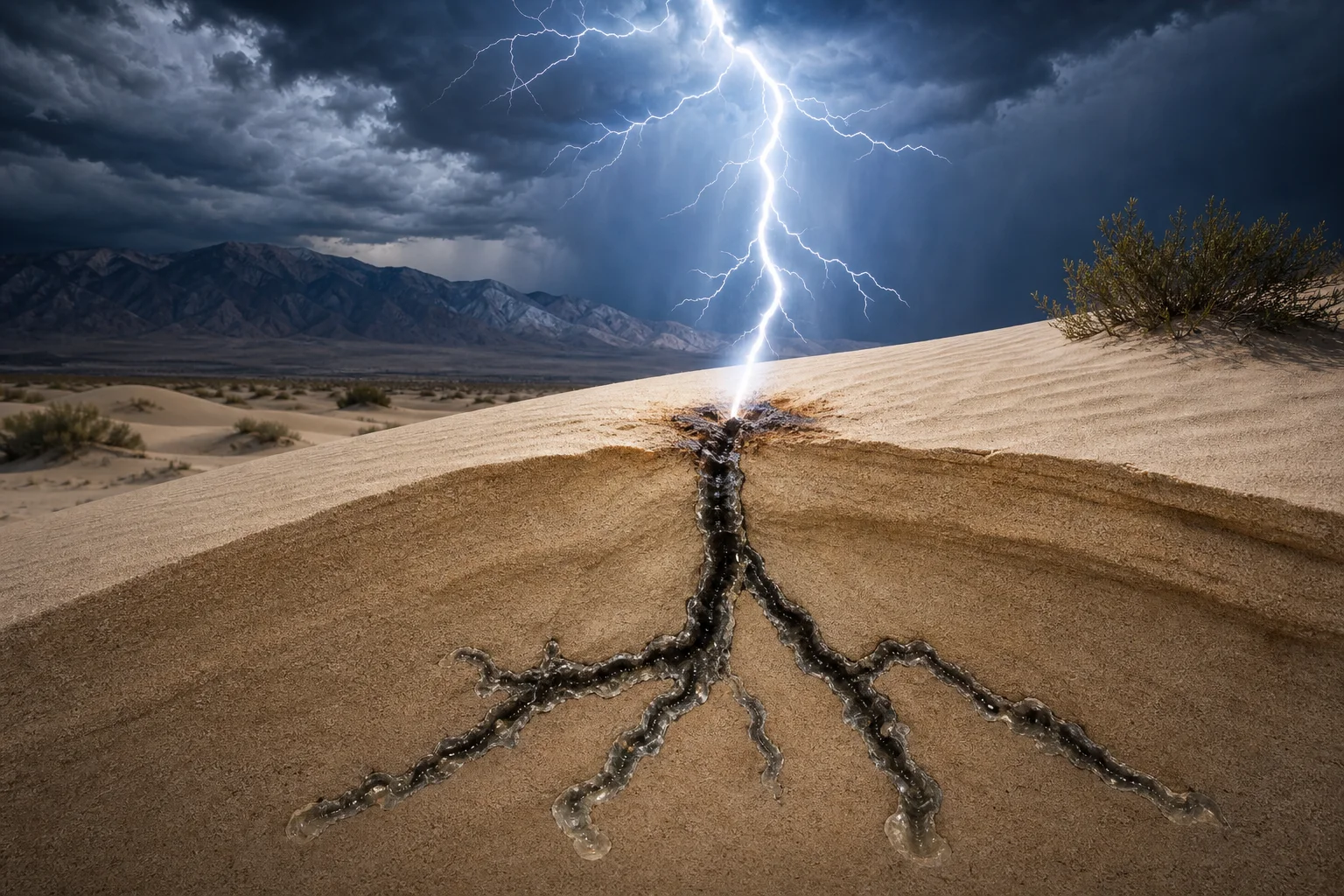
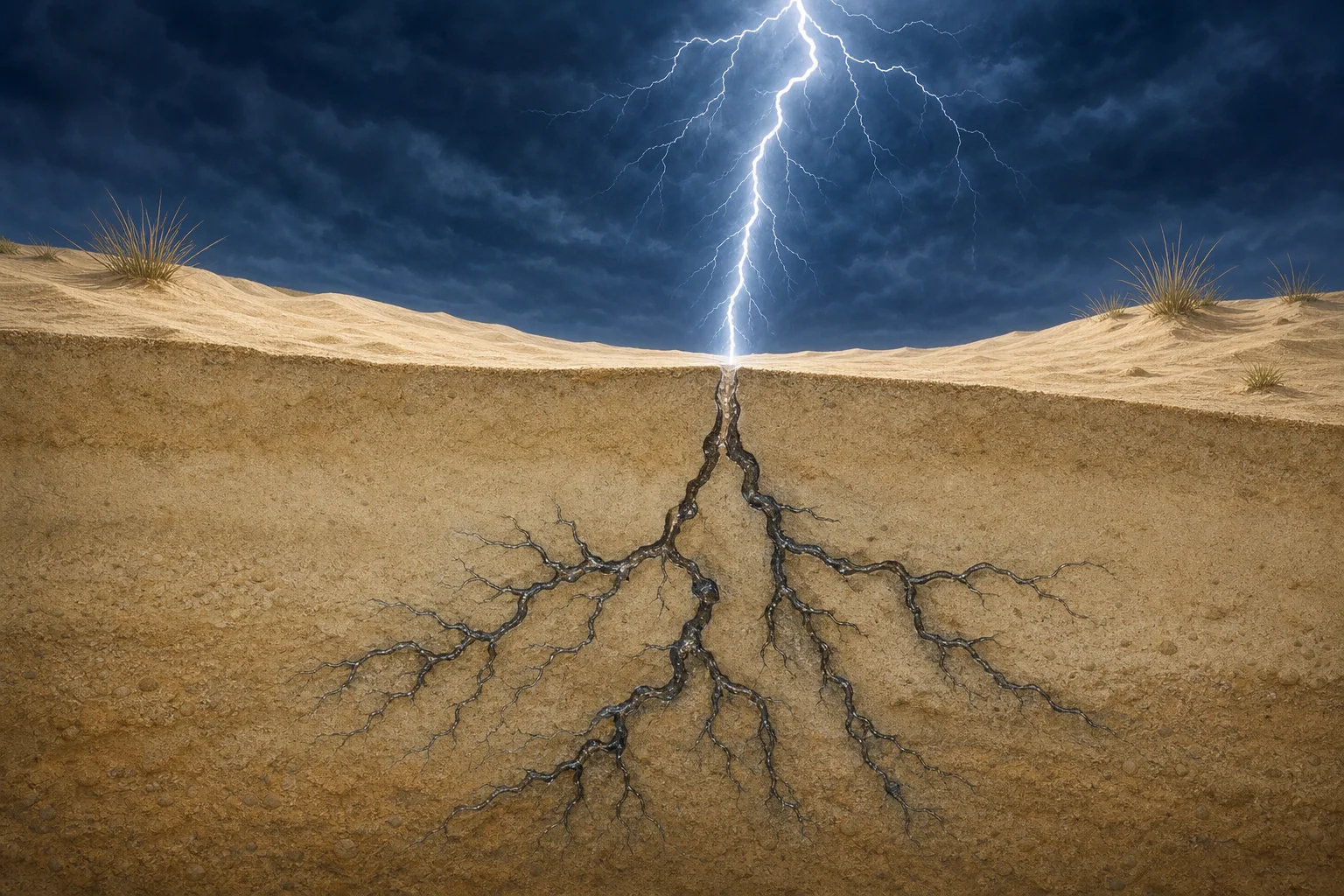
    Editorial illustration showing lightning entering a dune and a branching dark glass structure below the sand surface.
    Editorial illustration

    They are also easy to break. What survives is only a fraction of a very fast event, then exposed to shifting sand, water, weather, and curious hands. That fragility is part of the appeal: a fulgurite is a physical trace of a moment that lasted only an instant.

    Look, do not collect

    The strange part of a fulgurite is not that lightning can melt material. It is that the result can remain recognizable after the storm is gone. But it is not a reason to chase thunderstorms or dig into dunes. The National Park Service warns visitors at Great Sand Dunes to come down from the dunes when storms approach, and says fulgurites there should be left in place because park resources are protected for future visitors.

    So the best way to appreciate a fulgurite may be the least dramatic one: after the weather is safely past, learn how to recognize the phenomenon, enjoy documented examples, and leave protected finds where their story can continue.

    Sources

  • Jaipur’s Giant Stone Instruments That Read the Sky

    Jaipur’s Giant Stone Instruments That Read the Sky

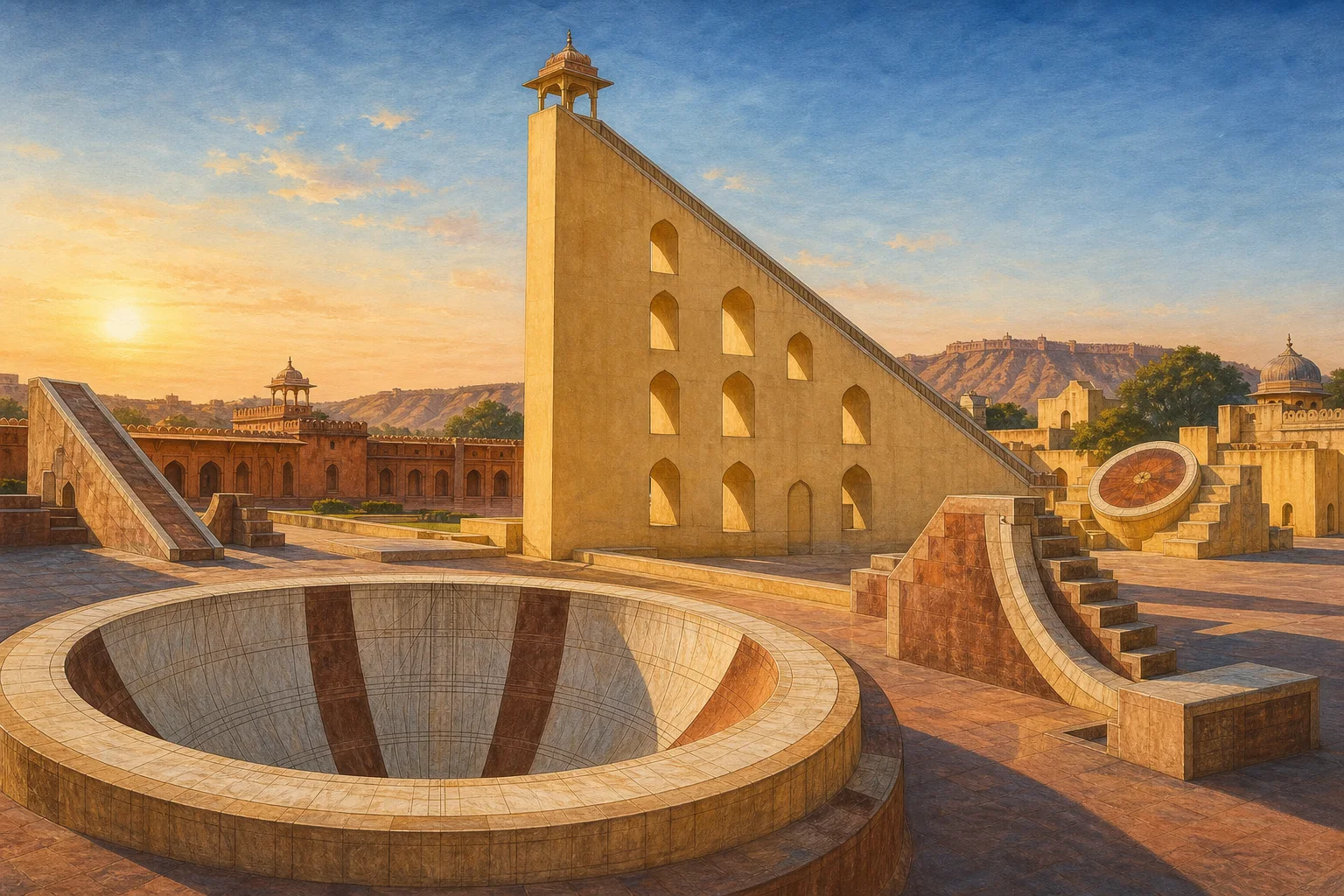
    In the middle of Jaipur, India, an 18th-century observatory looks less like a room full of instruments than a small city of ramps, bowls, walls and arcs. At Jantar Mantar, the tools for watching the sky were built at architectural scale. A visitor can walk beside a sundial rather than hold one in a hand.

    UNESCO describes Jantar Mantar as an early-18th-century astronomical observation site with roughly 20 fixed masonry instruments, designed for naked-eye observations of celestial positions. Rajasthan Tourism counts 19 instruments at the monument, a reminder that different inventories group some structures differently. The useful point is not a contest over the number: this is a whole landscape of measuring devices.

    A court turned measurement into architecture

    Jantar Mantar was created under Sawai Jai Singh II, the founder of Jaipur. Rajasthan government sources date the Jaipur complex to the 1720s and say it was completed in 1734. UNESCO places it among the most significant and best-preserved historic observatories in India, built at a moment when the court brought astronomy, calculation, architecture and ideas about the cosmos together in one public-scale setting.

    That setting matters. Many earlier astronomical instruments had familiar forms: sundials, circles, sections of circles and astrolabe-like devices. At Jaipur, those forms became masonry. Their size made fine graduations and shadows easier to read, while the structures themselves became a startling part of the city’s built environment.

    The giant triangle is a clock

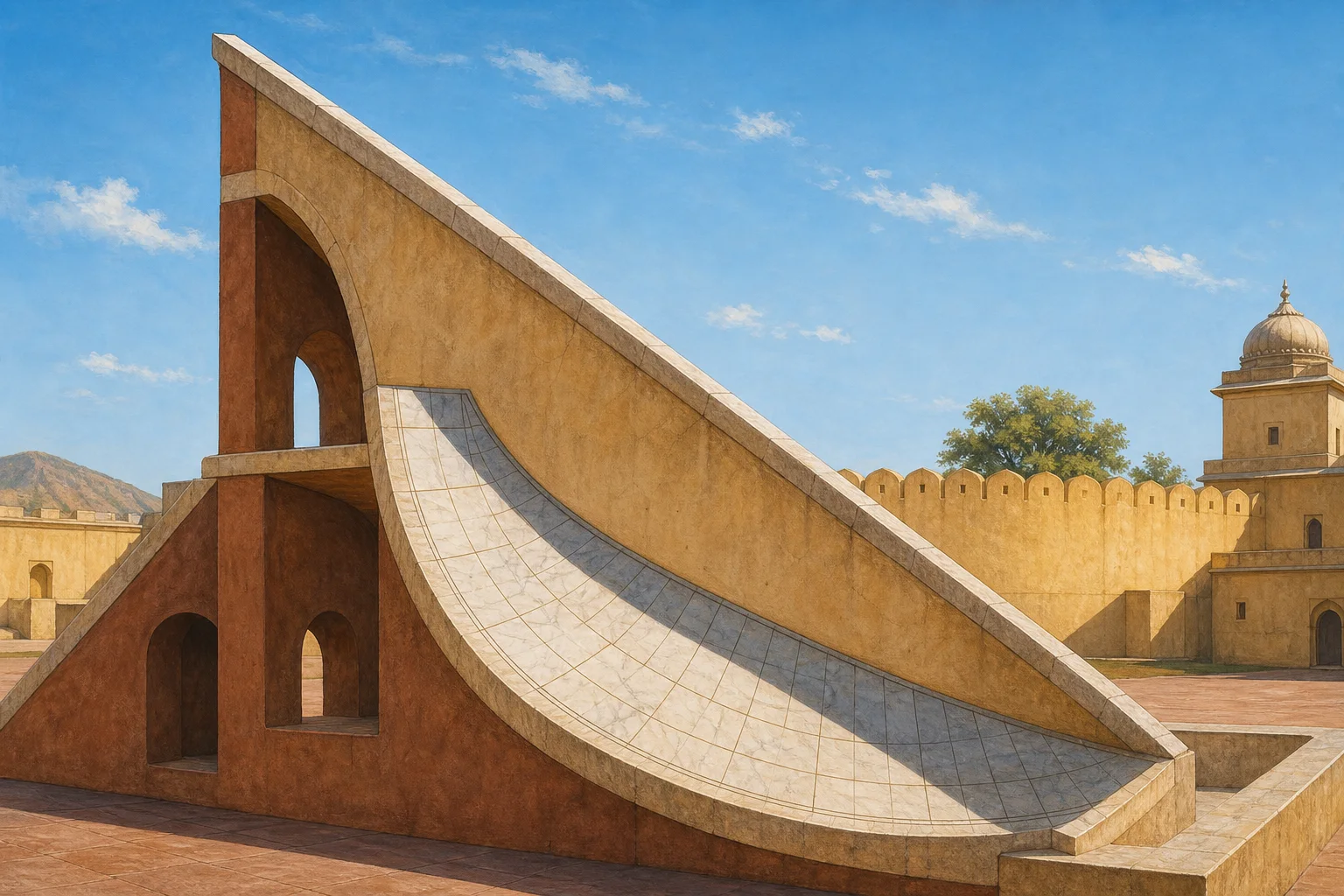
    The complex’s most immediately recognizable structure is the Vrihat Samrat Yantra, a huge triangular sundial. Rajasthan Tourism calls it the world’s largest stone sundial and lists it at 27 metres long. Its sloping edge acts as the shadow-casting element; the surrounding calibrated surfaces are read against that moving shadow.

    It is important to read that claim in its proper setting. A sundial reports local solar time, not the standardized clock time on a phone. Its usefulness at Jantar Mantar was part of a broader observing system: a way to locate and track celestial bodies, not a quaint precursor to a wristwatch.

    Editorial illustration of a monumental stone sundial casting a shadow across a curved marble scale at Jaipur’s Jantar Mantar.
    Editorial illustration of the monumental-sundial principle at Jantar Mantar.

    More than one way to read the sky

    The giant sundial is only the beginning. Rajasthan Tourism describes the Ram Yantra as a pair of open-to-the-sky cylindrical structures used to measure the altitude and azimuth of the Sun and planets. Its Jai Prakash Yantra uses two bowl-like forms with graduated marble surfaces to work with the sky’s image and shadows. Other instruments address coordinates, declination, rising and setting times, or different ways of describing a body’s position.

    That variety explains why Jantar Mantar can feel so strange on first encounter. The site is not a collection of oversized sculptures with a scientific backstory tacked on. Its unusual curves and walls are the working shapes of different observational questions. UNESCO notes that the instruments draw on a long tradition of positional astronomy shared across cultures, while also incorporating distinctive architectural and instrumental innovations.

    Why the place still feels futuristic

    Modern observatories often hide their mechanisms inside domes, screens and software. Jantar Mantar does the opposite: it turns geometry outward. The instrument is visible from across the courtyard. The measurement depends on a real shadow, a real horizon and a scale large enough to inhabit.

    That is the lasting oddity of the place. It is an observatory where the technology has not been miniaturized, polished into a box or pushed behind glass. It remains legible as architecture—an enduring record of people making the sky measurable with stone, marble, labor and mathematical care.

    Sources

  • Haxey Hood: The English Village Game Where the Goal Is a Pub

    Haxey Hood: The English Village Game Where the Goal Is a Pub

    All three images in this article are original editorial illustrations. They are not documentary photographs or depictions of a specific Haxey Hood event.

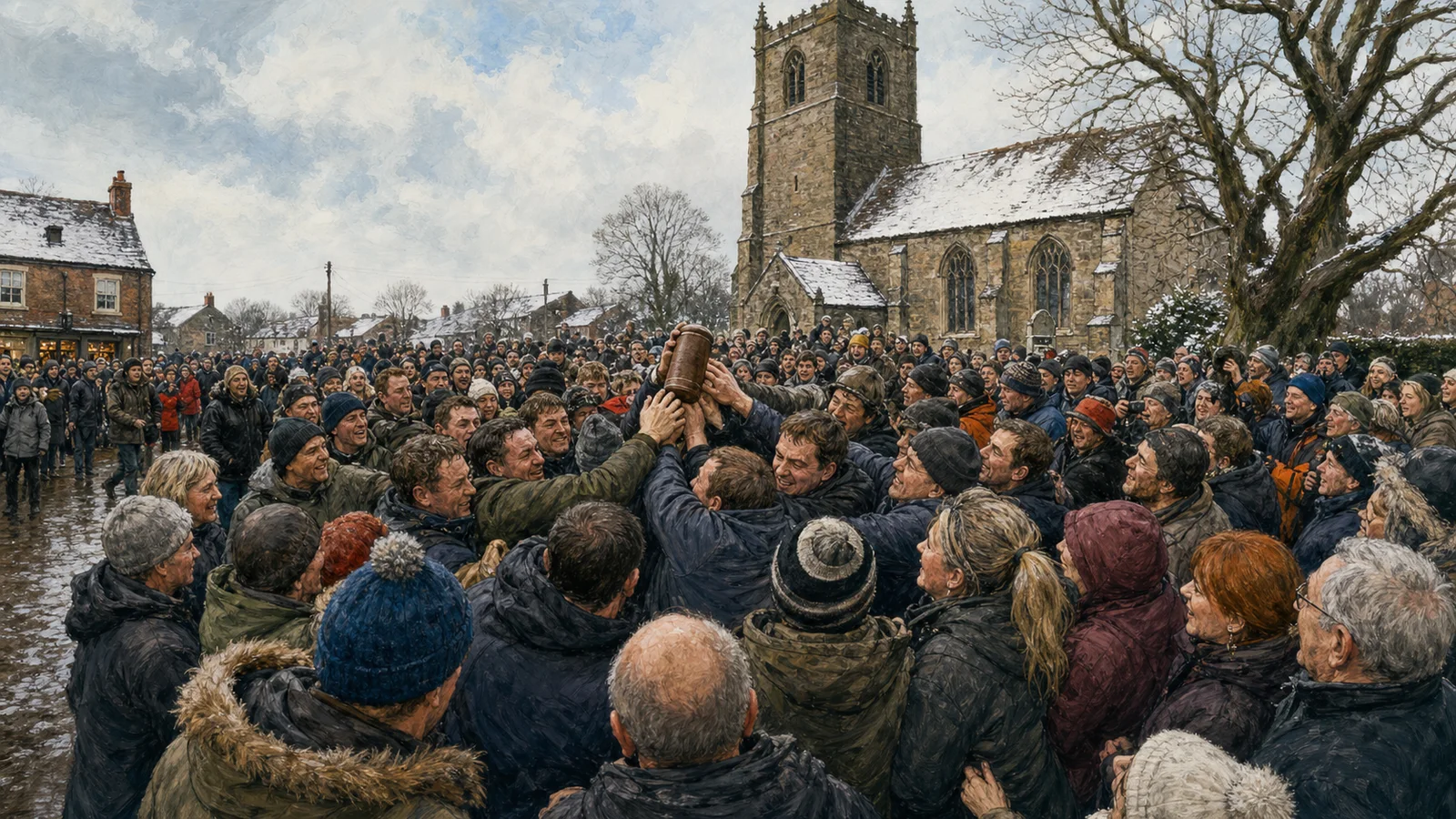
    Every January, a North Lincolnshire village makes a local pub the finish line for a contest that is part procession, part scrum, and very much its own thing. The object at the middle of the Haxey Hood is not a football: it is a leather cylinder called the Hood. The aim is to move it to one of four pubs in Haxey and nearby Westwoodside.

    That much is a living custom with a clear setting. Historic England’s listing for the Lady Mowbray, or Hood, Stone records its association with the annual Haxey Hood game, the Fool’s Speech, and “Smoking the Fool.” The community’s Haxey Hood information site says the event is held on January 6, except when that date falls on a Sunday, and describes the central mass of players as a “Sway.”

    The one rule that makes it stranger

    The local guide says participants may not run with or throw the Hood. Instead, the crowd pushes and pulls it through the Sway. That makes the contest less like a conventional match than a slow, collective argument about direction. The finish comes when the Hood reaches a favored pub, where it stays until the next game.

    Editorial illustration of a winter village ceremony beside a weathered stone cross base
    Editorial illustration; not a documentary rendering of the Haxey ceremony.

    The ceremony has its own vocabulary: the Fool, the Lord of the Hood, and the Boggins, who help marshal the occasion. The English Folk Dance and Song Society describes the Hood as a two-foot leather cylinder and the destination as one of four local pubs. It also notes that the event is a broader community gathering, not merely a contest with formal teams.

    What is history, and what is folklore?

    The often-retold origin story concerns Lady de Mowbray: according to folklore, a gust took her riding hood and local laborers chased it, inspiring the annual game. That story is tradition, not a settled historical account. It is best read as the community’s explanation for a custom whose deep history is difficult to document in the modern sense.

    There is firmer physical context nearby. Historic England identifies the Hood Stone as a medieval cross base and specifically connects it to the annual ritual. The stone does not prove the precise origin of the game, but it anchors the custom in the village landscape and confirms that the ceremony has a recognized historic association.

    Editorial illustration of a stitched leather cylinder resting on a wooden pub bar
    Editorial illustration of the kind of leather cylinder described as the Hood; not an image of the actual object.

    Why a pub is the point

    At Haxey, the finish line is deliberately social. A pub receiving the Hood gets to keep it until the next year’s event, turning a piece of leather into a temporary local emblem. The route, the crowd, and the post-game gathering matter as much as the outcome.

    That is the useful weirdness of the Haxey Hood: it preserves a game whose rules make sense only inside its own community. Rather than polishing it into a standardized sport, the village has kept the odd names, the ritual speech, the muddy Sway, and the wonderfully specific reward of delivering a Hood to a pub.

    Sources

  • Why Nijo Castle’s Floors Chirp Underfoot

    Why Nijo Castle’s Floors Chirp Underfoot

    Walk through one corridor at Nijo Castle in Kyoto and the floor answers with a high, birdlike chirp. The sound is real, the mechanism is wonderfully physical, and the famous explanation for it is more complicated than the legend.

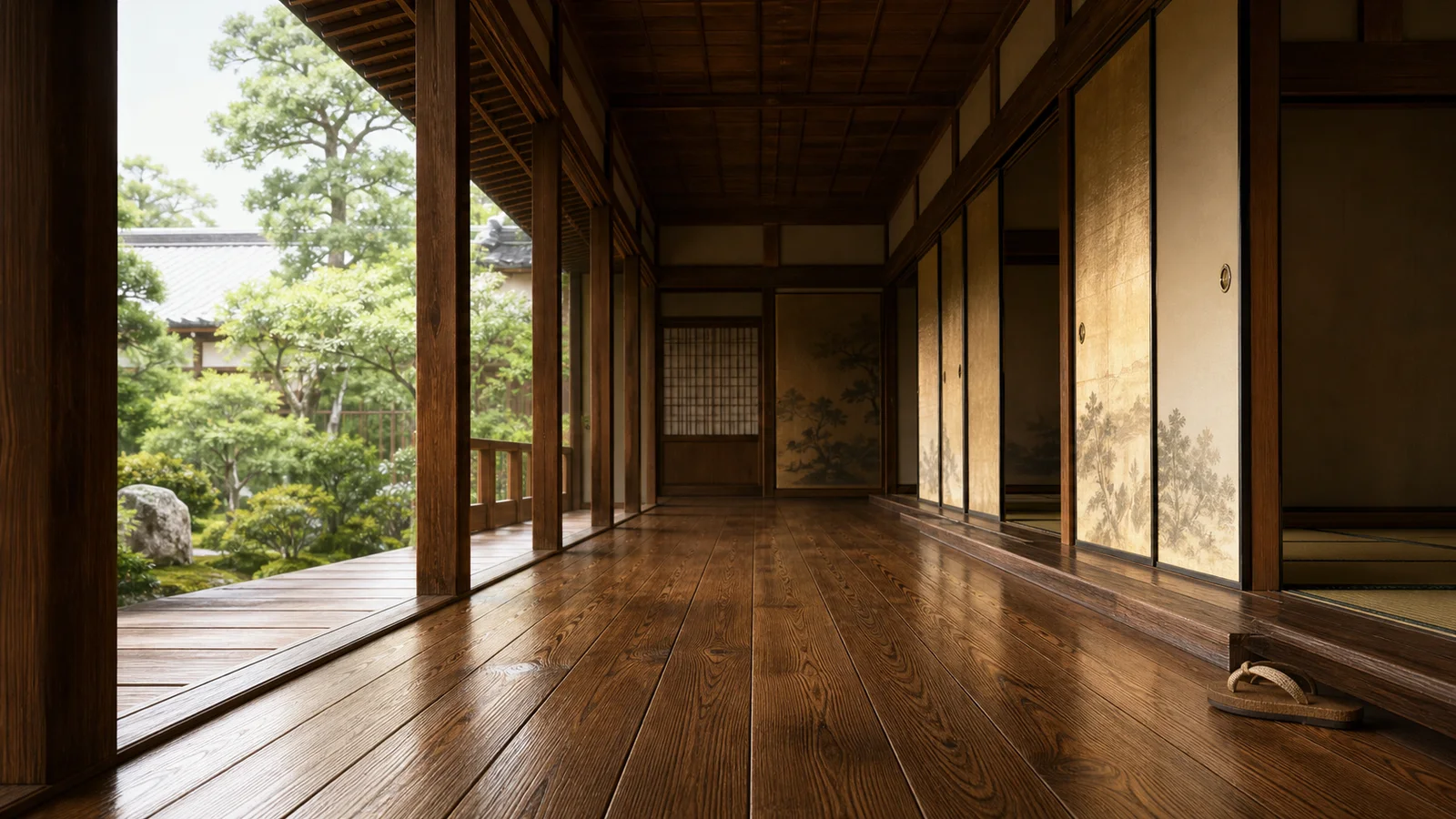
    The corridor is part of the Ninomaru Palace at Nijo Castle, the former Kyoto residence of the Tokugawa shoguns. The palace’s six connected buildings are a rare surviving fortified-palace complex, and the castle’s own historical guide calls the chirping walkway the “Nightingale Corridor.” The sound comes from floor hardware: metal clamps move against nails driven into the wooden beams beneath the boards.

    That is the documented part. The popular story says the floor was deliberately made noisy to expose intruders. Nijo Castle’s official guide makes an unusually useful correction: it says that explanation is mistaken. A floor can be memorable without having been designed as an alarm.

    Editorial illustration showing cedar floorboards, a metal clamp, and a nail on a wooden support beam beneath a nightingale floor.
    Editorial illustration showing the clamp-and-nail arrangement that produces the corridor’s chirp.

    A palace built to make an impression

    Nijo Castle was built in 1603 by Tokugawa Ieyasu, according to UNESCO’s evaluation of Kyoto’s historic monuments. It served both as protection for the Imperial Palace and as Ieyasu’s residence when he visited Kyoto. The complex was substantially expanded in 1626, and the surviving Ninomaru Palace buildings are recognized as National Treasures.

    The setting helps explain why an audible floor acquired such a durable story. The Ninomaru Palace was a place of waiting rooms, reception rooms, formal audiences, senior councilors, and the shogun’s private quarters. Its murals, carved transoms, and gilt fittings were arranged to communicate authority. In such a building, a floor that announces each step feels as if it belongs to the drama of the place—even when the evidence does not support the popular security tale.

    How wood and metal make a birdlike sound

    The important word is friction. As someone walks, the floorboards flex slightly. The clamps beneath them shift against the nails in the supporting beams, producing a repeated squeak or chirp. The effect is not a recording hidden in the floor and not a magical property of the wood. It is a mechanical interaction that happens under changing weight.

    That practical explanation is stranger in its own way. A small fitting, a nail, and the springiness of a wooden floor can turn an ordinary step into a sound distinctive enough to become part of a castle’s identity. It also gives the visitor a reminder that historic buildings are not silent objects: their materials expand, flex, rub, and respond.

    Editorial illustration of a long cedar corridor in a Japanese palace with sliding screens and a garden beyond the open side.
    Editorial illustration of a palace corridor inspired by the architectural setting of Nijo Castle’s Ninomaru Palace.

    The legend is worth keeping in its proper place

    There is a satisfying lesson in the correction. Nijo Castle does not need a secret anti-ninja invention to be fascinating. The audible floor is already a precise artifact of joinery and use: a historic building where each careful step turns a hidden piece of hardware into a brief, recognizable sound.


    Sources: Nijo-jo Castle, “Ninomaru-goten Palace / Garden”; UNESCO, Historic Monuments of Ancient Kyoto evaluation; Japan Cultural Heritage Online, “Former Nijo Imperial Villa (Nijo Castle)”.

  • Why the U.S. Senate Has a Candy Desk

    Why the U.S. Senate Has a Candy Desk

    Some traditions begin with a grand ceremony. The U.S. Senate’s candy desk began with something much more portable: a drawer of sweets and a senator willing to share.

    The tradition is delightfully specific. At the start of each Congress, one desk in the Senate Chamber takes on the unofficial job of being the candy desk. Its keeper stocks it with treats for colleagues passing through one of the room’s busy entrances. The official history is less a tale of a permanent piece of furniture than of a location, a habit, and a succession of people who agree that a little sugar belongs in the workday.

    It started with George Murphy

    The Senate’s curator dates the custom to 1965, when California senator George Murphy kept hard-candy lozenges in his desk drawer. The curator notes that the lozenges were likely useful after vocal-cord surgery. Murphy was also a former stage and film performer, a detail that makes the origin story feel unusually well cast.

    In 1968, Murphy moved to a rear aisle desk near a frequently used entrance and invited colleagues to help themselves. That bit of placement mattered. The candy could be shared without turning the chamber into a candy store: people simply passed the desk, opened the drawer, and carried on.

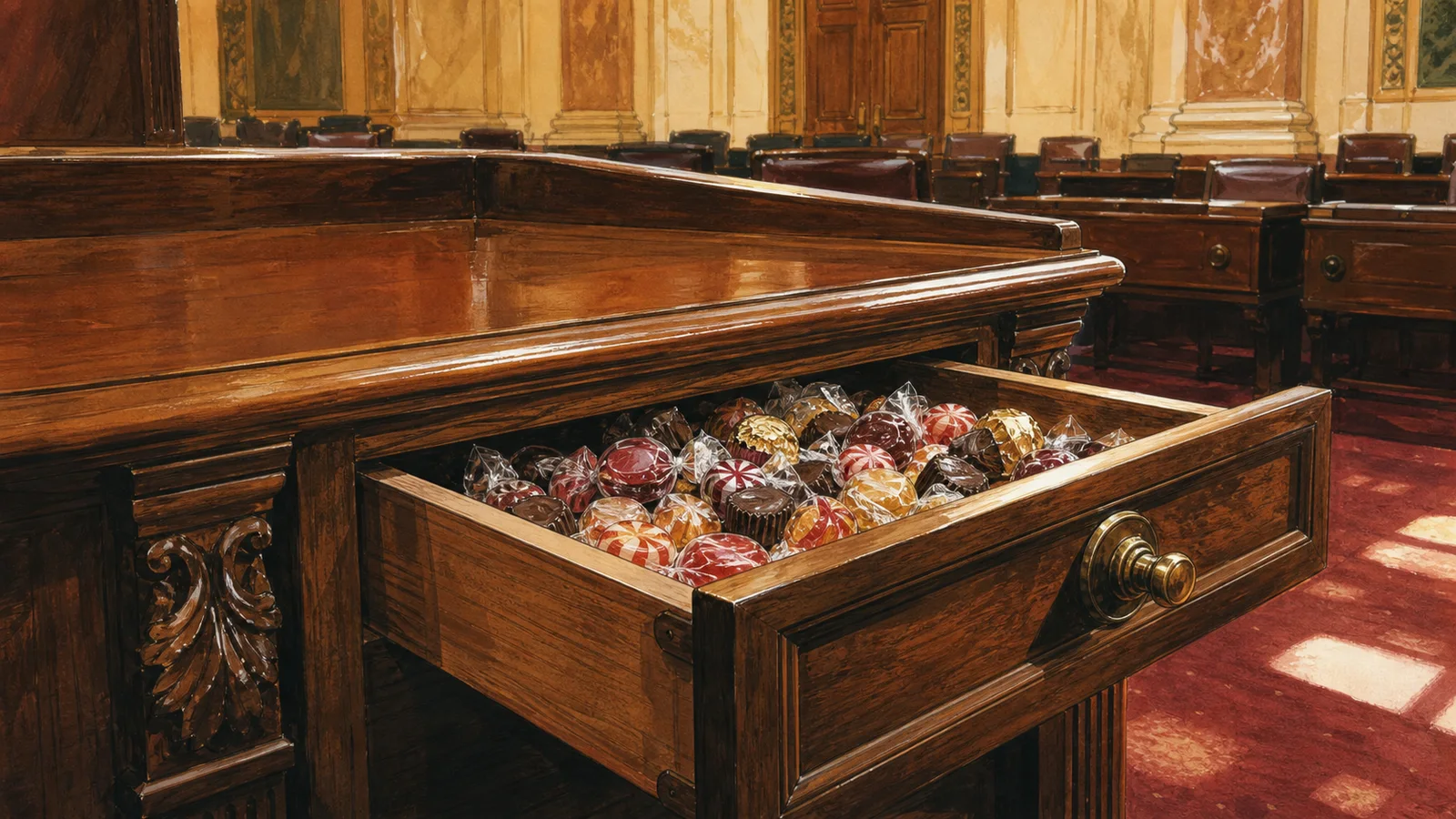
    Editorial illustration of a senator seen from behind offering a bowl of wrapped candies beside an open wooden desk drawer.
    Editorial illustration of the small act of sharing that turned a desk drawer into a tradition.

    The desk is a job, not a relic

    After Murphy left the Senate in 1971, the senators who occupied the same general location continued the practice. A 1979 floor speech publicly acknowledged the early run of candy-desk keepers, according to the Senate curator. Since 1985, the curator’s office has tracked the occupants.

    That history explains a charming wrinkle: the candy desk is not permanently bolted to one numbered desk. The Senate’s guide says any desk can become the candy desk in a new Congress, but the designated one must be on the Republican side, in the last row, on the aisle, next to the chamber’s busiest entrance. In other words, the tradition follows a useful spot as much as it follows a drawer.

    Editorial illustration of curved rows of wooden desks with one candy-filled drawer beside a busy aisle.
    Editorial illustration showing why an aisle-side desk is ideal for a shared candy drawer.

    What is in the drawer?

    The earliest supplies were usually hard candy. Later keepers broadened the selection to bite-size, individually wrapped sweets, often from their home states. The treats change with the person holding the seat; the quiet invitation to take one is the part that persists.

    It is an odd little example of how institutions accumulate personality. Rules and procedures organize a chamber, but a shared drawer can create a tiny recurring pause in the day: a greeting, a piece of candy, and the reminder that even formal places make room for human habits.

    Sources

  • The Mechanical Turk: The Chess Machine That Hid a Human

    The Mechanical Turk: The Chess Machine That Hid a Human

    Editor’s note: The images in this article are original editorial illustrations, not archival photographs or technical reconstructions.

    For decades, audiences could sit down across a chessboard from a figure in a turban and watch it move the pieces with its own hand. The performer was known as the Mechanical Turk, and its showmanship was so persuasive that it became one of history’s most durable stories about a machine that seemed to think.

    The strange part is not that the Turk was a primitive computer. It was not. It was a stage illusion built around a real human chess player, hidden inside an elaborate cabinet. The spectacle’s real achievement was making the audience look at exposed gears and open doors—and still miss the person doing the thinking.

    A machine made for an audience

    Wolfgang von Kempelen introduced the device at the court of Empress Maria Theresa in 1769, according to a Smithsonian account of the Turk’s later descendants. The figure sat behind a wooden cabinet, dressed in stylized Turkish costume, and appeared to play chess against visitors. The costume was part of the performance’s exoticized stage presentation, not a description of a real person or culture.

    Its later showman, Johann Nepomuk Mälzel, took the attraction on tour. A 1828 Boston exhibition broadside preserved by the Library of Congress advertised the “automaton chess-player” as invented by “De Kempelin” and improved by Mälzel. It promised that the figure would play members of the audience, move its head, eyes, lips and hands, announce échec (“check”), and correct an invalid move. That is an advertisement’s claim, of course—but it is unusually vivid evidence of what paying spectators were invited to believe.

    Editorial cutaway illustration of a wooden chess automaton cabinet with mechanisms and a concealed human operator
    Editorial illustration: a conceptual cutaway, not a technical reconstruction of the Turk.

    The trick was space, not artificial intelligence

    The cabinet was designed to make a hidden operator seem impossible. During demonstrations, doors could be opened to reveal machinery. The point was not merely to hide a person behind a closed panel; it was to choreograph what spectators saw when the cabinet was opened and in what order. The operator could shift position within the available space while visible mechanisms helped occupy the eye.

    The Smithsonian describes the same basic strategy in its history of Ajeeb, a later chess-and-checkers automaton inspired by the Turk: panels displayed complex machinery while hidden operators worked inside the base. That comparison is useful because it keeps the distinction plain. The moving arm and theatrical cabinet were mechanical; the chess judgment came from a human being.

    That distinction was already part of the public conversation in the nineteenth century. In an encyclopedia digitized by the Library of Congress, the chess player is described as a figure of a Turk that moved chessmen and was “generally supposed” to conceal a small person directing the moves. The entry’s conclusion is blunt: the ingenuity lay in concealing the real player, rather than in creating a self-thinking machine.

    Why the reveal did not ruin the story

    Knowing the Turk’s secret does not make the object less interesting. It changes the question. Instead of asking how eighteenth-century machinery could calculate a chess move, we can ask how a designer and a performer created an experience in which the audience wanted to grant a cabinet a mind.

    That is why the Turk still feels contemporary. Today’s technology debates often focus on what a system can do. The Turk reminds us to ask a parallel question: what labor, expertise, and staging sit behind the appearance of autonomy? Its concealed player was not a flaw in the story. The player was the story’s essential collaborator.

    The device’s afterlife also shows how entertainment can outlast its physical object. A Smithsonian guest letter traces the Turk’s 1769 debut and identifies the concealed human player as the source of its chess ability. The original object was later destroyed in the 1854 fire at Philadelphia’s Chinese Museum, according to a technical history from Vienna University of Technology and a contemporary-history collection held by the Free Library of Philadelphia. What survives is a dense paper trail: broadsides, essays, reports, and the recurring temptation to call a convincing performance a thinking machine.

    Editorial illustration of the Mechanical Turk chess automaton performing before eighteenth-century spectators
    Editorial illustration of the Mechanical Turk’s theatrical appeal; it does not depict a documented performance.

    The weird truth

    The Mechanical Turk was neither magic nor an early computer. It was a meticulously staged collaboration between woodwork, mechanisms, a hidden chess player, and an audience primed to be astonished. The cabinet never thought. But it made people think—about machines, deception, and how readily a convincing performance can acquire a mind in the public imagination.

    Sources

  • Zzyzx: The Desert Name That Became a Landmark

    Zzyzx: The Desert Name That Became a Landmark

    All artwork in this story is an original editorial illustration. It is not archival or documentary imagery of Zzyzx.

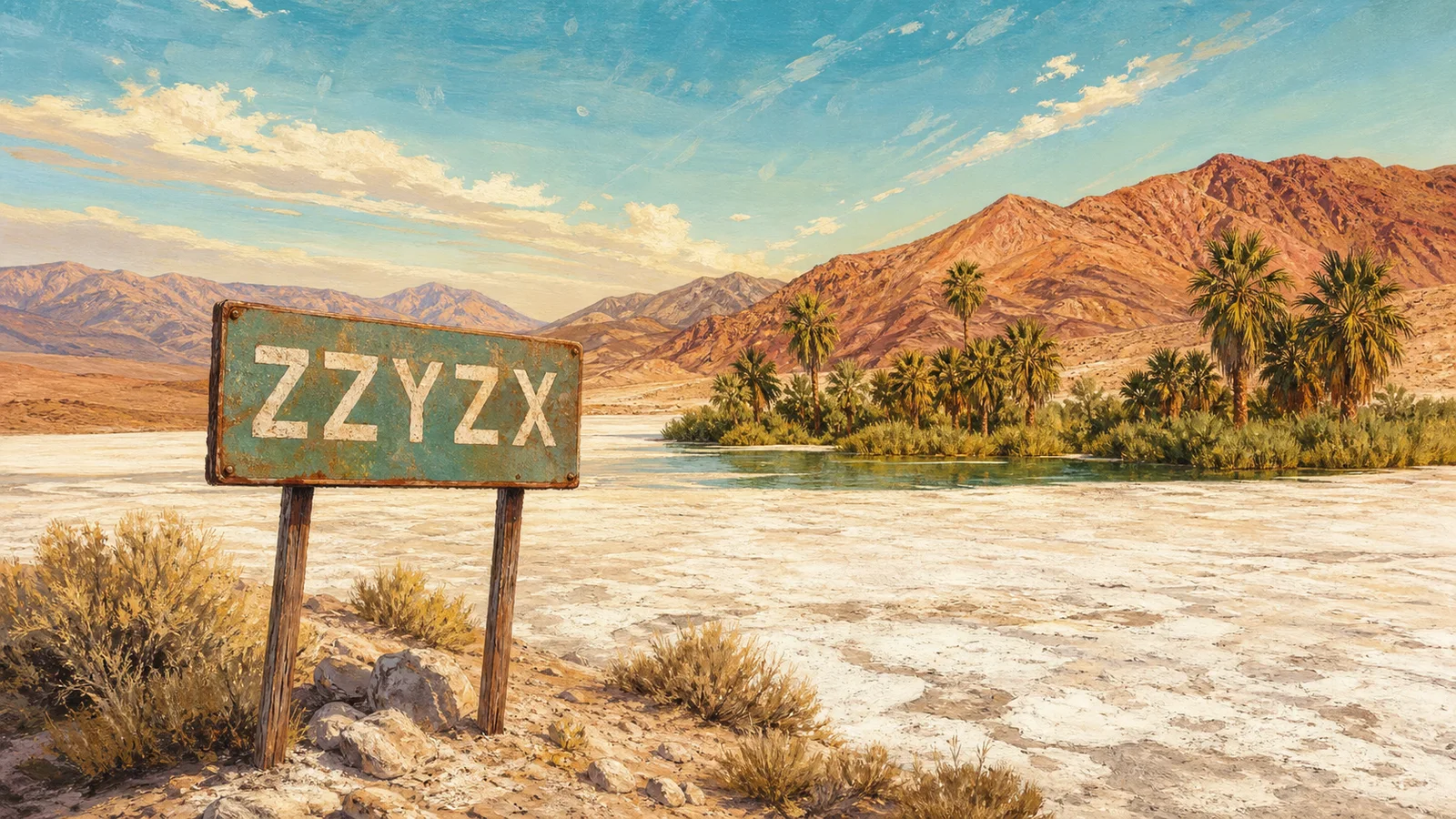
    On the drive through California’s Mojave Desert, a road sign can seem to be playing a private joke: ZZYZX. It looks like someone tried to win a contest for the last possible word in the dictionary. But the sign points to a real place—an oasis on the edge of Soda Dry Lake, west of Baker—and its odd name sits on top of a much older landscape.

    Before the name, there was water

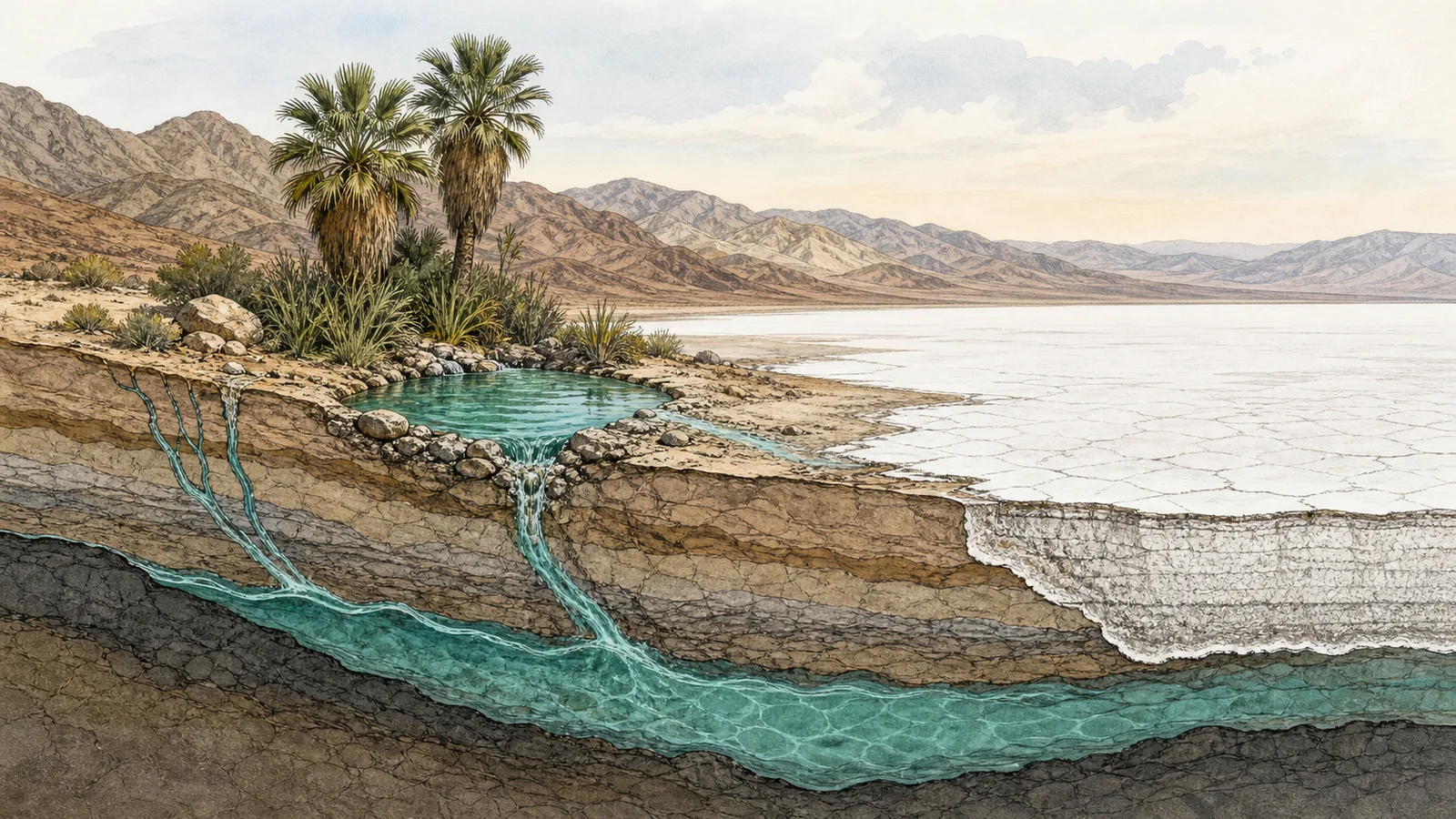
    The National Park Service describes Soda Springs as a natural spring system that the Mohave and Chemehuevi people used for many generations. It was also used by early western explorers and the U.S. Army by the mid-1800s. The wider basin tells an equally improbable story: when the climate was cooler and wetter, Lake Mojave covered this area; as conditions changed, salt flats remained while water persisted at the springs.

    That is the useful way to approach Zzyzx: not as a desert punch line, but as a name attached to a real, long-lived water source. The place’s layers—Indigenous use, travel routes, commercial ambition, and research—do not all belong to the same era or carry the same meaning.

    Editorial illustration of groundwater feeding a small desert oasis beside a salt flat.
    Editorial illustration of the springs-and-salt-flat setting; it is a conceptual image, not a geological survey.

    A resort with an alphabet-ending name

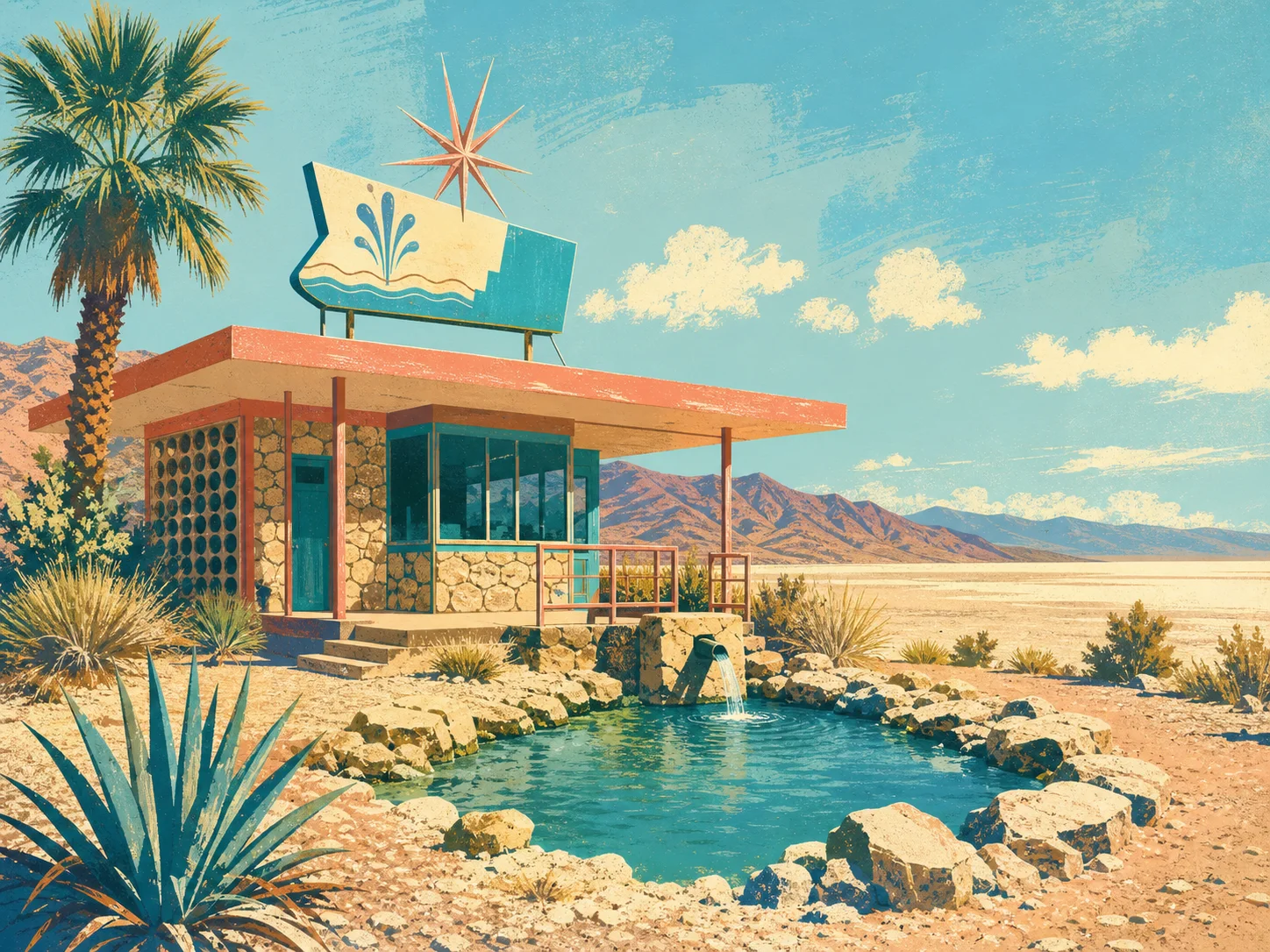
    In 1944, Curtis Springer began operating the Zzyzx Mineral Springs and Health Resort on mining-claim land, according to the National Park Service. The operation was a full desert spectacle: a castle-like building, dining hall, library, pool house, goat farm, rabbit rooms, radio advertising, and mail-order health products. The name proved memorable; the setting made the pitch feel even stranger.

    That history needs a little caution around the edges. Springer called himself a doctor despite leaving school after ninth grade, the Park Service says. By the late 1960s, complaints were increasing, and the site was far from medical care when genuinely ill visitors arrived. The account also notes accusations involving false advertising and tax evasion, along with a Bureau of Land Management challenge to his claims. The colorful resort story is documented; it is not a reason to repeat its health claims.

    Editorial illustration of a stylized mid-century desert mineral-springs pavilion beside a salt flat.
    Editorial illustration inspired by the idea of a mid-century desert resort, not a reconstruction of a historic building.

    What Zzyzx is now

    California State University took over the facility in 1976. Today the CSU Desert Studies Center describes itself as a 1,280-acre field station on the western edge of Mojave National Preserve, with access to salt flats, creosote lowlands, Joshua tree forests, rocky slopes, lava flows, and dunes. It supports courses and research; it is not simply a deserted roadside ruin.

    That distinction matters to visitors. The National Park Service says people may visit Lake Tuendae and the picnic area, while the buildings across the lake are private, active educational property. The Center likewise says its facilities are closed without a reservation. The best version of a Zzyzx stop is therefore a short, curious look at the public landscape—not an invitation to explore closed buildings.

    Why the word sticks

    Zzyzx earns its reputation because the name is visually absurd, but the story lasts because the place is not. A spring in a salt basin made travel, settlement, commerce, and study possible in different moments. The sign may be the hook; Soda Springs is the reason there is anything to point to.

    Sources