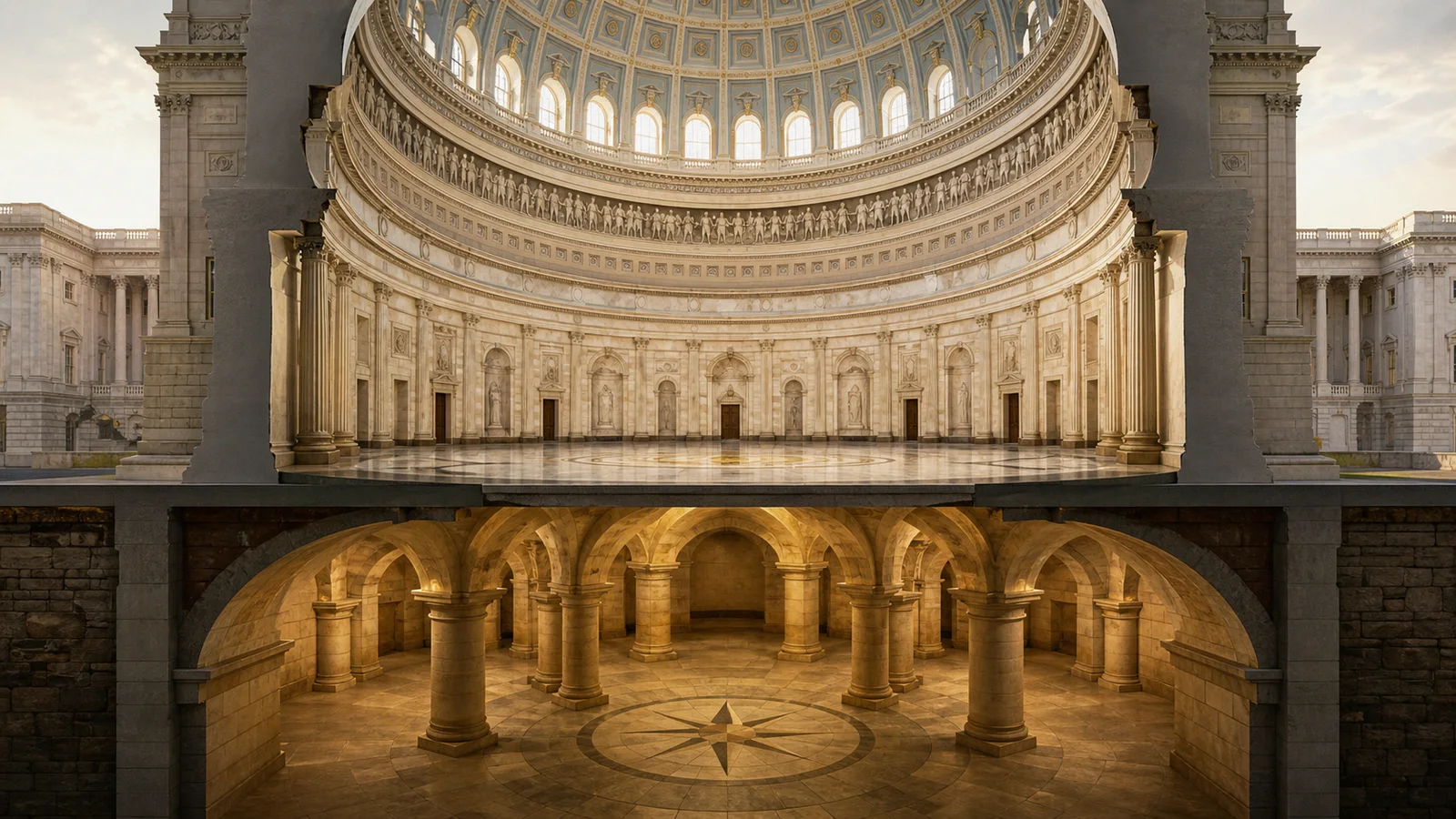
The U.S. Capitol has a room called the Crypt. It is beneath the Rotunda, lined with stone columns, and it has never held a burial.
That is not a modern irony attached to an old nickname. The name grew from the room’s church-like architecture: a vaulted space below a principal room. In churches, comparable spaces were often chapels or tombs. At the Capitol, the resemblance stuck. The burial itself never did.
A tomb planned for the first president
The unusual space is tied to the early plans for commemorating George Washington. After Washington died in 1799, Congress resolved that a monument should be erected at the new Capitol and sought permission to place his remains beneath it. Mount Vernon’s historical account says that Martha Washington’s consent was obtained and a crypt was provided below the Capitol dome, but the project was never completed.
Washington’s own wishes pointed home. His will called for a new brick tomb at Mount Vernon to replace the deteriorating family vault. His remains, and later Martha Washington’s, were moved to the new tomb in 1831. The Architect of the Capitol says that a tomb area was built beneath the Crypt, but Washington’s descendants honored the burial wish in his will. The official answer to the building’s most morbid-sounding question is therefore wonderfully plain: no one is buried in the Capitol.
What visitors actually find
The Crypt is a working part of the Capitol’s historic interior, rather than an unused underground chamber. Its 40 smooth Doric columns of Aquia Creek sandstone support the arches and the Rotunda floor above. They were installed in the 1820s under Architect of the Capitol Charles Bulfinch, whose work completed the building’s central section in 1826.
Look down, and the room has another civic trick: a white-marble compass star marks the Capitol’s center point, the reference point from which Washington is divided into northeast, northwest, southeast, and southwest quadrants. The original floor is paved with stone from Seneca, Maryland. The space also holds statues representing the 13 original colonies and a display centered on a replica of Magna Carta.

Why the name still works
Calling the room a crypt can sound like an error until the architectural meaning comes into view. The name describes its form and the burial purpose once imagined for the space; it does not report an occupant. In that sense, the Capitol Crypt preserves an unusually visible historical near-miss: a national memorial plan that was built around a tomb, while the person meant for it remained at the estate he had chosen.
It is also a useful reminder that the Capitol’s oddest details are often not hidden. Guided tours of the building include the Crypt, the Rotunda, and National Statuary Hall. Visitors walk through a room named for a burial chamber, supported by 40 columns, centered on a stone star—and leave knowing its most surprising fact: it has always been empty of graves.
Leave a Reply