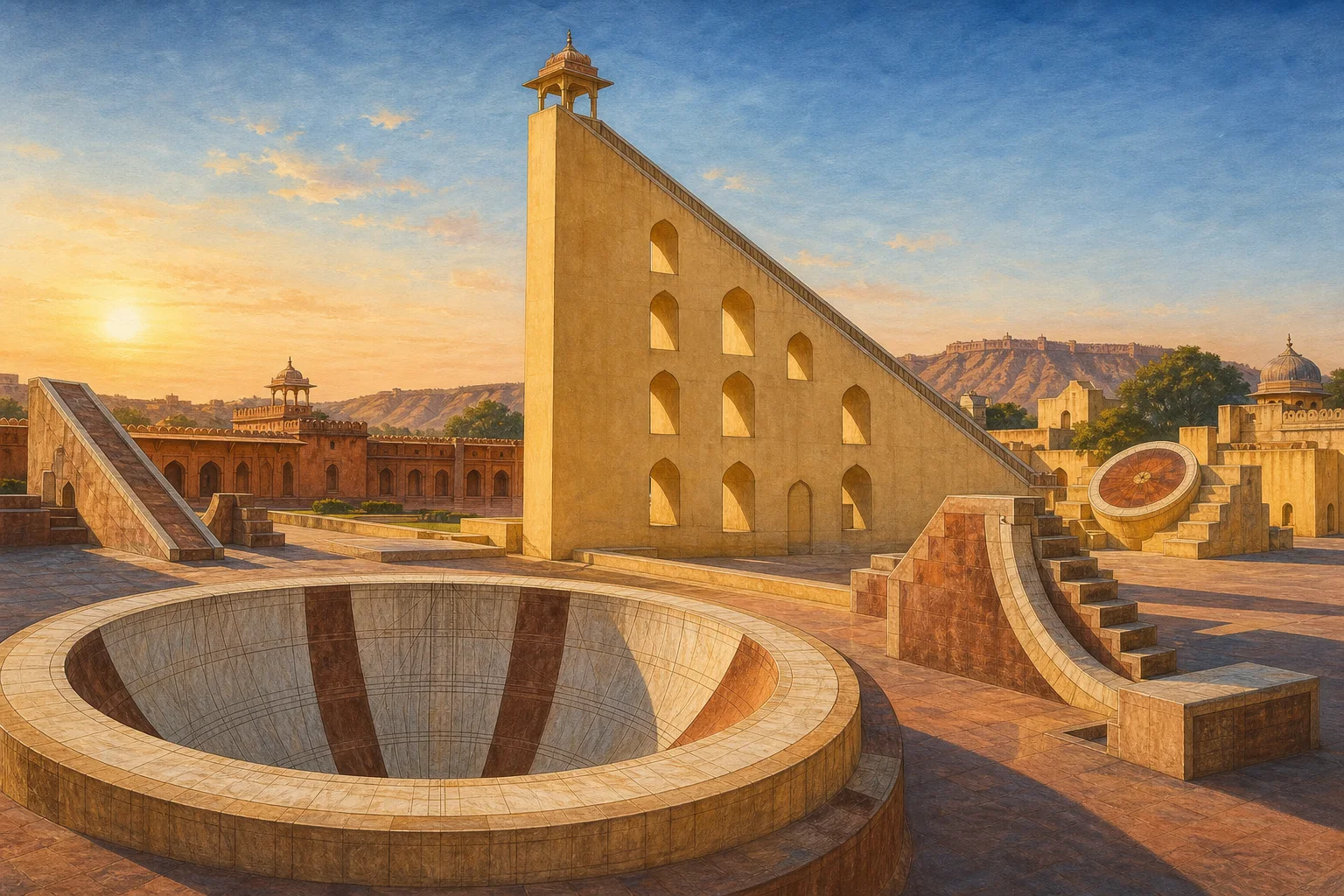
In the middle of Jaipur, India, an 18th-century observatory looks less like a room full of instruments than a small city of ramps, bowls, walls and arcs. At Jantar Mantar, the tools for watching the sky were built at architectural scale. A visitor can walk beside a sundial rather than hold one in a hand.
UNESCO describes Jantar Mantar as an early-18th-century astronomical observation site with roughly 20 fixed masonry instruments, designed for naked-eye observations of celestial positions. Rajasthan Tourism counts 19 instruments at the monument, a reminder that different inventories group some structures differently. The useful point is not a contest over the number: this is a whole landscape of measuring devices.
A court turned measurement into architecture
Jantar Mantar was created under Sawai Jai Singh II, the founder of Jaipur. Rajasthan government sources date the Jaipur complex to the 1720s and say it was completed in 1734. UNESCO places it among the most significant and best-preserved historic observatories in India, built at a moment when the court brought astronomy, calculation, architecture and ideas about the cosmos together in one public-scale setting.
That setting matters. Many earlier astronomical instruments had familiar forms: sundials, circles, sections of circles and astrolabe-like devices. At Jaipur, those forms became masonry. Their size made fine graduations and shadows easier to read, while the structures themselves became a startling part of the city’s built environment.
The giant triangle is a clock
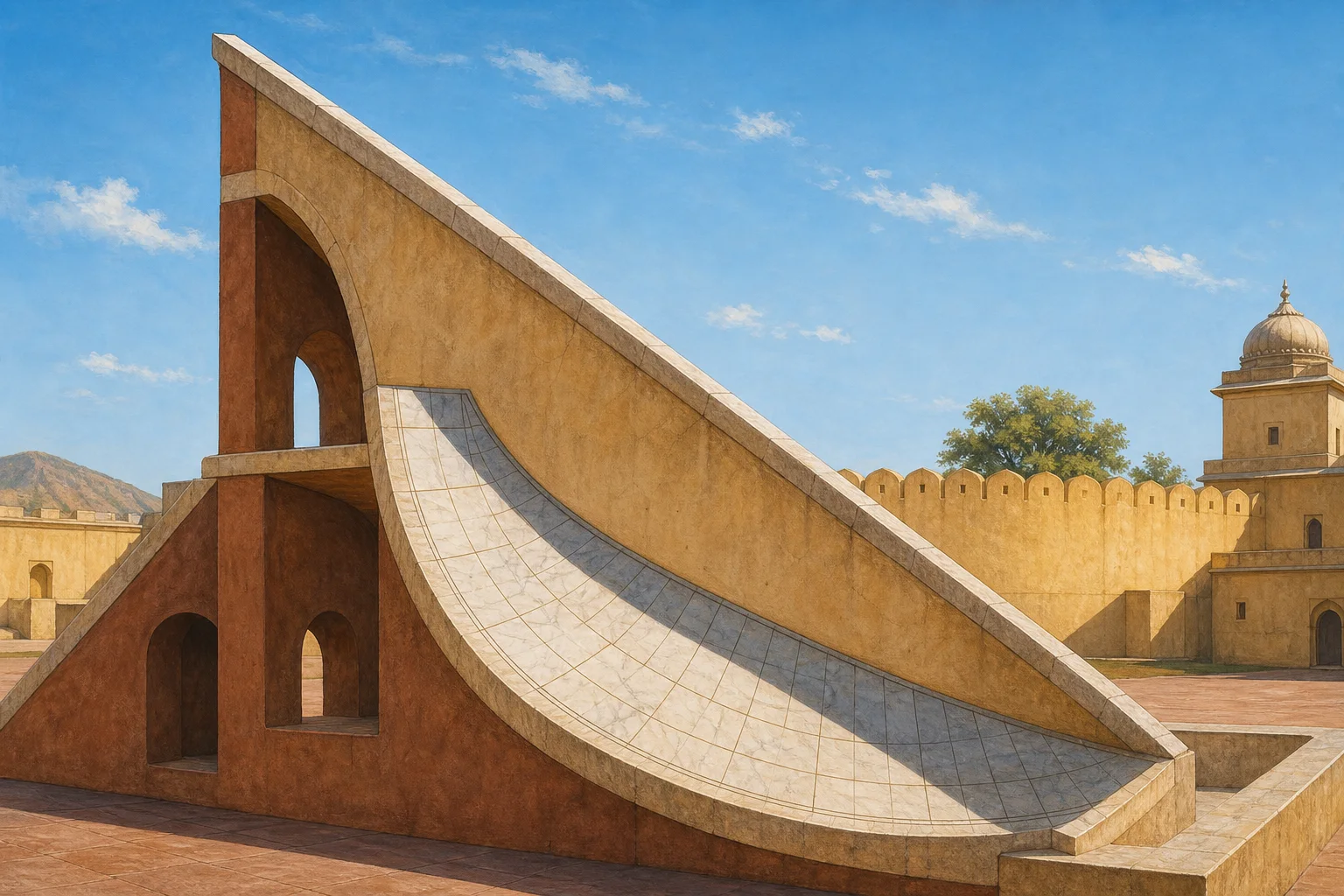
The complex’s most immediately recognizable structure is the Vrihat Samrat Yantra, a huge triangular sundial. Rajasthan Tourism calls it the world’s largest stone sundial and lists it at 27 metres long. Its sloping edge acts as the shadow-casting element; the surrounding calibrated surfaces are read against that moving shadow.
It is important to read that claim in its proper setting. A sundial reports local solar time, not the standardized clock time on a phone. Its usefulness at Jantar Mantar was part of a broader observing system: a way to locate and track celestial bodies, not a quaint precursor to a wristwatch.
More than one way to read the sky
The giant sundial is only the beginning. Rajasthan Tourism describes the Ram Yantra as a pair of open-to-the-sky cylindrical structures used to measure the altitude and azimuth of the Sun and planets. Its Jai Prakash Yantra uses two bowl-like forms with graduated marble surfaces to work with the sky’s image and shadows. Other instruments address coordinates, declination, rising and setting times, or different ways of describing a body’s position.
That variety explains why Jantar Mantar can feel so strange on first encounter. The site is not a collection of oversized sculptures with a scientific backstory tacked on. Its unusual curves and walls are the working shapes of different observational questions. UNESCO notes that the instruments draw on a long tradition of positional astronomy shared across cultures, while also incorporating distinctive architectural and instrumental innovations.
Why the place still feels futuristic
Modern observatories often hide their mechanisms inside domes, screens and software. Jantar Mantar does the opposite: it turns geometry outward. The instrument is visible from across the courtyard. The measurement depends on a real shadow, a real horizon and a scale large enough to inhabit.
That is the lasting oddity of the place. It is an observatory where the technology has not been miniaturized, polished into a box or pushed behind glass. It remains legible as architecture—an enduring record of people making the sky measurable with stone, marble, labor and mathematical care.
Leave a Reply