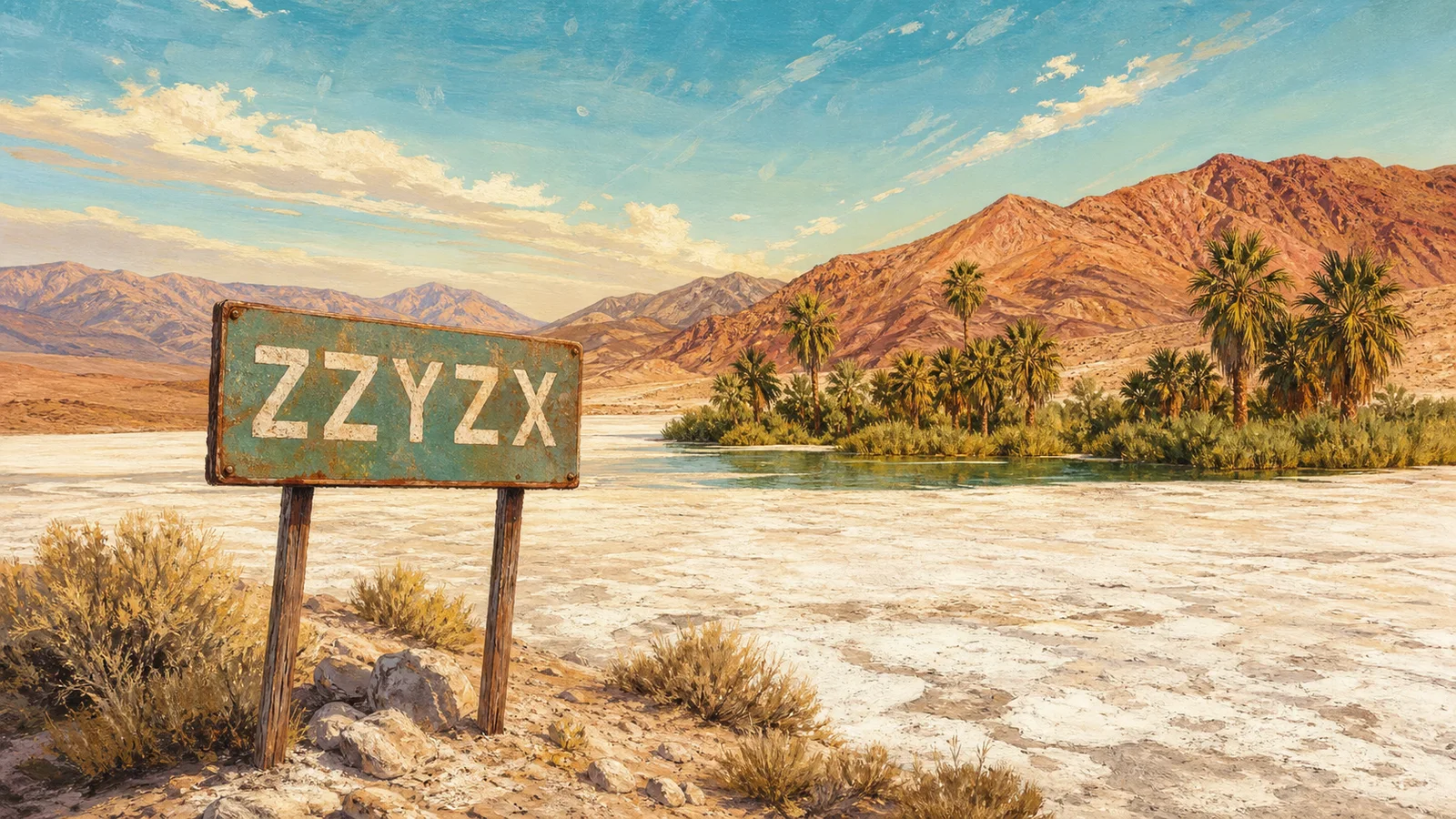
All artwork in this story is an original editorial illustration. It is not archival or documentary imagery of Zzyzx.
On the drive through California’s Mojave Desert, a road sign can seem to be playing a private joke: ZZYZX. It looks like someone tried to win a contest for the last possible word in the dictionary. But the sign points to a real place—an oasis on the edge of Soda Dry Lake, west of Baker—and its odd name sits on top of a much older landscape.
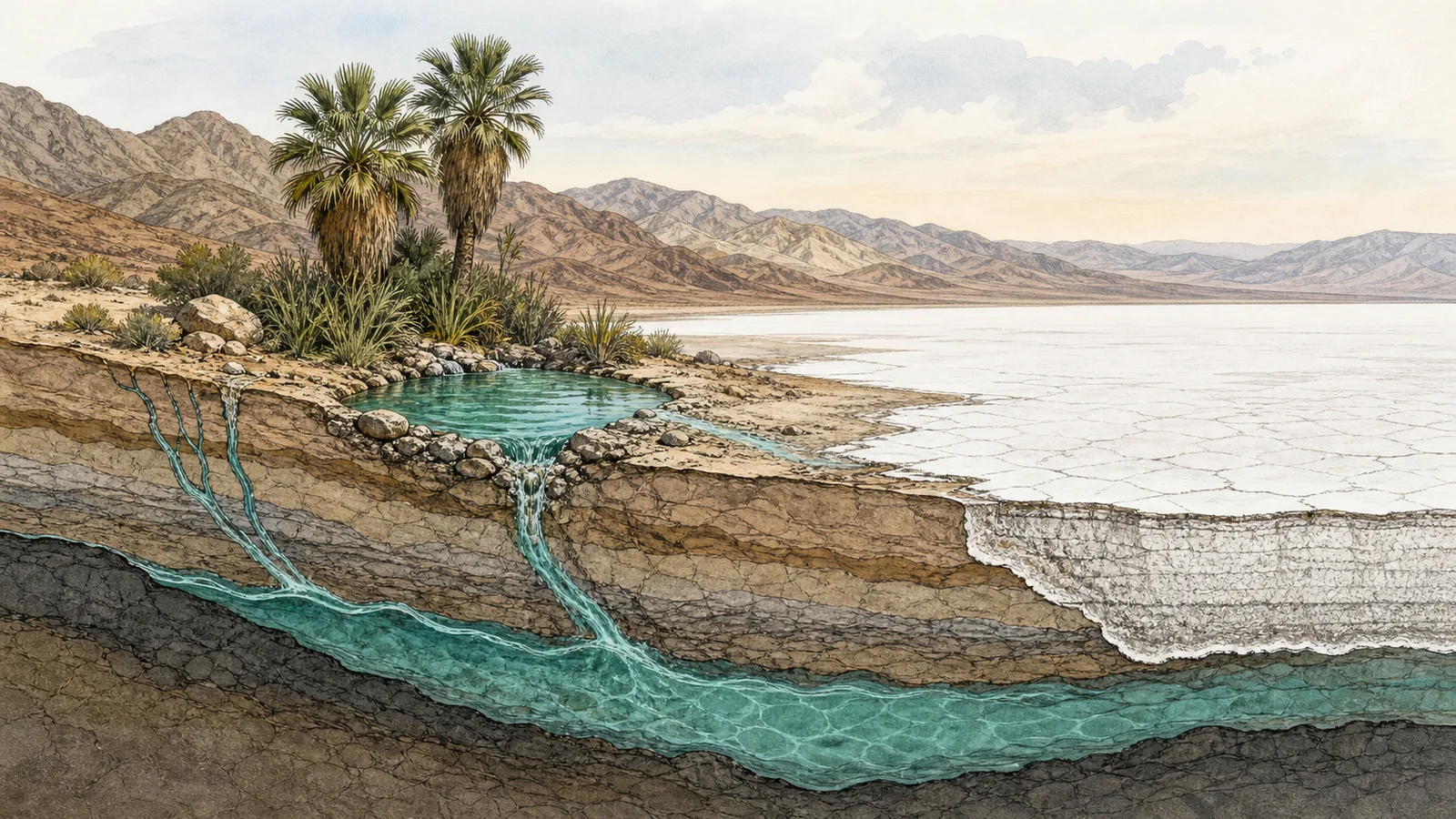
Before the name, there was water
The National Park Service describes Soda Springs as a natural spring system that the Mohave and Chemehuevi people used for many generations. It was also used by early western explorers and the U.S. Army by the mid-1800s. The wider basin tells an equally improbable story: when the climate was cooler and wetter, Lake Mojave covered this area; as conditions changed, salt flats remained while water persisted at the springs.
That is the useful way to approach Zzyzx: not as a desert punch line, but as a name attached to a real, long-lived water source. The place’s layers—Indigenous use, travel routes, commercial ambition, and research—do not all belong to the same era or carry the same meaning.
A resort with an alphabet-ending name
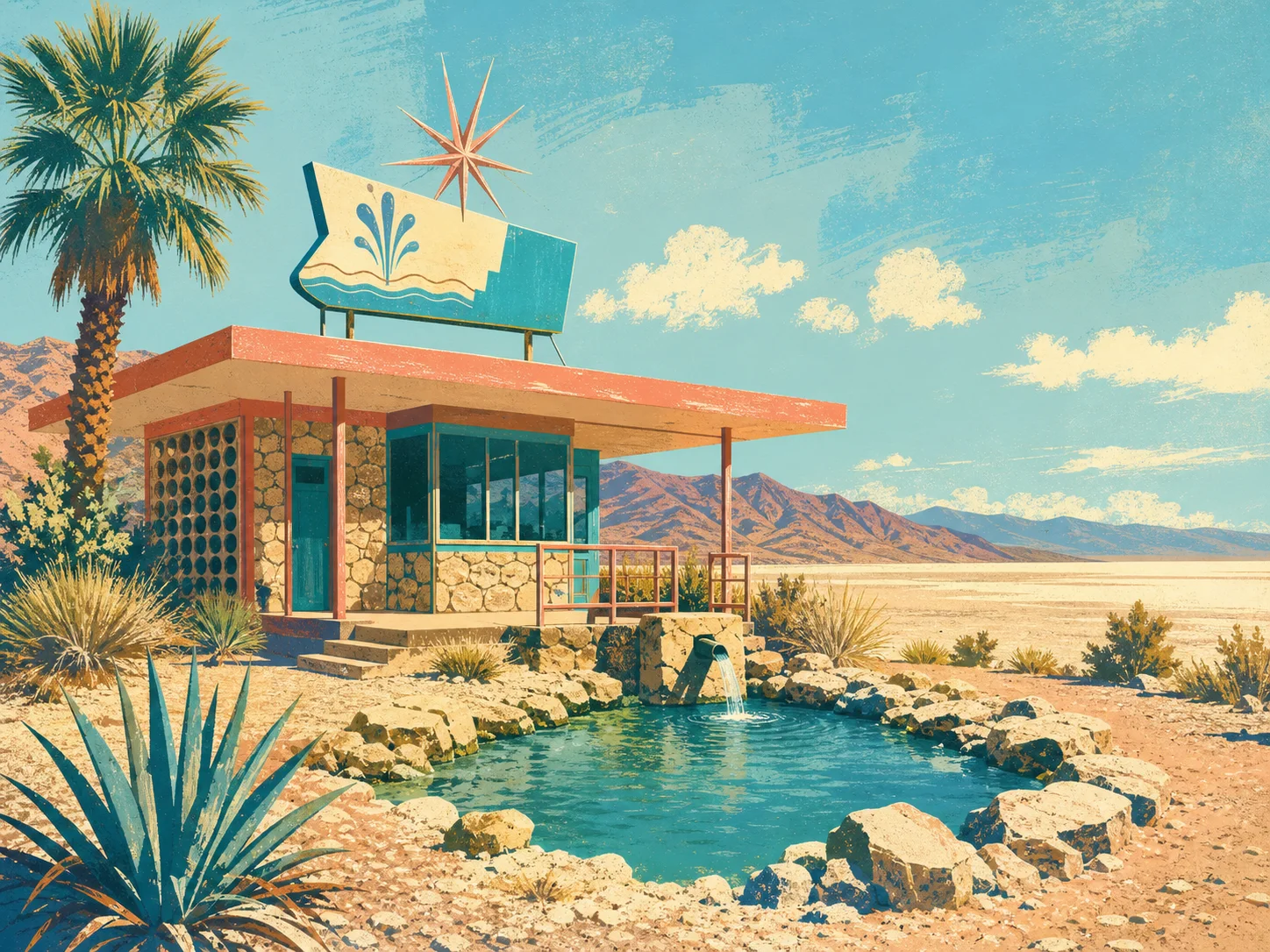
In 1944, Curtis Springer began operating the Zzyzx Mineral Springs and Health Resort on mining-claim land, according to the National Park Service. The operation was a full desert spectacle: a castle-like building, dining hall, library, pool house, goat farm, rabbit rooms, radio advertising, and mail-order health products. The name proved memorable; the setting made the pitch feel even stranger.
That history needs a little caution around the edges. Springer called himself a doctor despite leaving school after ninth grade, the Park Service says. By the late 1960s, complaints were increasing, and the site was far from medical care when genuinely ill visitors arrived. The account also notes accusations involving false advertising and tax evasion, along with a Bureau of Land Management challenge to his claims. The colorful resort story is documented; it is not a reason to repeat its health claims.
What Zzyzx is now
California State University took over the facility in 1976. Today the CSU Desert Studies Center describes itself as a 1,280-acre field station on the western edge of Mojave National Preserve, with access to salt flats, creosote lowlands, Joshua tree forests, rocky slopes, lava flows, and dunes. It supports courses and research; it is not simply a deserted roadside ruin.
That distinction matters to visitors. The National Park Service says people may visit Lake Tuendae and the picnic area, while the buildings across the lake are private, active educational property. The Center likewise says its facilities are closed without a reservation. The best version of a Zzyzx stop is therefore a short, curious look at the public landscape—not an invitation to explore closed buildings.
Why the word sticks
Zzyzx earns its reputation because the name is visually absurd, but the story lasts because the place is not. A spring in a salt basin made travel, settlement, commerce, and study possible in different moments. The sign may be the hook; Soda Springs is the reason there is anything to point to.
Leave a Reply