Some desert dunes can answer an avalanche with a low, sustained boom. It is a real acoustic phenomenon, not a campfire story: at the right dune, a small slide of very dry sand can produce a deep tone that people describe as a hum, a drone, or a distant aircraft.
The National Park Service records “singing sands” at Colorado’s Great Sand Dunes National Park & Preserve and says the park is among the relatively few places where the deep humming or booming sound can be heard. California’s Eureka Dunes offer another carefully described example. There, the Park Service says the sound can accompany sand avalanching down the steepest face of the highest dune, and compares it with a pipe-organ bass note or a distant airplane.
Not every dune—and not every day
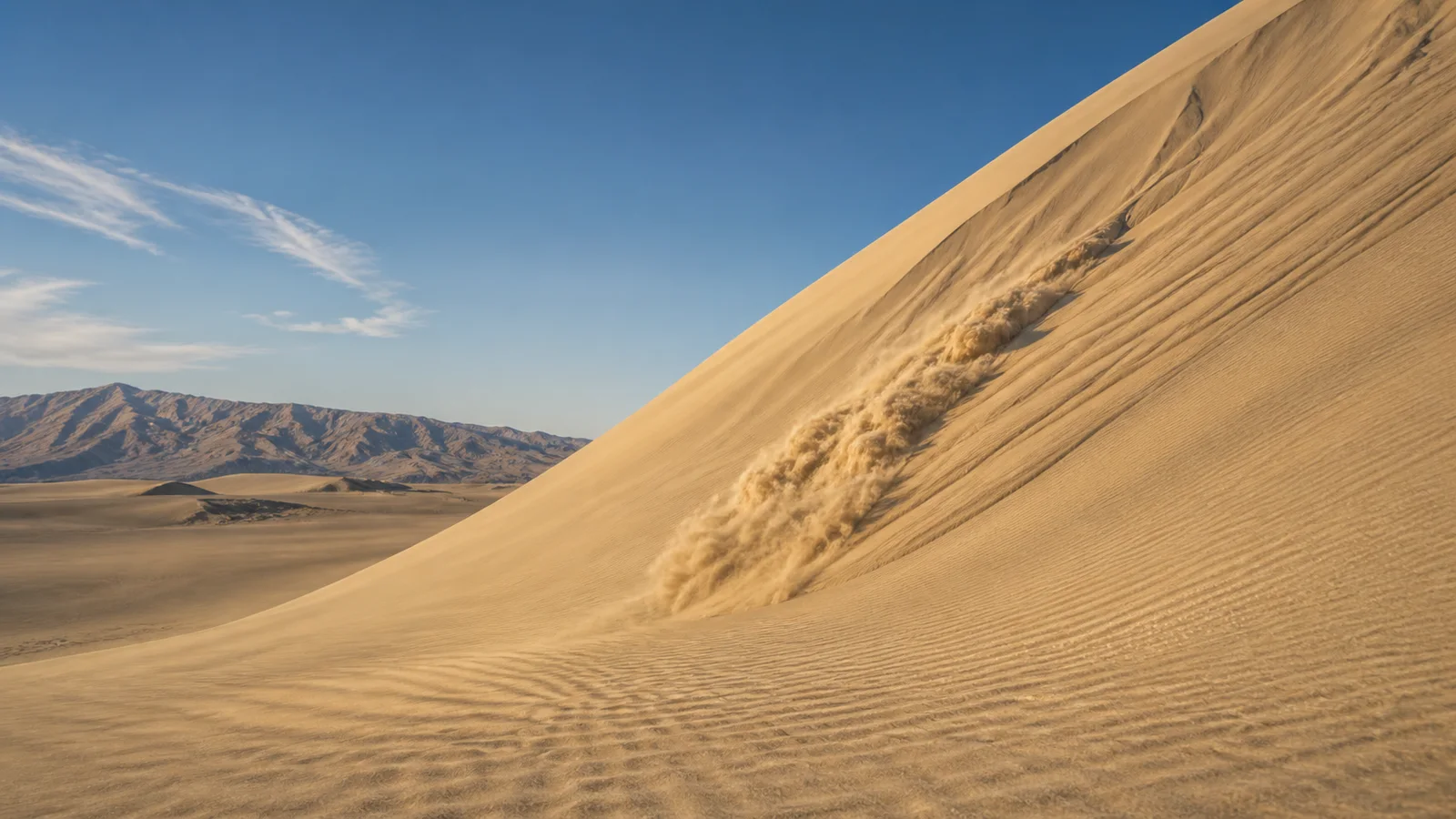
“Singing” is a useful name, but it can make the process sound more mystical than it is. The sound happens during a moving sheet of sand, especially when sand avalanches down a dune’s steep slip face. It is also fussy about conditions. The Eureka Dunes page says the sand must be completely dry; if the dune is damp, it may stay silent even when the moisture is not obvious to a hand on the surface.
That selectiveness helps explain why a broad dune field is not automatically a concert hall. Researchers distinguish booming dunes from more familiar squeaking or crunching beach sands. A review in Annual Review of Earth and Planetary Sciences describes booming as a phenomenon found at dozens of sites worldwide, with a dominant audible frequency commonly reported around 70 to 110 hertz plus higher harmonics. The particular note can persist longer than an observer might expect from a brief sand slide.
What scientists can say with confidence
A 2004 Physical Review Letters study reported that an avalanche excites elastic waves at a dune’s surface and that the motion of the grains can partly synchronize with those waves. A later review in Reports on Progress in Physics similarly describes the audible emission as a vibration of the sand excited by granular shear flow—the sliding and rearranging of grains in the moving layer.
Those findings give the phenomenon a solid physical footing: dry sand is moving, grains are interacting, and the dune is vibrating in a way that couples to the air as sound. They do not turn every detail into a closed case. The 2012 review evaluates several proposed mechanisms and says that some explanations have been rejected while amplification by guided elastic waves through friction still needed confirmation. In other words, the desert’s low note is documented; the most complete account of how a dune selects and sustains that note remains an active scientific question.

Why the caution matters
The audible result is so strange that it is easy to overstate it. Dunes are not producing a tune on command, and a visitor should not treat a fragile dune as an instrument to be tested. The Park Service’s descriptions are better read as an invitation to notice a rare natural process—and to follow site guidance that protects the dune and the habitat around it.
That restraint also makes the truth more interesting. A dune can look silent and still hold the ingredients for a sudden bass note: suitably dry grains, a steep moving layer, and a landscape capable of transmitting a collective vibration. The weird part is not that the desert is hiding a supernatural voice. It is that ordinary grains of sand can briefly behave like one remarkably large, resonant system.
Sources
- National Park Service, “Sound Library – Singing Sands”
- National Park Service, “Eureka Dunes”
- B. Andreotti, “The song of dunes as a wave-particle mode locking,” Physical Review Letters (2004)
- B. Andreotti, “Sonic sands,” Reports on Progress in Physics (2012)
- M. L. Hunt and N. M. Vriend, “Booming Sand Dunes,” Annual Review of Earth and Planetary Sciences (2010)
Leave a Reply