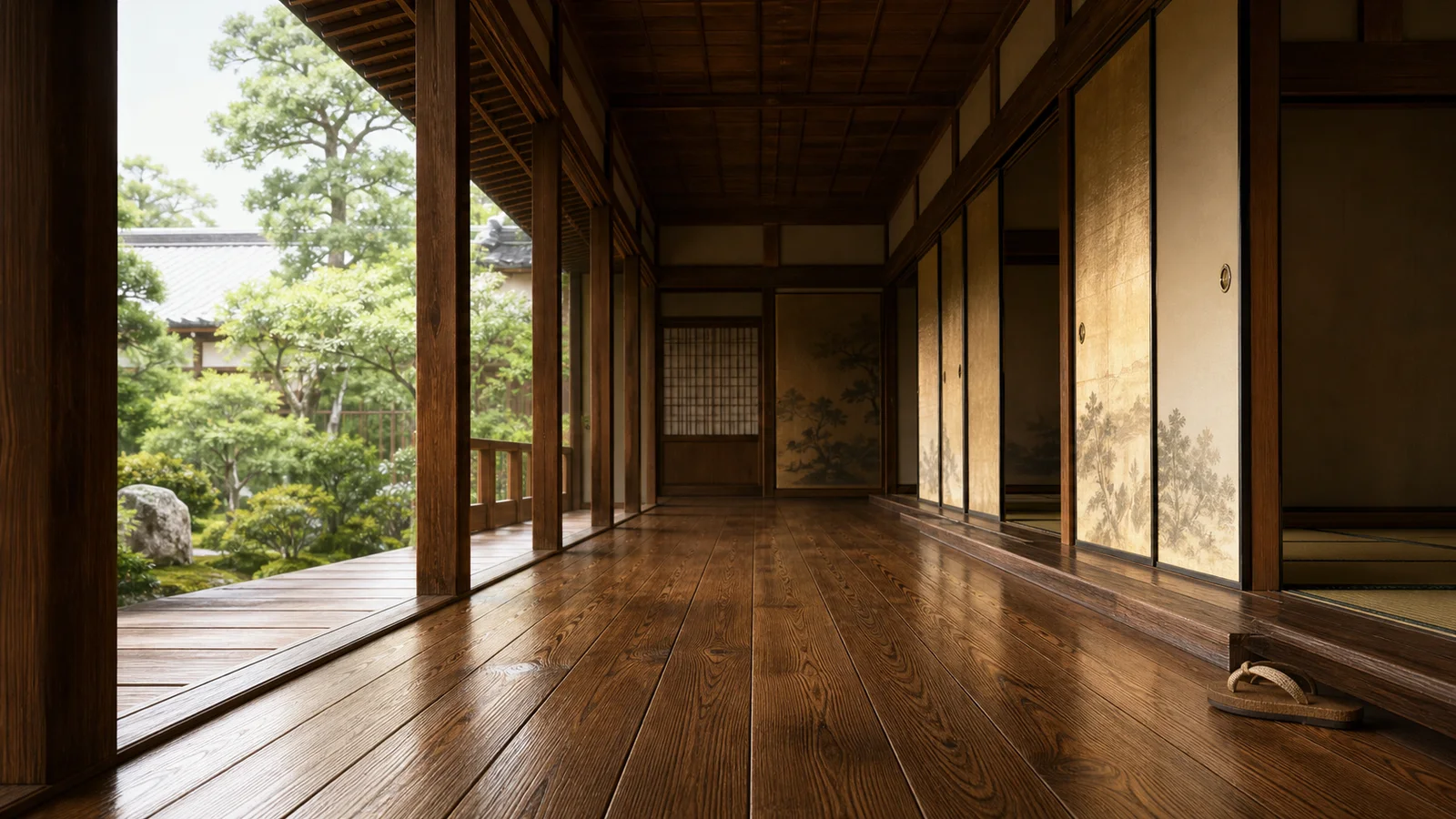
Walk through one corridor at Nijo Castle in Kyoto and the floor answers with a high, birdlike chirp. The sound is real, the mechanism is wonderfully physical, and the famous explanation for it is more complicated than the legend.
The corridor is part of the Ninomaru Palace at Nijo Castle, the former Kyoto residence of the Tokugawa shoguns. The palace’s six connected buildings are a rare surviving fortified-palace complex, and the castle’s own historical guide calls the chirping walkway the “Nightingale Corridor.” The sound comes from floor hardware: metal clamps move against nails driven into the wooden beams beneath the boards.
That is the documented part. The popular story says the floor was deliberately made noisy to expose intruders. Nijo Castle’s official guide makes an unusually useful correction: it says that explanation is mistaken. A floor can be memorable without having been designed as an alarm.

A palace built to make an impression
Nijo Castle was built in 1603 by Tokugawa Ieyasu, according to UNESCO’s evaluation of Kyoto’s historic monuments. It served both as protection for the Imperial Palace and as Ieyasu’s residence when he visited Kyoto. The complex was substantially expanded in 1626, and the surviving Ninomaru Palace buildings are recognized as National Treasures.
The setting helps explain why an audible floor acquired such a durable story. The Ninomaru Palace was a place of waiting rooms, reception rooms, formal audiences, senior councilors, and the shogun’s private quarters. Its murals, carved transoms, and gilt fittings were arranged to communicate authority. In such a building, a floor that announces each step feels as if it belongs to the drama of the place—even when the evidence does not support the popular security tale.
How wood and metal make a birdlike sound
The important word is friction. As someone walks, the floorboards flex slightly. The clamps beneath them shift against the nails in the supporting beams, producing a repeated squeak or chirp. The effect is not a recording hidden in the floor and not a magical property of the wood. It is a mechanical interaction that happens under changing weight.
That practical explanation is stranger in its own way. A small fitting, a nail, and the springiness of a wooden floor can turn an ordinary step into a sound distinctive enough to become part of a castle’s identity. It also gives the visitor a reminder that historic buildings are not silent objects: their materials expand, flex, rub, and respond.
The legend is worth keeping in its proper place
There is a satisfying lesson in the correction. Nijo Castle does not need a secret anti-ninja invention to be fascinating. The audible floor is already a precise artifact of joinery and use: a historic building where each careful step turns a hidden piece of hardware into a brief, recognizable sound.
Sources: Nijo-jo Castle, “Ninomaru-goten Palace / Garden”; UNESCO, Historic Monuments of Ancient Kyoto evaluation; Japan Cultural Heritage Online, “Former Nijo Imperial Villa (Nijo Castle)”.
Leave a Reply