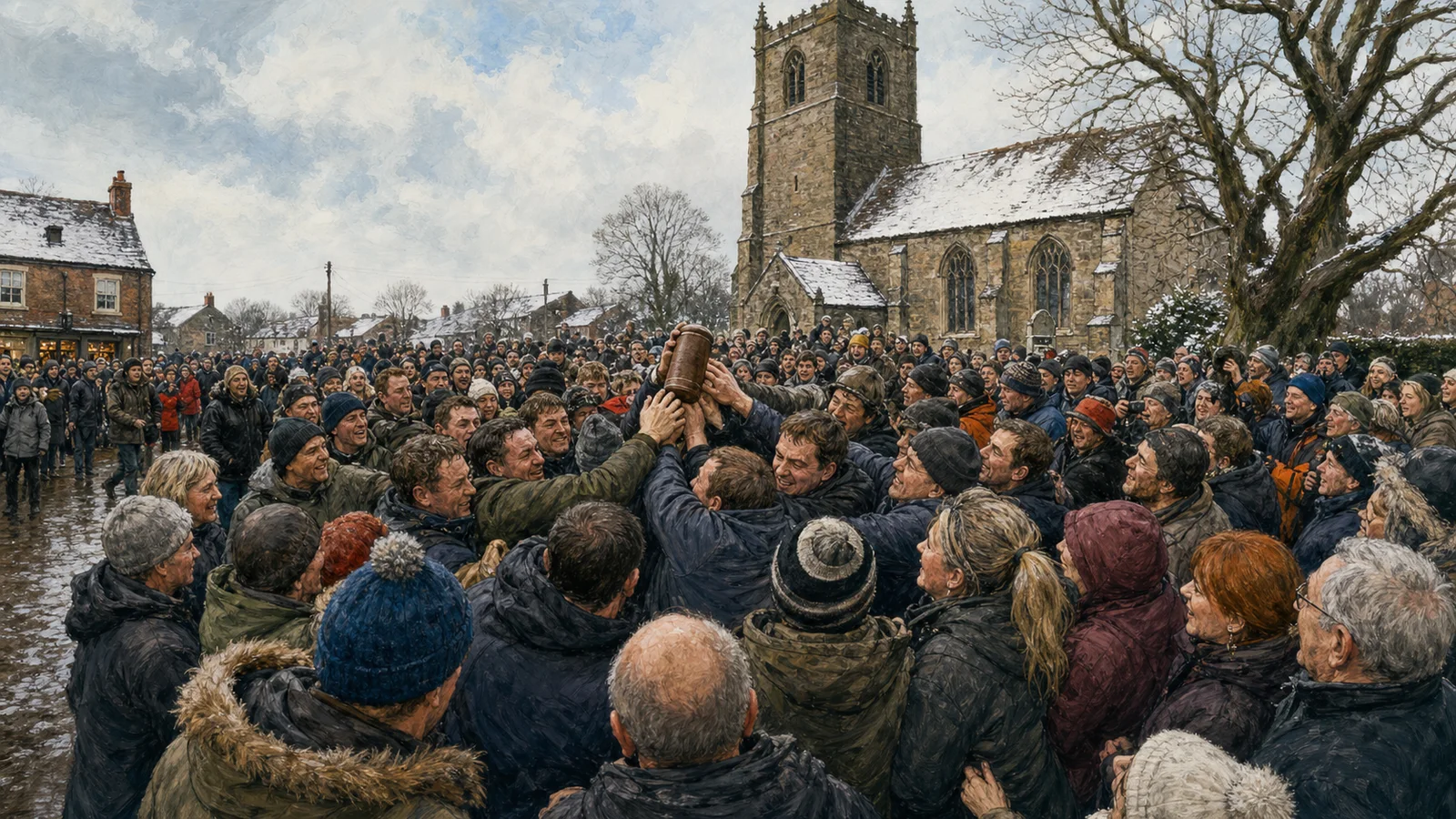
All three images in this article are original editorial illustrations. They are not documentary photographs or depictions of a specific Haxey Hood event.
Every January, a North Lincolnshire village makes a local pub the finish line for a contest that is part procession, part scrum, and very much its own thing. The object at the middle of the Haxey Hood is not a football: it is a leather cylinder called the Hood. The aim is to move it to one of four pubs in Haxey and nearby Westwoodside.
That much is a living custom with a clear setting. Historic England’s listing for the Lady Mowbray, or Hood, Stone records its association with the annual Haxey Hood game, the Fool’s Speech, and “Smoking the Fool.” The community’s Haxey Hood information site says the event is held on January 6, except when that date falls on a Sunday, and describes the central mass of players as a “Sway.”
The one rule that makes it stranger
The local guide says participants may not run with or throw the Hood. Instead, the crowd pushes and pulls it through the Sway. That makes the contest less like a conventional match than a slow, collective argument about direction. The finish comes when the Hood reaches a favored pub, where it stays until the next game.
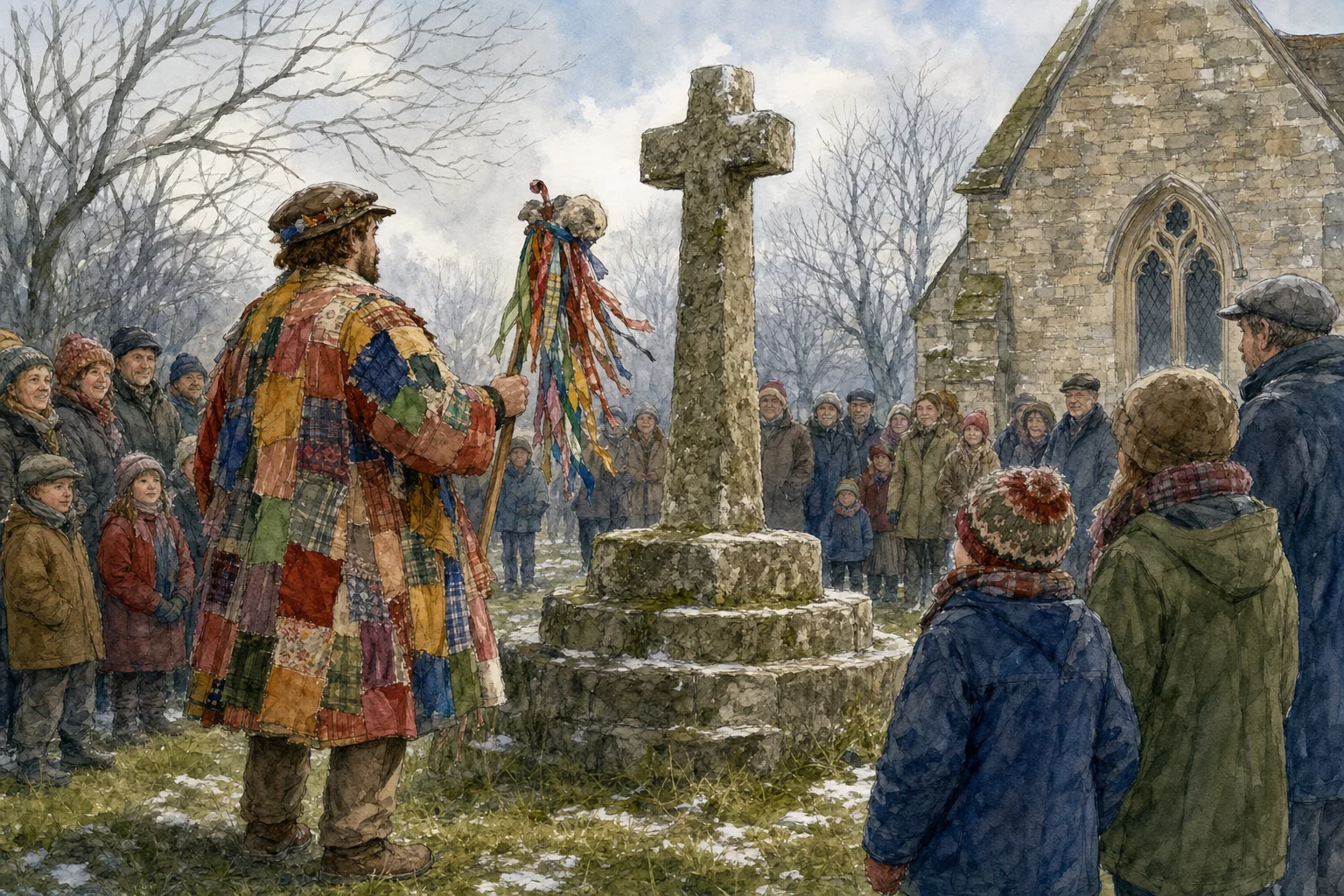
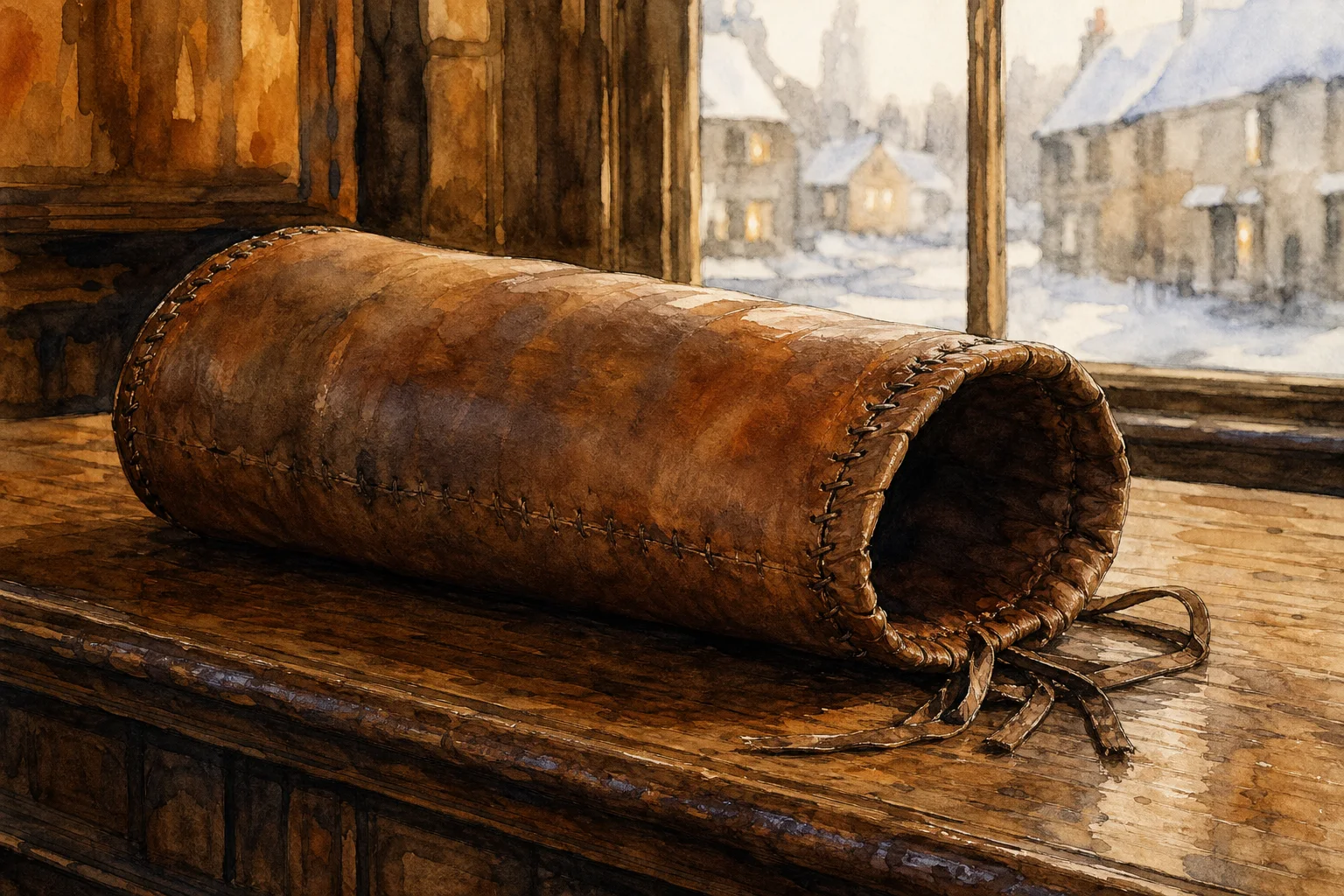
The ceremony has its own vocabulary: the Fool, the Lord of the Hood, and the Boggins, who help marshal the occasion. The English Folk Dance and Song Society describes the Hood as a two-foot leather cylinder and the destination as one of four local pubs. It also notes that the event is a broader community gathering, not merely a contest with formal teams.
What is history, and what is folklore?
The often-retold origin story concerns Lady de Mowbray: according to folklore, a gust took her riding hood and local laborers chased it, inspiring the annual game. That story is tradition, not a settled historical account. It is best read as the community’s explanation for a custom whose deep history is difficult to document in the modern sense.
There is firmer physical context nearby. Historic England identifies the Hood Stone as a medieval cross base and specifically connects it to the annual ritual. The stone does not prove the precise origin of the game, but it anchors the custom in the village landscape and confirms that the ceremony has a recognized historic association.
Why a pub is the point
At Haxey, the finish line is deliberately social. A pub receiving the Hood gets to keep it until the next year’s event, turning a piece of leather into a temporary local emblem. The route, the crowd, and the post-game gathering matter as much as the outcome.
That is the useful weirdness of the Haxey Hood: it preserves a game whose rules make sense only inside its own community. Rather than polishing it into a standardized sport, the village has kept the odd names, the ritual speech, the muddy Sway, and the wonderfully specific reward of delivering a Hood to a pub.
Leave a Reply