Category: Strange History

  • How a Homing Pigeon Carried an Early Aerial Camera

    How a Homing Pigeon Carried an Early Aerial Camera

    Editorial illustration

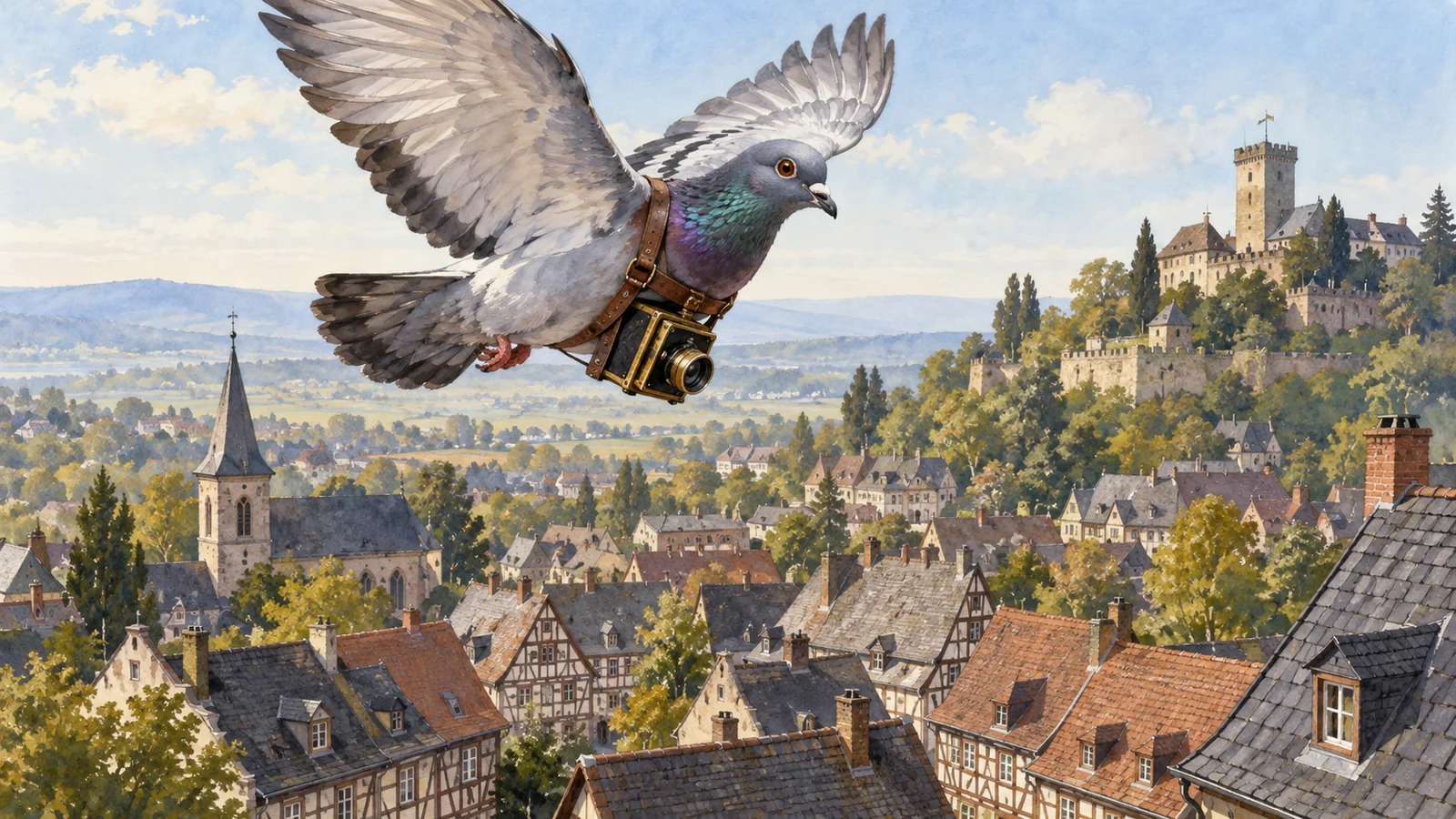
    In the hills near Frankfurt, a homing pigeon once carried a miniature camera home. The bird’s flight turned a familiar talent for navigation into a wonderfully unusual way to make photographs from above.

    The idea belonged to Julius Neubronner, a pharmacist and enthusiastic photographer in Kronberg, Germany. At the beginning of the twentieth century, he developed compact cameras designed to ride on carrier pigeons in a small harness. When a bird made its return flight, the camera’s timer could release its shutter and bring back a view shaped by the pigeon’s route.

    The result is one of photography’s most charming pieces of inventive history: a carefully built camera, a well-trained bird and a perspective that turned rooftops, fields and streets into a living map.

    A camera built for a homeward flight

    Neubronner had practical experience with carrier pigeons before he began making cameras. Museum accounts describe how pigeon post formed part of his world as a pharmacist. That knowledge made the birds’ dependable instinct to return to their loft an appealing starting point for a new kind of aerial picture.

    His camera designs stayed small because every detail mattered. The German Museum of Technology’s collection account describes a lightweight camera equipped with a pneumatic shutter release. A rubber bulb could be prepared before a flight; as it released air, it created a delay and then triggered the exposure. The timing turned a bird’s journey into a planned photographic experiment.
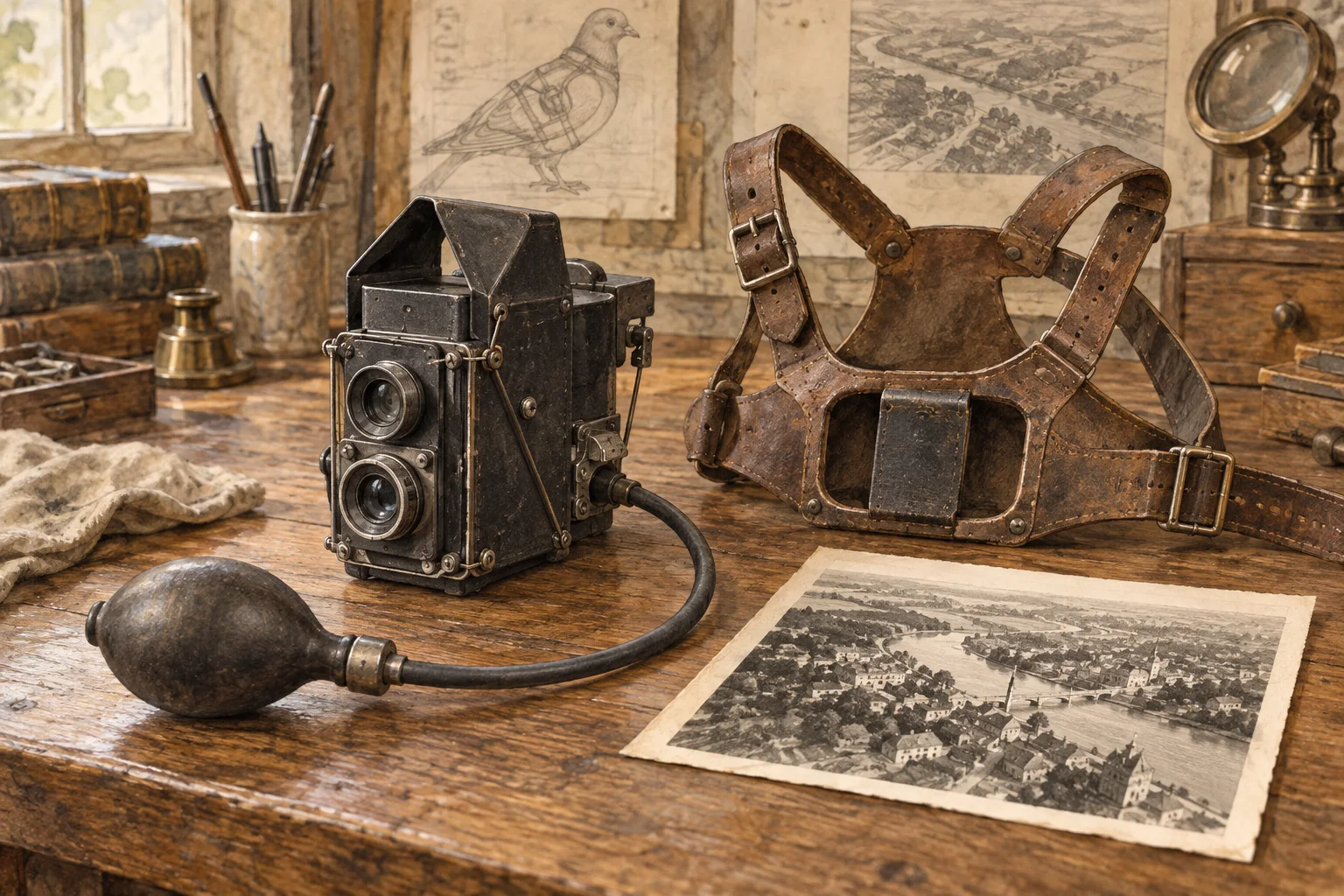
    Editorial illustration of a compact early twentieth-century pigeon camera, leather harness and pneumatic timing bulb on a wooden workbench.
    Editorial illustration of the compact camera, harness and timed shutter idea that made pigeon photography possible.

    The apparatus was inventive in an especially hands-on way. A pigeon’s natural flight supplied the movement; Neubronner’s mechanism supplied the moment of exposure. Accounts from the Deutsches Museum describe cameras ranging through several models, including a two-lens design that increased the chance of producing a useful image.

    The patent office asked for pictures

    Neubronner filed his application in 1907 for a method and device for photographing landscapes from a bird’s-eye view. The German Museum of Technology recounts that the application initially met skepticism. Photographs made by his pigeons gave the concept a concrete demonstration, and the invention received a patent on December 2, 1908.

    The patent story gives the invention its memorable shape. The key proof was not a complicated pitch. It was a set of small aerial photographs that showed the camera could travel with a bird and come back with an image.

    Neubronner later presented the work at photography and aviation exhibitions. The Smithsonian’s National Air and Space Museum places his pigeons among the early routes people used to see the landscape from above, alongside balloons, kites and rockets. His photographs offered an intimate version of that lofty ambition: a bird’s return trip, recorded one shutter click at a time.

    A bird’s-eye view with a human-scale invention

    The surviving cameras and photographs are valuable because they show how much patience sat behind an apparently playful idea. Pigeons needed training. A camera needed to sit securely. The shutter needed a reliable delay. The finished image depended on light, route and timing, just as any early photograph did.

    Editorial illustration of a homing pigeon carrying a compact camera as it approaches a wooden dovecote above a historic town.
    Editorial illustration of a camera-equipped homing pigeon returning to its loft.

    That combination of animal skill and mechanical craft is what makes pigeon photography endure as a strange-but-true chapter in visual history. The pictures were made through a partnership between a person who built a tiny tool and birds whose routes already connected distant places with home.

    Today, museum collections in Munich, Berlin and Vevey preserve examples and explain the methods behind them. Their records keep the story grounded: this was a real early experiment in aerial imaging, assembled from small cameras, leather harnesses, pneumatic timing and the determined flight of a pigeon.
    Sources

  • Why Some American Barns Have Eight Sides

    Why Some American Barns Have Eight Sides

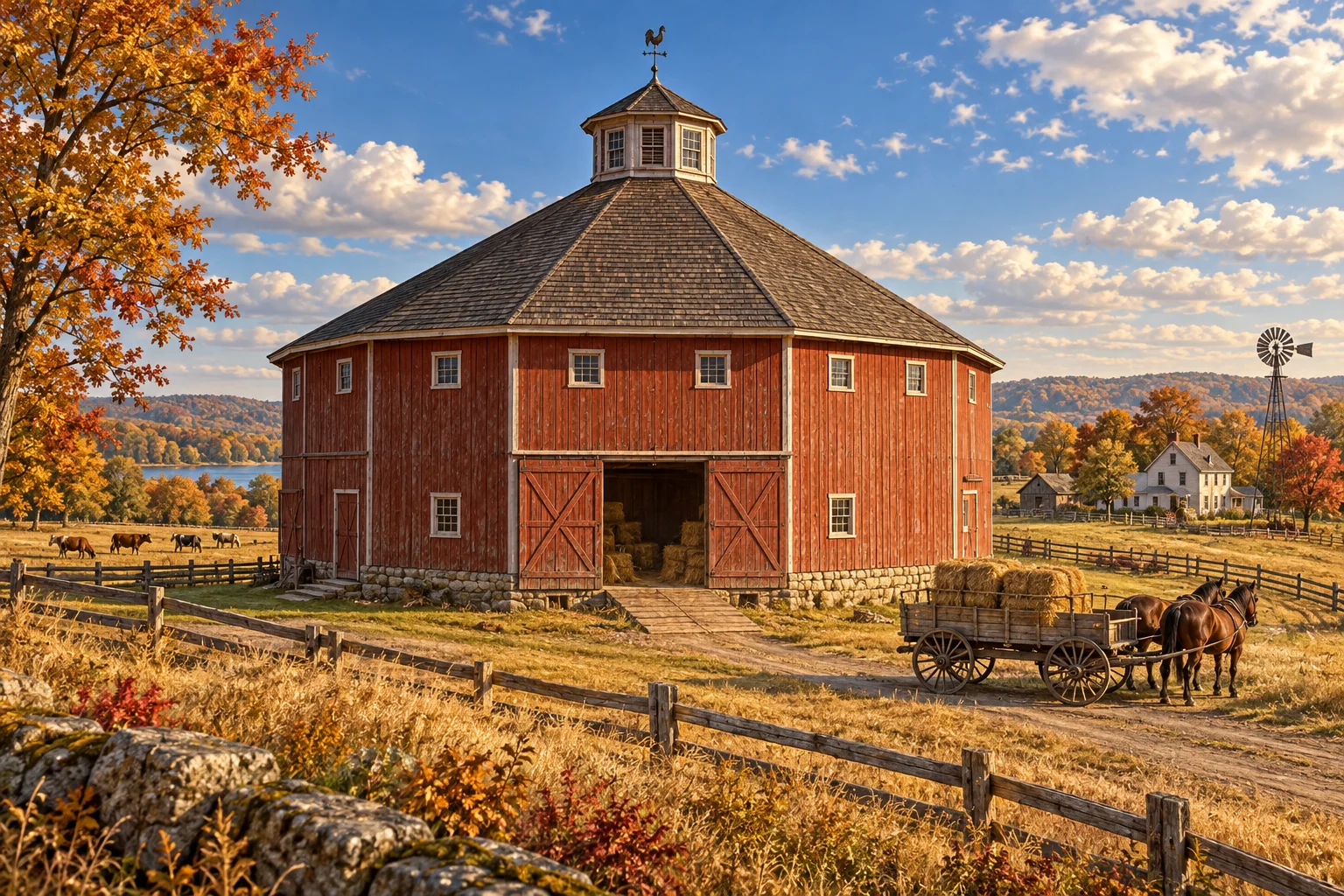
    Editorial illustration: an eight-sided barn brings a distinctive silhouette to an American farm landscape.

    A barn with eight walls has a way of making a familiar field feel freshly surprising. The form is called an octagon, and many American builders used it for practical reasons as well as visual character. In the late nineteenth and early twentieth centuries, farm owners and agricultural advocates explored round and polygonal barns as compact places for the daily work of caring for animals, storing feed, and moving hay.

    Historic records show that the idea took root in several regions. A National Park Service study of Iowa round barns describes the 1880s octagon barn as an innovative, progressive design: a single large building could gather functions that had often occupied several smaller structures. The same study describes the period as an experiment in farm planning, one shaped by the needs of particular farms and builders.

    A shape built around work

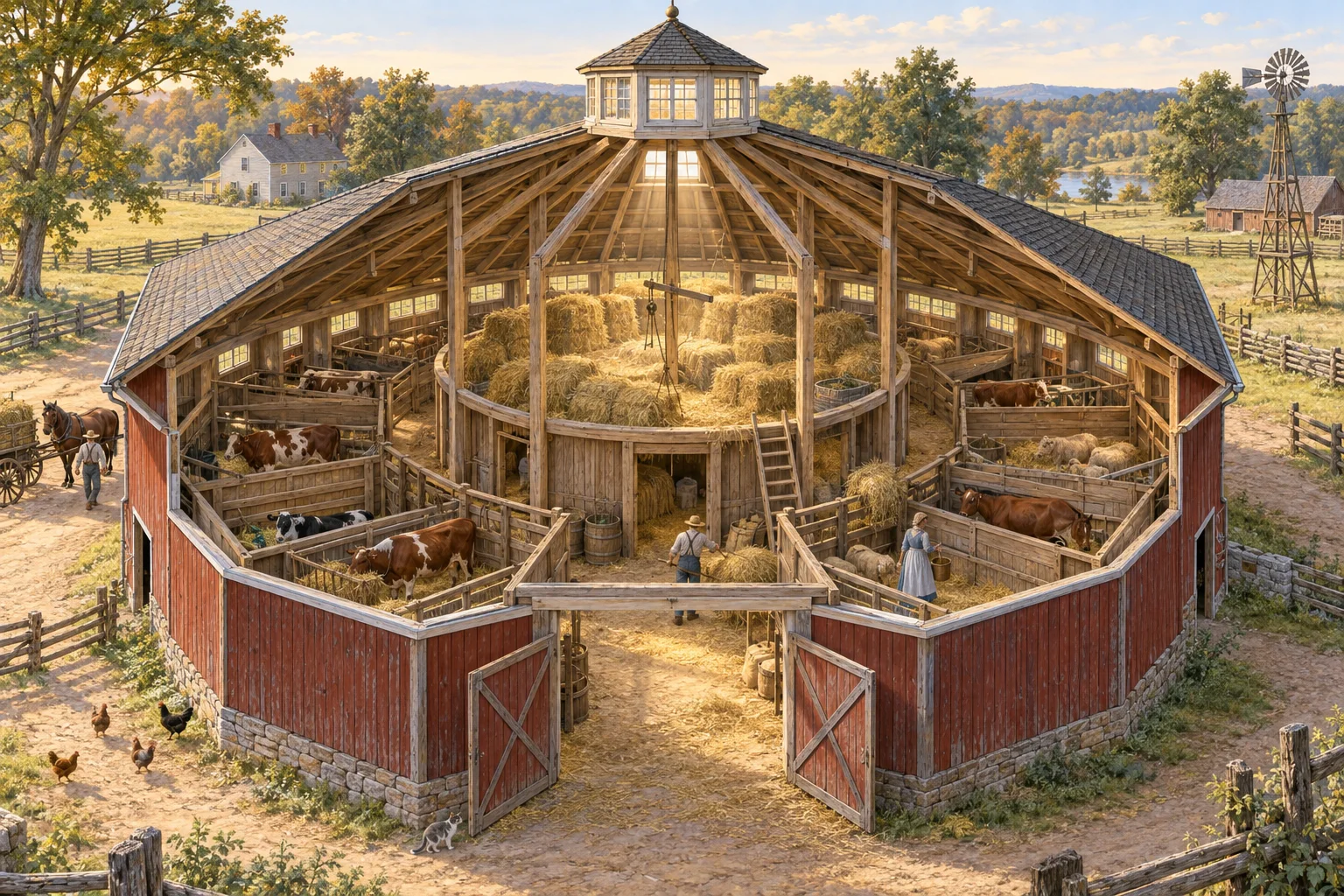
    The geometry gave builders an inviting organizing principle. A wide outer ring could hold animal spaces, while an interior circle could keep feed close at hand. The National Park Service’s Iowa documentation treats “round barn” as a broad term that includes circular barns and barns with five or more equal sides. That useful definition makes room for the many ways builders adapted a compact plan to local materials and daily work.

    Editorial illustration showing the interior layout of an octagonal timber barn with animal stalls around the outside and hay storage near the center.
    Editorial illustration: a cutaway view highlights the practical rings of an octagonal barn.

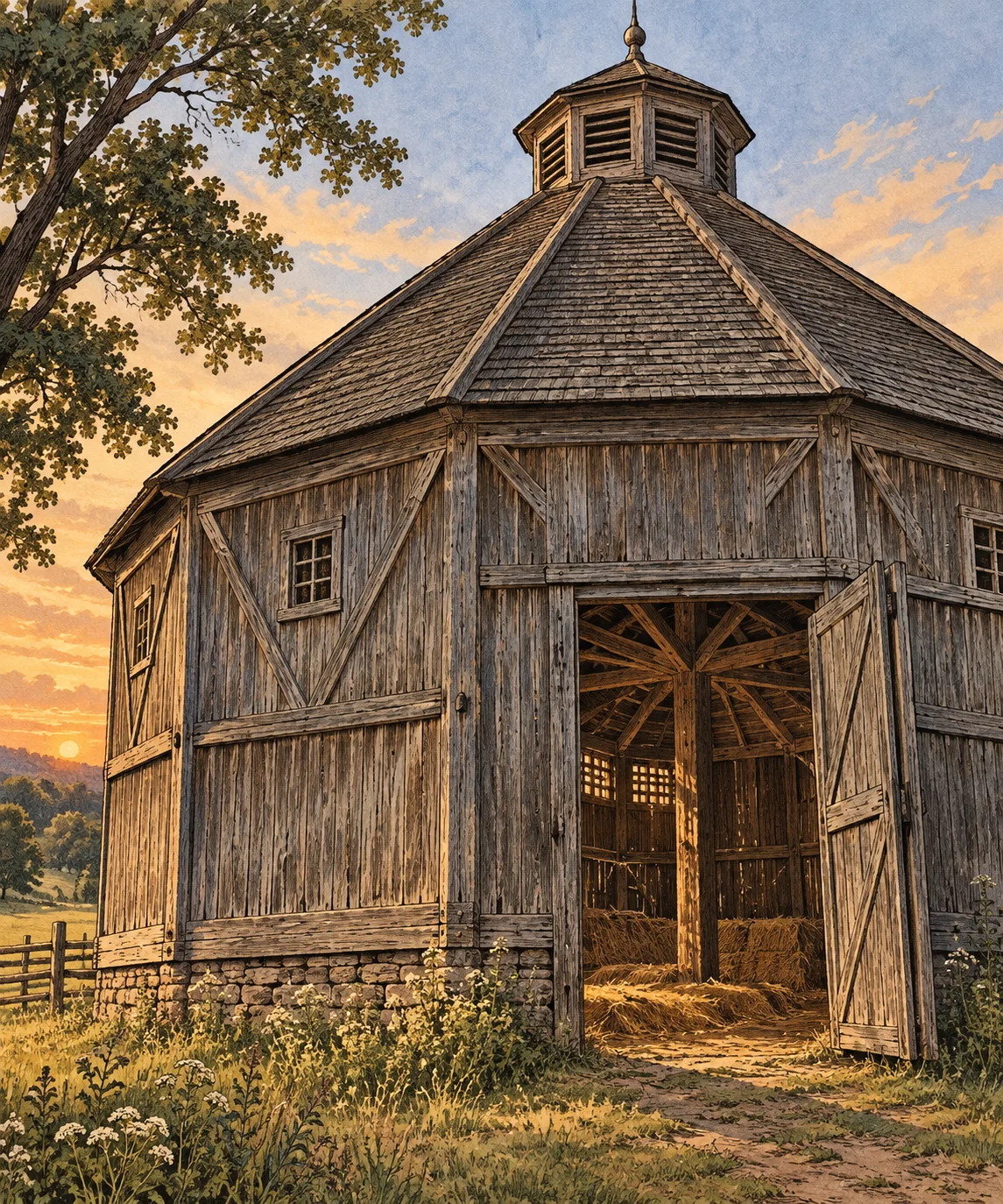
    That arrangement also made the building’s roof part of the story. Rafters could radiate from a central point, creating a high interior with a cupola above. The cupola brought daylight and ventilation into the working space, while the roof’s repeated angles made the whole barn feel like a piece of large-scale carpentry.

    Survivors from a lively design experiment

    Each surviving barn carries its own local history. The National Park Service’s Iowa survey identified 160 round barns in the state during its research and describes a roughly sixty-year period of experimentation, from 1867 to 1929. Its thematic documentation groups the buildings by shape, construction, interior arrangement, function, and design influence, preserving the choices made by local builders and farm families.

    These examples give the eight-sided form a human scale. A farmer, carpenter, or family chose an unusual plan because it promised a useful way to arrange a day’s labor. The result was a barn that held animals, feed, tools, and ambition beneath one roof.

    Editorial illustration of weathered wooden walls, angled roof planes, and a cupola on an octagonal barn in evening light.
    Editorial illustration: angled roof planes and timber joinery give an octagonal barn its lasting presence.

    Why the form still feels wonderfully strange

    Rectangular barns became the familiar default across much of rural America, yet octagonal barns remain memorable because their geometry stays visible from every angle. Their faceted walls catch light differently through the day, their roofs rise like broad wooden umbrellas, and their interior plans reveal a designer thinking in circles and spokes.

    Today, historic surveys and preservation records let visitors encounter these buildings as evidence of a practical design adventure. An octagonal barn is a reminder that a farmyard can also be a workshop for big ideas: eight sides, one roof, and a carefully imagined place for the work of everyday life.

    Sources

  • Acadia’s Bates Cairns Turn Trail Markers Into Tiny Stone Gateways

    Acadia’s Bates Cairns Turn Trail Markers Into Tiny Stone Gateways

    On a bare granite ridge in Acadia National Park, a small arrangement of stones can carry a remarkably specific message. Two upright rocks support a flat lintel, and a smaller stone on top points the way. It is called a Bates cairn, and it is part trail marker, part piece of living park history.

    Editorial illustration of a Bates cairn on a granite Acadia trail above the Maine coast.
    Editorial illustration

    Cairns have guided travelers in many landscapes for a long time. Acadia’s version is especially distinctive because it was designed as a useful system rather than a generic pile of rocks. The National Park Service describes a Bates cairn as two base stones that support a flat lintel stone, with a pointer stone placed above it to show the direction of the trail.

    A trail builder’s small signature

    The name comes from Waldron Bates, a Boston lawyer and outdoorsman who became an influential pathmaker on Mount Desert Island. From 1900 to 1909, Bates chaired the Path Committee of the Bar Harbor Village Improvement Association. The National Park Service says 25 miles of trails were added under his leadership, including the Giant Slide, Canon Brook, Gorham Mountain, and Cadillac Cliffs trails.

    His influence also reached the map in a hiker’s pocket. Bates led the 1896 comprehensive island path map, a predecessor of the maps used in the park today. He wrote an early handbook for the workers who built and maintained trails, establishing standards that turned practical route finding into a recognizable local craft.

    The cairn design is the charming part. Its broad lintel gives the marker an architectural silhouette, while the pointer stone helps it function on exposed terrain where a painted blaze alone can be harder to follow. The structure feels a little like a miniature stone gateway: deliberately made, durable, and placed in conversation with the next bend in the path.

    Why the shape matters

    Acadia’s trails cross open granite, weathered ledges, and areas where the route can blend into the surrounding rock. Park volunteers known as Waldron’s Warriors help inspect the markers, answer visitor questions, and report trail damage. The park says the cairns work alongside blue blazes in treeless areas and help hikers stay on the established route in changing weather and seasons.

    Editorial illustration showing the two base stones, flat lintel, and pointer stone of a Bates cairn beside an Acadia trail.
    Editorial illustration

    That function is why the individual stones deserve to stay in their places. The National Park Service asks visitors to leave cairns undisturbed and avoid building additional rock objects. A maintained marker can guide a hiker; an improvised one can make the route less clear. Keeping the historic forms intact also protects the thin soil and plants that hold onto Acadia’s rocky slopes.

    A restoration with direction

    Bates cairns were replaced by more conventional conical markers during the mid-20th century. Beginning in the 1990s, Acadia began restoring the older style on many east-side trails. The result is an unusually direct connection between present-day hikers and the people who planned the island’s early paths more than a century ago.

    The whole story is a pleasant reminder that useful design can become a local landmark. These markers have no plaques, screens, or batteries. Their instructions are written in balance, shape, and placement. On a foggy granite ridge, a small stone lintel and a pointed rock quietly turn history into a way forward.

    Sources

  • Benjamin Franklin’s Glass Armonica Turned Spinning Bowls Into Music

    Benjamin Franklin’s Glass Armonica Turned Spinning Bowls Into Music

    Benjamin Franklin is usually introduced through electricity, printing and public life. One of the inventions that gave him the most personal pleasure was built for a quieter kind of experiment: a musical instrument made from a procession of spinning glass bowls.

    The instrument is the glass armonica, often called a glass harmonica. It turned the familiar sound of a damp fingertip circling a drinking glass into an instrument a player could perform with both hands. The effect was graceful, practical and a little uncanny: instead of setting out separate glasses, the player sat at a treadle and drew notes from a moving row of glass.

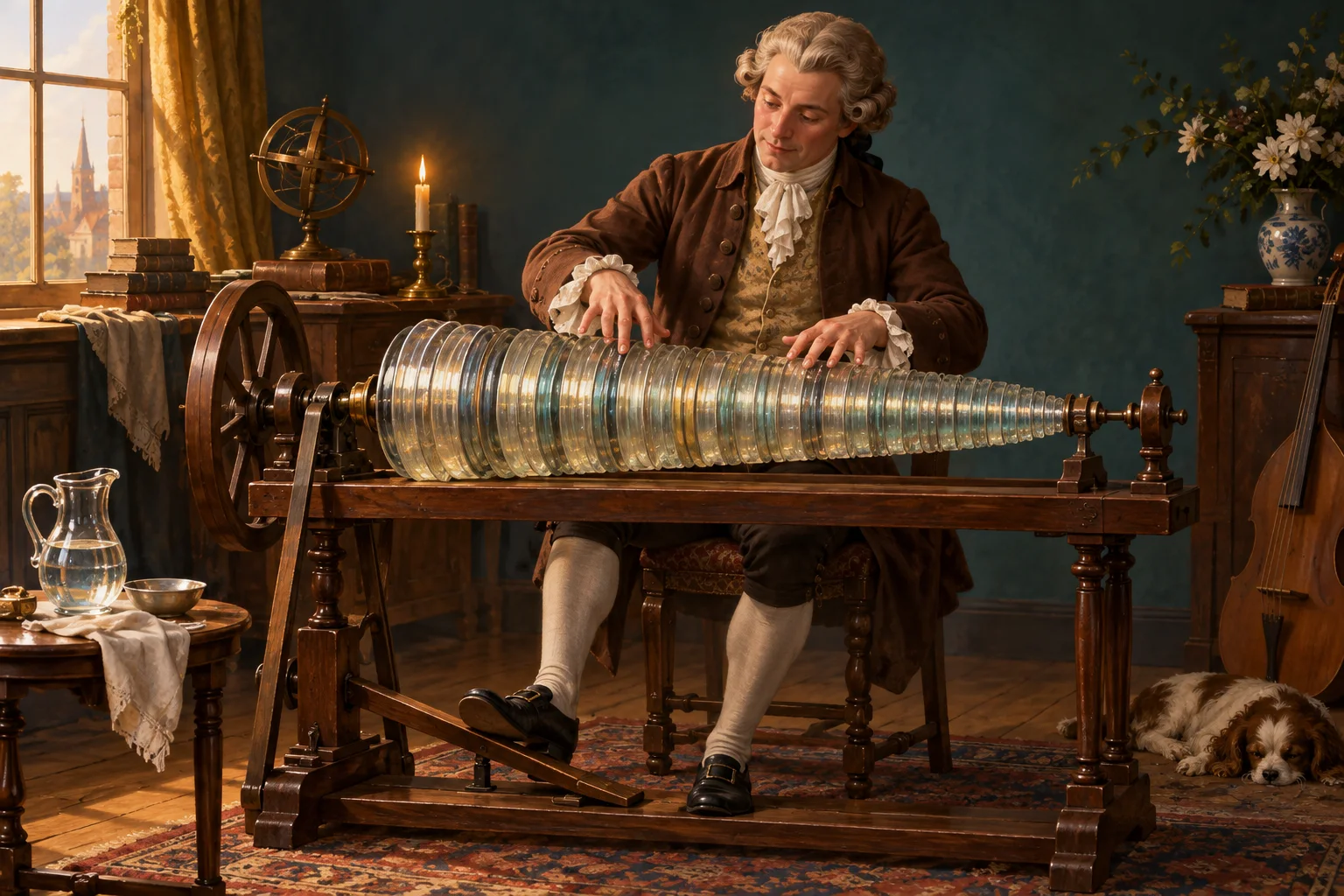
    Editorial illustration of a period musician playing nested glass bowls on a treadle-powered armonica.
    Editorial illustration: a period musician plays a glass armonica.

    A row of bowls, a pedal and wet fingertips

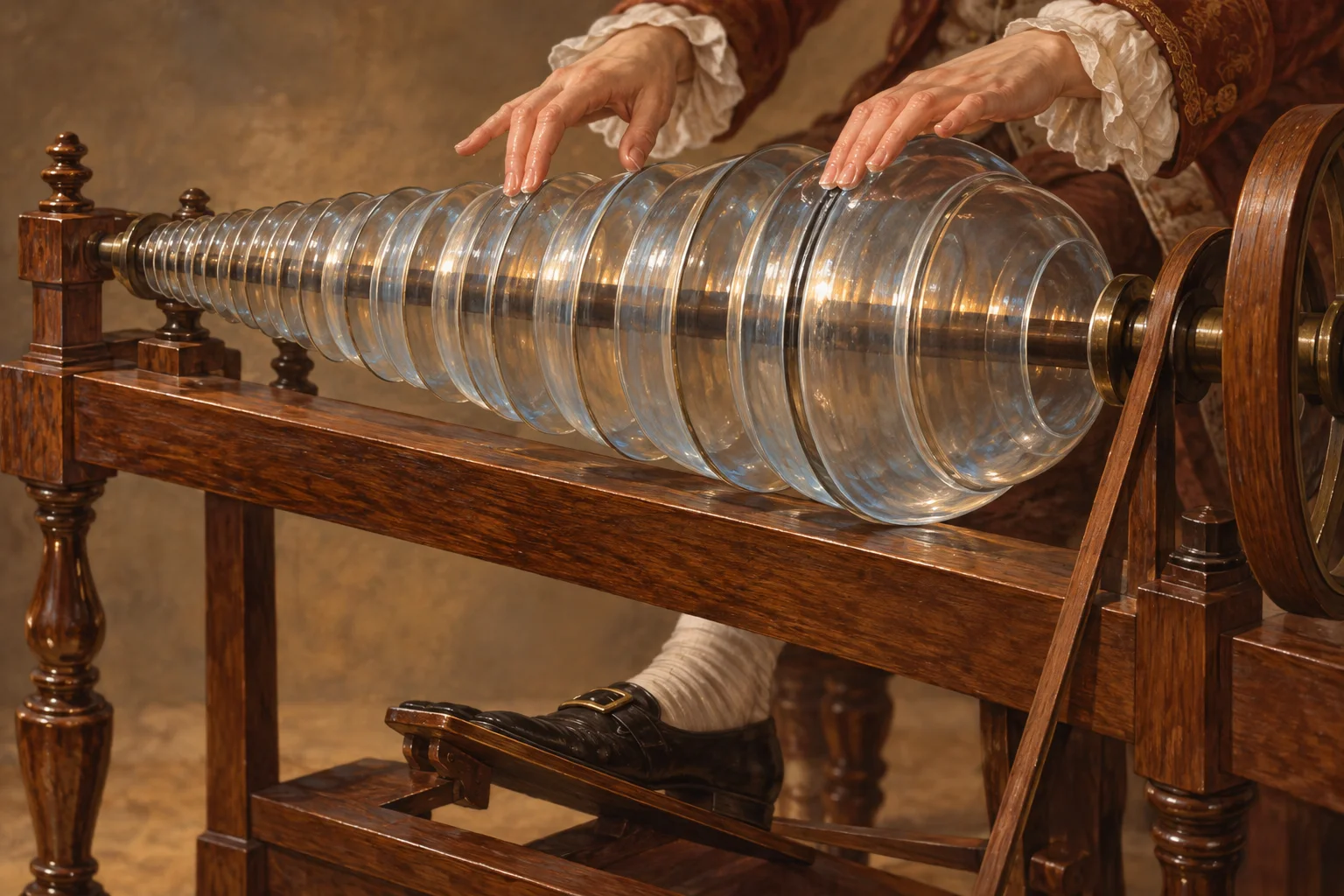
    The Library of Congress describes Franklin’s design as a series of graduated glass discs fitted to a horizontal spindle. A foot treadle turned the spindle while the player touched the revolving glass with wet fingers. The varying sizes supplied different pitches, so the nested bowls could produce more than one note at a time.

    That arrangement refined an earlier tradition of musical glasses. Franklin described his improvement to the Italian philosopher Giambatista Beccaria before leaving London in 1762, according to the Library of Congress. The bowls sat one inside another on a single rod, leaving the player’s hands free to choose notes while the pedal kept the instrument moving.

    Editorial illustration showing hands touching the graduated bowls and the treadle mechanism of a glass armonica.
    Editorial illustration: the nested bowls and treadle form one continuous playing mechanism.

    Why the design mattered

    Musical glasses could already make ringing tones, yet Franklin’s layout gathered their pitches into a compact instrument. A seated player could work across the row of bowls much as a keyboard player works across keys. The instrument’s compact geometry is part of its enduring appeal: a set of fragile-looking circles becomes a machine for sustained sound.

    The glass armonica gained an audience in Europe. The Library of Congress notes that Mozart and Beethoven composed for it, an extraordinary afterlife for an instrument built around water, friction and rotation. A 1765 letter from Franklin to composer Francis Hopkinson, preserved by the Library, also records Franklin asking about a performance on the newly invented armonica.

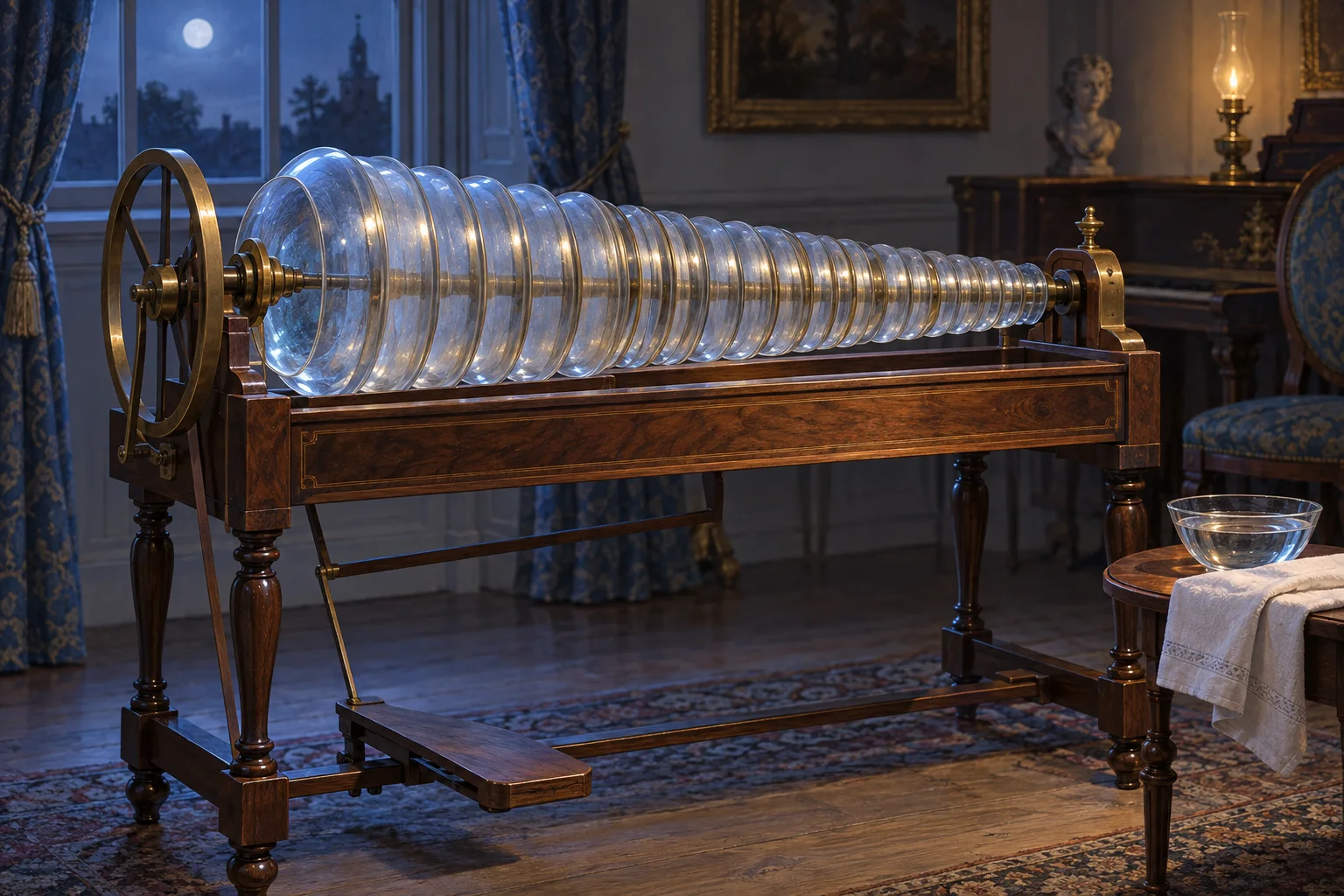
    Editorial illustration of a glass armonica on a wooden stand in a softly lit historic music room.
    Editorial illustration: an armonica ready for a player’s hands and foot treadle.

    A strange idea with a clear logic

    The armonica feels unusual because its music begins with touch rather than a string, reed or hammer. Its logic is wonderfully direct: glass creates the tone, a pedal provides motion, and the player selects notes by touching the rims. The design shows how a familiar household sound can become a carefully engineered performance tool.

    Franklin’s glass armonica remains a small marvel of musical history—part instrument, part workshop experiment, and a reminder that inventive ideas can begin with an attentive ear.

    Sources

  • Why a Railway Mail Dog Came Home Wearing a Harness of Travel Tags

    Why a Railway Mail Dog Came Home Wearing a Harness of Travel Tags

    Editorial illustrations accompany this feature.

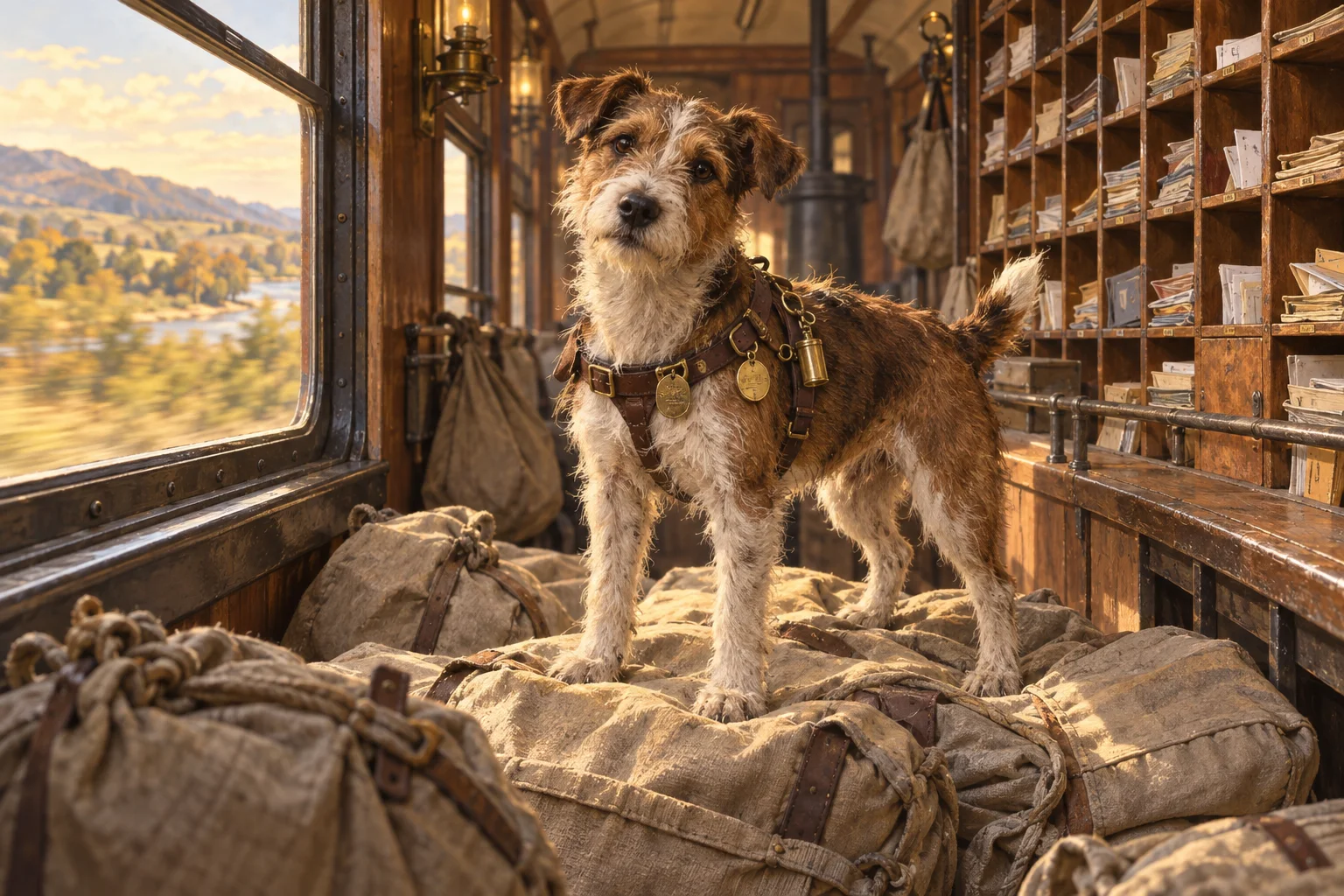
    In the late nineteenth century, a scruffy dog named Owney made a very unusual career out of following mailbags. He became such a familiar sight on railway post-office cars that clerks adopted him as their mascot, marked his travels with tags and medals, and helped turn a small Albany, New York, post-office regular into a globe-trotting piece of postal history.

    Editorial illustration of a small scruffy dog in a leather travel harness standing among canvas mailbags in a nineteenth-century railway mail car.
    Editorial illustration of Owney’s railway-mail era.

    A dog who followed the mail

    The U.S. Postal Service dates Owney’s Albany post-office life to 1888. Its account says the shaggy pup wandered into the post office, where postal employees welcomed him. He soon began following the mail from wagons onto railway mail cars.

    Owney’s story also preserves a glimpse of working life aboard Railway Post Office cars, where clerks sorted mail while trains crossed the country. He traveled with the people and sacks that connected those routes. The National Postal Museum describes his trips expanding from New York across the United States and Canada, with some accounts also placing him in Mexico.

    The harness became a travel record

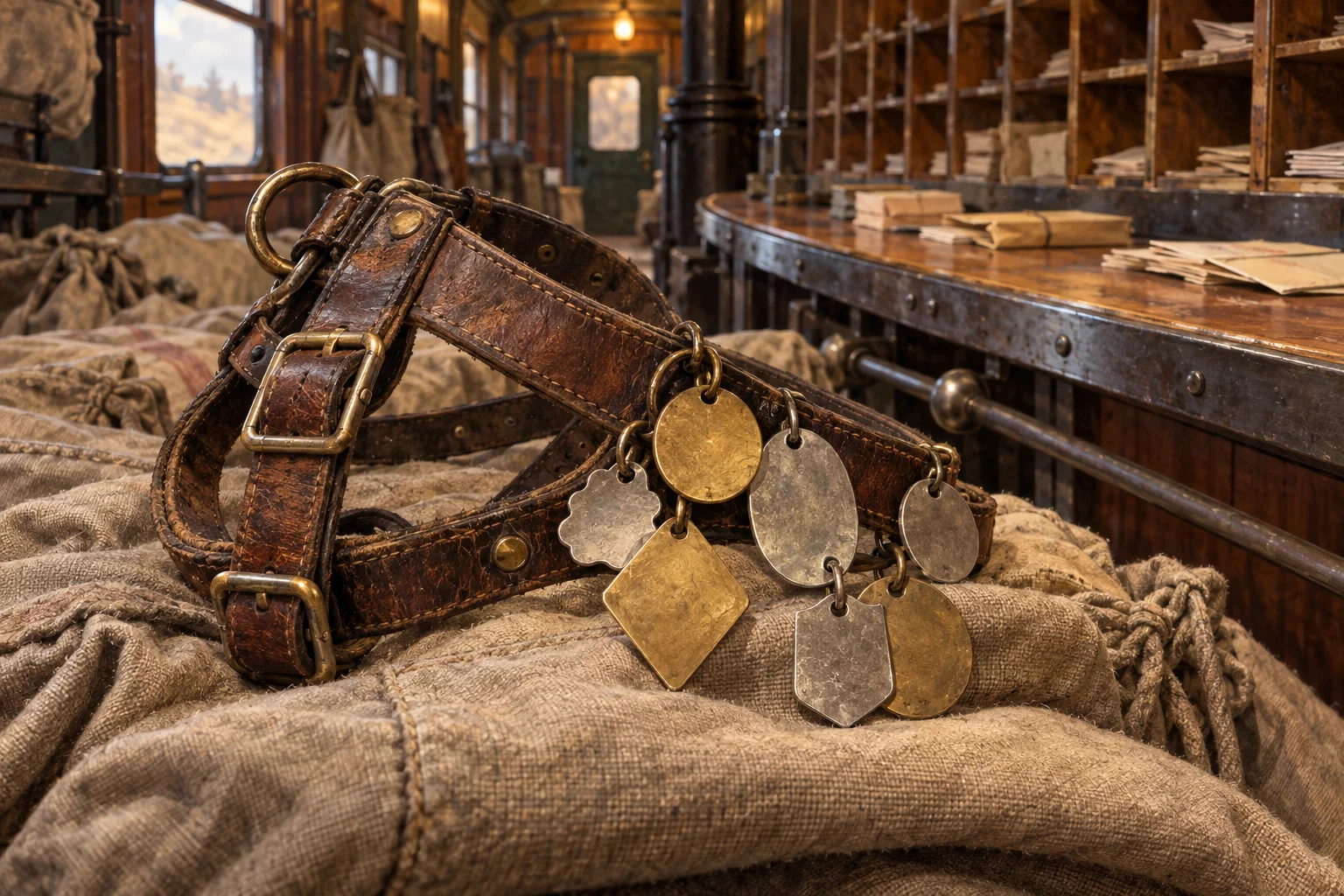
    Railway mail clerks treated Owney as a good-luck mascot and attached tokens to his collar to mark where he had been. The museum’s collection describes the assortment as including travel tags, medals, dog licenses, baggage checks, and even hotel-key tokens. As the collection grew, the weight became enough of a practical problem that Postmaster General John Wanamaker provided a harness that could distribute the souvenirs across Owney’s body.

    It is a wonderfully strange precursor to a stamped passport or a luggage sticker: a traveling dog whose route could be read in small objects that jingled. The tags also tell a human story. Postal workers and people encountered along the way kept adding mementos, creating a collaborative record of an animal who had become part of the mail service’s public character.

    Editorial illustration of a weathered leather dog harness with blank brass and nickel travel tags resting on canvas mailbags inside a railway mail car.
    Editorial illustration of the travel-tag tradition associated with Owney.

    A round-the-world mail route

    In 1895, Owney’s travels took on an international scale. The Library of Congress places his round-the-world journey between August 19 and December 23, with travel by steamer and rail through destinations that included Japan, China, and Singapore. The Postal Service also records visits to Suez, Algiers, and the Azores.

    Owney’s famous trip belonged to a particular moment in the history of mail and transportation. He traveled in the care of the postal network and its workers, alongside mailbags that moved through rail and steamship connections. That infrastructure makes his story both odd and revealing.

    Editorial illustration of a small scruffy dog beside canvas mailbags on the deck of a nineteenth-century steamship, with open sea and a distant coast.
    Editorial illustration evoking the steamship portion of Owney’s 1895 journey.

    Where to find Owney now

    The Postal Service says Owney’s preserved body was entrusted to the Smithsonian Institution in 1911 and has been displayed at the National Postal Museum since 1993. The Library of Congress guide connects readers with digitized newspaper accounts from Owney’s own era, while the illustrations here serve as contemporary visual companions.

    His appeal lasts because the evidence preserves both the improbable scale of the trip and its everyday origin. A dog liked mailbags. Clerks welcomed him. Tags accumulated. Then a railway mascot became a traveler whose story links an Albany post office, mail trains, a Tacoma promotion, and a trip around the world.

    Sources

  • When Americans Tried to Mail Their Children—and the Postal Service Said No

    When Americans Tried to Mail Their Children—and the Postal Service Said No

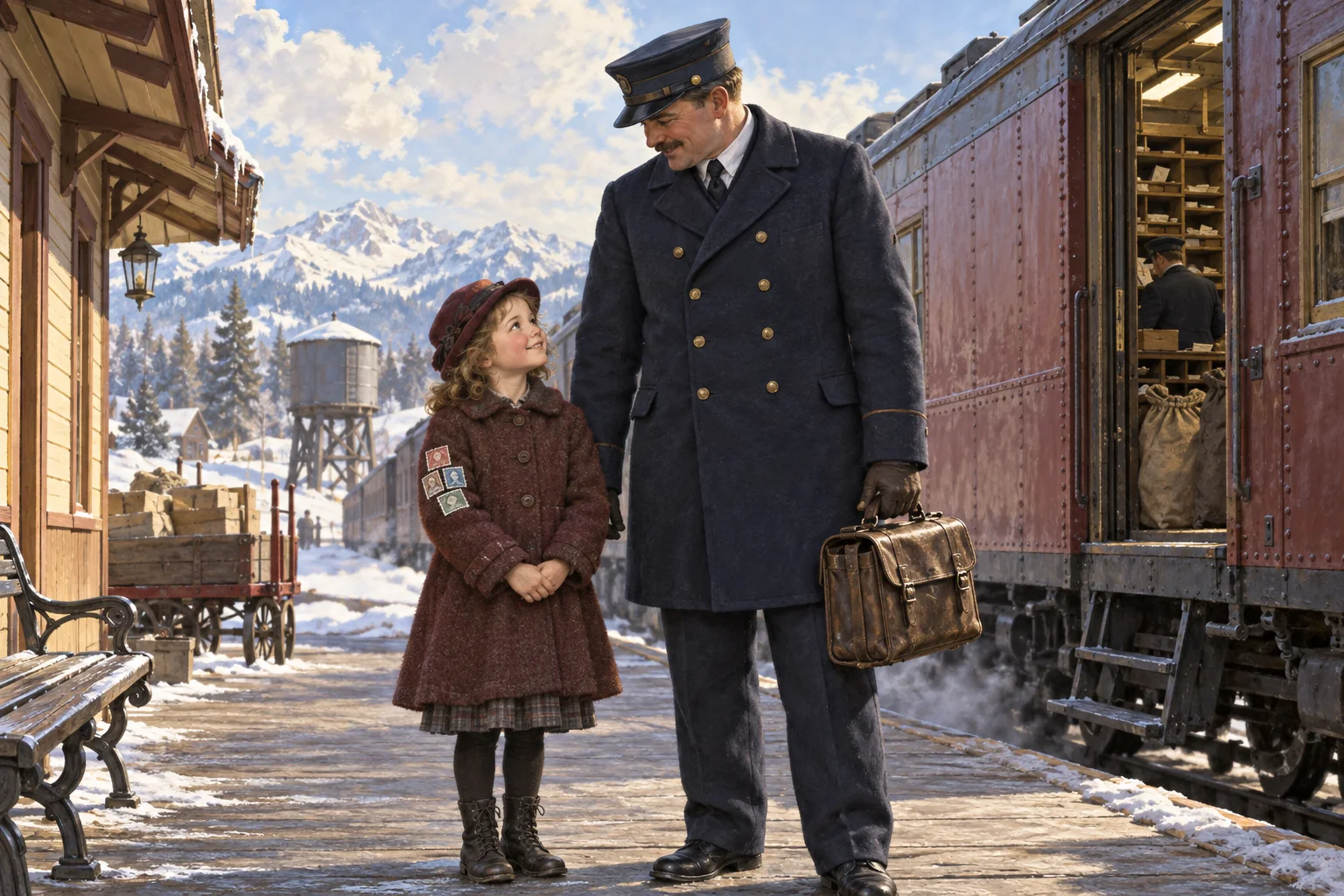
    In 1914, a nearly six-year-old Idaho girl named May Pierstorff traveled about 73 miles from Grangeville to Lewiston to visit her grandparents. The story is remembered because 53 cents in parcel-post stamps were attached to her coat.

    That fact is strange enough. It does not mean the Post Office Department had a normal service for shipping children, or that May was put in a sack with the letters. Smithsonian Libraries’ parcel-post history and the U.S. Postal Service record these trips as unusual attempts to stretch a new service beyond its purpose. Postal officials ultimately made their position plain: children were not mail.

    A new service, a very bad loophole

    Parcel Post began on January 1, 1913. It mattered especially to rural Americans, who could suddenly send and receive larger packages at standardized rates instead of relying entirely on private express companies. Smithsonian Libraries records that more than four million packages moved through 1,594 post offices in the service’s first five days.

    New services invite imaginative customers. The U.S. Postal Service records that in 1913 the parents of an eight-month-old Ohio baby sent him a few miles to his grandmother. He was safely delivered, and regulations were quickly established to prevent additional attempts to send children through the mail. That makes the episode a revealing snapshot of an unfamiliar system, not an example to imitate.

    The surviving accounts describe a handful of unusual trips, not a routine postal passenger service. Their specificity helped the stories endure, while the rule change made the Postal Service’s intended boundary clear.

    Editorial illustration of an early twentieth-century postal clerk placing stamps on a folded wool coat beside a parcel scale
    Editorial illustration: an early Parcel Post counter and the unusual stamps-on-a-coat detail behind the stories.

    May Pierstorff’s famous trip

    May’s case became the best-known one. Smithsonian Libraries records that in 1914 the five-year-old traveled from Grangeville, Idaho, to her grandparents elsewhere in the state for 53 cents, then the rate used for chickens. The shared point is the important one: she traveled with adults, not as freight.

    The stamps on her sleeve have made the story durable. They turned a family journey into a perfect newspaper oddity: an ordinary trip given a postage receipt. But the postal rules did not create a hidden passenger class. Smithsonian Libraries says word of May’s excursion quickly prompted the Post Office Department to forbid sending any human being by mail.

    Why the legend needs a little care

    “Children in the mail” is a memorable shorthand, but it can hide the human part of the history. These were families making questionable use of a new service, and workers who took responsibility for a child on a particular route. The surviving postal histories show why officials moved quickly to shut down the practice.

    The story is still delightfully weird, just more precise when told straight. Parcel Post changed rural life by moving eggs, tools, food, catalog goods and thousands of other things. For a brief period, a few families tried to stretch its promise too far. The postal service’s answer was uncomplicated: a child was a traveler, not a parcel.

    Fact check

    • Documented: Parcel Post began in 1913, and postal-history sources document a small number of cases in which children traveled through the mail system.
    • Documented: May Pierstorff traveled from Grangeville to her grandparents elsewhere in Idaho in 1914 with 53 cents in postage attached to her clothing.
    • Important context: These episodes were not a standard passenger service. Officials quickly established regulations preventing children from being sent through the mail.

    Sources

  • The Long Island Duck That Became a Roadside Building

    The Long Island Duck That Became a Roadside Building

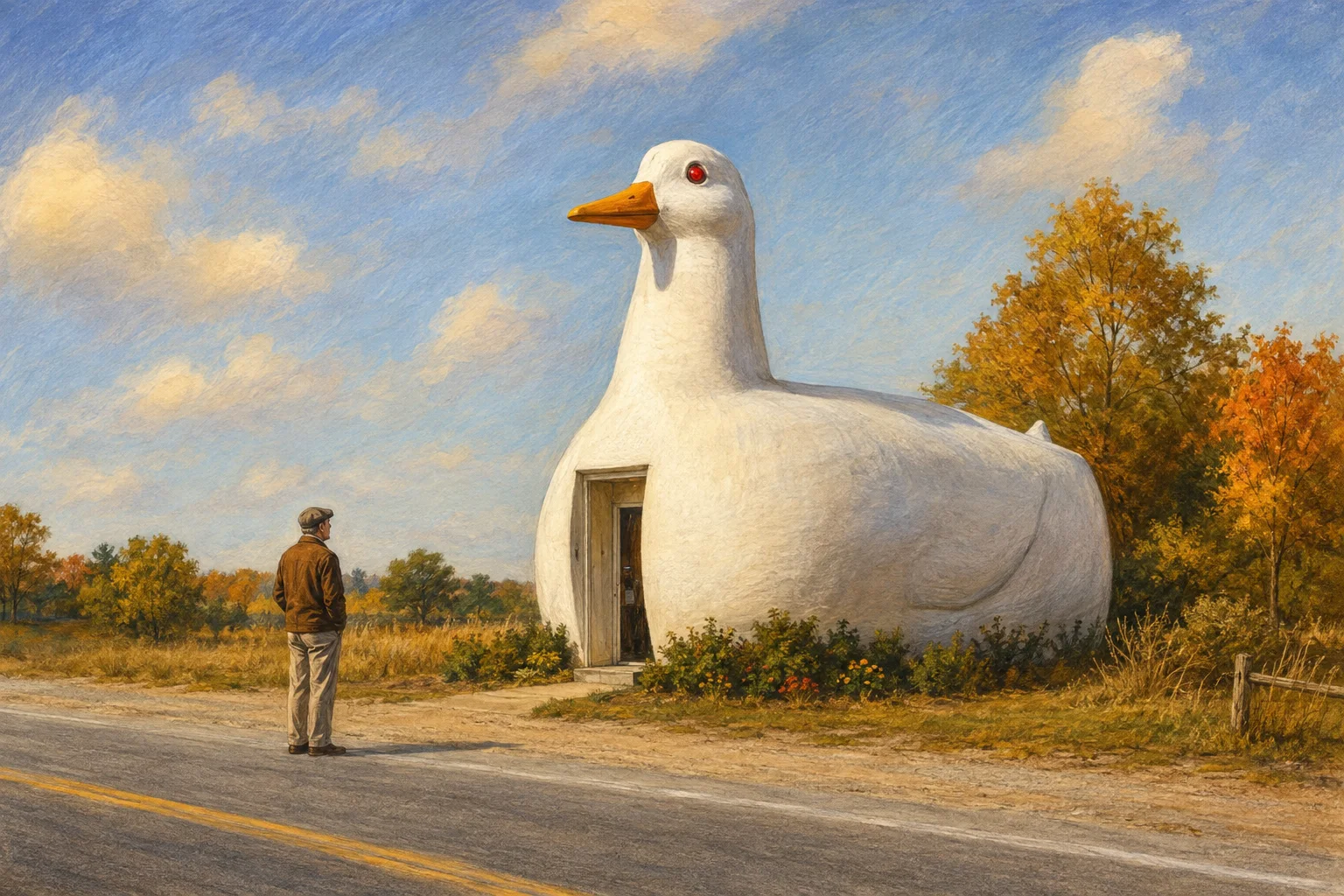
    Weird, but true: On eastern Long Island, a small shop was built as a giant white duck. Its eyes came from Ford Model T taillights, its doorway sat in the bird’s chest, and its compact interior once served a working duck farm.

    Editorial illustration of the Big Duck beside a Long Island road, with a visitor showing the landmark's scale.
    Editorial illustration of the Big Duck as a roadside landmark.

    A roadside building can advertise with a sign, a window display, or a bright awning. Martin Maurer’s answer in 1930–31 was more direct: make the store itself into a Peking duck. The result, called the Big Duck, was built on West Main Street in Riverhead, New York, as a retail poultry shop. For people driving east, the message arrived before they had time to read a word.

    A duck with a room inside

    The National Park Service describes the building as a wood-frame structure covered with wire mesh and concrete. It measured about 15 feet across the front, 30 feet from breast to tail, and 20 feet to the top of its head. The shop inside measured roughly 11 by 15 feet. Those measurements make the joke more impressive: a building that looks oversized from the road still held a room sized for an everyday transaction.

    Its red eyes have a particularly practical origin. They are Ford Model T taillights. A detail from an ordinary car became a pair of eyes for a very large bird, an economical piece of theater for a farm business.

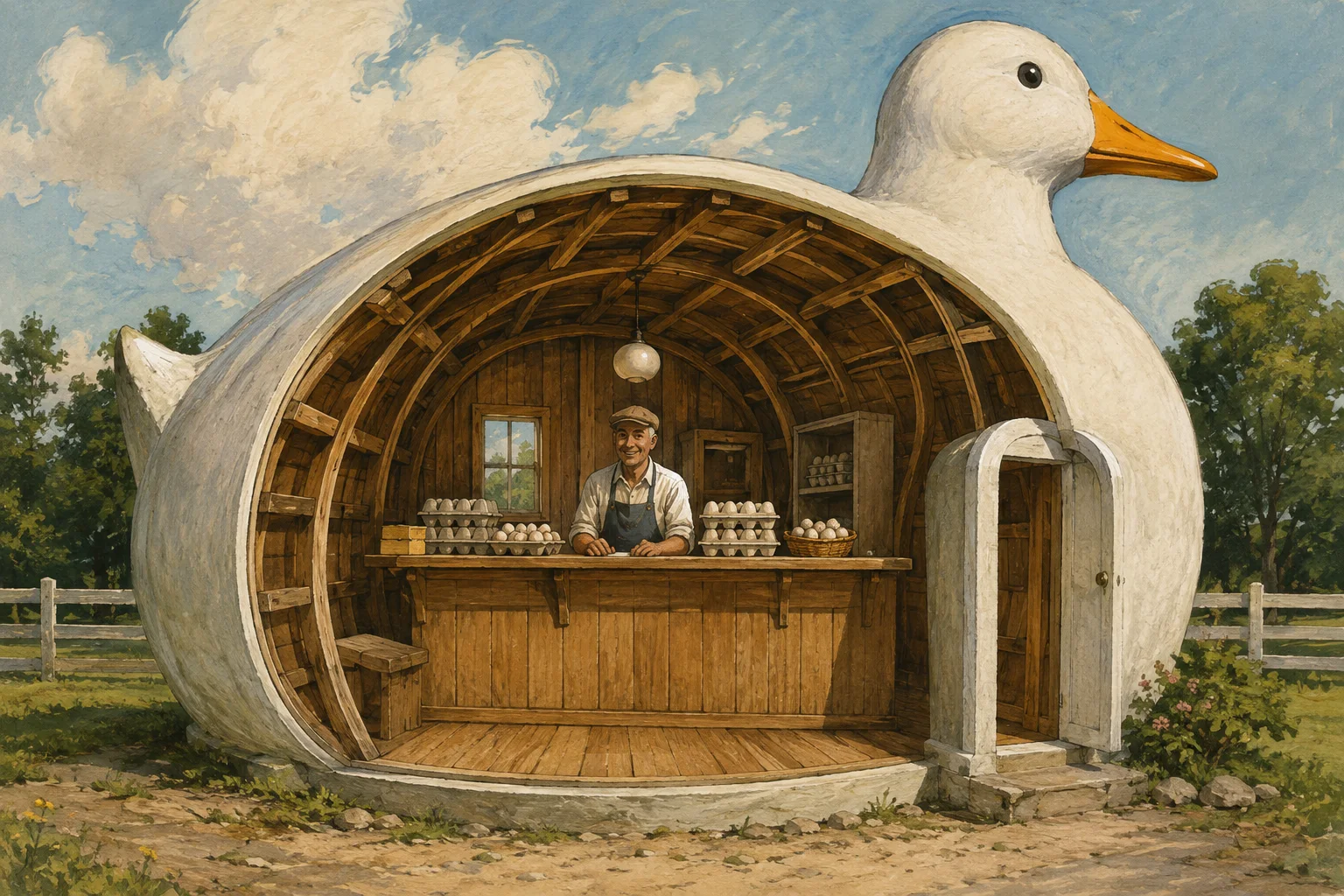
    Editorial cutaway illustration showing the warm wooden interior of a duck-shaped roadside shop with a counter and a shopkeeper.
    Editorial illustration imagining the human-scale shop space inside the duck-shaped building.

    The documented history

    Several dates in the Big Duck’s life are unusually well anchored. The National Park Service records its construction in 1930–31 and says Maurer moved it about four miles southeast to Flanders in 1937, near his new ranch, duck barns, and marshes. The building closed in 1984 and moved to Sears-Bellows Pond County Park in 1988. The National Register listed the Big Duck in 1997; the larger Big Duck Ranch historic district followed in 2008.

    That record matters because a giant roadside bird can invite a loose retelling. The verified version is already plenty strange: a working agricultural business used a three-dimensional duck as its salesroom, then the building gained a second life as a preserved landmark.

    Folklore, shorthand, and an architectural idea

    The Big Duck has gathered a powerful bit of architectural shorthand. In Learning from Las Vegas, Robert Venturi, Denise Scott Brown, and Steven Izenour used “duck” for a building whose overall form carries the message. The Library of Congress connects that term directly to the Long Island Duck. In this sense, a “duck” means a building that speaks through its silhouette.

    That label is a later architectural reading, while the 1930–31 store and its moves are documented historical facts. Popular stories can make a landmark sound like the sole beginning of every whimsical roadside structure. The surviving record supports a narrower, more satisfying claim: this particular duck became a durable example that architects used to explain a design idea.

    What remains an inference

    The National Park Service calls this kind of design “literalism in advertising,” and the route to the Hamptons gave Maurer’s building a prominent audience. It is reasonable to read the white bird, orange bill, and glowing eyes as a way to catch a motorist’s attention. That is an interpretation of the design’s public effect. Maurer’s exact private reasoning belongs to history’s quieter corners, so this feature leaves it as an inference.

    For a visitor, the Big Duck offers a small lesson in scale. From the road, it is a duck. At the door, it is a room. In the archive, it is a farm business, a preservation project, and an architectural vocabulary word—all gathered under a pair of old taillights.

    Sources

  • The Big Bend Tablet Mystery Began With a Family, a Crevice and a Handful of Mud

    The Big Bend Tablet Mystery Began With a Family, a Crevice and a Handful of Mud

    In 1962, a family exploring the Hot Springs area of Big Bend National Park fitted together fragile mud fragments covered with unfamiliar marks. The find became a decades-long mystery, and the park’s own records preserve a careful lesson in how strange evidence should be handled.

    A family examines a fragile mud tablet beside a desert river in Big Bend
    Editorial illustration of the family examining the fragments near Tornillo Creek.

    The discovery began with a small movement in a very big landscape. During the winter of 1962, Donald Uzzell was climbing along a cliff above Tornillo Creek, opposite the Hot Springs Post Office and Motel. In an L-shaped cleft, he found a stack of pieces that looked like parts of a clay tablet. He passed the fragments down to the rest of his group—his mother and stepfather, Bernice and Charles Nickles, and his wife, Reva Uzzell—and they assembled the pieces like a jigsaw puzzle.

    The assembled object carried more than 70 marks. Family members photographed it, then brought the pieces to Big Bend National Park headquarters at Panther Junction. That handoff placed an ordinary family outing at the center of a question that would travel through park files, university correspondence and magazine pages for years.

    A park naturalist saw a different clue

    Douglas Evans, the park’s chief naturalist in 1962, examined the fragments. In a letter preserved by the National Park Service, Evans described material made from sun-baked mud peeled from a recently soaked flat along Tornillo Creek after a flood. He recalled that the surface looked fresh, showed very little weathering and crumbled with handling. The pieces eventually broke down into dust while they were stored at the park.

    A close view of a sun-baked mud tablet with hand-drawn marks beside a field notebook
    Editorial illustration of the fragile material and its simple marks.

    Those physical observations form the strongest evidence in the surviving record. A fragile sheet of river mud with a fresh-looking surface fits a recent mark-making episode. The park’s account says people who saw the object in the office found no archaeological or historical significance in it. Ross Maxwell, Big Bend’s first superintendent, later wrote that conversations with people who had been children around Hot Springs before 1964 supported the possibility of a child making marks in the mud with a stick.

    Why the mystery kept moving

    The family who found the pieces kept asking questions. Bernice and Charles Nickles contacted Lewis R. Church, who shared photographs with a classical-languages scholar at Brigham Young University. That early exchange produced a cautious comparison with an old Greek alphabet. In 1969, the Nickles connected with Jack and Bernice McGee, writers who had taken an interest in reports of unusual inscriptions and objects around the United States.

    From 1969 through 1977, the McGees corresponded with Big Bend staff and academics. In October 1970, they returned to the discovery area with the Nickles, the Uzzells and Miriam Lowrance of Sul Ross University. They collected dust and fragments from the crevice and sent samples to researchers. The expedition shows the human side of the story: people followed a puzzling object across years because its marks seemed to promise a larger history.

    A national park naturalist studies a delicate mud tablet on a tray in a historic office
    Editorial illustration of a park-office examination and the paper trail that followed.

    Some observers continued to read the marks as evidence of an ancient language. The NPS account records suggestions involving Greek, Hebrew, Phoenician and other scripts. In 1977, a translation attributed to Barry Fell described the writing with a mixture of ancient-language names. The park’s historian also records that Fell’s background was marine biology and that his language work was a personal interest.

    What can be said with confidence

    The Big Bend Tablet is a verified historical episode: a named family found fragments in a specific place, photographed them, delivered them to park staff and pursued an explanation. The object itself no longer survives. Its material, its rapid disintegration and the observations of park personnel are documented in the National Park Service record.

    The ancient-inscription reading belongs to the story’s interpretation layer. It appears in correspondence and later claims, while the park’s material observations and local recollections point toward a recent drawing in dried river mud. The evidence invites curiosity and rewards restraint. A family found something genuinely odd; the surviving record helps explain why the oddity became a legend.

    Today, Hot Springs remains a historic district at the confluence of Tornillo Creek and the Rio Grande. Visitors can see preserved structures, ancient pictographs and the spring that shaped the area’s human history. The tablet’s story adds one more human-scale detail to that landscape: a brief set of marks that turned a walk along a creek into a long investigation.

    Sources and further reading

  • The 18th-Century Automaton That Wrote With a Quill

    The 18th-Century Automaton That Wrote With a Quill

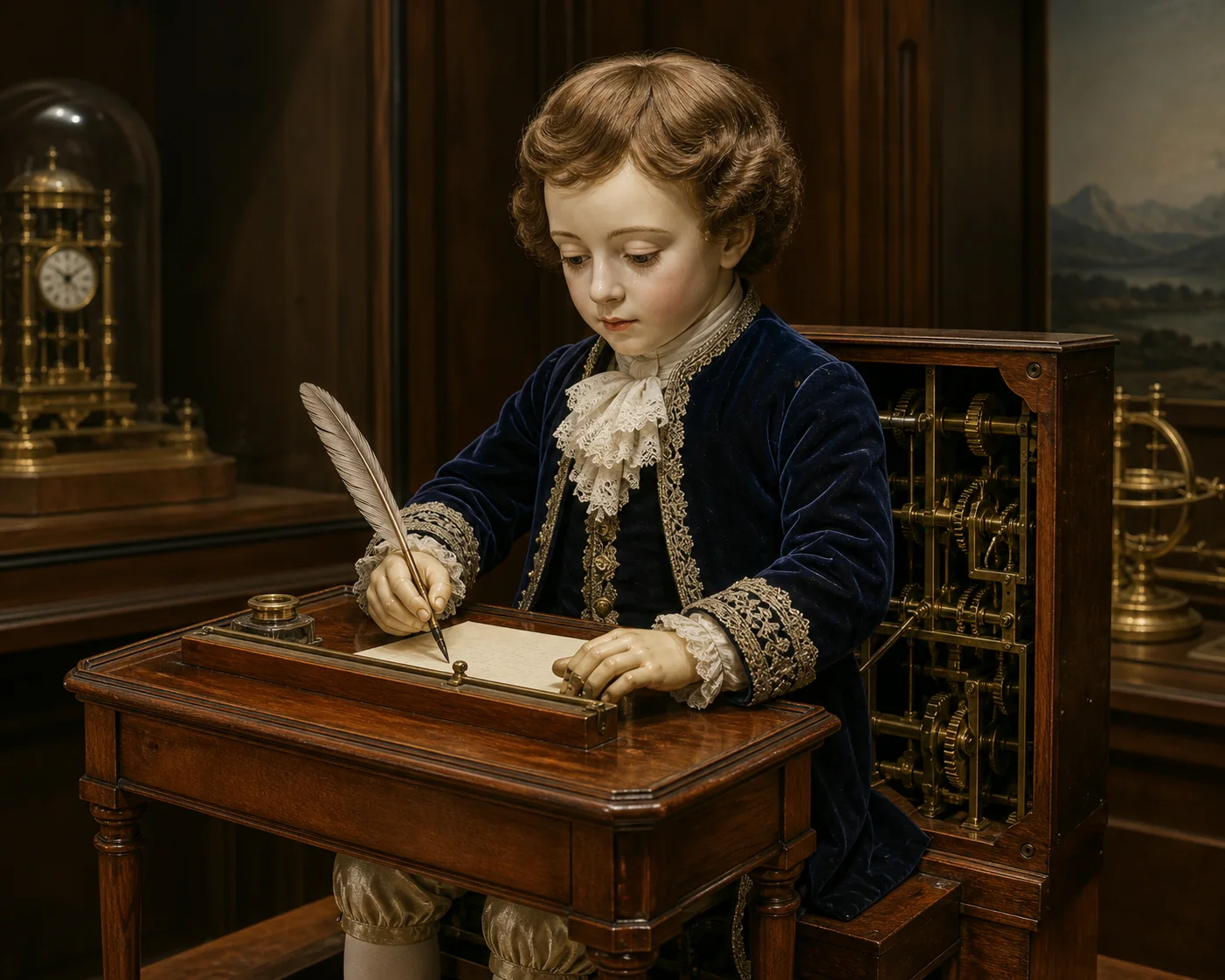
    Editorial illustration: More than two centuries before “robot” became a familiar word, a child-sized automaton sat at a desk, dipped a quill, and wrote a chosen short message. Known as the Writer, it is one of the Jaquet-Droz automata: a surviving feat of Swiss watchmaking that treated handwriting as a problem of motion, timing, and precision.

    A writer built like a clock

    The Writer was made in the workshop of Pierre Jaquet-Droz, his son Henri-Louis, and Jean-Frédéric Leschot. The Musée d’Art et d’Histoire in Neuchâtel dates the three famous companion automata—the Writer, the Draughtsman, and the Musician—to between 1768 and 1774. They are still central works in the museum’s collection and are demonstrated to visitors.

    The Writer is the unnerving one because its task is so familiar. Its small hand holds a quill over real paper. It does not “understand” a sentence or improvise; it performs a physical sequence designed in advance. But the sequence includes convincing details: a controlled arm, a pause, a pen dip, and a line of handwriting whose movement was choreographed entirely in mechanism.

    Editorial illustration of an eighteenth-century child-sized writing automaton holding a feather quill at a small wooden desk, with brass clockwork visible in an open side panel.
    Editorial illustration

    How a machine becomes handwriting

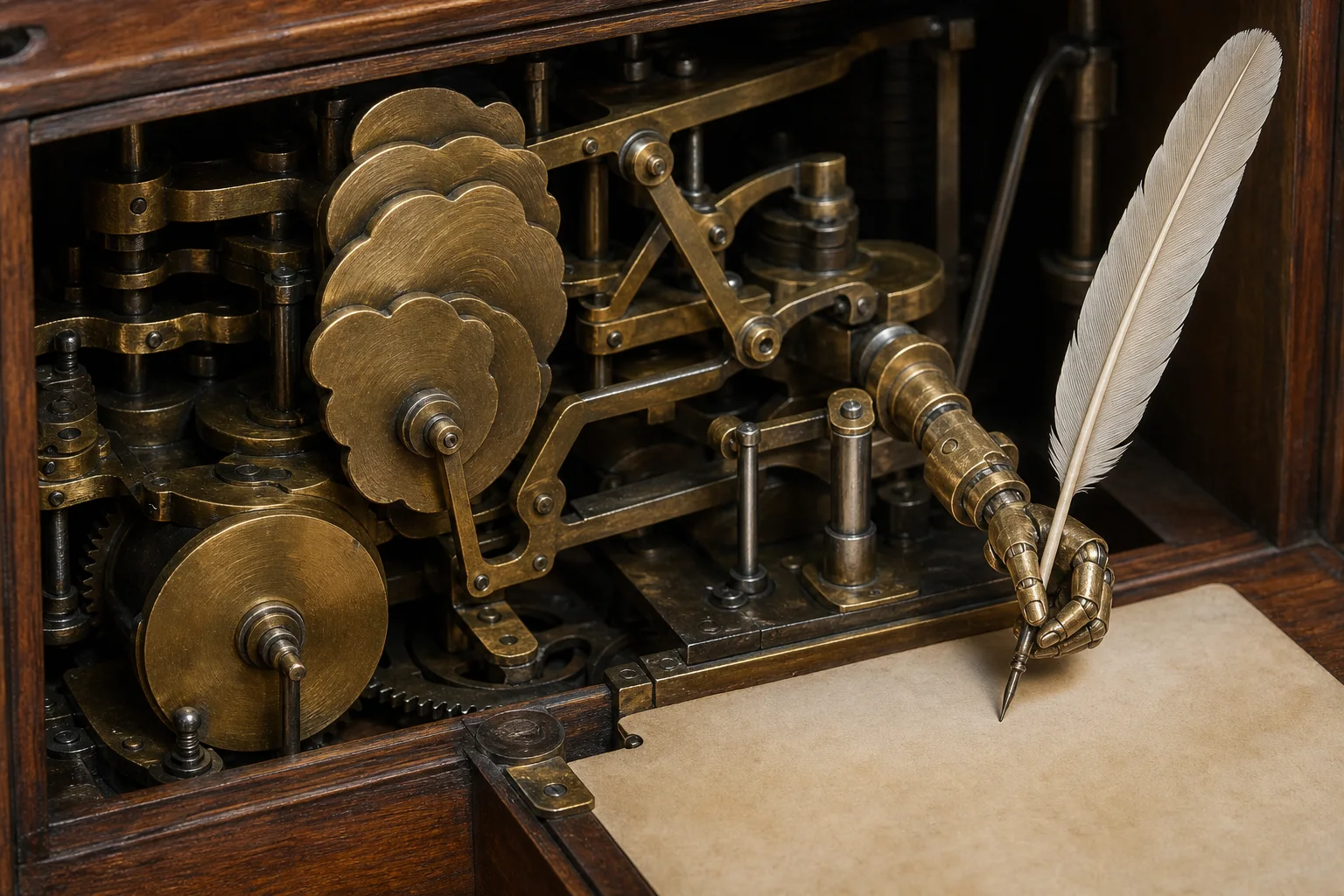
    The apparent magic comes from breaking a gesture into repeatable motions. In eighteenth-century automata, shaped cams and linked levers could turn a steady drive into carefully timed movements. The hand could move side to side and forward and back while the pen rose and fell. The principle is close to a music box or a mechanical clock: the information is embodied in the shape and arrangement of physical parts.

    A 1938 Museum of Modern Art catalogue described the Writer’s mechanism as a system of levers concealed in the figure and noted that the automaton dips its pen, shakes it, positions its hand, and writes with varying strokes. The Metropolitan Museum of Art identifies the Writer as one of the Jaquet-Droz group and records that it could write a sentence of forty letters. That is a restricted but remarkably deliberate form of mechanical “programming.”

    Editorial illustration of brass cams and levers inside an eighteenth-century writing automaton, connected to an articulated hand holding a feather quill over blank paper.
    Editorial illustration

    Not a hidden person, not a modern robot

    Automata sit in an awkward historical space because their lifelike gestures invite the wrong questions. The Writer was not a trick operated by someone inside, and it was not a thinking machine. It was a highly sophisticated object made by watchmakers who could package a sequence of actions into springs, cams, and levers. Its achievement was not artificial consciousness; it was the translation of a human writing gesture into durable mechanics.

    That makes the Writer more interesting than a simple novelty. In an era before electric motors, digital storage, and programmable electronics, the Jaquet-Droz workshop produced an object that could carry out a selected written performance in front of an audience. The action stays strange because it makes a private, expressive act—putting pen to paper—look like a clock’s idea of a person.

    Why it still feels modern

    The Writer is not a direct ancestor of today’s software, and calling it an early computer would overstate the case. Still, it offers a useful historical lesson: instructions do not have to live in code on a screen. They can be cut into material, distributed across moving parts, and replayed with astonishing consistency. The Writer’s quill reminds us that “automation” was already a serious artistic and engineering question in the eighteenth century.

    Sources

  • Inside the U.S. Capitol’s ‘Crypt,’ Where No One Is Buried

    Inside the U.S. Capitol’s ‘Crypt,’ Where No One Is Buried

    The U.S. Capitol has a room called the Crypt. It is beneath the Rotunda, lined with stone columns, and it has never held a burial.

    That is not a modern irony attached to an old nickname. The name grew from the room’s church-like architecture: a vaulted space below a principal room. In churches, comparable spaces were often chapels or tombs. At the Capitol, the resemblance stuck. The burial itself never did.

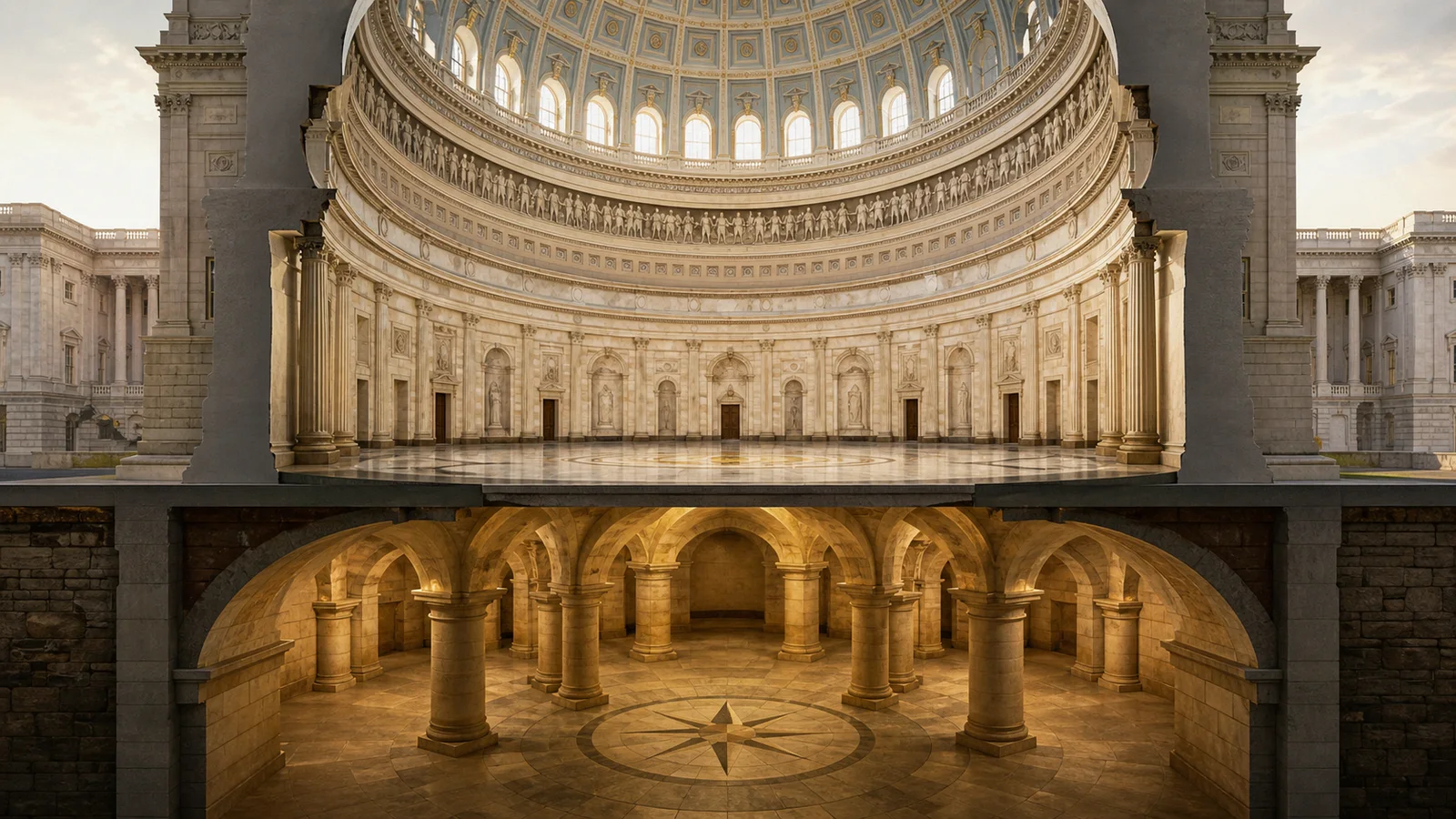
    Editorial illustration showing a cutaway of the U.S. Capitol Rotunda above the empty vaulted Crypt.
    Editorial illustration of the Rotunda and the vaulted Crypt beneath it.

    A tomb planned for the first president

    The unusual space is tied to the early plans for commemorating George Washington. After Washington died in 1799, Congress resolved that a monument should be erected at the new Capitol and sought permission to place his remains beneath it. Mount Vernon’s historical account says that Martha Washington’s consent was obtained and a crypt was provided below the Capitol dome, but the project was never completed.

    Washington’s own wishes pointed home. His will called for a new brick tomb at Mount Vernon to replace the deteriorating family vault. His remains, and later Martha Washington’s, were moved to the new tomb in 1831. The Architect of the Capitol says that a tomb area was built beneath the Crypt, but Washington’s descendants honored the burial wish in his will. The official answer to the building’s most morbid-sounding question is therefore wonderfully plain: no one is buried in the Capitol.

    What visitors actually find

    The Crypt is a working part of the Capitol’s historic interior, rather than an unused underground chamber. Its 40 smooth Doric columns of Aquia Creek sandstone support the arches and the Rotunda floor above. They were installed in the 1820s under Architect of the Capitol Charles Bulfinch, whose work completed the building’s central section in 1826.

    Look down, and the room has another civic trick: a white-marble compass star marks the Capitol’s center point, the reference point from which Washington is divided into northeast, northwest, southeast, and southwest quadrants. The original floor is paved with stone from Seneca, Maryland. The space also holds statues representing the 13 original colonies and a display centered on a replica of Magna Carta.

    Editorial illustration of the empty U.S. Capitol Crypt with sandstone columns and a white compass star set in the stone floor.
    Editorial illustration of the Crypt’s columned interior and central compass star.

    Why the name still works

    Calling the room a crypt can sound like an error until the architectural meaning comes into view. The name describes its form and the burial purpose once imagined for the space; it does not report an occupant. In that sense, the Capitol Crypt preserves an unusually visible historical near-miss: a national memorial plan that was built around a tomb, while the person meant for it remained at the estate he had chosen.

    It is also a useful reminder that the Capitol’s oddest details are often not hidden. Guided tours of the building include the Crypt, the Rotunda, and National Statuary Hall. Visitors walk through a room named for a burial chamber, supported by 40 columns, centered on a stone star—and leave knowing its most surprising fact: it has always been empty of graves.

    Sources