Category: Strange History

  • Why Nijo Castle’s Floors Chirp Underfoot

    Why Nijo Castle’s Floors Chirp Underfoot

    Walk through one corridor at Nijo Castle in Kyoto and the floor answers with a high, birdlike chirp. The sound is real, the mechanism is wonderfully physical, and the famous explanation for it is more complicated than the legend.

    The corridor is part of the Ninomaru Palace at Nijo Castle, the former Kyoto residence of the Tokugawa shoguns. The palace’s six connected buildings are a rare surviving fortified-palace complex, and the castle’s own historical guide calls the chirping walkway the “Nightingale Corridor.” The sound comes from floor hardware: metal clamps move against nails driven into the wooden beams beneath the boards.

    That is the documented part. The popular story says the floor was deliberately made noisy to expose intruders. Nijo Castle’s official guide makes an unusually useful correction: it says that explanation is mistaken. A floor can be memorable without having been designed as an alarm.

    Editorial illustration showing cedar floorboards, a metal clamp, and a nail on a wooden support beam beneath a nightingale floor.
    Editorial illustration showing the clamp-and-nail arrangement that produces the corridor’s chirp.

    A palace built to make an impression

    Nijo Castle was built in 1603 by Tokugawa Ieyasu, according to UNESCO’s evaluation of Kyoto’s historic monuments. It served both as protection for the Imperial Palace and as Ieyasu’s residence when he visited Kyoto. The complex was substantially expanded in 1626, and the surviving Ninomaru Palace buildings are recognized as National Treasures.

    The setting helps explain why an audible floor acquired such a durable story. The Ninomaru Palace was a place of waiting rooms, reception rooms, formal audiences, senior councilors, and the shogun’s private quarters. Its murals, carved transoms, and gilt fittings were arranged to communicate authority. In such a building, a floor that announces each step feels as if it belongs to the drama of the place—even when the evidence does not support the popular security tale.

    How wood and metal make a birdlike sound

    The important word is friction. As someone walks, the floorboards flex slightly. The clamps beneath them shift against the nails in the supporting beams, producing a repeated squeak or chirp. The effect is not a recording hidden in the floor and not a magical property of the wood. It is a mechanical interaction that happens under changing weight.

    That practical explanation is stranger in its own way. A small fitting, a nail, and the springiness of a wooden floor can turn an ordinary step into a sound distinctive enough to become part of a castle’s identity. It also gives the visitor a reminder that historic buildings are not silent objects: their materials expand, flex, rub, and respond.

    Editorial illustration of a long cedar corridor in a Japanese palace with sliding screens and a garden beyond the open side.
    Editorial illustration of a palace corridor inspired by the architectural setting of Nijo Castle’s Ninomaru Palace.

    The legend is worth keeping in its proper place

    There is a satisfying lesson in the correction. Nijo Castle does not need a secret anti-ninja invention to be fascinating. The audible floor is already a precise artifact of joinery and use: a historic building where each careful step turns a hidden piece of hardware into a brief, recognizable sound.


    Sources: Nijo-jo Castle, “Ninomaru-goten Palace / Garden”; UNESCO, Historic Monuments of Ancient Kyoto evaluation; Japan Cultural Heritage Online, “Former Nijo Imperial Villa (Nijo Castle)”.
  • The Mechanical Turk: The Chess Machine That Hid a Human

    The Mechanical Turk: The Chess Machine That Hid a Human

    Editor’s note: The images in this article are original editorial illustrations, not archival photographs or technical reconstructions.

    For decades, audiences could sit down across a chessboard from a figure in a turban and watch it move the pieces with its own hand. The performer was known as the Mechanical Turk, and its showmanship was so persuasive that it became one of history’s most durable stories about a machine that seemed to think.

    The strange part is not that the Turk was a primitive computer. It was not. It was a stage illusion built around a real human chess player, hidden inside an elaborate cabinet. The spectacle’s real achievement was making the audience look at exposed gears and open doors—and still miss the person doing the thinking.

    A machine made for an audience

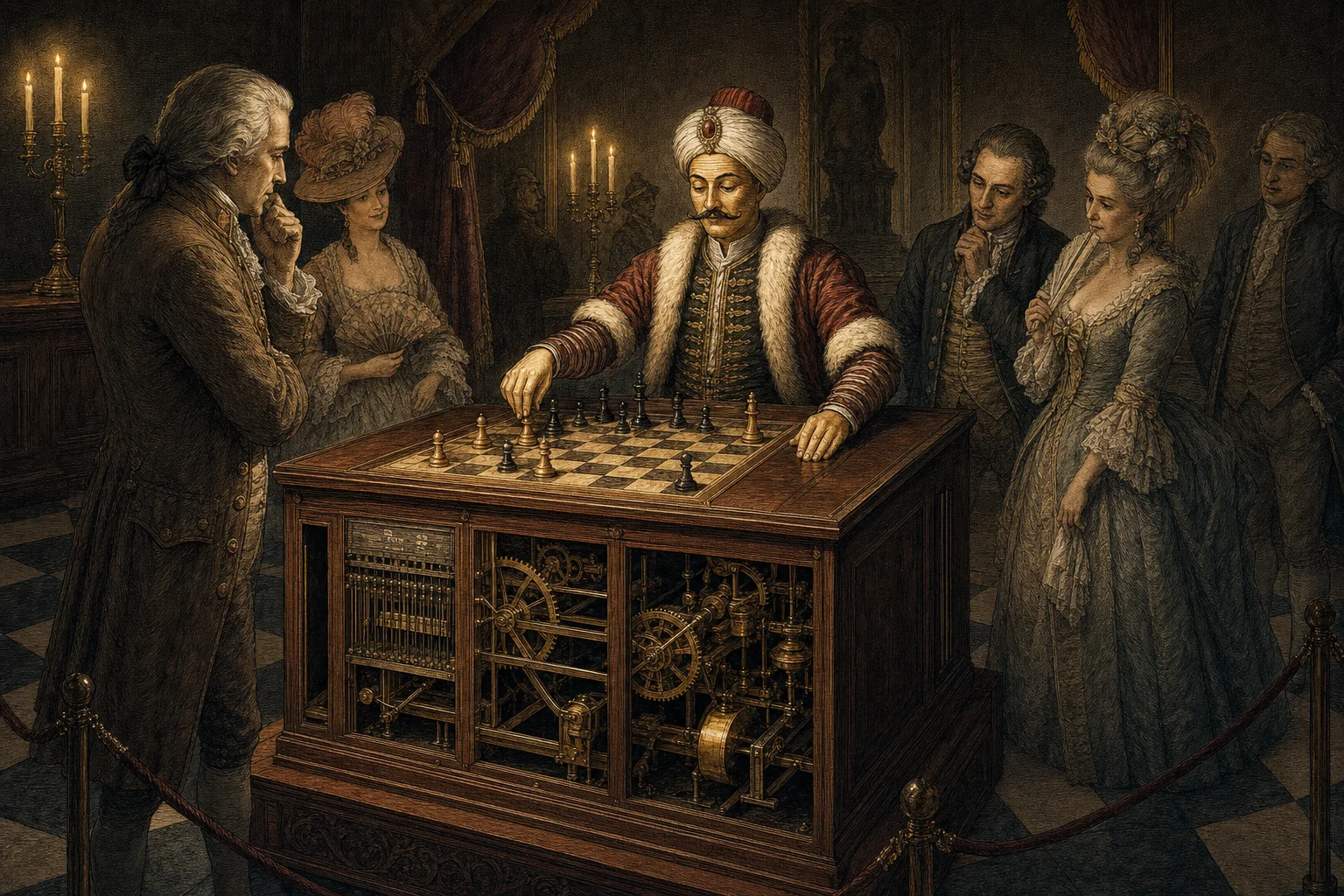
    Wolfgang von Kempelen introduced the device at the court of Empress Maria Theresa in 1769, according to a Smithsonian account of the Turk’s later descendants. The figure sat behind a wooden cabinet, dressed in stylized Turkish costume, and appeared to play chess against visitors. The costume was part of the performance’s exoticized stage presentation, not a description of a real person or culture.

    Its later showman, Johann Nepomuk Mälzel, took the attraction on tour. A 1828 Boston exhibition broadside preserved by the Library of Congress advertised the “automaton chess-player” as invented by “De Kempelin” and improved by Mälzel. It promised that the figure would play members of the audience, move its head, eyes, lips and hands, announce échec (“check”), and correct an invalid move. That is an advertisement’s claim, of course—but it is unusually vivid evidence of what paying spectators were invited to believe.

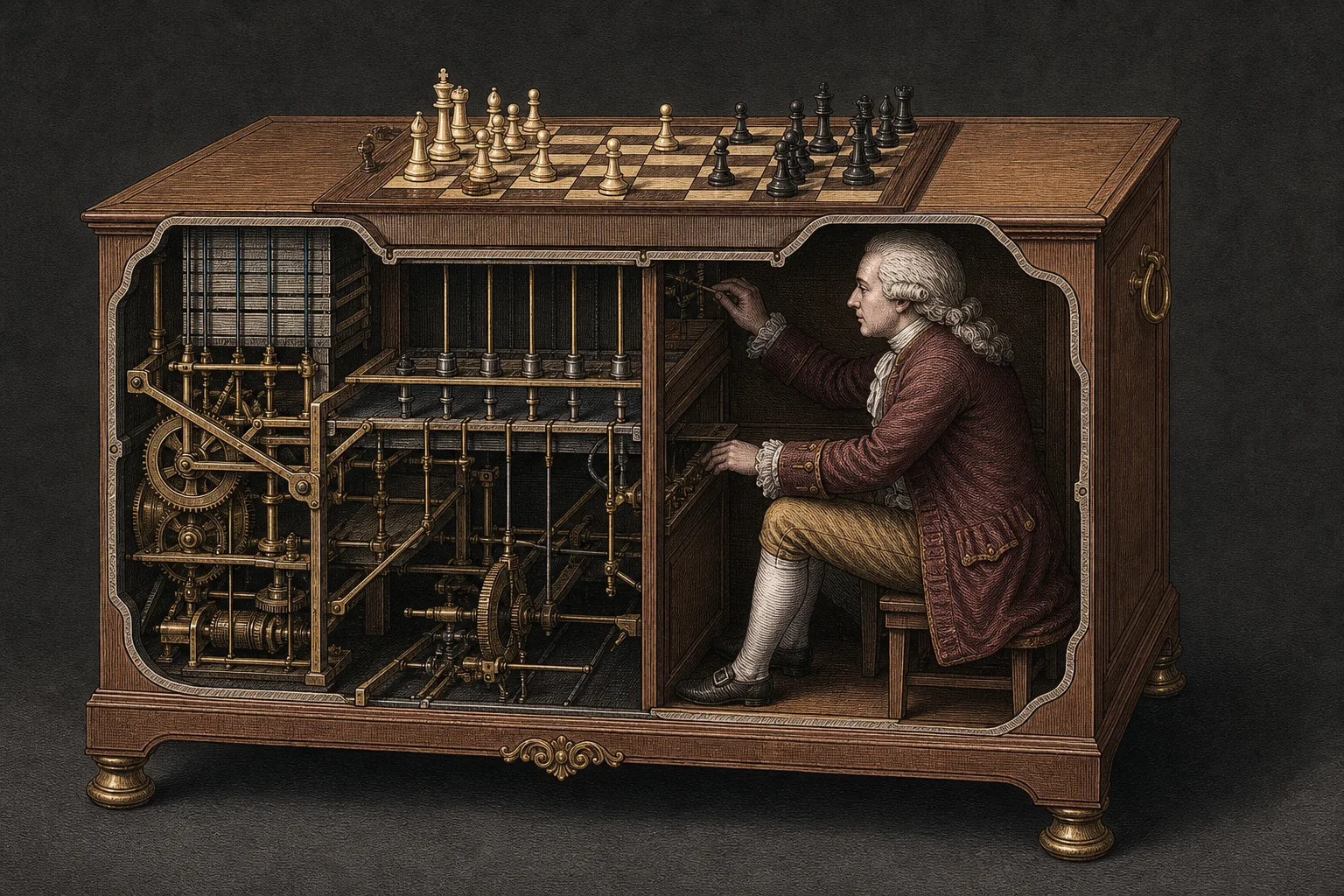
    Editorial cutaway illustration of a wooden chess automaton cabinet with mechanisms and a concealed human operator
    Editorial illustration: a conceptual cutaway, not a technical reconstruction of the Turk.

    The trick was space, not artificial intelligence

    The cabinet was designed to make a hidden operator seem impossible. During demonstrations, doors could be opened to reveal machinery. The point was not merely to hide a person behind a closed panel; it was to choreograph what spectators saw when the cabinet was opened and in what order. The operator could shift position within the available space while visible mechanisms helped occupy the eye.

    The Smithsonian describes the same basic strategy in its history of Ajeeb, a later chess-and-checkers automaton inspired by the Turk: panels displayed complex machinery while hidden operators worked inside the base. That comparison is useful because it keeps the distinction plain. The moving arm and theatrical cabinet were mechanical; the chess judgment came from a human being.

    That distinction was already part of the public conversation in the nineteenth century. In an encyclopedia digitized by the Library of Congress, the chess player is described as a figure of a Turk that moved chessmen and was “generally supposed” to conceal a small person directing the moves. The entry’s conclusion is blunt: the ingenuity lay in concealing the real player, rather than in creating a self-thinking machine.

    Why the reveal did not ruin the story

    Knowing the Turk’s secret does not make the object less interesting. It changes the question. Instead of asking how eighteenth-century machinery could calculate a chess move, we can ask how a designer and a performer created an experience in which the audience wanted to grant a cabinet a mind.

    That is why the Turk still feels contemporary. Today’s technology debates often focus on what a system can do. The Turk reminds us to ask a parallel question: what labor, expertise, and staging sit behind the appearance of autonomy? Its concealed player was not a flaw in the story. The player was the story’s essential collaborator.

    The device’s afterlife also shows how entertainment can outlast its physical object. A Smithsonian guest letter traces the Turk’s 1769 debut and identifies the concealed human player as the source of its chess ability. The original object was later destroyed in the 1854 fire at Philadelphia’s Chinese Museum, according to a technical history from Vienna University of Technology and a contemporary-history collection held by the Free Library of Philadelphia. What survives is a dense paper trail: broadsides, essays, reports, and the recurring temptation to call a convincing performance a thinking machine.

    Editorial illustration of the Mechanical Turk chess automaton performing before eighteenth-century spectators
    Editorial illustration of the Mechanical Turk’s theatrical appeal; it does not depict a documented performance.

    The weird truth

    The Mechanical Turk was neither magic nor an early computer. It was a meticulously staged collaboration between woodwork, mechanisms, a hidden chess player, and an audience primed to be astonished. The cabinet never thought. But it made people think—about machines, deception, and how readily a convincing performance can acquire a mind in the public imagination.

    Sources

  • Why 70-Foot Concrete Arrows Still Point Across the American West

    Why 70-Foot Concrete Arrows Still Point Across the American West

    All images in this article are Editorial illustration.s, created to explain the technology. They are not photographs of a particular surviving arrow or beacon.

    In parts of the American West, a hiker or satellite-image browser can still run into an odd piece of aviation infrastructure: a giant concrete arrow, laid flat on the ground and pointing toward an empty horizon. It can look like a forgotten piece of roadside art. In fact, it was part of an early navigation system built for the age when getting lost after sunset could make air mail slower than the train.

    Editorial illustration of a concrete directional arrow leading to a 1920s-style airway beacon at dusk in a western desert.
    Editorial illustration, not a depiction of a particular historic installation.

    Before electronic navigation, the ground had to give directions

    Early air-mail pilots often navigated visually, following railroads, rivers and towns. Night flying made that method especially precarious. The National Air and Space Museum describes a 1921 cross-country test in which bonfires were meant to help pilots find the route; only one of the two mail planes completed the trip after an Omaha fire was left unlit. The episode helped make the case for a more reliable, built system of guidance.

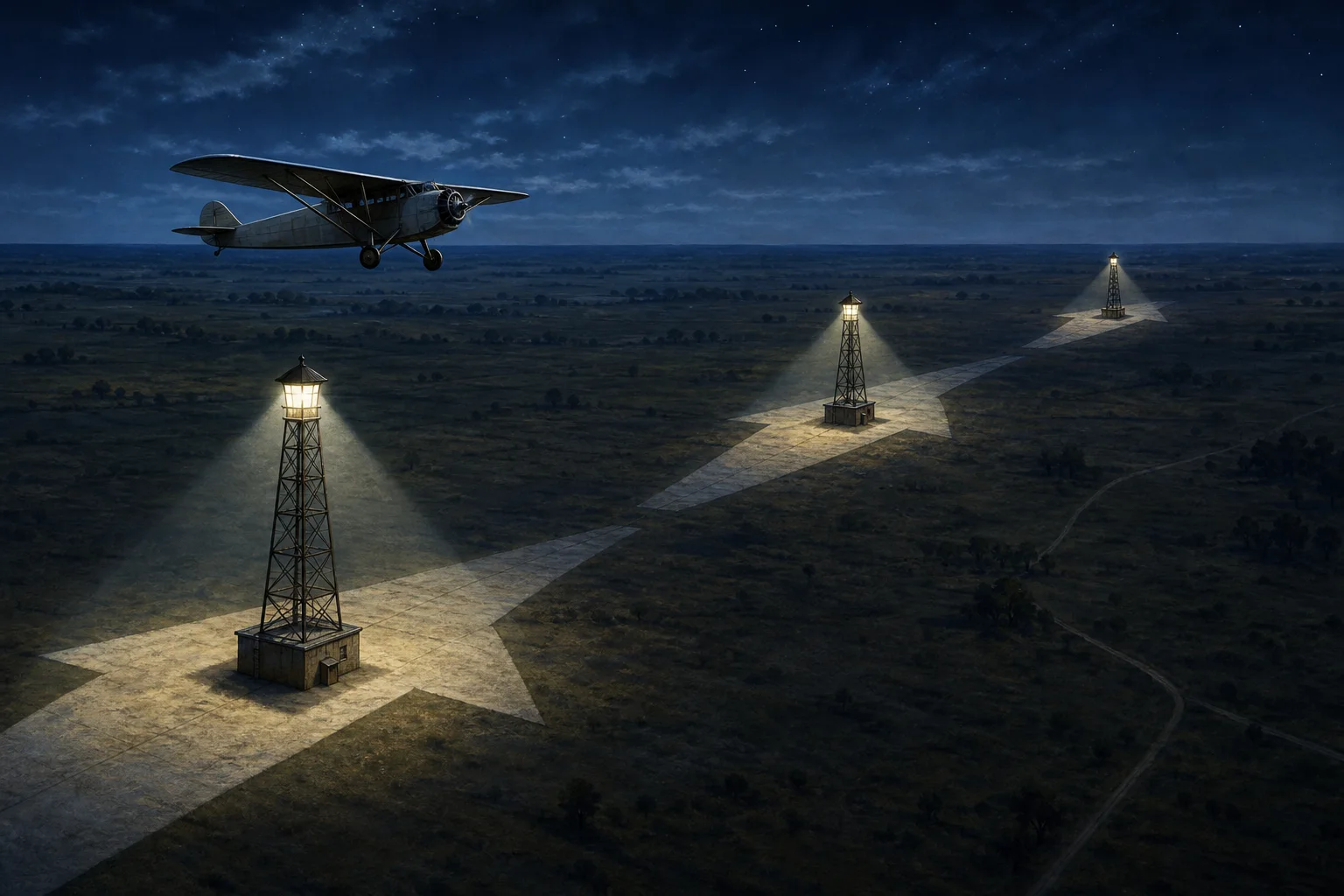
    That system became the lighted airway. The Smithsonian records the first lighted airway beacon in 1923, and the Federal Aviation Administration says the standardized installations were typically placed about 10 miles apart. A 51-foot tower carried a powerful rotating light, while two course lights pointed forward and backward along the route. The lights could flash a code identifying the beacon site.

    Why the arrows were so enormous

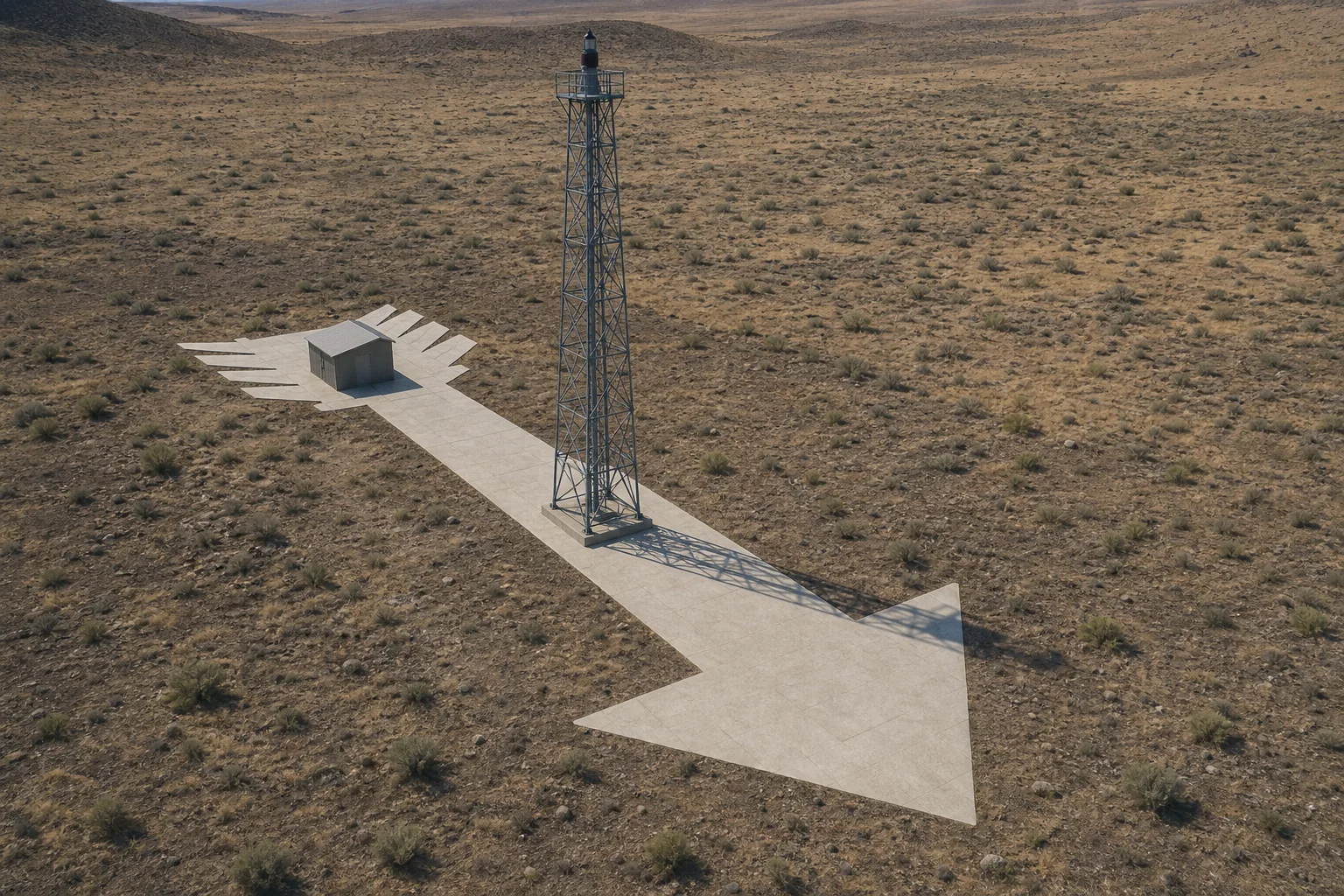
    The lights worked at night. By day, pilots needed a simpler cue: the tower usually stood in the center of a concrete arrow about 70 feet long, according to the FAA’s historical account. The arrow pointed toward the next beacon. Where a generator shed was needed, it sat at the feather end of the arrow.

    Editorial illustration of an airway beacon tower, a long concrete arrow and a small generator shed in a high-desert landscape.
    Editorial illustration of the basic arrangement described in FAA history; it is not a survey of one site.

    That is why the surviving shapes can feel so delightfully oversized. They were not signs for motorists. They were a high-contrast, pilot-facing instruction written at landscape scale, intended to be read from above when a moving aircraft did not have the luxury of stopping to ask for directions.

    A chain of small lighthouses

    The concrete arrows were only one part of a network. The Air and Space Museum says that the 1926 Air Commerce Act accelerated beacon construction, and that acetylene-powered beacons with Fresnel lenses appeared along air-mail airways. By 1946, it reports, 2,112 beacons operated on 124 U.S. airways.

    Editorial illustration showing a small mail plane following a line of illuminated airway beacon towers and concrete arrows across a nighttime plain.
    Editorial illustration of how repeated beacon sites could make a route legible at night.

    It is tempting to describe the arrows as relics from a time before navigation existed. The more interesting truth is that they were navigation: an ambitious, visible network made from light, concrete and a pilot’s ability to see the next point in the chain. Radio navigation gradually made the beacons obsolete, and the Smithsonian says the last federal airway beacon was decommissioned in 1972. Some towers and arrows remain, though, turning up as quiet reminders that the first national air routes once had to be drawn directly onto the land.

    Sources