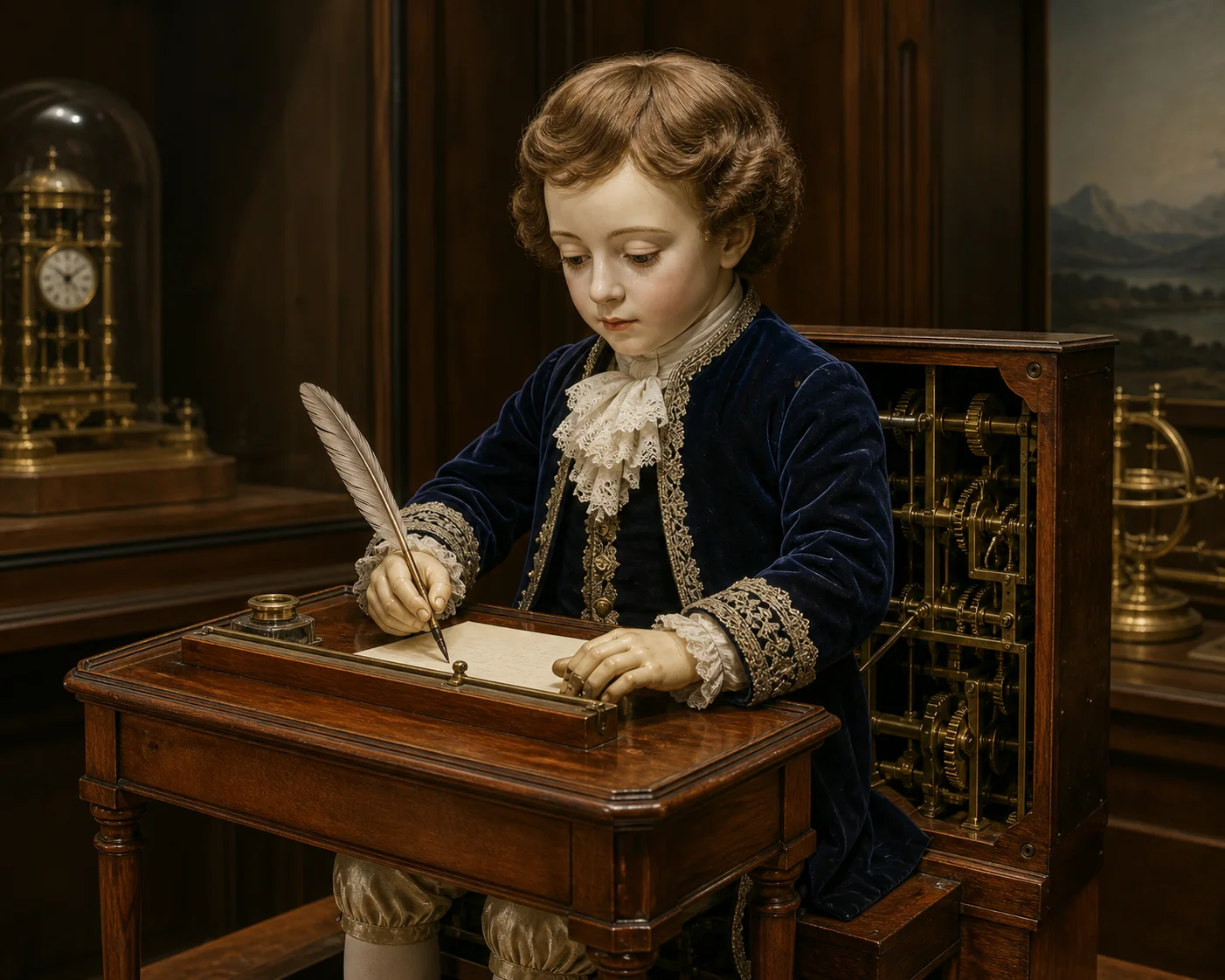
Editorial illustration: More than two centuries before “robot” became a familiar word, a child-sized automaton sat at a desk, dipped a quill, and wrote a chosen short message. Known as the Writer, it is one of the Jaquet-Droz automata: a surviving feat of Swiss watchmaking that treated handwriting as a problem of motion, timing, and precision.
A writer built like a clock
The Writer was made in the workshop of Pierre Jaquet-Droz, his son Henri-Louis, and Jean-Frédéric Leschot. The Musée d’Art et d’Histoire in Neuchâtel dates the three famous companion automata—the Writer, the Draughtsman, and the Musician—to between 1768 and 1774. They are still central works in the museum’s collection and are demonstrated to visitors.
The Writer is the unnerving one because its task is so familiar. Its small hand holds a quill over real paper. It does not “understand” a sentence or improvise; it performs a physical sequence designed in advance. But the sequence includes convincing details: a controlled arm, a pause, a pen dip, and a line of handwriting whose movement was choreographed entirely in mechanism.
How a machine becomes handwriting
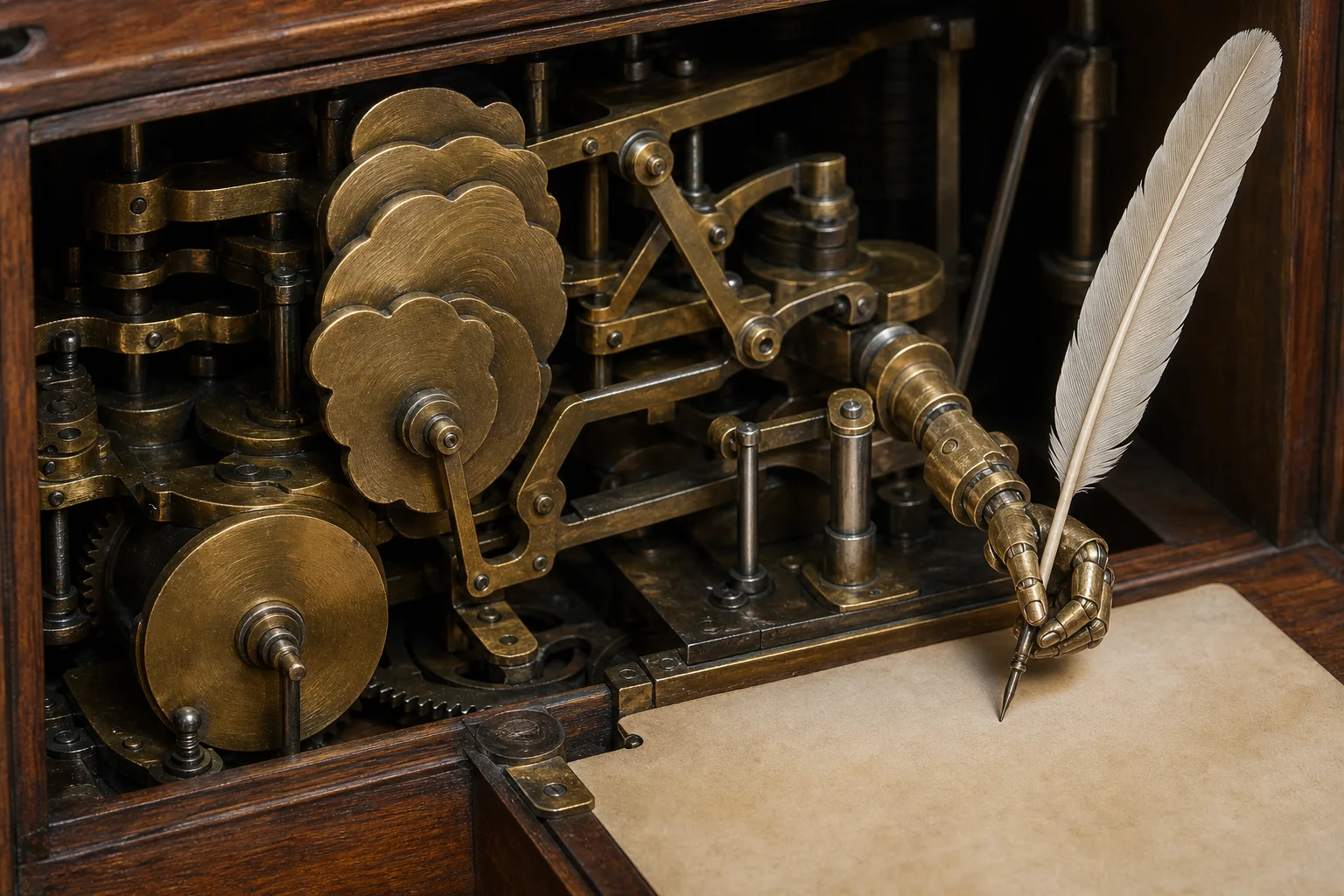
The apparent magic comes from breaking a gesture into repeatable motions. In eighteenth-century automata, shaped cams and linked levers could turn a steady drive into carefully timed movements. The hand could move side to side and forward and back while the pen rose and fell. The principle is close to a music box or a mechanical clock: the information is embodied in the shape and arrangement of physical parts.
A 1938 Museum of Modern Art catalogue described the Writer’s mechanism as a system of levers concealed in the figure and noted that the automaton dips its pen, shakes it, positions its hand, and writes with varying strokes. The Metropolitan Museum of Art identifies the Writer as one of the Jaquet-Droz group and records that it could write a sentence of forty letters. That is a restricted but remarkably deliberate form of mechanical “programming.”
Not a hidden person, not a modern robot
Automata sit in an awkward historical space because their lifelike gestures invite the wrong questions. The Writer was not a trick operated by someone inside, and it was not a thinking machine. It was a highly sophisticated object made by watchmakers who could package a sequence of actions into springs, cams, and levers. Its achievement was not artificial consciousness; it was the translation of a human writing gesture into durable mechanics.
That makes the Writer more interesting than a simple novelty. In an era before electric motors, digital storage, and programmable electronics, the Jaquet-Droz workshop produced an object that could carry out a selected written performance in front of an audience. The action stays strange because it makes a private, expressive act—putting pen to paper—look like a clock’s idea of a person.
Why it still feels modern
The Writer is not a direct ancestor of today’s software, and calling it an early computer would overstate the case. Still, it offers a useful historical lesson: instructions do not have to live in code on a screen. They can be cut into material, distributed across moving parts, and replayed with astonishing consistency. The Writer’s quill reminds us that “automation” was already a serious artistic and engineering question in the eighteenth century.
Sources
- Musée d’Art et d’Histoire, “The Jaquet-Droz automata”
- The Metropolitan Museum of Art, “Mantel clock with musical movement” collection essay
- Museum of Modern Art, The Machine, as Seen at the End of the Mechanical Age (1938 catalogue)
- British Museum, engraving and description of the Jaquet-Droz automata’s London exhibition
Leave a Reply