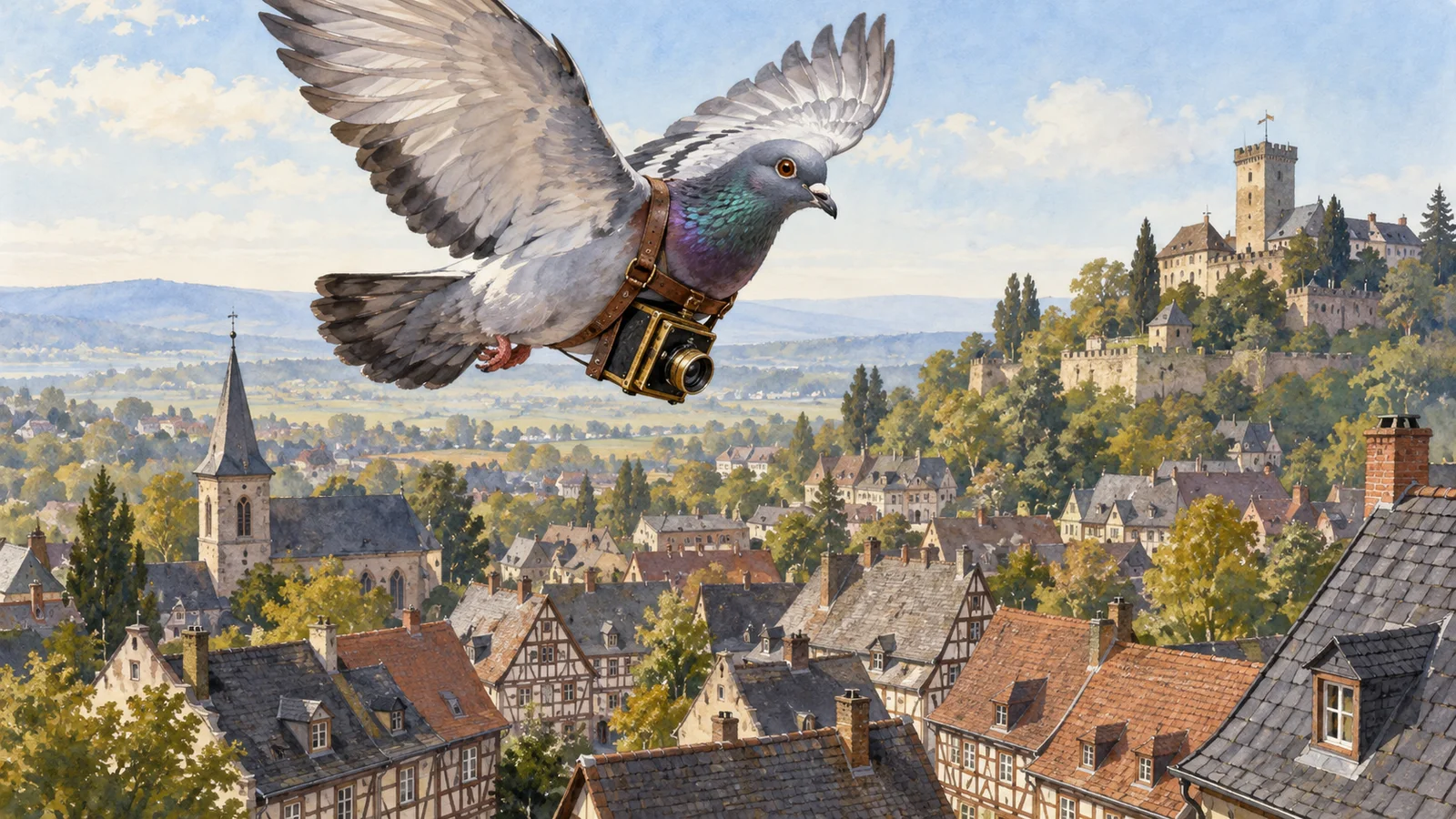
Editorial illustration
In the hills near Frankfurt, a homing pigeon once carried a miniature camera home. The bird’s flight turned a familiar talent for navigation into a wonderfully unusual way to make photographs from above.
The idea belonged to Julius Neubronner, a pharmacist and enthusiastic photographer in Kronberg, Germany. At the beginning of the twentieth century, he developed compact cameras designed to ride on carrier pigeons in a small harness. When a bird made its return flight, the camera’s timer could release its shutter and bring back a view shaped by the pigeon’s route.
The result is one of photography’s most charming pieces of inventive history: a carefully built camera, a well-trained bird and a perspective that turned rooftops, fields and streets into a living map.
A camera built for a homeward flight
Neubronner had practical experience with carrier pigeons before he began making cameras. Museum accounts describe how pigeon post formed part of his world as a pharmacist. That knowledge made the birds’ dependable instinct to return to their loft an appealing starting point for a new kind of aerial picture.
His camera designs stayed small because every detail mattered. The German Museum of Technology’s collection account describes a lightweight camera equipped with a pneumatic shutter release. A rubber bulb could be prepared before a flight; as it released air, it created a delay and then triggered the exposure. The timing turned a bird’s journey into a planned photographic experiment.
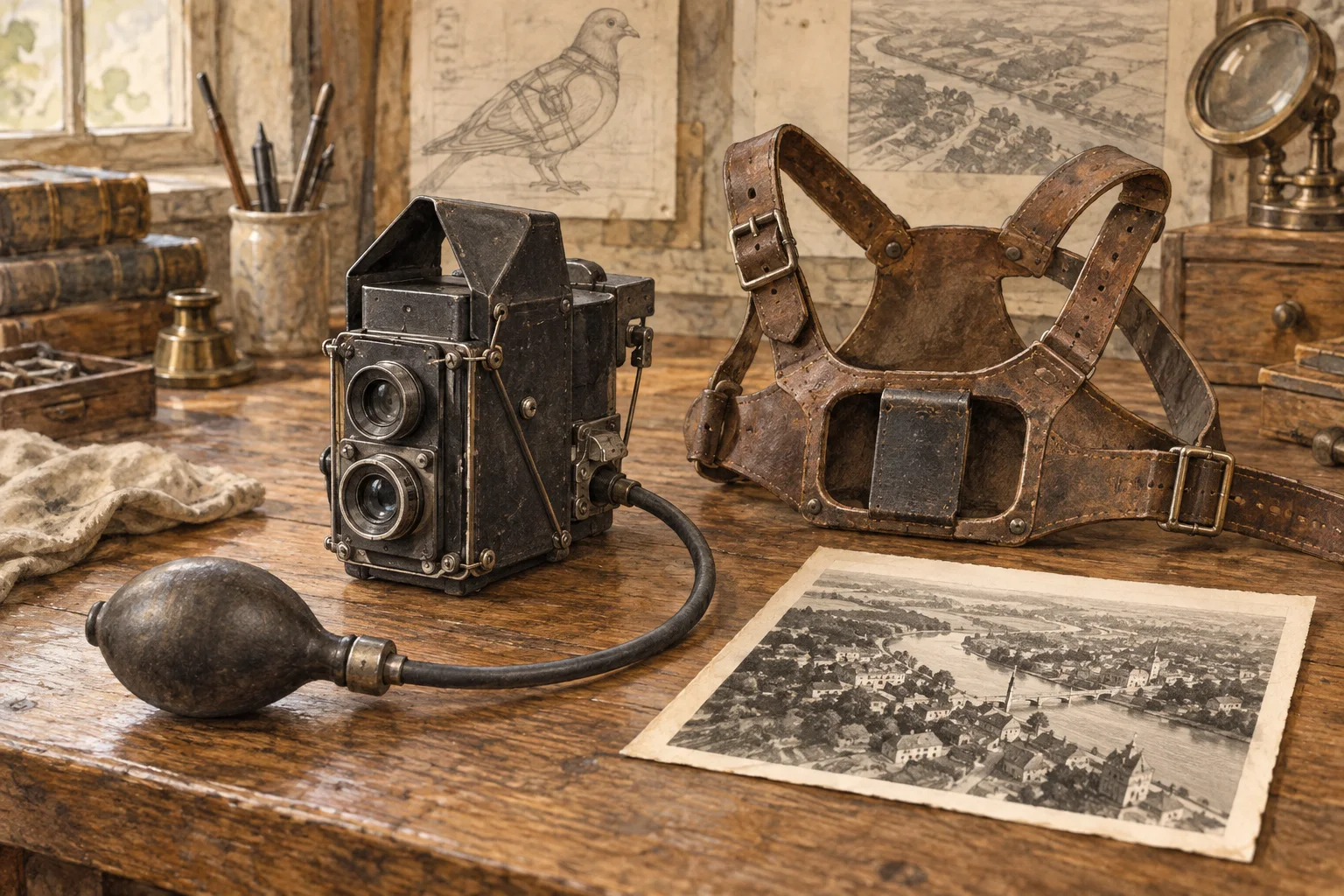
The apparatus was inventive in an especially hands-on way. A pigeon’s natural flight supplied the movement; Neubronner’s mechanism supplied the moment of exposure. Accounts from the Deutsches Museum describe cameras ranging through several models, including a two-lens design that increased the chance of producing a useful image.
The patent office asked for pictures
Neubronner filed his application in 1907 for a method and device for photographing landscapes from a bird’s-eye view. The German Museum of Technology recounts that the application initially met skepticism. Photographs made by his pigeons gave the concept a concrete demonstration, and the invention received a patent on December 2, 1908.
The patent story gives the invention its memorable shape. The key proof was not a complicated pitch. It was a set of small aerial photographs that showed the camera could travel with a bird and come back with an image.
Neubronner later presented the work at photography and aviation exhibitions. The Smithsonian’s National Air and Space Museum places his pigeons among the early routes people used to see the landscape from above, alongside balloons, kites and rockets. His photographs offered an intimate version of that lofty ambition: a bird’s return trip, recorded one shutter click at a time.
A bird’s-eye view with a human-scale invention
The surviving cameras and photographs are valuable because they show how much patience sat behind an apparently playful idea. Pigeons needed training. A camera needed to sit securely. The shutter needed a reliable delay. The finished image depended on light, route and timing, just as any early photograph did.
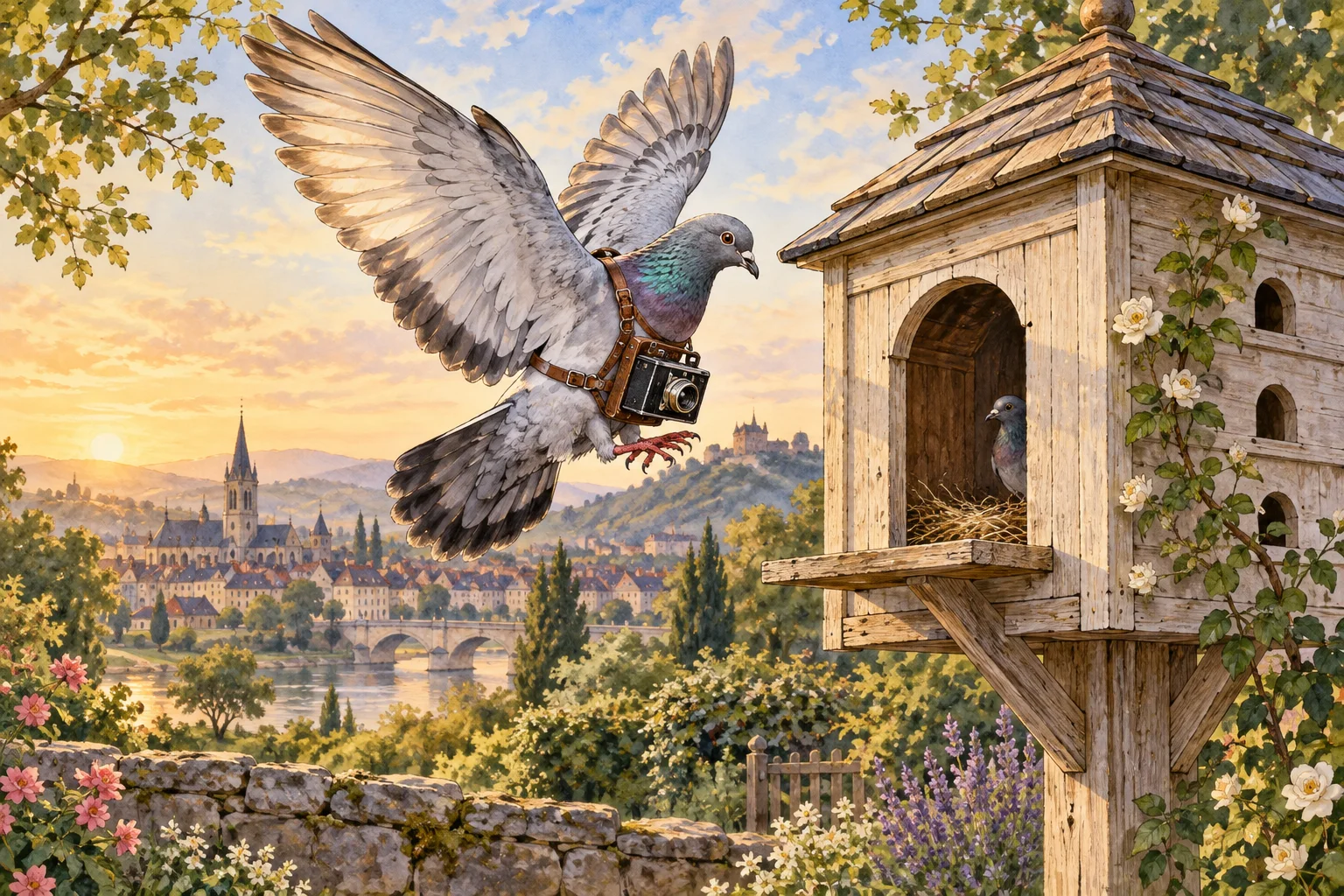
That combination of animal skill and mechanical craft is what makes pigeon photography endure as a strange-but-true chapter in visual history. The pictures were made through a partnership between a person who built a tiny tool and birds whose routes already connected distant places with home.
Today, museum collections in Munich, Berlin and Vevey preserve examples and explain the methods behind them. Their records keep the story grounded: this was a real early experiment in aerial imaging, assembled from small cameras, leather harnesses, pneumatic timing and the determined flight of a pigeon.
Leave a Reply