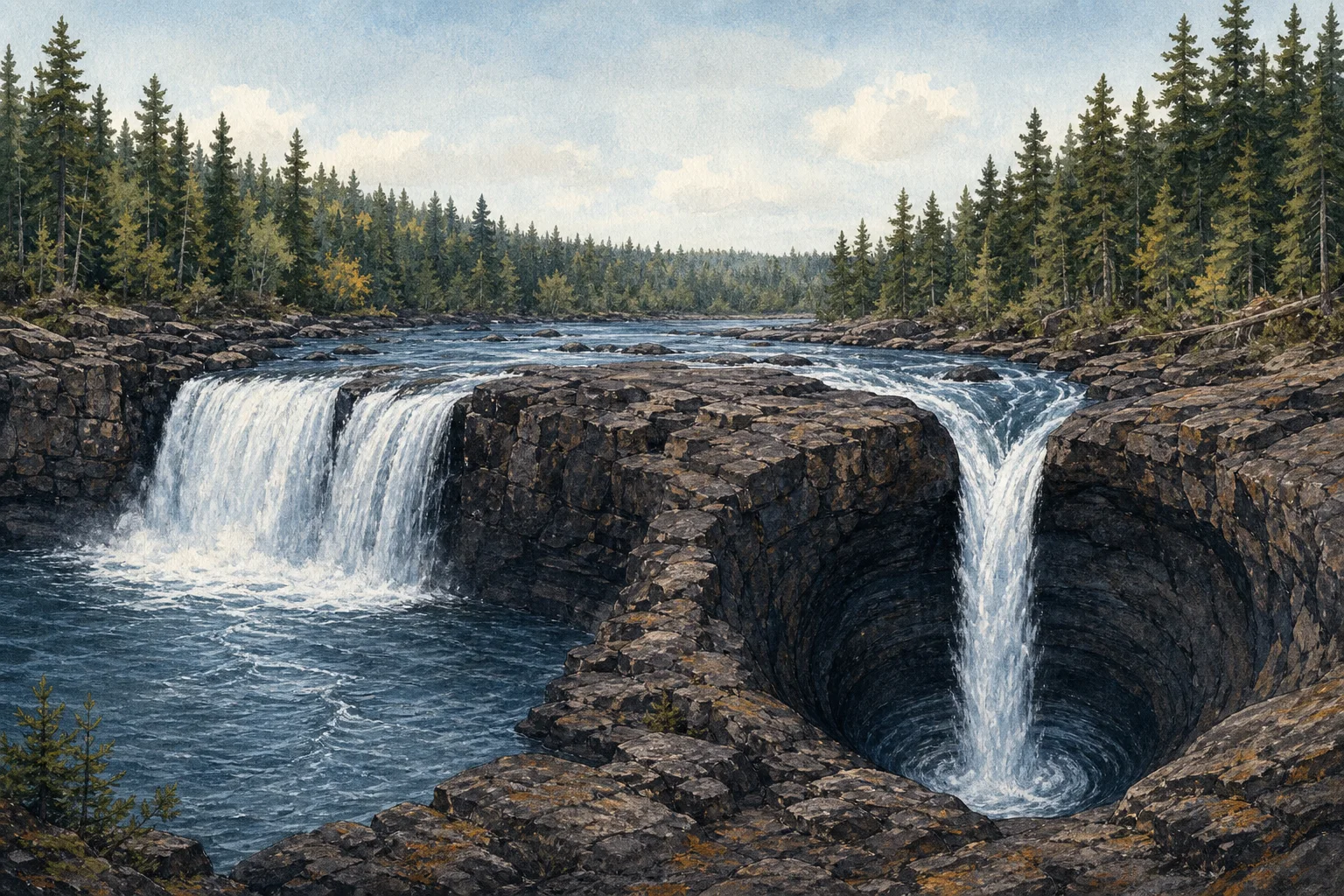
A Minnesota waterfall looks as if it sends half a river into a hole in the rock. It does not. The best measurements say the water returns to the Brule River below the falls—just out of sight.
At Devil’s Kettle Falls in Judge C. R. Magney State Park, near Grand Marais, Minnesota, the Brule River arrives at a rocky ledge and splits. One branch makes an ordinary-looking drop into a pool. The other falls into a dark, rounded opening called the kettle. From the overlook, that second stream seems to vanish.
That visual trick has produced decades of perfectly reasonable questions: Is there a hidden tunnel? Does the water travel to Lake Superior? Why do tossed objects not immediately appear downstream? The short answer is less supernatural and more interesting: measuring the river turned out to be more useful than watching the hole.
What makes the falls look impossible
The Minnesota Department of Natural Resources describes the falls as a split in the Brule River, with one side dropping into a pool and the other into the large pothole. The park sits in a landscape shaped by ancient volcanic activity; the exposed rock around the falls is part of a thick volcanic flow complex. The setting matters because the popular “secret cave to Lake Superior” explanation would require a kind of long, open underground route that geologists did not expect in that hard volcanic rock.
Folklore naturally filled the gap. Visitors tried informal tests with sticks and other floating objects, then waited for a reappearance that did not come. Those observations are memorable, but they are not a water-budget experiment. A powerful plunge pool can trap, sink, break up, or delay visible debris, while the water itself keeps moving.
The clue was the flow above and below
In 2016, DNR hydrologists measured the river above Devil’s Kettle and then again several hundred feet downstream. They recorded 123 cubic feet of water per second above the falls and 121 cubic feet per second below. The DNR said the small difference was within the measuring equipment’s normal tolerance—effectively no missing water in the reach below the kettle.
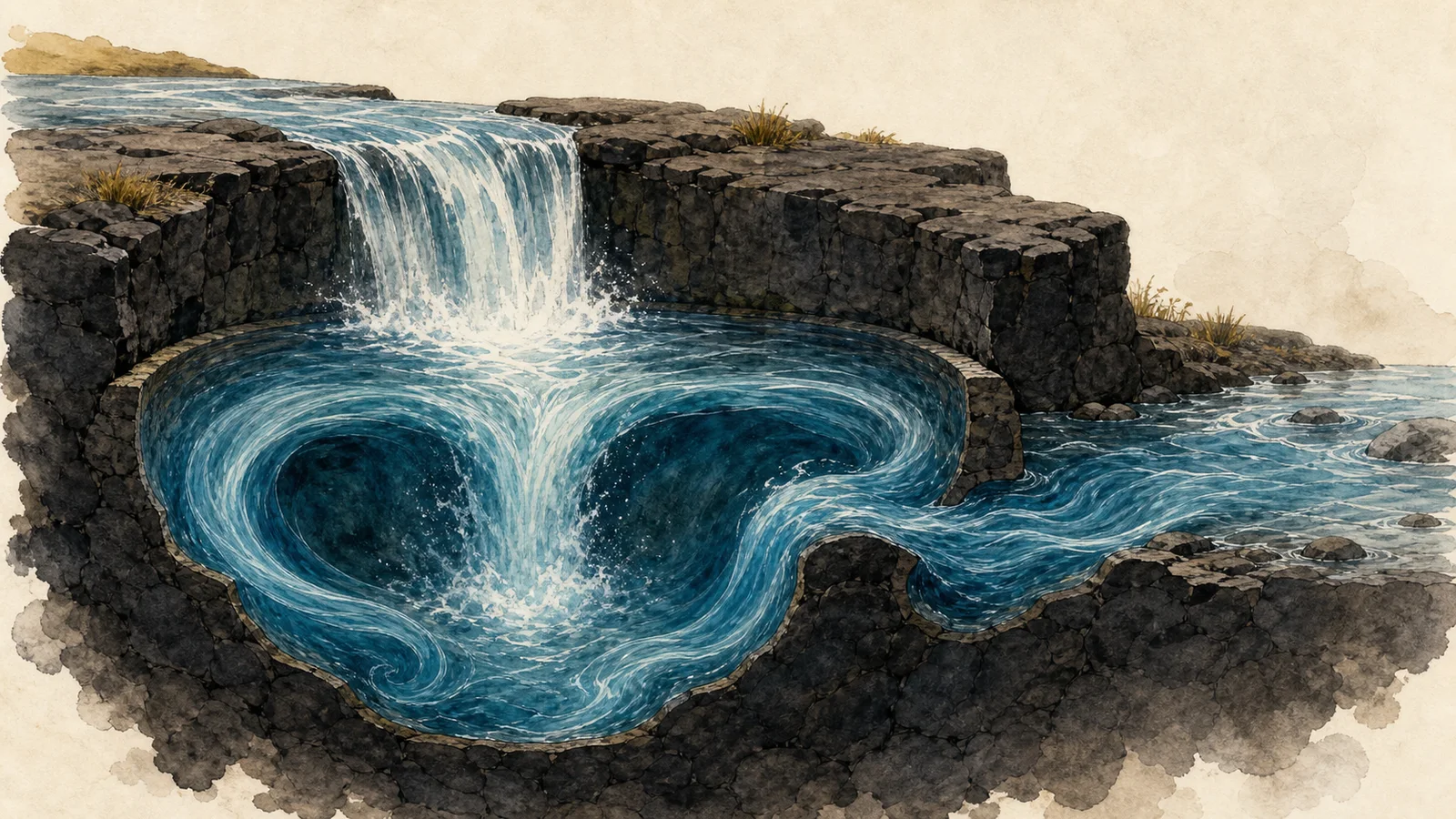
That does not mean anyone can point to a neat pipe with a labeled exit. It means the simplest explanation fits the observations: the water entering the kettle resurges into the Brule River downstream, where a turbulent, submerged system hides the route from a visitor at the overlook. The DNR reported that a dye trace was planned as a later visual test; the stream-gauging result itself is the evidence behind the conclusion that the river is not being diverted away.
Why a missing stick is not a missing river
Water and floating objects do not behave alike in a violent plunge pool. The DNR’s 2017 account quoted University of Minnesota geologist Calvin Alexander’s explanation that the pool’s recirculating currents can hold material underwater and break it apart before it resurfaces farther downstream. In other words, a log is a poor tracer: it has size, buoyancy, drag, and a tendency to get caught in chaotic flow. A flow measurement, by contrast, compares the river’s total volume.
That distinction turns Devil’s Kettle into a useful lesson in how a good mystery gets investigated. The striking view raised a question; the geology narrowed the plausible answers; then hydrologists checked whether the river was actually losing water. The result leaves room for wonder at the hidden turbulence without needing to invent a tunnel.
A strange place, with a very ordinary accounting
Devil’s Kettle is still an odd thing to see: a river splitting around a rock rib, with one half visibly continuing and the other apparently swallowed. But the known evidence supports a less dramatic destination. The water is still part of the Brule River.
If you visit, keep the mystery observational. Follow current park guidance, stay on designated trails and overlooks, and do not throw objects into the water to repeat the old tests. The point is not to make the river reveal its route on command; it is to notice how much can happen in a few hidden, turbulent seconds.
Leave a Reply