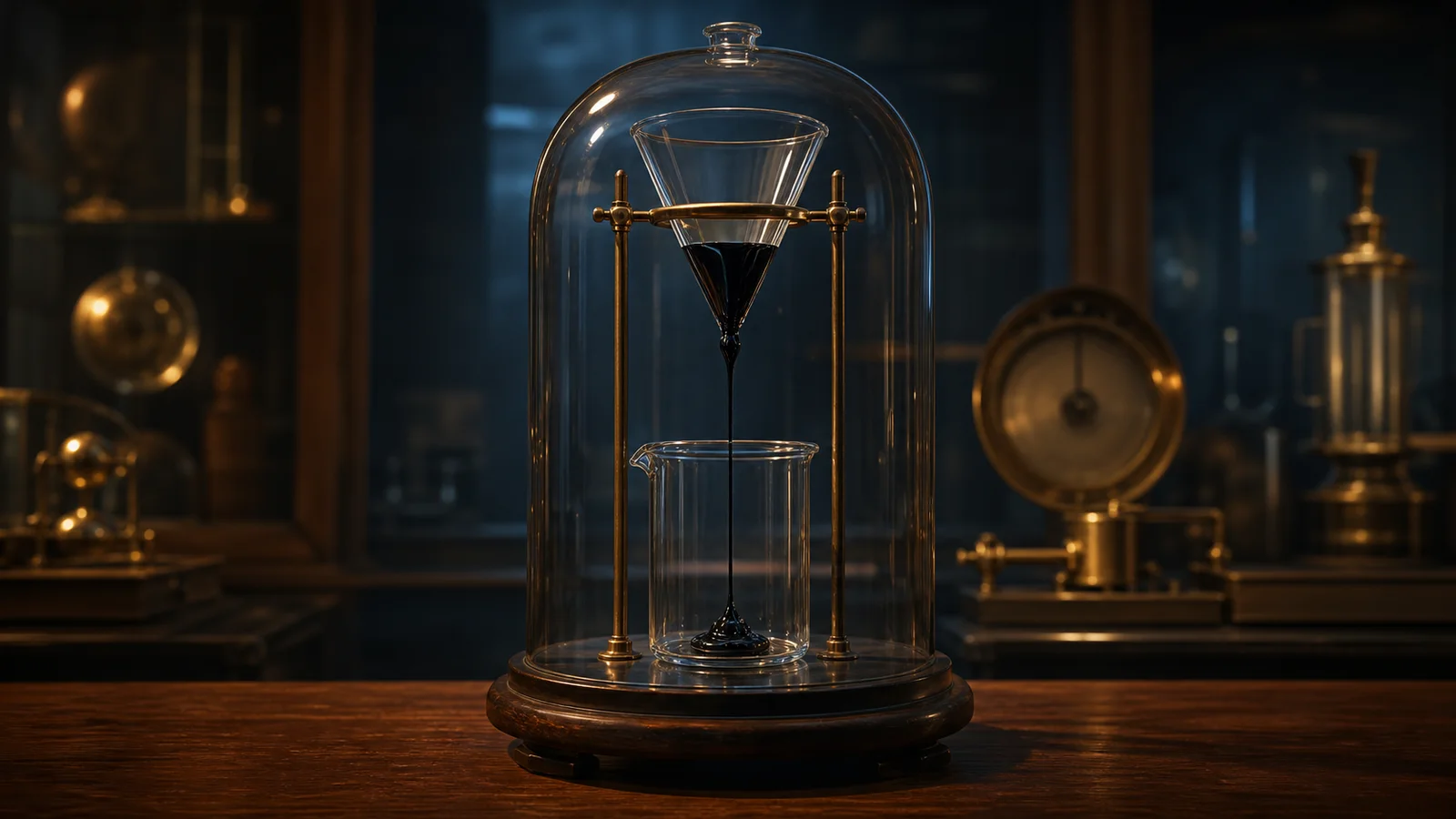
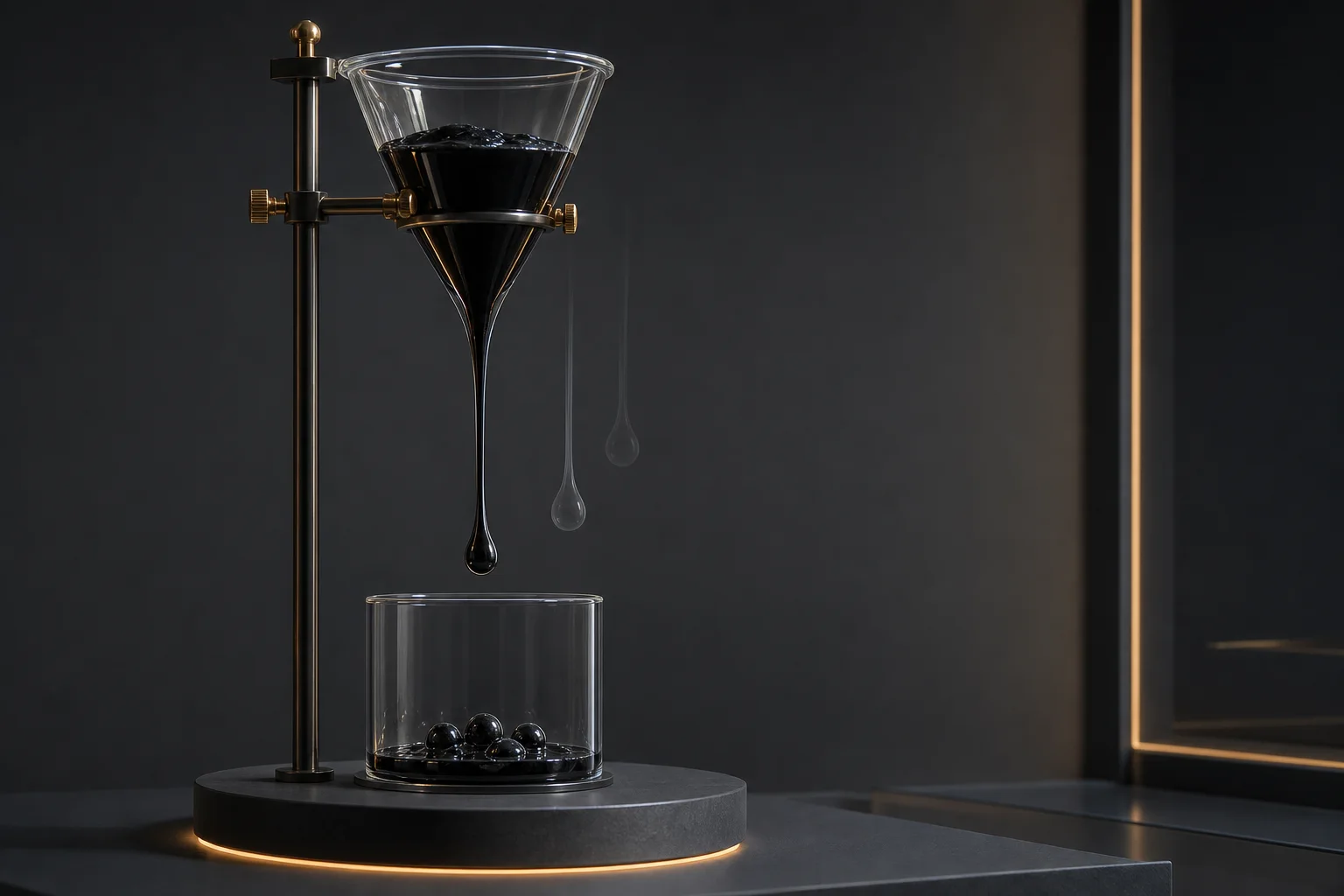
Editor’s note: The images in this article are original editorial illustrations. They are not photographs of the University of Queensland apparatus or scientific evidence.
In a glass funnel at the University of Queensland, a black substance that looks solid has been conducting one of science’s slowest demonstrations since 1927. It can feel hard and even shatter under a hammer, yet given enough time it flows.
The substance is pitch, an extremely viscous fluid. In this experiment, “extremely” means that only nine drops have completed their descent in nearly a century. A tenth is still taking shape.
A lecture demonstration with no convenient ending
University of Queensland physics professor Thomas Parnell set up the apparatus in 1927. According to the university’s Physics Museum, he heated pitch, poured it into a sealed glass funnel, and then let it settle for three years. The funnel’s stem was cut in 1930, giving gravity a very long assignment.
The first drop took roughly eight years to fall. For the first several decades, another drop arrived about every seven to nine years. The eighth and ninth took longer, about 13 years apiece, according to a University of Queensland account of the ninth drop.
Why something hard can still flow
Viscosity is a fluid’s resistance to flowing. Water has relatively low viscosity; honey resists flow more strongly. The pitch in Parnell’s funnel sits at an almost comical extreme. The Physics Museum says estimates put it at about 100 billion times more viscous than water.
That number is an estimate for this sample and setup, not a universal constant for every material called pitch. Temperature matters greatly. The apparatus was created as a teaching demonstration rather than a tightly climate-controlled experiment. University records note that seasonal temperature changes affect the flow, and air-conditioning installed near the display helped slow later drops.
The experiment therefore makes a useful point without requiring pitch to fit neatly into everyday categories. On a human timescale, it seems solid. On the experiment’s timescale, its continuing deformation is unmistakable.
The drop that kept dodging its audience
The long waits created a second, accidental experiment: could anyone catch a drop at the decisive moment?
Former custodian John Mainstone repeatedly came close. University accounts say he missed the 1977 drop by a day and the 1988 drop after briefly leaving the display. In 2000, a webcam was watching—but a short power failure covered the crucial interval.
The ninth behaved differently. Instead of cleanly breaking free, it slowly touched the older drop beneath it in April 2014. The university used time-lapse images to study the contact, then replaced the crowded beaker so the experiment could continue. That intervention is one reason a simple drop count hides a messier history: “falling” has not always meant a dramatic, free-falling plop.
A record with an important qualifier
Guinness World Records recognizes the Queensland Pitch Drop Experiment as the longest-running laboratory experiment. That wording is best treated as a specific record title, not a claim that no older scientific apparatus or long-term observation exists anywhere. The University of Queensland also describes the piece as an ongoing teaching experiment and museum object.
The funnel still contains enough pitch for future drops. Predictions are necessarily loose because temperature, the changing amount of material, and the geometry of each forming drop affect the timing. The honest answer to “When will the tenth fall?” is the answer this apparatus has always demanded: keep watching.
What the experiment actually proves
- Pitch can behave like a hard solid during a quick test and still flow under sustained stress.
- Our everyday labels depend partly on the timescale of observation.
- A simple demonstration can become scientifically interesting in new ways when its surroundings and maintenance history affect the result.
It does not prove the common myth that old window glass sags because glass is a slow liquid. The pitch in this apparatus was selected precisely because it flows on a timescale that can be observed across years. The experiment’s weirdness is real enough without borrowing claims from unrelated materials.
Leave a Reply