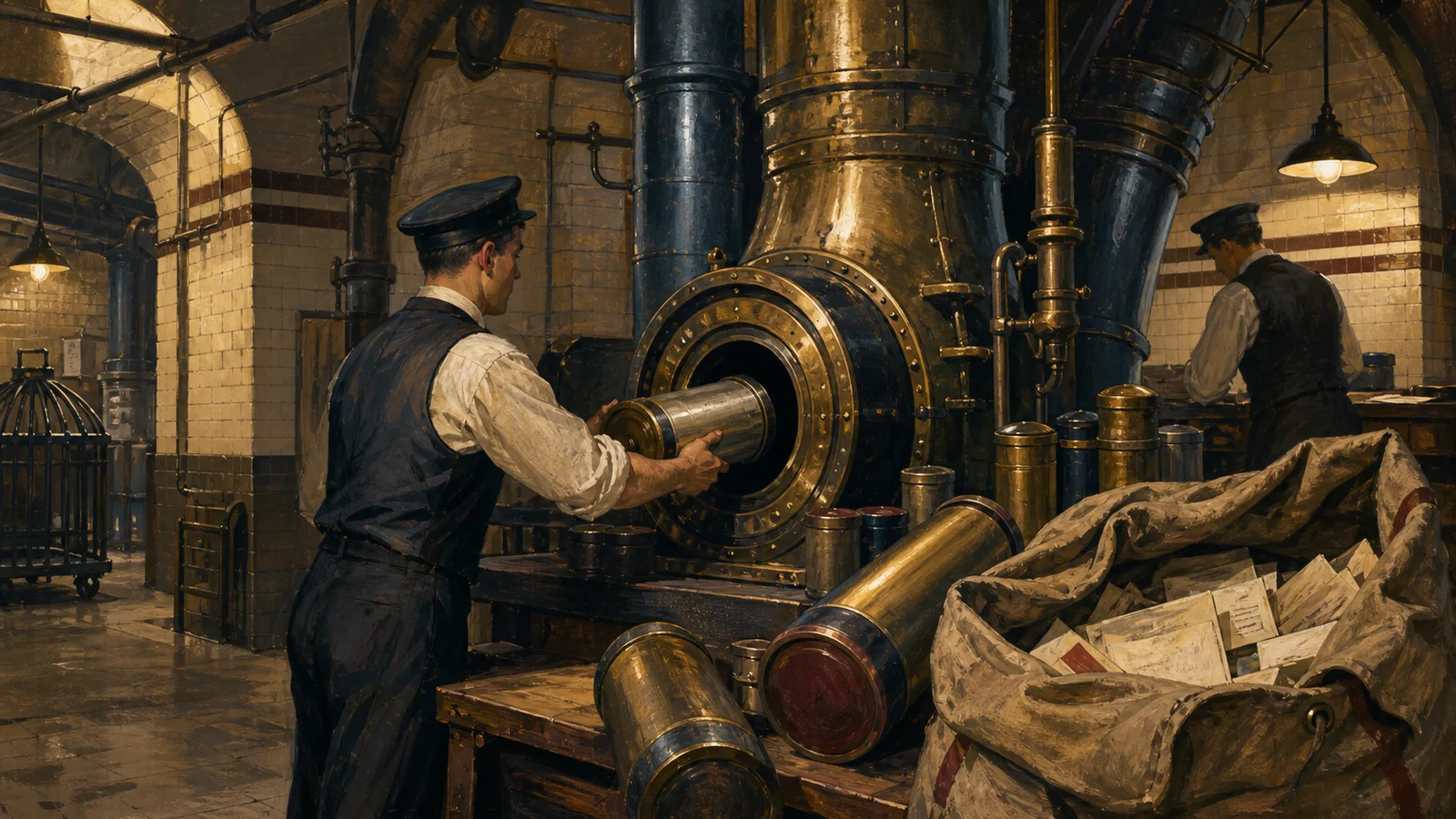
All artwork in this article is an editorial illustration generated for WeirdNews.org. It is not archival evidence or a reconstruction of a particular postal station.
Long before a message could disappear into a screen and arrive on another continent, some American letters took a more theatrical route: they were sealed into metal cylinders and shot beneath city streets by air pressure.
In the late 19th and early 20th centuries, pneumatic mail networks linked post offices in several crowded U.S. cities. To a person feeding a canister into a hatch, the apparatus must have seemed half post office and half submarine. To the postal service, it was a practical answer to a very ordinary problem: getting mail across a traffic-clogged city quickly.
A letter-sized ride through the underworld
The first U.S. pneumatic mail service began in Philadelphia in 1893, according to the Smithsonian’s National Postal Museum. Boston, Brooklyn, New York, Chicago, and St. Louis followed. By 1915, those six cities had laid more than 56 miles of pneumatic tube beneath their streets.
The system did not transmit a message the way a telegraph did. It moved the message itself. Clerks packed letters into a cylindrical carrier, loaded it into an airtight tube, and used compressed air to push it along. Depending on its direction, a carrier could also be drawn through by suction. The National Postal Museum says canisters could hold up to 600 letters and commonly traveled at about 35 miles per hour.
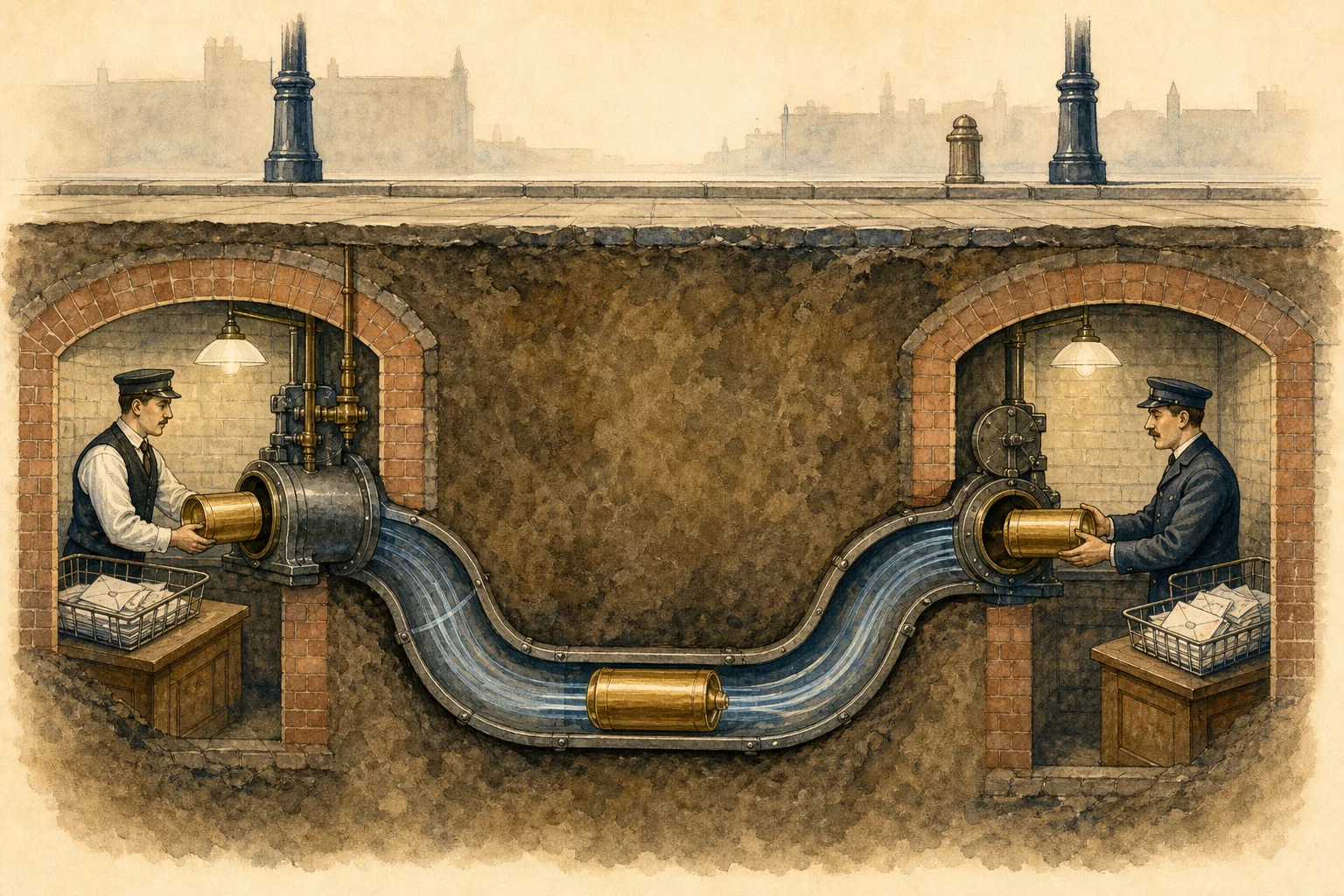
That speed mattered. A National Postal Museum account notes that a New York route that could take a mail wagon 40 minutes could be covered by tube in about seven. In a city where the last mile might be just a few blocks but traffic could be punishing, the tubes made an invisible shortcut.
New York’s hidden postal machinery
New York embraced the idea most enthusiastically. Its service began in 1897, and a line across the Brooklyn Bridge connected Brooklyn and Manhattan the following year. The museum says the city eventually had 27 miles of pneumatic tube. The system moved mail between postal facilities and railroad terminals, not directly from one household to another; a letter still needed people at both ends.
That human detail is what keeps the story from becoming a Victorian version of email. Postal clerks worked around the clock in basement facilities, filling carriers, sending them, opening them at the other end, and putting their contents back into the larger flow of sorting and delivery. The tube was fast, but it was never magic. It was a carefully maintained handoff between workers and machinery.
Ingenious, expensive, and stubbornly fixed in place
The tubes had a built-in flaw: once they were underground, they had to share the underground with everything else. The National Postal Museum notes that existing sewage and gas lines limited where tubes could go and how large they could be. Water-table conditions created another challenge; parts of Philadelphia’s system had to be buried well below the water level.
They were also costly. Private companies built the systems and rented them to the Post Office Department. The same feature that made the tubes wonderfully fast—their fixed physical route—made them awkward as cities and postal patterns changed. A truck could be sent somewhere new tomorrow. A steel tube under a street could not.
During World War I, the Post Office Department suspended the service to conserve funds. After the war, it returned in New York and Boston, but the age of the tubes was closing. Larger mail volumes, changing streets, and more flexible motor vehicles gradually made the networks harder to justify. Boston’s service ended in 1950; New York’s ended in 1953 and was not restored.
The strange part is that the idea never really vanished
The citywide postal networks are gone, but their logic is familiar. Bank drive-throughs, hospitals, pharmacies, and big-box stores still use pneumatic dispatch systems for documents, cash, samples, and small supplies. They are smaller and less romantic than a 27-mile network under New York, but the satisfying premise is identical: put a small thing in a capsule, give the air a job, and let the walls do the rest.
A Library of Congress photograph labeled N.Y. Post Office — Pneumatic Tube preserves one visual trace of that era. It is a useful reminder that the story is not a retrofuturist fantasy. For decades, parts of America’s postal system really did hum underfoot.
Leave a Reply