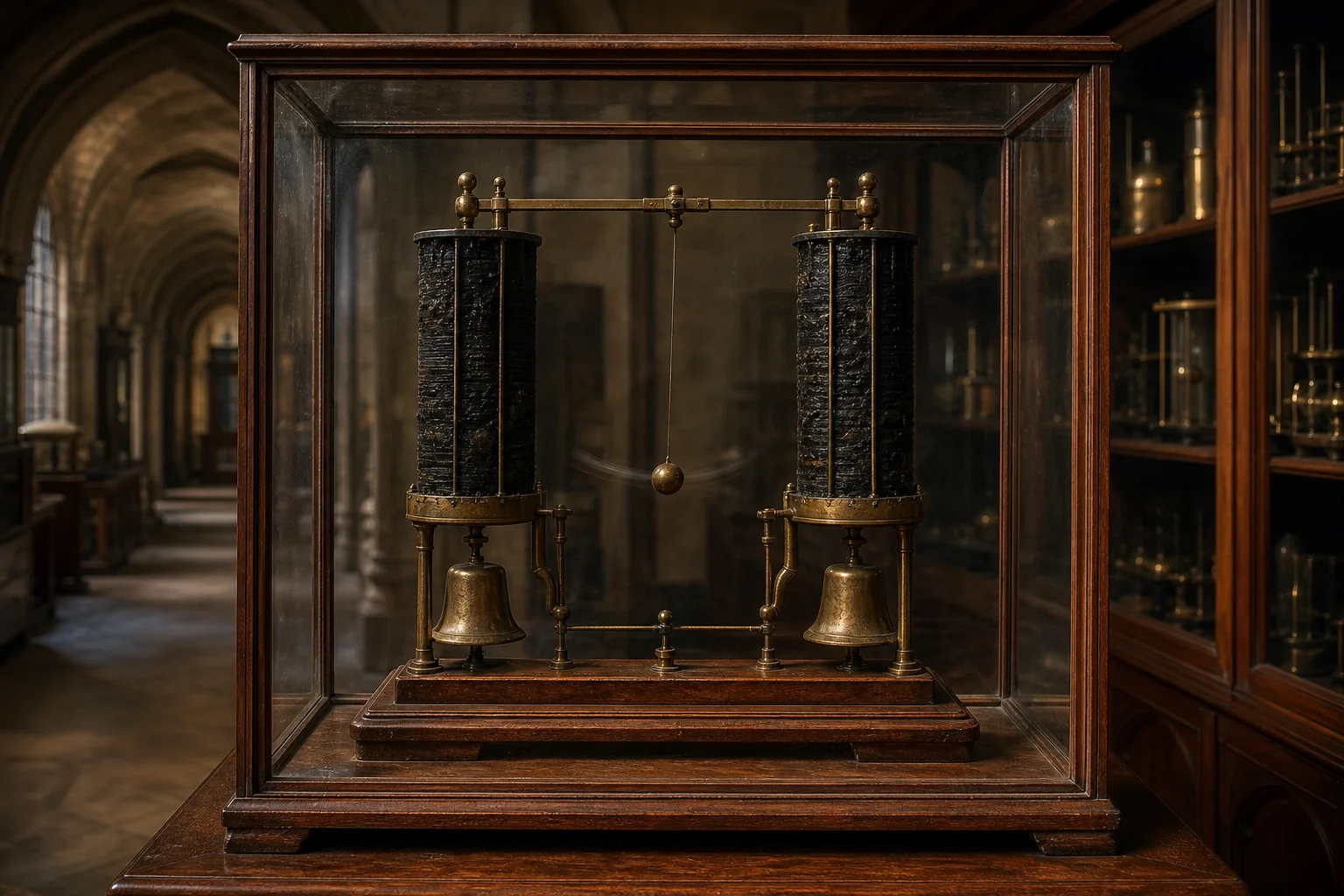
In a glass case at the University of Oxford, a metal ball no bigger than a pea keeps making the same short trip. It touches one brass bell, crosses a narrow gap, touches a second bell, and heads back again. The mechanism was set up in 1840. Oxford’s Department of Physics says it still oscillates about twice each second.
The apparatus is usually called the Oxford Electric Bell or the Clarendon Dry Pile. Its longevity sounds like a perpetual-motion story, but it is nothing of the kind. The bell is an unusually frugal electrical machine: it uses high voltage, an extraordinarily small current, and a simple electrostatic shuttle to spend its stored energy almost grudgingly.
Two batteries, two bells, one restless ball
The visible arrangement is beautifully spare. Two tall dry-pile batteries stand side by side. Each connects to a brass bell, giving the bells opposite electrical charges. A metal sphere about four millimeters across hangs between them on a thread.
When the sphere touches one bell, it picks up that bell’s charge. Like charges repel, so the newly charged sphere is pushed away from the bell it has just touched. At the same time, it is attracted toward the oppositely charged bell. On contact with the second bell, its charge changes and the process reverses. The ball becomes a tiny courier, carrying charge back and forth while tapping the bells on every crossing.
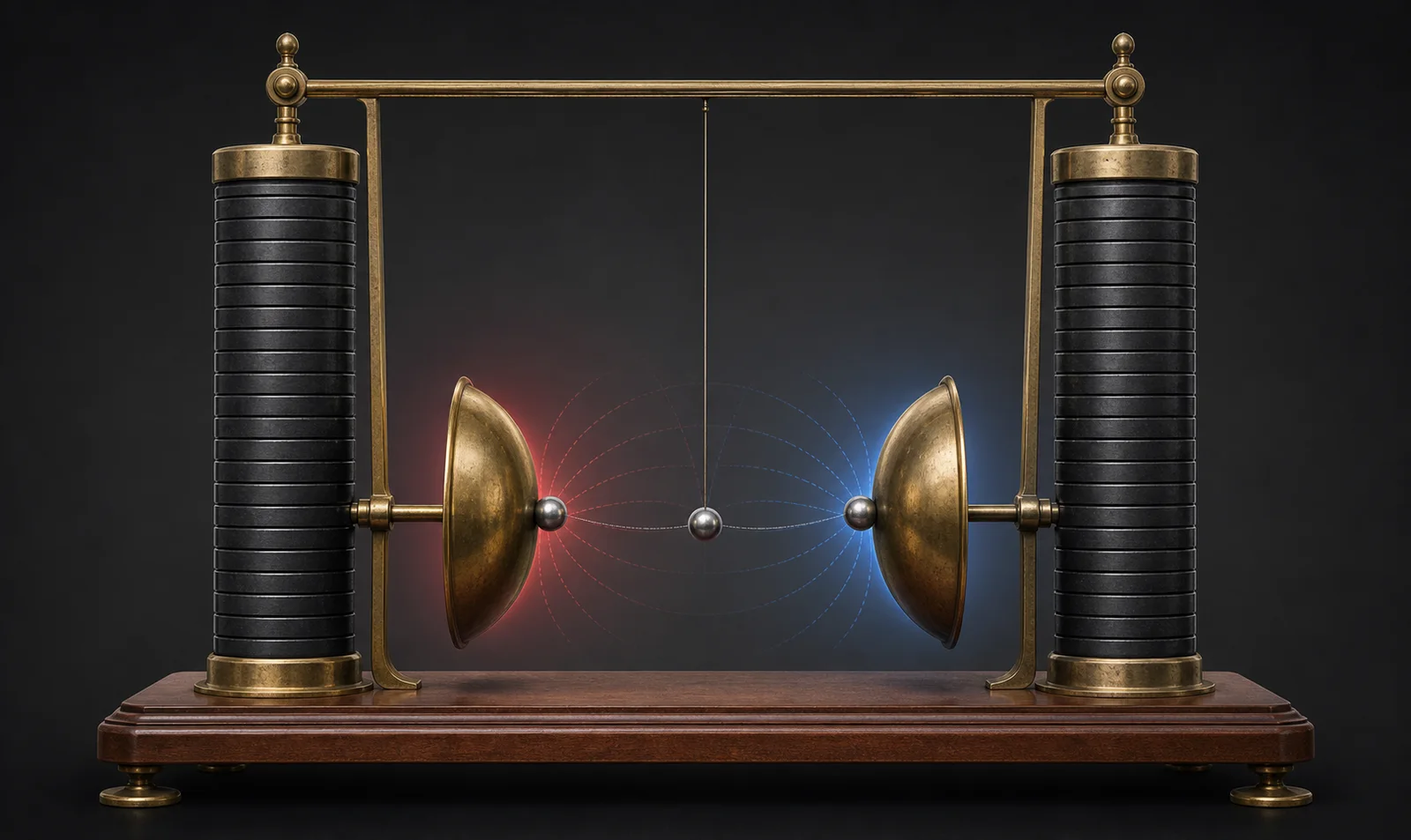
A 2025 demonstration published in The Physics Teacher reproduced the principle with modern, readily available materials. The authors describe the motion as an electrostatic effect driven by charge on the battery terminals. Their replica helps confirm that the famous Oxford apparatus does not need a conventional motor or a large continuous current to keep the shuttle moving.
The trick is high voltage and almost no current
Most battery-powered devices draw enough current to do conspicuous work: heating a wire, turning a motor, lighting a screen. The Oxford bell has a much smaller assignment. Its clapper is light, the distance is short, and each trip transfers only a minuscule amount of charge.
In a history of Oxford’s Clarendon Laboratory, physicist A. J. Croft described the apparatus as operating at roughly 2,000 volts but only about one nanoampere. Those figures are estimates rather than a promise about its present output, but they capture the central point. Voltage measures electrical potential; current measures the flow of charge. The bell has plenty of the first and vanishingly little of the second.
That tiny current is why “still running” does not mean “free energy.” The batteries are continually surrendering stored chemical energy, just at a rate so low that the process has outlasted generations of laboratory equipment. Oxford estimates that the bells have been struck on the order of 10 billion times. The sound is muffled by the display case, so visitors see the motion rather than hear a 186-year concert.
What is inside the dry piles?
This is where documentation ends and informed reconstruction begins.
Oxford says the two battery columns are covered with an insulating layer of sulfur. Their exact internal construction remains unknown. Similar early nineteenth-century “dry piles” were assembled from large numbers of very thin metal-and-paper layers. The university’s exhibit notes that the Oxford piles may contain alternating foil and paper coated with manganese dioxide. Croft favored a related historical recipe involving roughly 2,000 pairs of zinc and “silvered” paper discs.
Those are plausible comparisons, not an inventory of the sealed Oxford batteries. The device cannot be opened without ending—or at least radically altering—the very long-running performance people want to understand. Its survival has therefore protected its mystery.
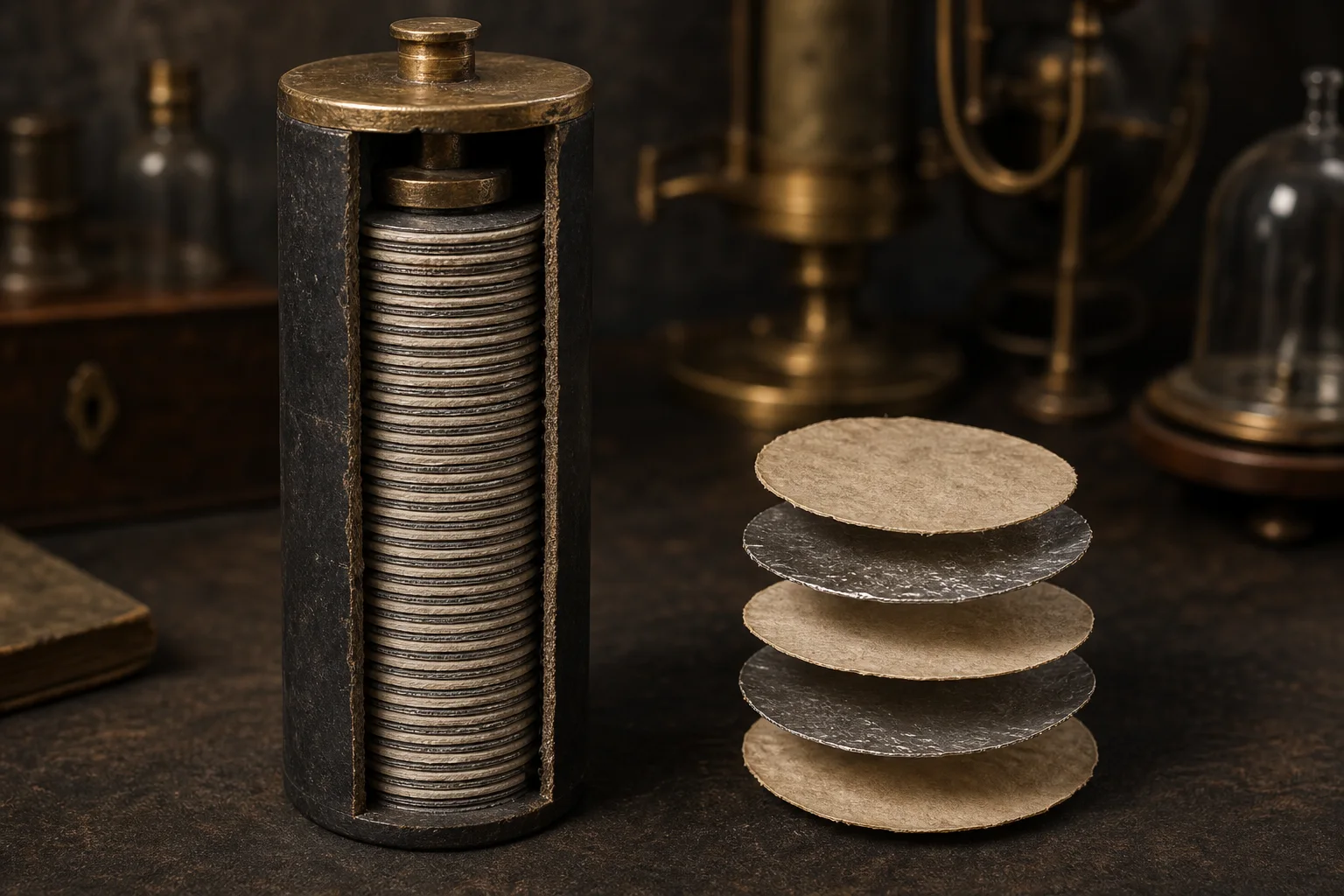
The word dry can also mislead. Croft argued that the pile would not work if it were absolutely moisture-free. In his account, the sulfur coating helped retain a small amount of water needed for the electrolyte while limiting leakage and unwanted chemical reactions. It is a sealed, slow electrochemical system—not a stack of perfectly dry inert wafers.
A three-year prediction that missed by two centuries
The apparatus carries a handwritten note saying it was “set up in 1840,” although Oxford records that it may have been constructed about 15 years earlier. Croft’s history reproduces an 1841 letter to Oxford physicist Robert Walker from instrument maker Francis Watkins. Watkins doubted that the residual power could keep the clapper moving for more than three or four years.
That was a reasonable expectation based on the instruments of the period. It was also spectacularly wrong. The sulfur seal, the enormous number of thin battery layers, the microscopic current draw, and the light electrostatic shuttle combined into a machine whose useful lifetime was far outside ordinary experience.
Why it is not perpetual motion
Oxford explicitly rejects the popular “perpetual motion” label. The bell has an energy source: its dry-pile batteries. Every swing dissipates a little energy through electrical resistance, air drag, sound, deformation, and friction at the suspension. Eventually the chemical potential will become too weak to move the clapper, or a mechanical part will fail first.
The uncertainty is not whether it will stop, but how and when. Croft thought the clapper might wear out before the electrochemical energy was exhausted. That, too, is a hypothesis. The sealed apparatus has made patience part of the experiment.
The weird lesson in the glass case
The Oxford Electric Bell lasts because it does almost nothing, extremely efficiently, for an extremely long time. It turns a tiny flow of charge into a visible rhythm and makes the difference between voltage, current, power, and energy impossible to ignore.
Its greatest mystery is also carefully bounded. The operation is understood. The broad family of battery technology is understood. What remains uncertain is the exact recipe inside two sealed nineteenth-century columns and which component will finally determine the ending. Until then, the little sphere keeps crossing the gap.
Leave a Reply