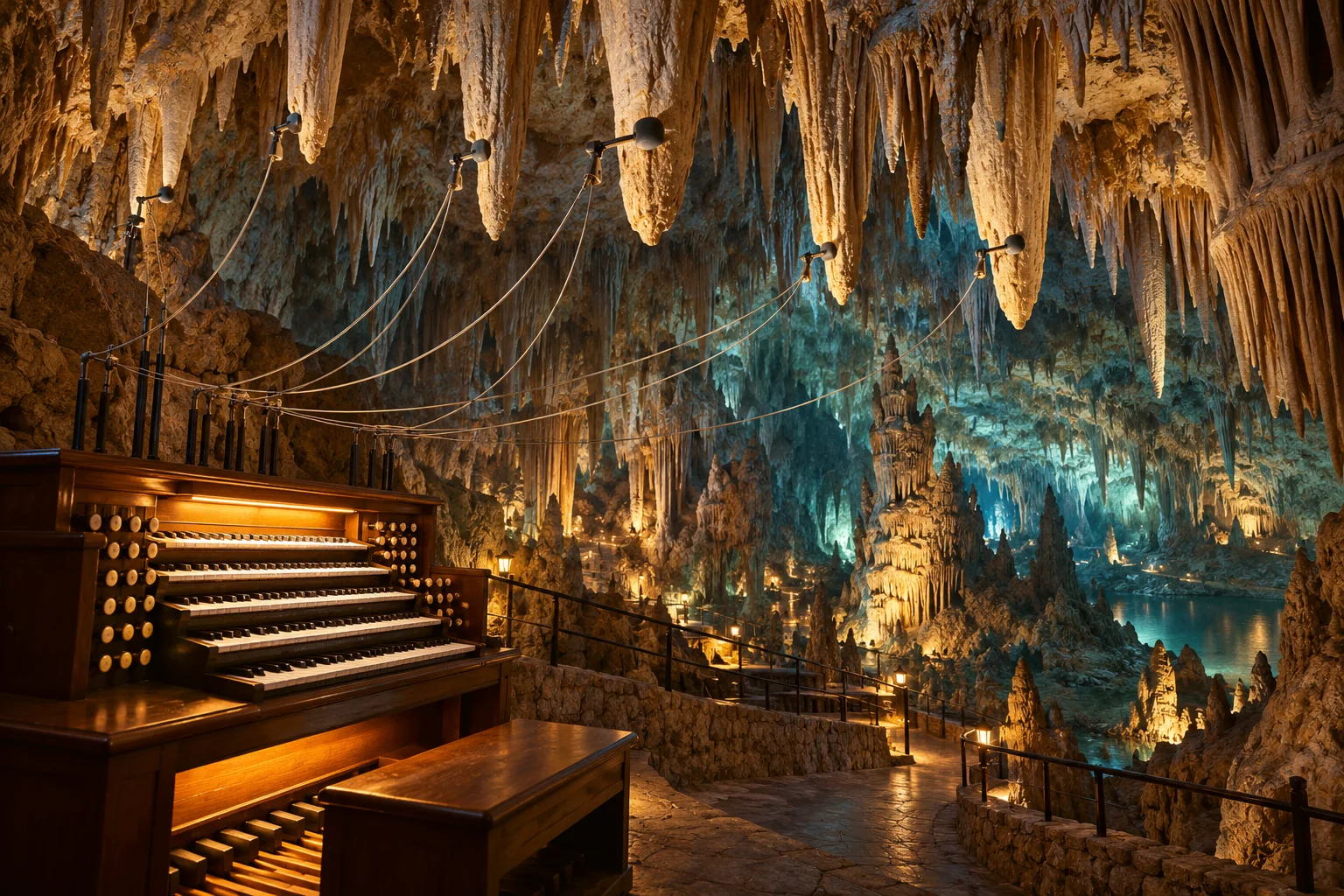
Deep beneath Virginia’s Shenandoah Valley, a keyboard can set a cave singing. The Great Stalacpipe Organ at Luray Caverns turns selected stalactites into sounding elements, linking a human-made console with stone formations spread through an underground chamber.
Editorial illustration of the Great Stalacpipe Organ’s blend of engineering and cave acoustics.
A tour sparked the idea
Leland W. Sprinkle, a Virginia mathematician and electronics scientist who worked at the Pentagon, visited Luray Caverns in 1954. During the tour, he heard a guide tap a stone formation and noticed the musical tone. Sprinkle imagined extending that simple demonstration into an instrument spanning the cave.
Over the next three years, he searched the caverns with tuning forks, listening for stalactites whose natural pitches could fit musical notes. The cavern’s own history says he used 13 English tuning forks and selected formations across more than three acres. The result is a lithophone: an instrument that makes sound by striking stone.
How the cave plays
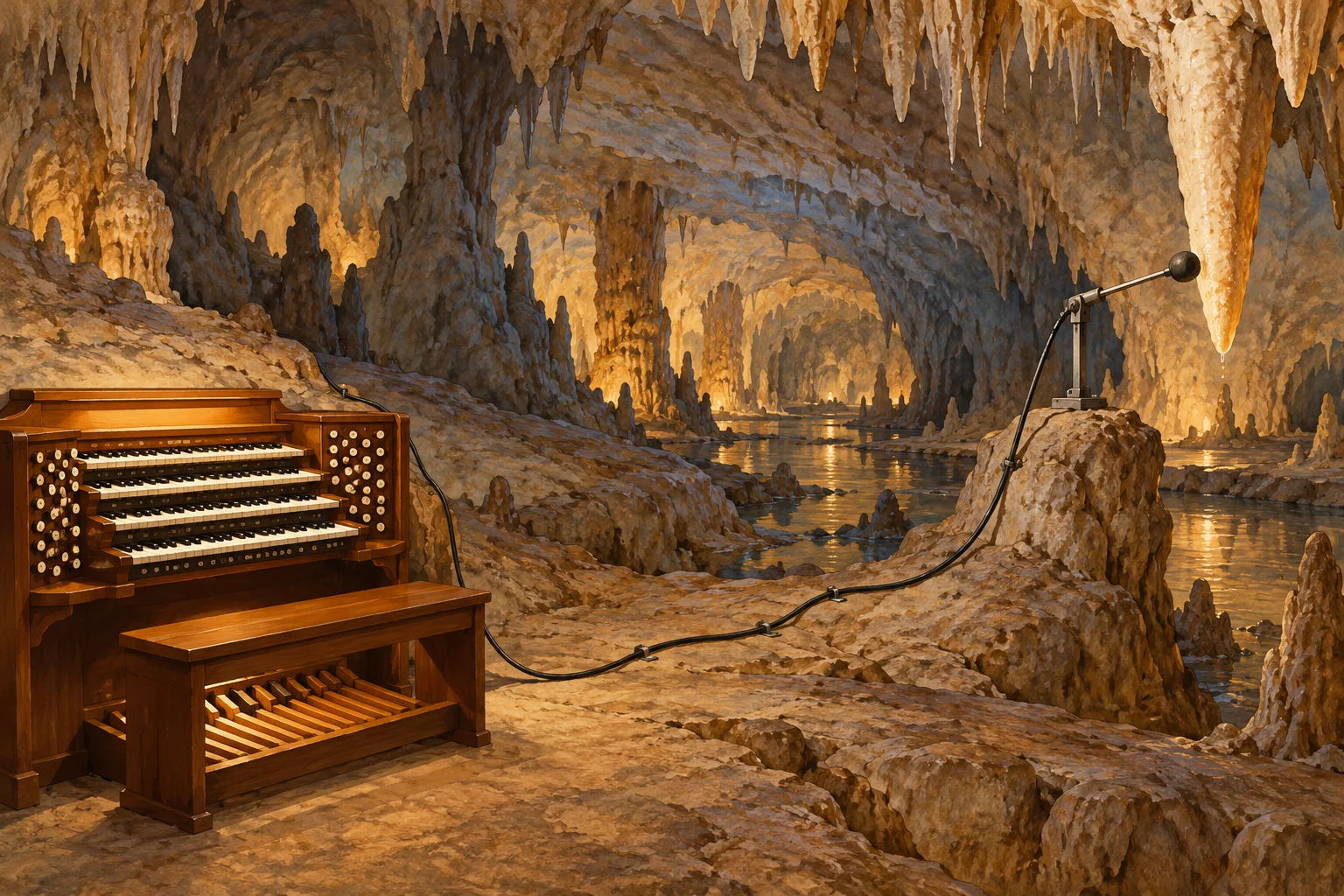
The system connects a four-manual console to electronic mallets placed beside selected stalactites. Pressing a key sends a signal to a rubber-tipped plunger, which gently taps its assigned formation. Each one responds with a tone; together, the spread-out notes make the cavern part of the instrument.
Editorial illustration showing the basic path from a keyboard key to a cave formation’s tone.
The cave shapes the performance as much as the mechanism does. A tone may take a moment to reach the player, and different chambers carry sound in different ways. Luray Caverns now uses an automated music-box-style system for regular melodies, while the console can also be played manually.
An instrument measured in acres
The Great Stalacpipe Organ’s scale is part of its appeal: its sounding formations are distributed through a natural chamber rather than gathered into a conventional case. Guinness World Records lists it as the largest natural underground musical instrument, describing a keyboard-linked arrangement of stalactites and rubber-tipped mallets covering about 3.5 acres.
That record-sized idea began with a small moment of curiosity on a cave tour. Sprinkle heard music in a stone formation, then spent years finding a way to let visitors hear a whole cavern answer.
In Queen Maud Land, Antarctica, Lake Untersee holds a remarkable freshwater world beneath a lasting cover of ice. The lake’s clear water, unusual chemistry and cone-shaped microbial structures make it one of the planet’s most distinctive natural laboratories.
A lake beneath permanent ice
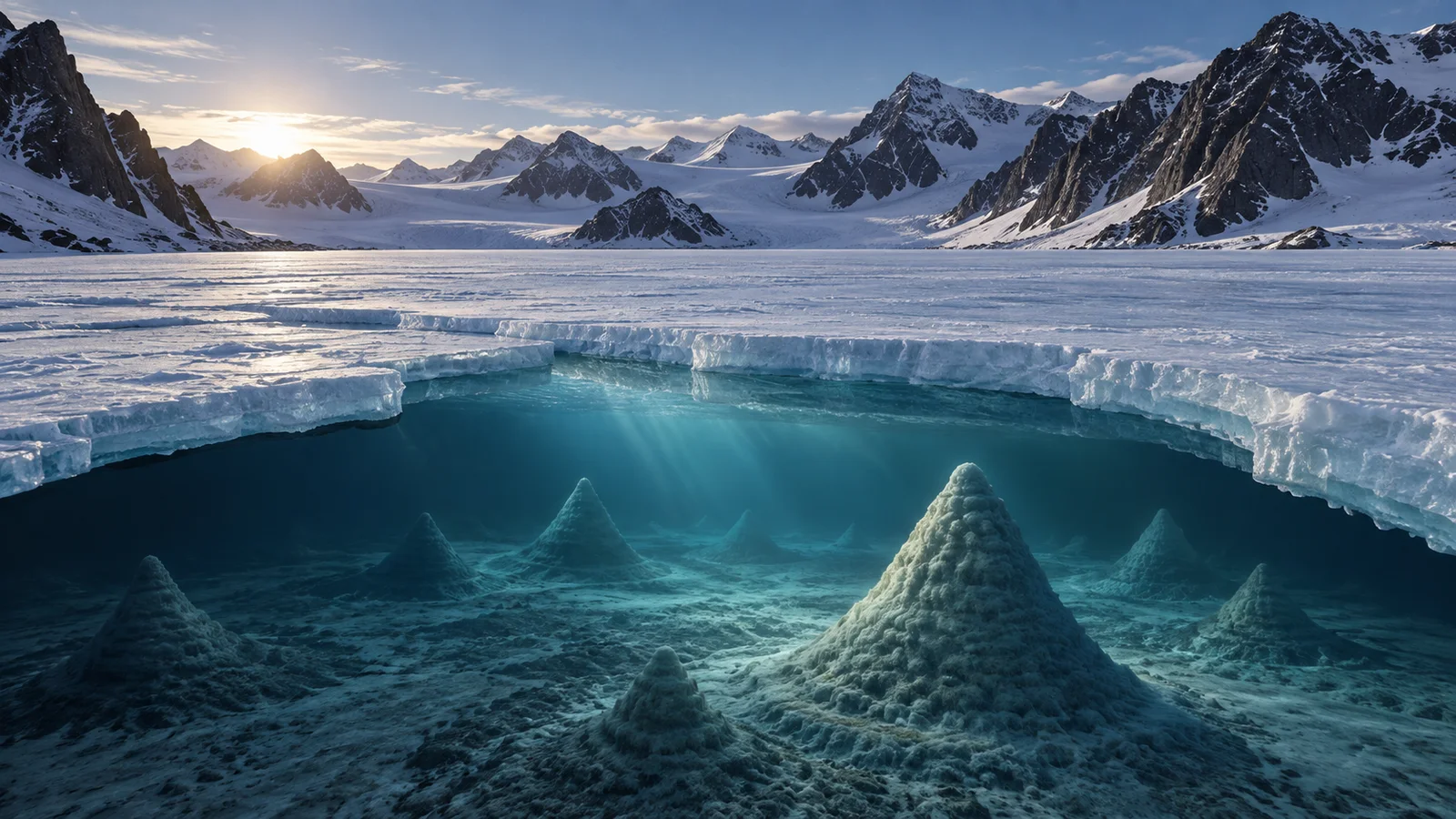
NASA’s Earth Observatory describes Lake Untersee as one of East Antarctica’s larger and deeper surface lakes. Its ice cover usually measures about two to four meters thick, creating a sheltered setting where the water’s chemistry develops on a very different timetable from an open lake.
Editorial illustration of Lake Untersee’s ice-covered setting in Antarctica.
The lake sits in a cold, dry landscape, yet its water holds exceptionally high dissolved oxygen and methane, low dissolved carbon dioxide and a high pH. Those conditions give researchers a detailed setting for studying how microbial communities organize themselves in an extreme freshwater environment.
Cones assembled by microscopic life
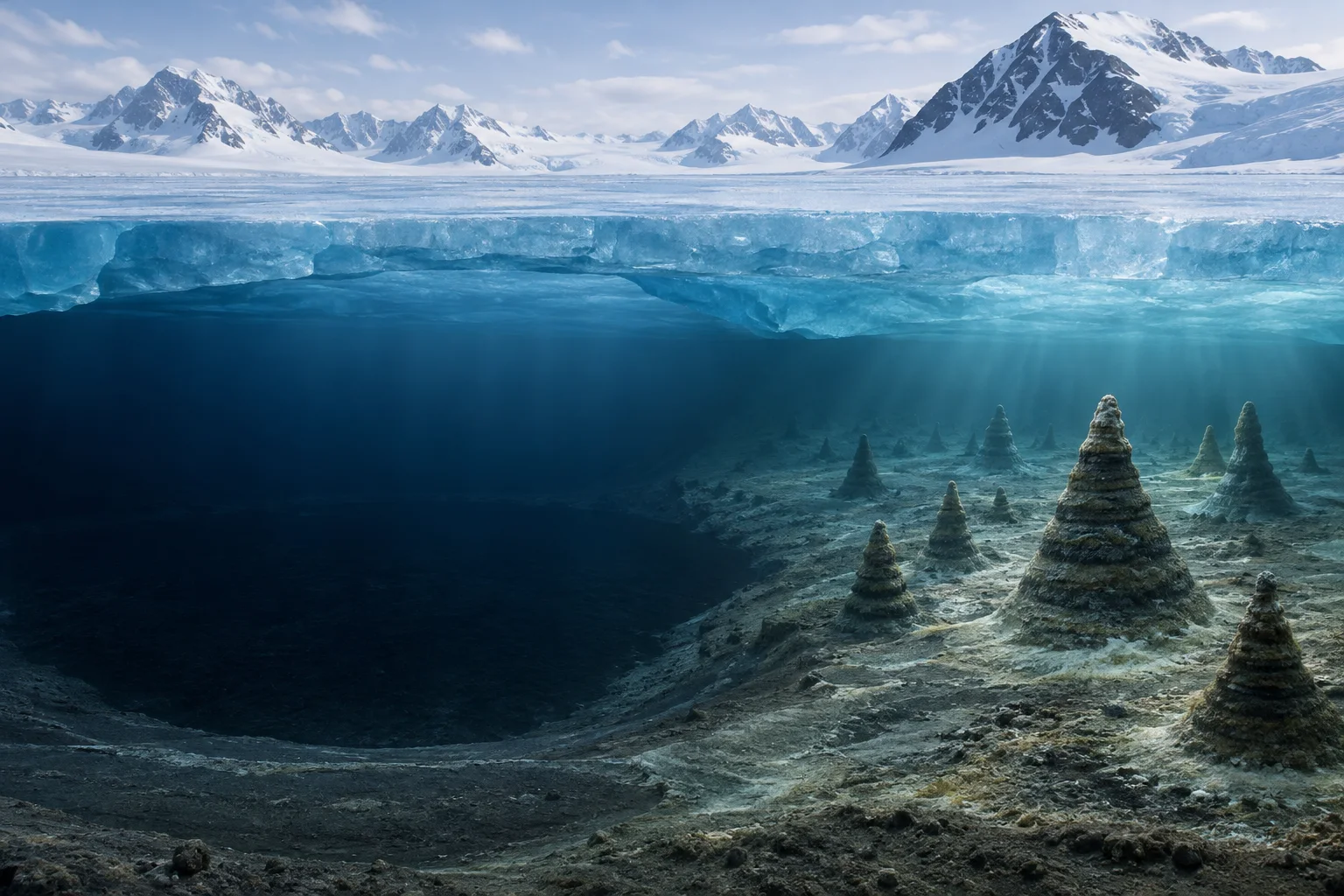
On the lake floor, photosynthetic microbial mats build layered structures that rise into large cones. NASA Astrobiology reported that researchers identified distinct microbial communities in the mats and that the conical forms resemble structures familiar from Earth’s ancient rock record.
The Natural History Museum’s StromatoLife project describes the cones as modern organo-sedimentary structures built from alternating layers of sediment and microbially derived organic material. Its researchers are examining the communities and processes that shape them, including the roles of cyanobacteria and other microorganisms.
Editorial illustration of the layered microbial cones studied beneath Lake Untersee’s ice.
One lake, several worlds
Lake Untersee contains sharply different habitats within a single basin. NASA’s research materials describe a clear, oxygen-rich water column alongside a deeper anoxic area where methane accumulates. The contrast helps scientists ask focused questions about how chemistry, light and microbial life interact in isolated water bodies.
That combination also gives the lake value beyond Antarctica. NASA and the Natural History Museum both discuss Lake Untersee as an analogue for ancient ice-covered lakes and icy environments elsewhere in the solar system. The comparison guides research questions about the conditions that can support microbial communities.
A slow-growing record of a strange place
The microbial cones provide a vivid answer to a familiar question: what can life build when it has time, light and a remarkably stable place to grow? At Lake Untersee, the answer rises from the lake floor in layers, beneath blue ice and a long Antarctic winter.
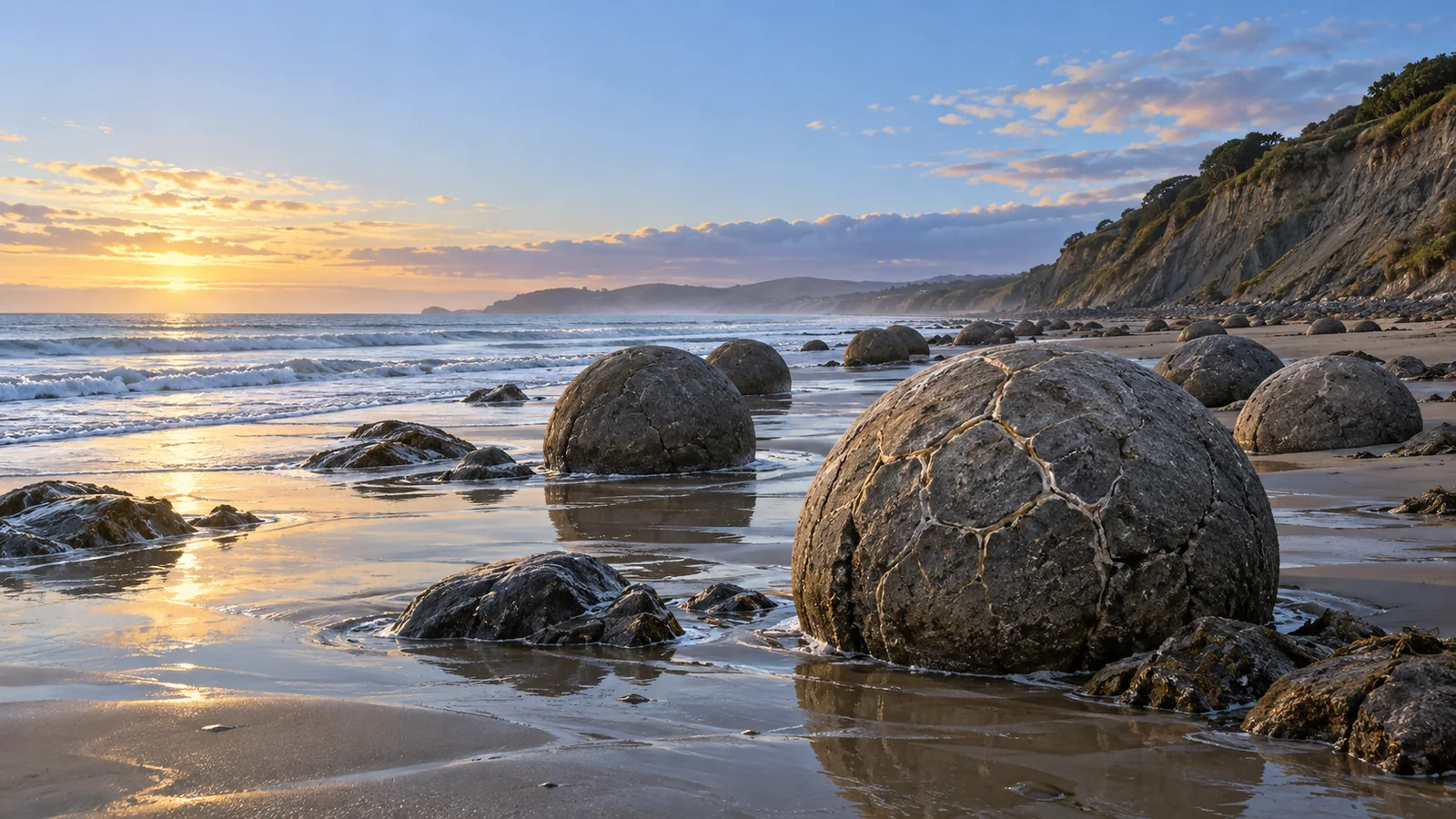
On a beach in Otago, Aotearoa New Zealand, the tide threads around boulders that look suspiciously like a giant misplaced bag of marbles. The Moeraki Boulders / Kaihinaki are real stone spheres, some large enough to make a person look small beside them. They grew inside ancient mudstone, then the coast gradually set them free.
The oddity is heightened by a second, equally important story. In Māori tradition, the round forms at this coast are connected with the wreck of the voyaging waka Ārai-te-uru. A good explainer keeps those accounts distinct: geology describes mineral processes; tradition records relationship, place, and memory. Both deserve to be named accurately.
Editorial illustration: rounded calcite concretions catch the first light on an Otago beach.
Confirmed: these are giant mineral-grown concretions
The New Zealand Department of Conservation calls the Moeraki Boulders / Kaihinaki geological marvels exposed as surrounding mudstone erodes. The agency says the sedimentary rocks here were laid down roughly 65 to 13 million years ago and that the boulders formed through the gradual precipitation of calcite in mudstone over about four million years. A concretion is a compact mass of mineral-cemented sediment that grows within surrounding sedimentary rock; at Moeraki, the result is unusually large and strikingly spherical.
Geologist James R. Boles and colleagues described the boulders in a peer-reviewed study as calcite concretions reaching about two metres across, with internal septarian veins of calcite and smaller amounts of other minerals. Those pale seams are part of why a weathered boulder can look like an enormous stone turtle shell or a cracked hard-boiled egg. Geologists classify the structures as calcite concretions, while the resemblance supplies visual fun.
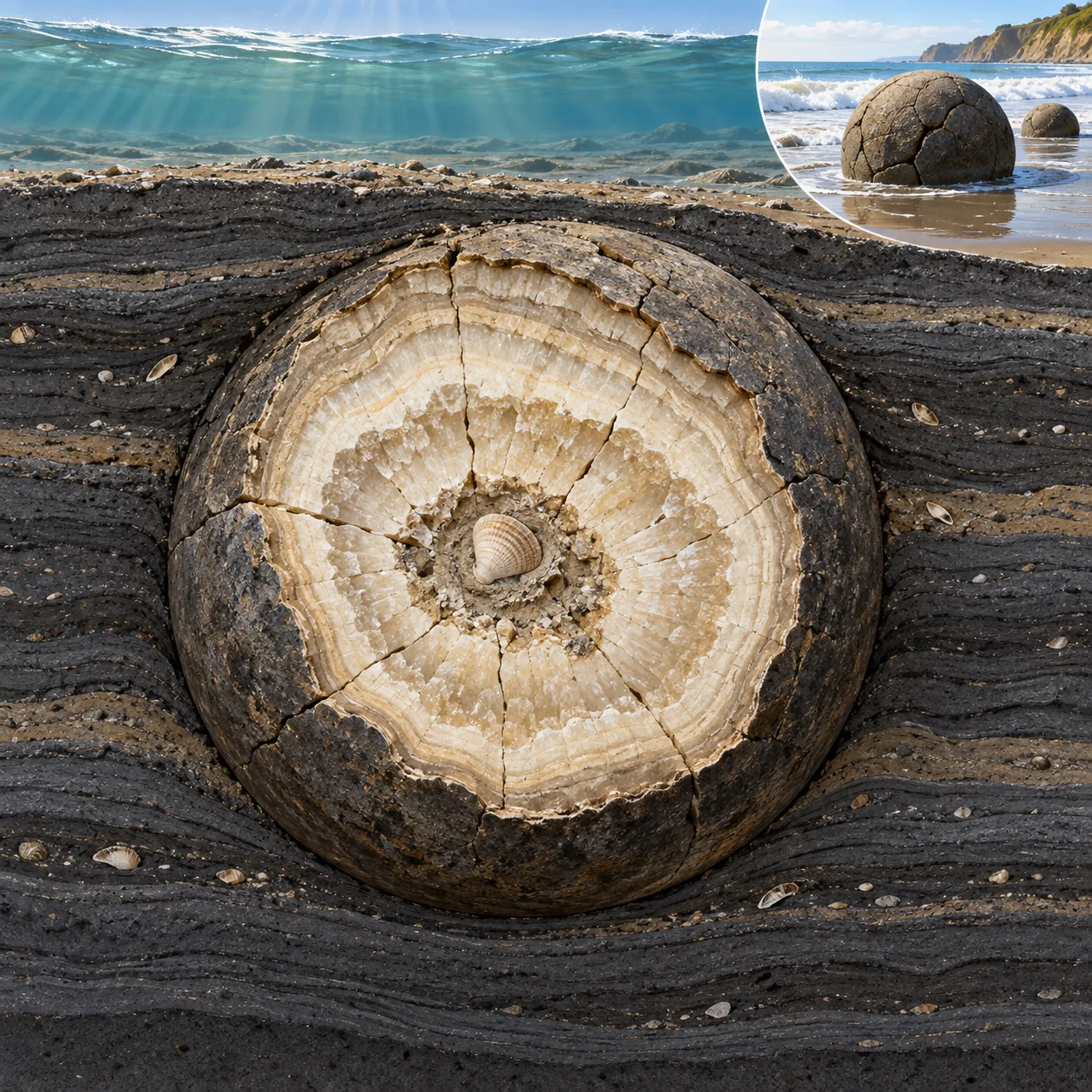
Here is the slow-motion version. Fine sediment accumulated on an ancient seafloor. In that mud, dissolved minerals precipitated and cemented sediment together around centres of growth. Over immense time, the hardening body expanded into a rounded concretion. Much later, coastal erosion wore away the softer enclosing mudstone. The resistant spheres emerged, while more can still be seen partly embedded in the cliff.
Editorial illustration: mineral-rich calcite gradually cements sediment into a rounded concretion within mudstone.
Confirmed: the coast is still doing the revealing
The boulders form a living coastal display revealed by erosion. The Department of Conservation notes that erosion exposes them from the surrounding mudstone; its management material describes boulders at the foot of the cliff as well as partly embedded forms above the tide line. The site feels less like a sculpture garden than a paused geological process. Every visible sphere is a chapter of rock history, and the cliff remains the next page.
That process also explains why individual boulders differ so much. Some remain almost whole; some have weathered into broken segments; others reveal their pale calcite vein network. The famous roundness is real, while each sphere carries its own natural variation. Nature has made durable spheres, then handed them to surf, salt, wind, and time.
Editorial illustration: weathering brings the pale calcite seams of a concretion into view.
Folklore and tradition: a waka, gourds, and eel baskets
Waitaki District planning material records a Kāi Tahu tradition connecting the boulders with the voyaging waka Ārai-te-uru. In that account, round food baskets and water-carrying gourds were lost overboard and formed the boulders before the waka continued south and capsized at Matakaea. The Department of Conservation uses the names Moeraki Boulders / Kaihinaki and Te Kaihinaki for the site.
This is a tradition alongside the mineral-formation account. Present it as cultural history, while the geological account describes the evidence from calcite and sediment. The accounts answer different questions: one explains how the stones formed; the other locates the remarkable coast within an inherited history of voyage, loss, food, and place.
What remains speculative
Scientists can study the boulders’ mineral chemistry and structure. Reconstructions of their earliest growth conditions draw on the rock record: the surrounding mudstone, the mineral cement, and the textures left inside each stone. A shell fragment, organic matter, or another small feature can serve as a possible growth focus for concretions in general; current evidence leaves the precise starting particle of any one Moeraki boulder open.
The evidence already offers a delightful mystery. Their verified explanation is slower and stranger: a coastal landscape has been opening mineral spheres that began growing in ancient seabed mud, one erosion season at a time.
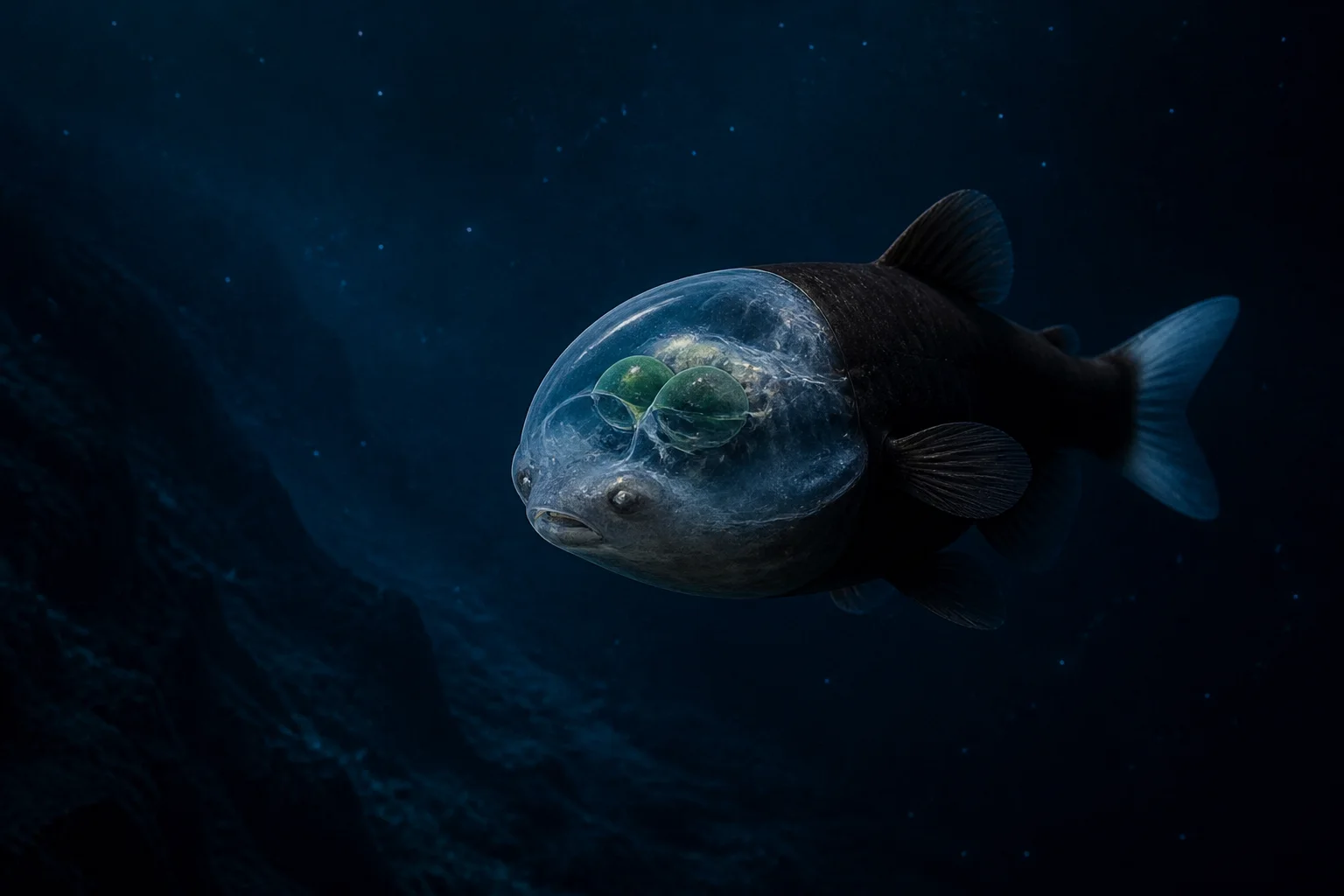
Deep in the Pacific, a small fish carries a clear dome over its head. Its green tubular eyes usually point upward, then rotate forward when dinner arrives.
Editorial illustration of a barreleye fish in the deep ocean.
At first glance, the barreleye looks as if someone put a glass helmet on a fish. The resemblance is real enough to be useful: Macropinna microstoma has a transparent, fluid-filled dome over the top of its head, and its bright green, tubular eyes can be seen inside it.
The fish lives in the ocean’s twilight zone, generally between about 2,000 and 2,600 feet (600 to 800 metres) in the northeastern Pacific, according to the Monterey Bay Aquarium. At that depth, sunlight has faded to a thin suggestion. A fish that wants to find food needs a very different visual strategy from one cruising near the surface.
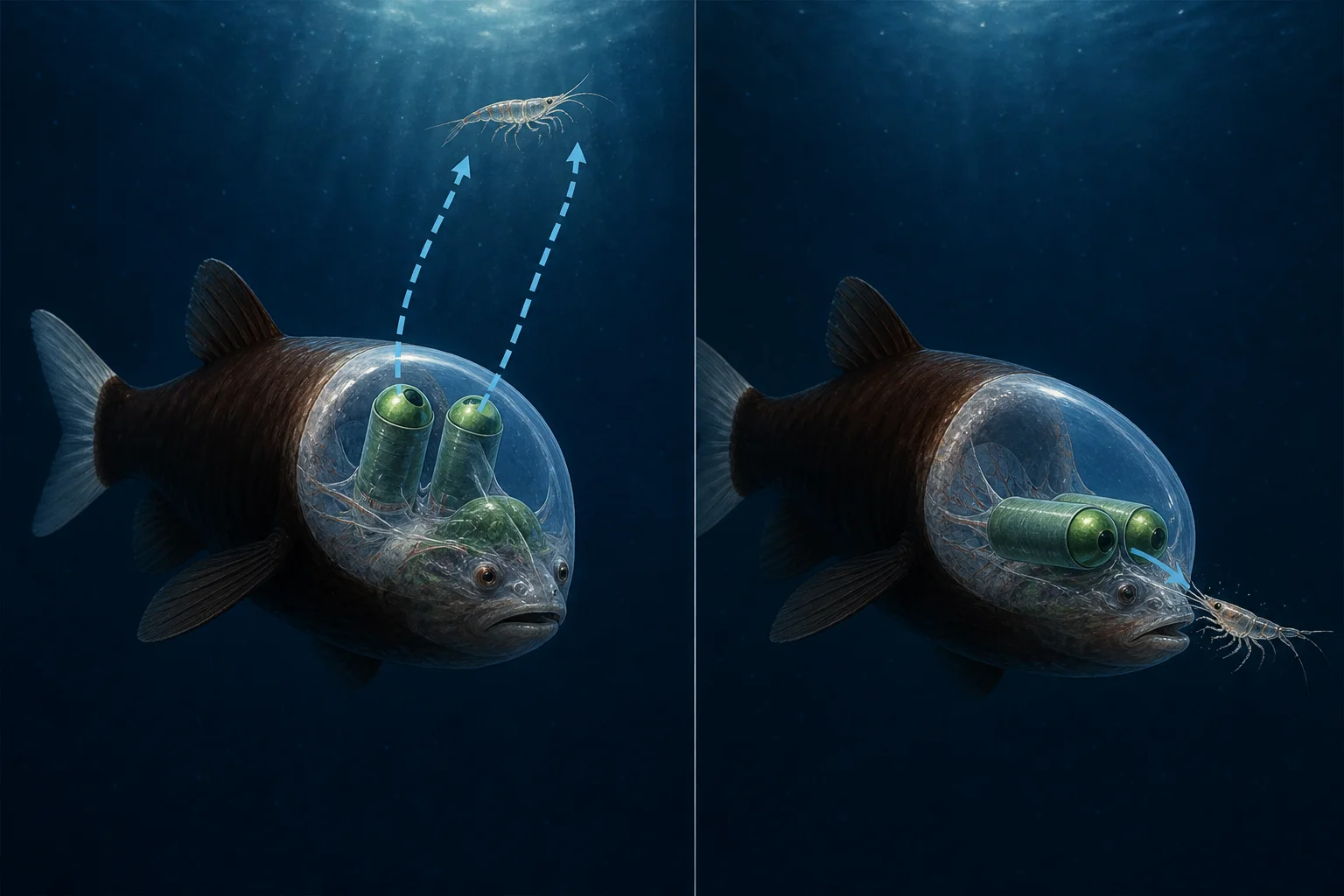
The barreleye’s strategy begins with looking up. Its sensitive eyes point toward the water above, where the silhouettes of small animals can stand out against the faint light filtering down from the surface. The transparent dome lets those eyes work inside a protected space rather than sitting exposed on the outside of the head.
The eyes turn toward the meal
For years, scientists observing barreleyes thought the eyes were fixed in an upward position. That created an obvious puzzle: if the fish spotted a possible meal overhead, how could it see the meal once it turned to feed?
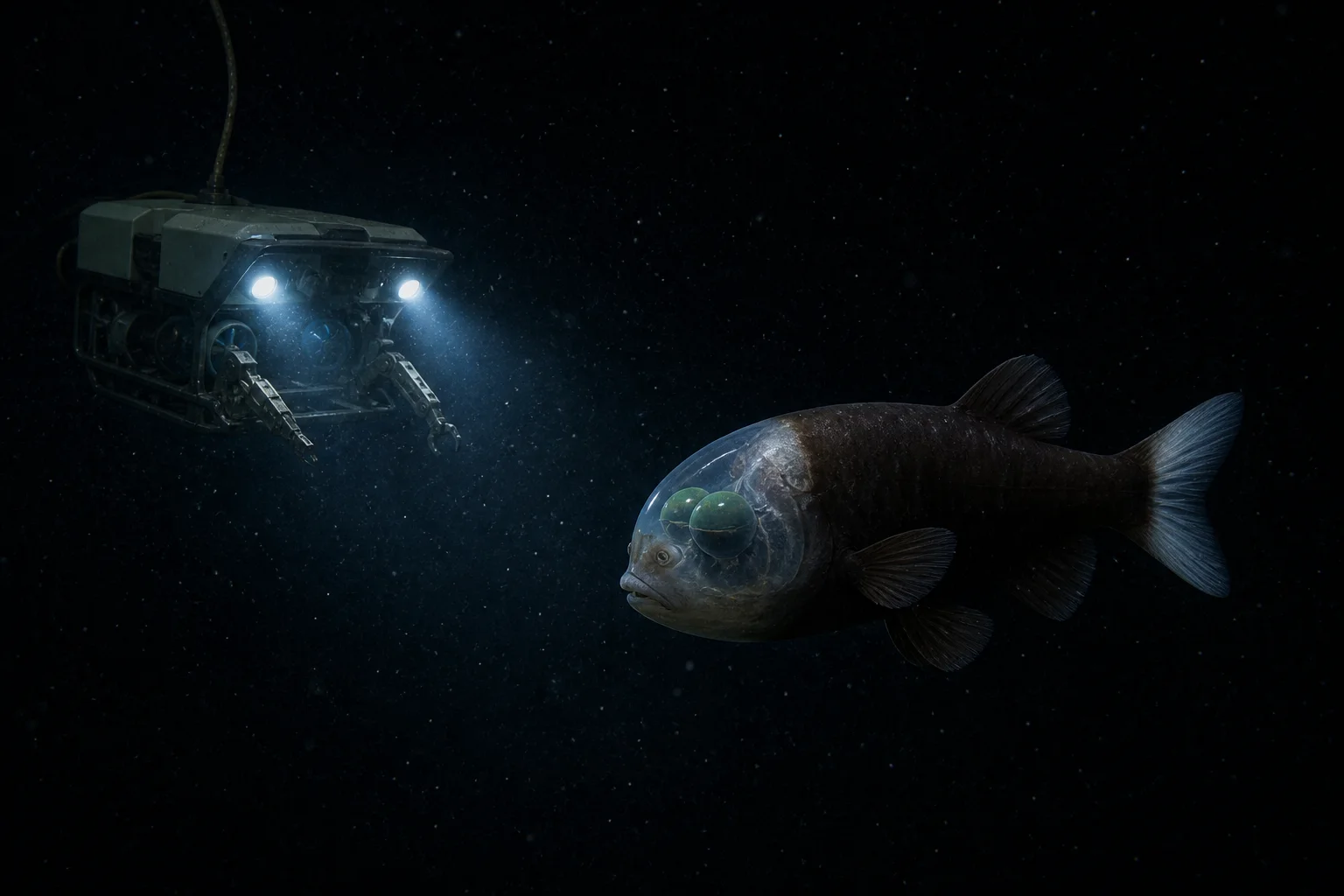
In 2009, researchers at the Monterey Bay Aquarium Research Institute used video from remotely operated vehicles to document the answer. The fish can rotate its tubular eyes from their usual upward position toward the front of the head. A fish that spends much of its time scanning the ceiling of the ocean can therefore shift its view when it brings food close.
That movement is easy to describe but strange to picture. Imagine walking through a dark room while looking at the ceiling, then swivelling your eyes forward without turning your head when you reach for a snack. The barreleye’s transparent head is part of the same arrangement: it gives the eyes room to move while keeping their delicate surfaces shielded.
Editorial illustration of a remotely operated vehicle meeting a barreleye in its deep-sea habitat.
A rare fish made visible by patient machines
Barreleyes are rare sights, even for researchers who spend years sending cameras into the deep. The Monterey Bay Aquarium says MBARI remotely operated vehicles logged more than 5,600 dives over more than three decades, yet had encountered the fish only nine times as of 2022.
That scarcity helps explain why a familiar-looking fish can still hold a scientific surprise. Early observations gave researchers an incomplete picture because the animals were seen only briefly, far below the surface and under artificial lights. Repeated expeditions and better video made it possible to connect the fish’s odd anatomy with its behavior.
The ROV does more than make a dramatic picture. It allows scientists to watch an animal without bringing it into a tank, where pressure, light and the surrounding water would be radically different. The aquarium describes its deep-sea encounters as video observations of animals in their habitat, adding movement and context to what specimens alone can show.
Editorial illustration of the barreleye’s two viewing positions: upward scanning and forward feeding.
Inside the clear dome
The dome is a transparent, fluid-filled structure that covers the eyes and upper part of the head. The visible green tubes are the eyes; the small spots on the front of the fish’s face are its nostrils, or nares.
The fish’s appearance also comes with an important limit on what researchers can say. Scientists know the barreleye’s upward gaze helps it detect prey above and that its eyes rotate forward for feeding. They have proposed additional advantages, including protection from stinging siphonophore tentacles, but the aquarium presents those ideas as hypotheses rather than settled facts.
That distinction is part of the animal’s appeal. The barreleye’s transparent head, periscope-like eyes and daily view of a dark water column make it extraordinary on their own. A camera lowered into that darkness revealed a fish whose strangest feature is also a carefully tuned solution to life where almost no light reaches.
For a human observer, the fish seems built backward. For the barreleye, the arrangement is practical: watch the ceiling, track a meal, turn the eyes, eat, and return to the dark. The clear head is a working adaptation for life in a place where looking up is the difference between finding food and missing it.
Deep inside Virginia’s Luray Caverns, a keyboard can make a cave sing. The instrument is real, but its origin story has more than one version.
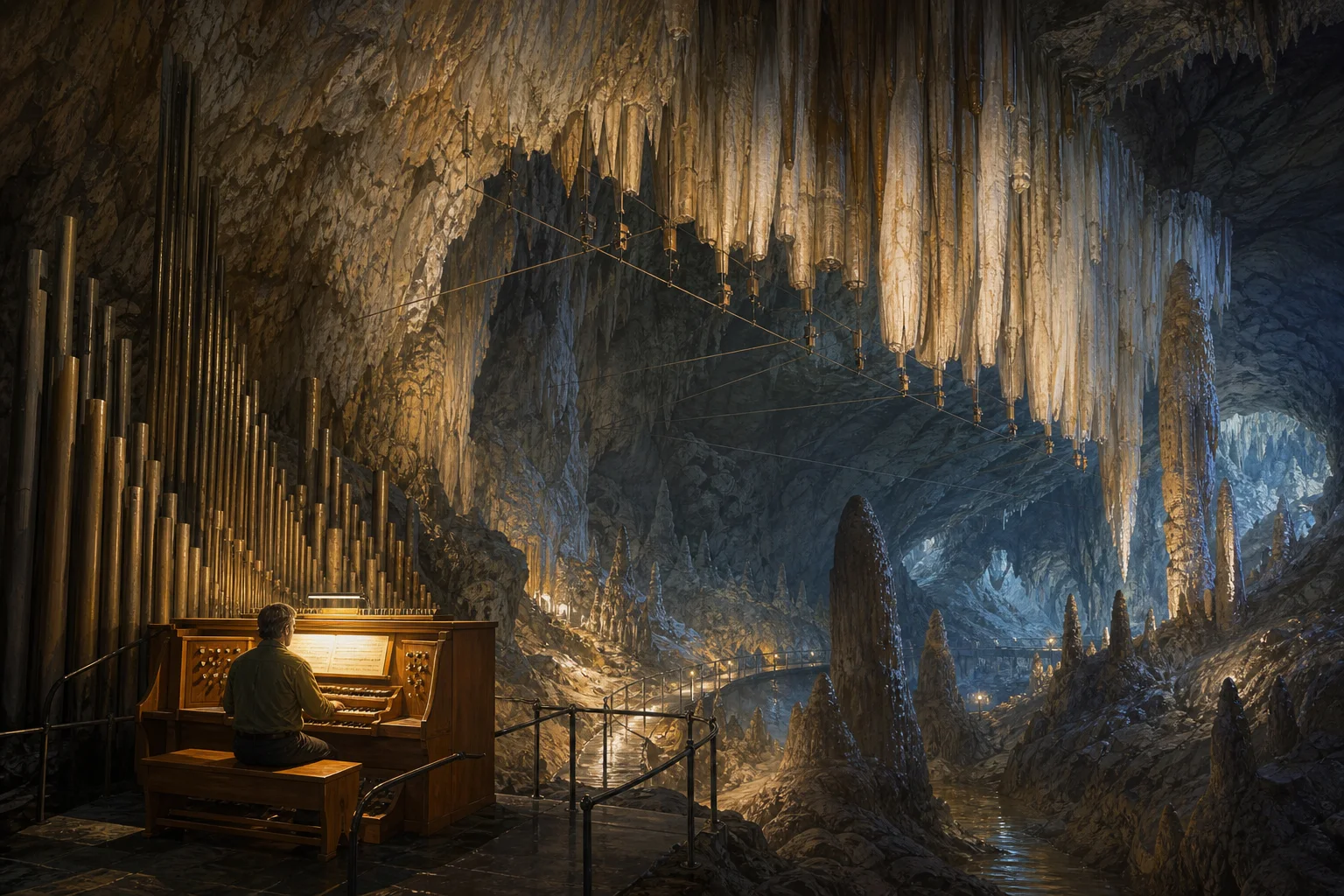
Editorial illustration: the Great Stalacpipe Organ occupies a network of tuned formations inside Luray Caverns.
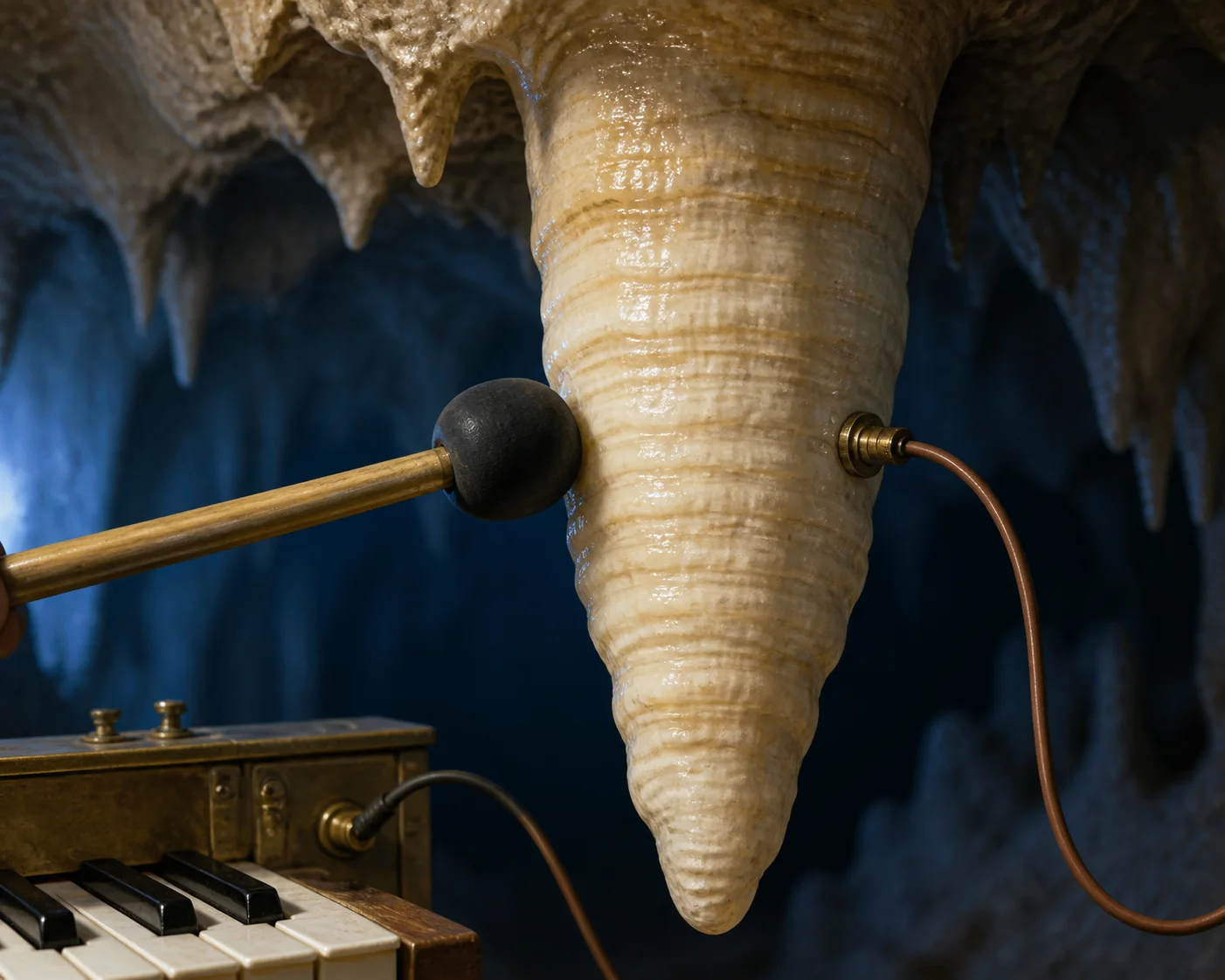
Most keyboards send electricity to speakers. The Great Stalacpipe Organ sends it to rubber-tipped mallets hidden around a cavern, where they tap selected stalactites. The result is a musical instrument whose “pipes” are mineral formations and whose concert hall is the cave itself.
A strange idea, tested patiently
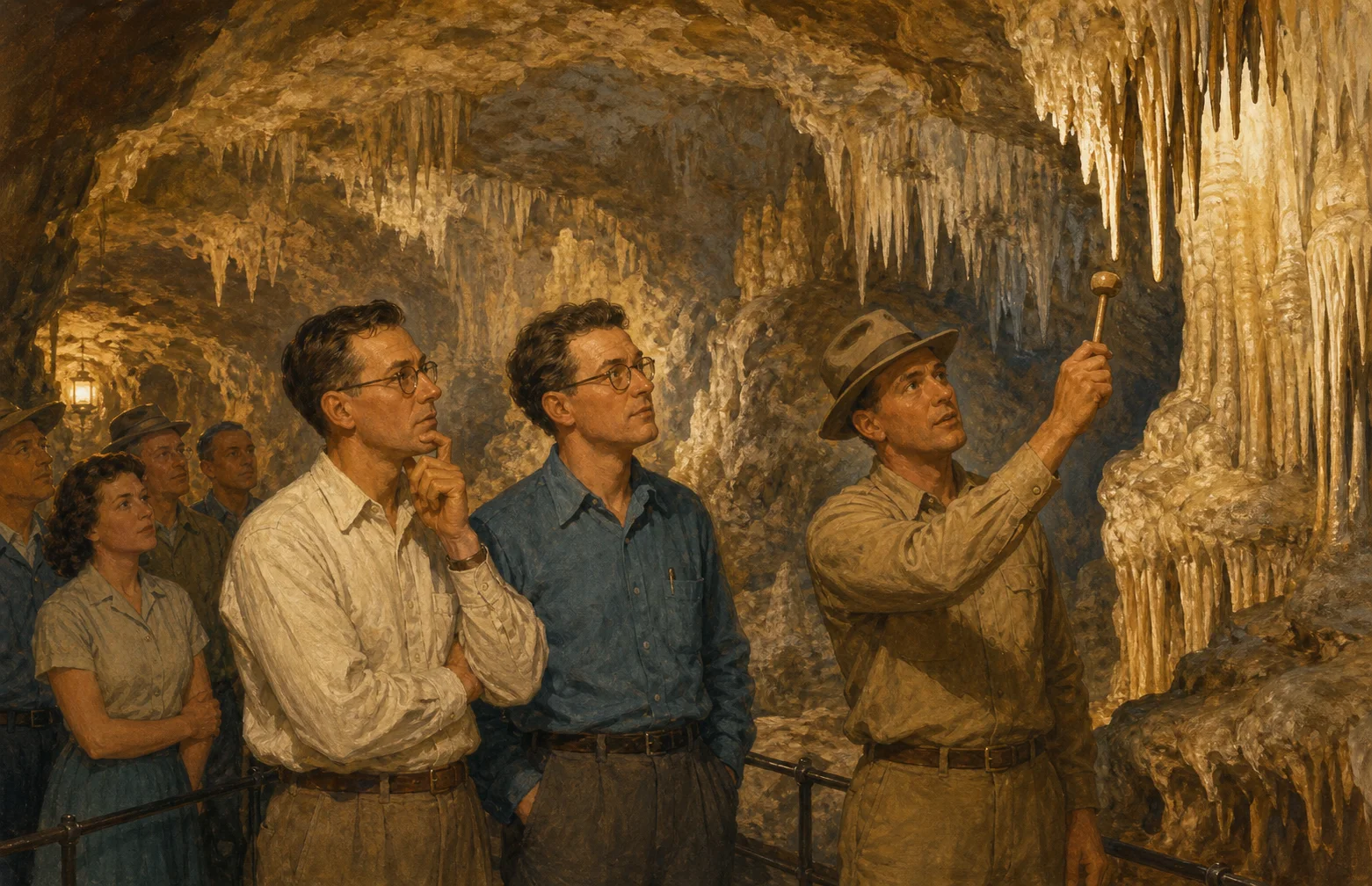
The documented version of the story begins in 1954. Leland W. Sprinkle, a mathematician and electronics scientist who worked at the Pentagon, visited Luray Caverns in Virginia with his son. Guides then demonstrated the formations by tapping them with a small mallet; different shapes produced different tones. Luray Caverns’ own history says that demonstration gave Sprinkle the idea for a much larger instrument.
Sprinkle spent the next three years testing formations across more than 3.5 acres of the cave. The cavern’s account says he used 13 English tuning forks while searching for tones, then carefully altered selected stalactites to bring them to pitch. Electrical mallets and wiring connected those formations to a large, four-manual console.
Editorial illustration: a cave-tour demonstration is the documented spark in Luray’s account of Sprinkle’s idea.
It is not quite a pipe organ
The name is a playful mash-up of “stalactite” and “pipe organ.” In engineering terms, the Stalacpipe is closer to a giant, electrically actuated lithophone: a keyboard triggers mechanical strikers, and the stone itself vibrates. PBS NewsHour described the working instrument as a 37-note percussion instrument. Luray says the mallets are rubber-tipped plungers, so the formations can sound without a performer taking a hammer to the cave by hand.
The cavern adds the instrument’s unusual scale. Guinness World Records lists the Great Stalacpipe Organ as the largest natural underground musical instrument, with stalactites covering 1.4 hectares, or about 3.5 acres. That is a measurement of the instrument’s reach through the cave—not a claim that the organ is the world’s largest conventional pipe organ. Guinness maintains separate records for conventional organs, an important distinction when a superlative is doing a lot of work in a headline.
Editorial illustration: a keyboard signal activates a mallet beside a tuned stalactite.
What is fact, and what is folklore?
Confirmed by the strongest available accounts: Sprinkle visited Luray in 1954; he was inspired by the sound of tapped formations; he developed the instrument over three years; electronic mallets connect selected stalactites to an organ-style console; and Guinness records the instrument’s 3.5-acre underground span. Luray also says the organ can still be played manually, although an automated system now plays many public melodies in a player-piano-like fashion.
Folklore or disputed retelling: later accounts sometimes say Sprinkle’s son struck his head on a low stalactite, and that the accidental note sparked the invention. It is a memorable detail, but it is not the origin story given in Luray’s own account or in the PBS description of the 1954 visit. The careful version is therefore the less cinematic one: a guide demonstrated the cave’s tones, and an observant engineer decided to build a system around them.
Why the stone can sing
Stalactites are not hollow pipes waiting for air. They are cave formations built when water dissolves limestone, carries calcium carbonate into an air-filled chamber, and deposits the mineral as the water loses carbon dioxide or evaporates. The National Park Service explains that stalactites hang from cave ceilings and can take thousands of years to form.
When one of these formations is struck, it can vibrate. Its dimensions and density determine the tone, much as the length and material of a xylophone bar affect its pitch. Sprinkle’s achievement was not making nature obey a mythic musical rule; it was identifying usable tones, shaping some formations with care, and building the electromechanical link that lets a person play them from a keyboard.
That is why the Great Stalacpipe Organ remains such a satisfying oddity. It is neither a geological miracle that composes by itself nor a conventional organ hidden underground. It is a patient human invention wrapped around very old stone—and a reminder that sometimes the weirdest instrument begins with somebody listening closely to a tour guide.
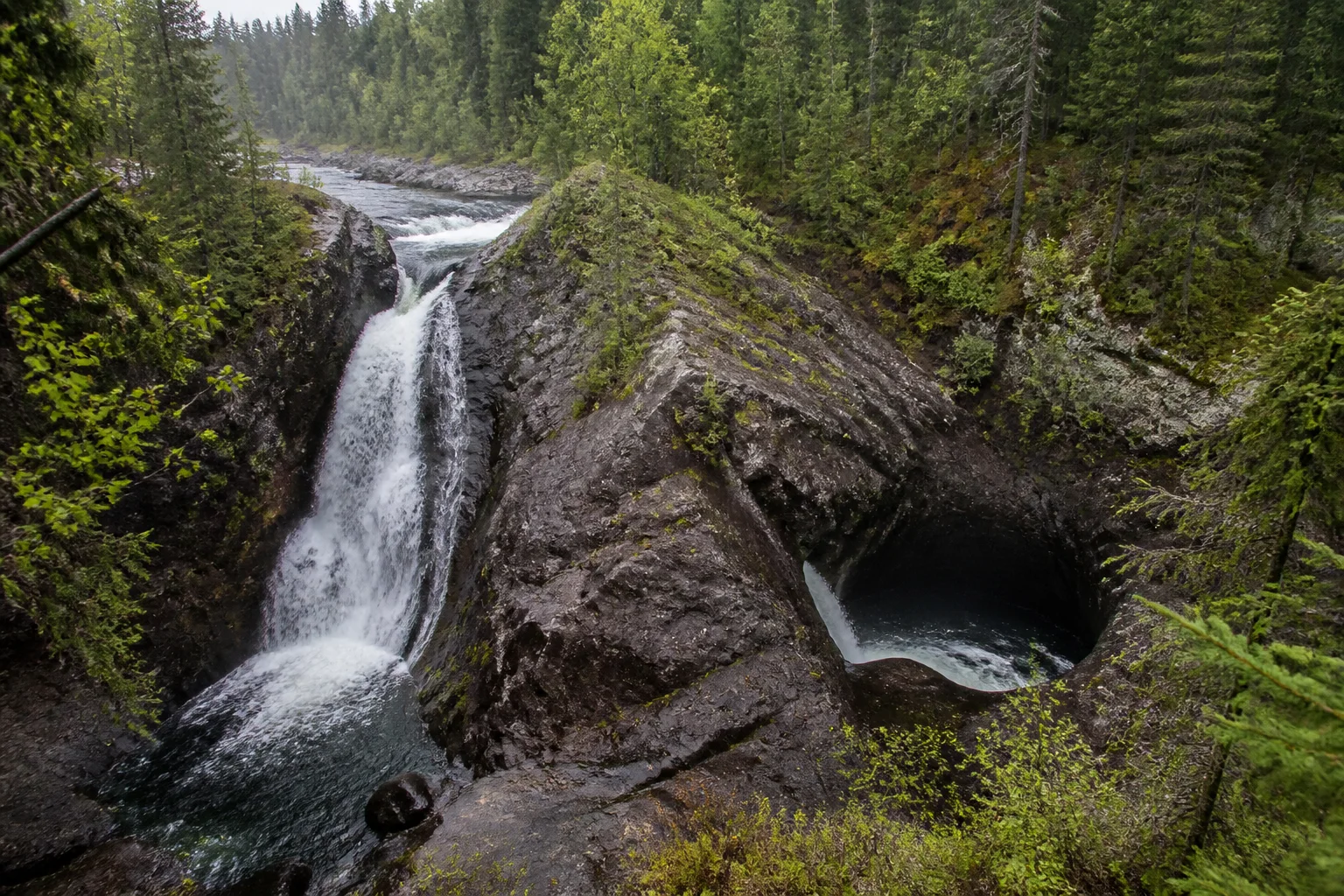
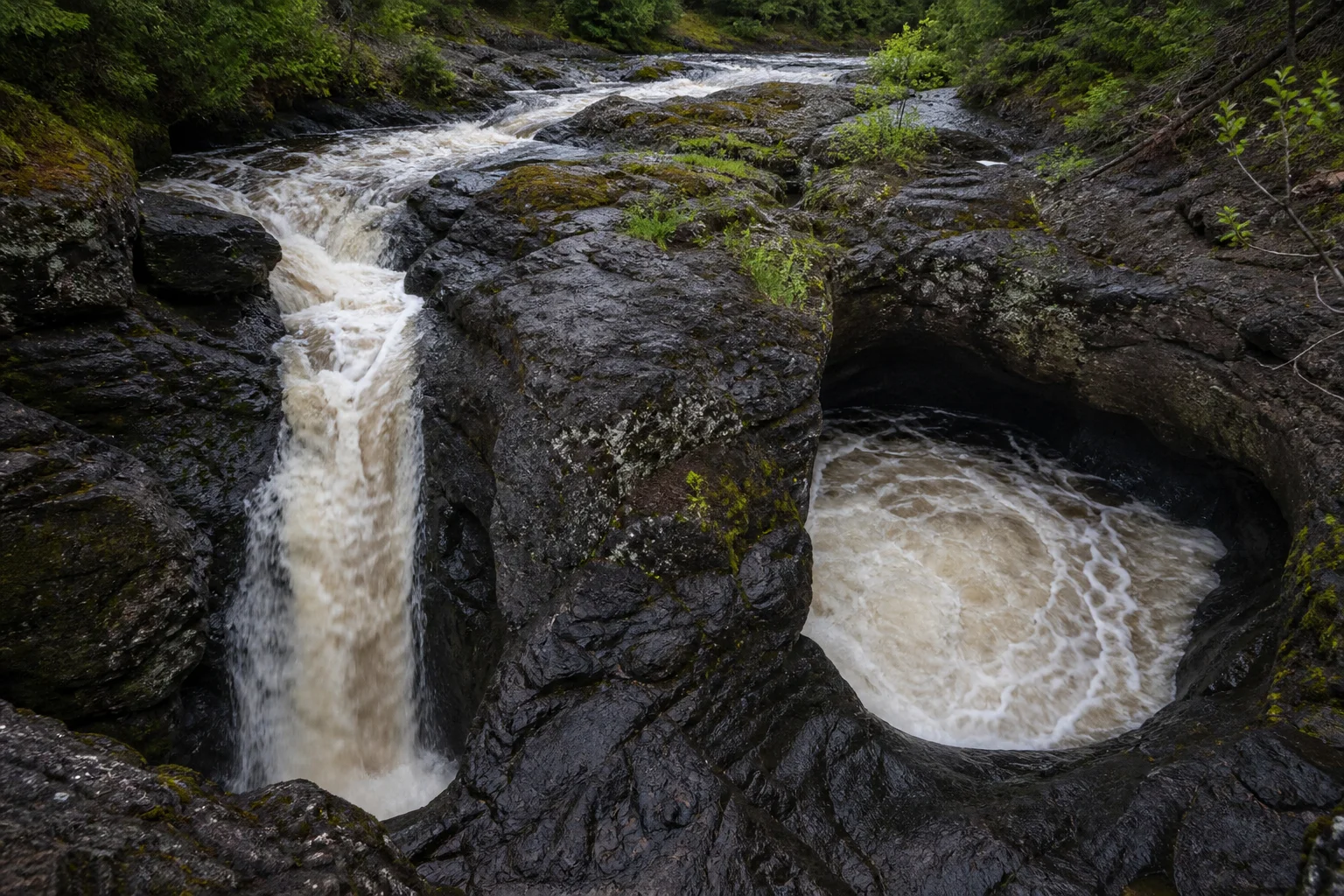
At first glance, Devil’s Kettle Falls looks like a river with a secret exit. The Brule River reaches a dark volcanic outcrop in northern Minnesota, splits in two, and sends one branch into a pothole that appears to swallow the flow. The odd part is real. The supernatural part is optional.
At Devil’s Kettle, the river’s two branches make the same landscape look like two different kinds of waterfall. Editorial illustration.
A hike toward a very strange fork
Devil’s Kettle sits in Judge C.R. Magney State Park, on Minnesota’s North Shore near Grand Marais. The park’s current map describes a one-mile walk along the Brule River, including roughly 175 stairs, to reach the falls. It is a small adventure with a large visual payoff: the river divides around a mass of volcanic rock, and the western branch pours into what the park calls a massive pothole.
The eastern branch behaves the way visitors expect a waterfall to behave, dropping about 50 feet into a pool. The western branch disappears from view. That vanishing act is why people have long tossed sticks and other buoyant objects into the hole, hoping to see them reappear farther down the river.
The natural setting is dramatic enough without adding a portal: wet rhyolite, whitewater and boreal forest do the work. Editorial illustration.
The two numbers that changed the story
For years, the most tempting explanation was that the missing water took a hidden route all the way to Lake Superior. That is folklore and speculation, not a demonstrated destination. Minnesota DNR geologists also noted that the North Shore’s hard volcanic rocks do not readily form the kind of broad limestone cave systems people often imagine.
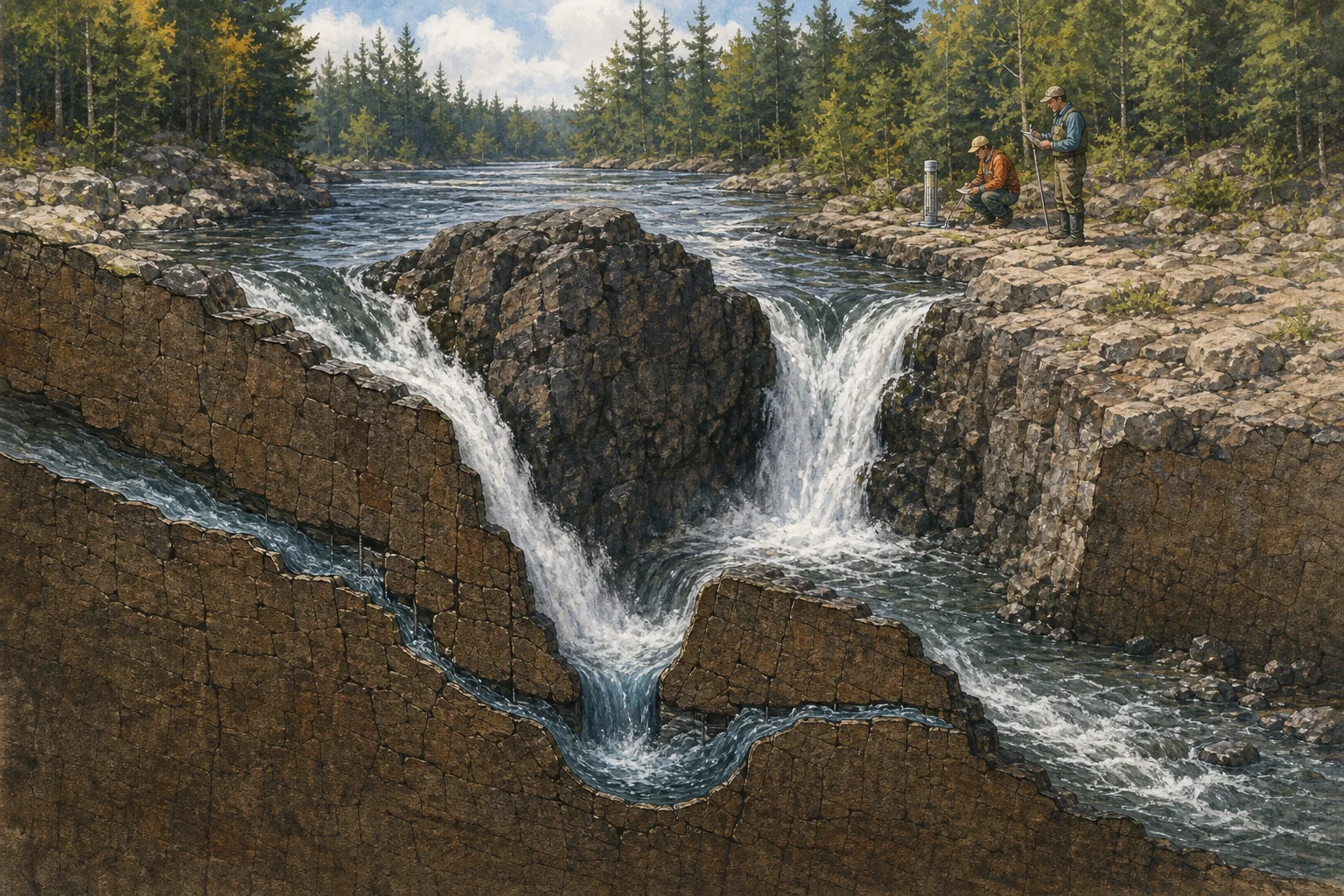
Then hydrologists tested the question in a less cinematic way: they measured flow. In late fall 2016, the Minnesota Department of Natural Resources recorded 123 cubic feet per second above the falls and 121 cubic feet per second several hundred feet below them. The DNR says those readings are essentially the same within the equipment’s tolerances. In other words, the water had not left the river system between the two gauges.
That is the confirmed answer to the big question: the water that drops into Devil’s Kettle resurges in the Brule River downstream. It is not an underground highway to a distant lake. The DNR’s account does not identify a single visible outlet or map every foot of the underground path, so “the water comes back downstream” is more precise than pretending the exact route is fully charted.
Why the sticks never made a triumphant return
The disappearing objects are a separate puzzle. The DNR’s hydrology explanation is that the plunge pool contains powerful recirculating currents. Water can hold an object below the surface, grind it against rock or break it apart before material resurfaces downstream. A stick failing to pop out beside the next footbridge is therefore not evidence of a bottomless hole.
Hydrologists can solve a disappearing-water question by comparing flow above and below the falls; the precise underground route remains a finer-grained geology question. Editorial illustration.
What is fact, what is folklore?
Documented: the Brule River splits at a volcanic outcrop; one branch drops about 50 feet and the other enters a pothole; the park sits within a roughly 1.1-billion-year-old volcanic landscape.
Measured: DNR gauges found nearly matching flow above and below Devil’s Kettle in 2016.
Explained, but not point-by-point mapped: the missing branch resurges in the river downstream, while recirculating currents help explain why tossed objects are not obvious afterward.
Folklore/speculation: stories that the water travels through a secret tunnel to Lake Superior, or that the pothole is bottomless.
That distinction is the charm of Devil’s Kettle. A person standing at the overlook can still feel the old mystery: half a river really does vanish. The satisfying answer is simply more interesting than a portal. Ancient volcanic rock, turbulent water and a pair of nearly identical measurements are enough to make a perfectly ordinary river look impossible for a minute.
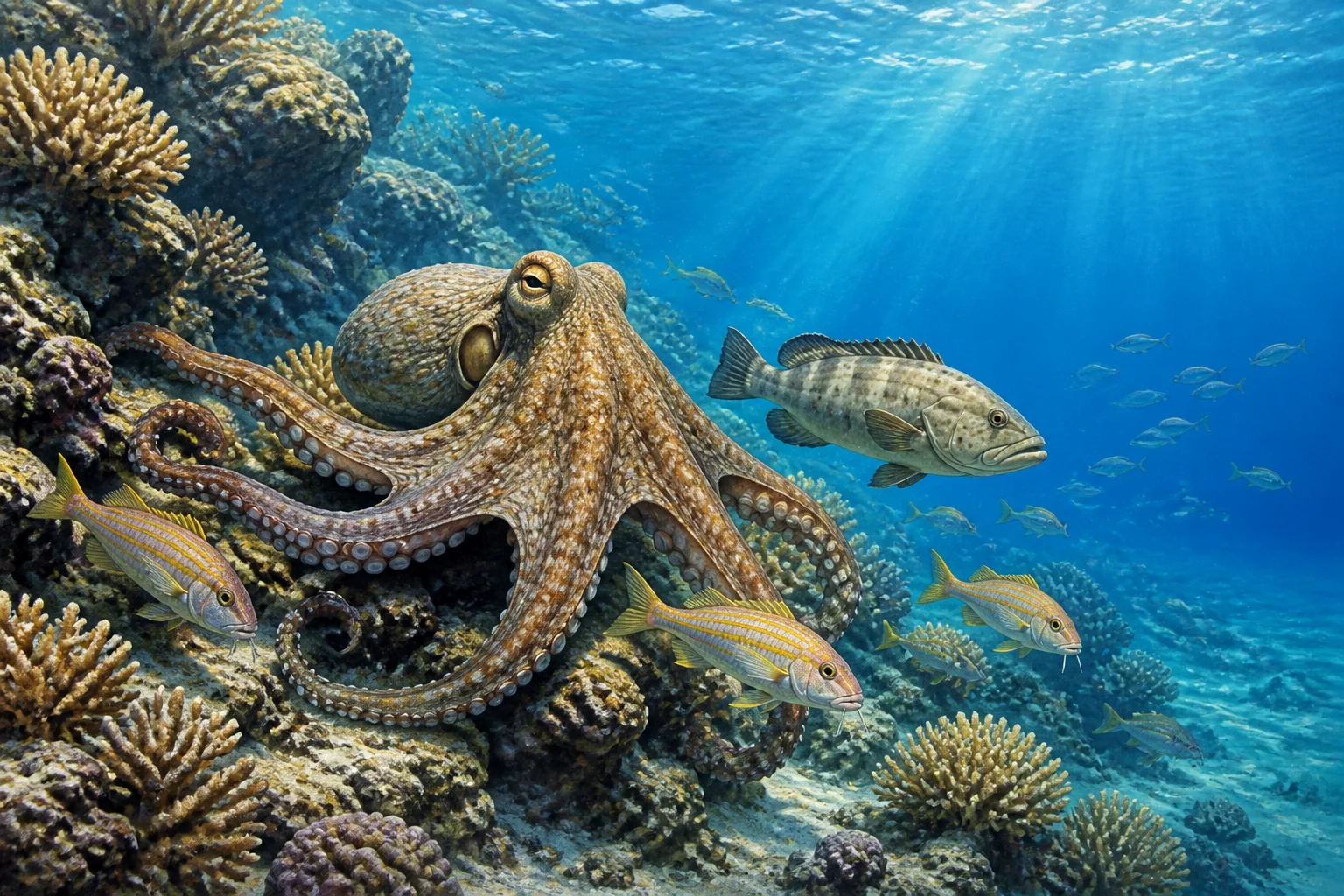
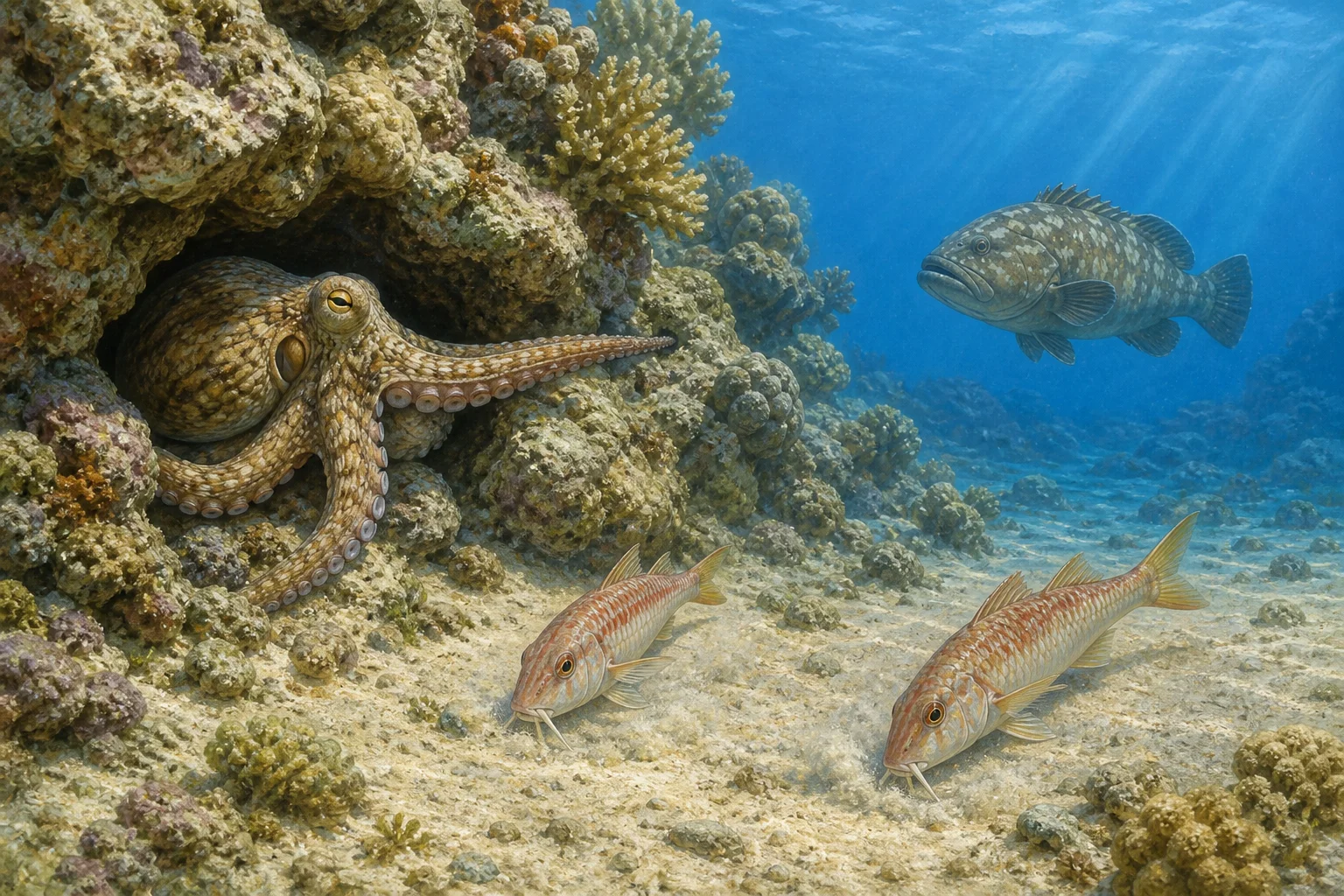
On a coral reef, an octopus can look like the least likely member of a hunting party. Yet day octopuses (Octopus cyanea) have been documented foraging alongside several kinds of fish. The fish search in one set of places, the octopus searches in another, and the group can keep moving for more than an hour. The strangest detail is real: researchers have filmed an octopus using a swift arm movement to knock a particular fish away.
It is tempting to call that a fishy workplace dispute. The useful version of the story is more interesting. These are mixed-species hunts in which the animals’ different ways of finding prey can fit together—and in which the costs and rewards do not always line up.
It is a hunt with different jobs
A 2021 field report described groups in the Red Sea that included a day octopus and several fish species. In those groups, the octopus can search inside rock and coral crevices. Bottom-feeding goatfish work a broader patch of seafloor, while other fishes can occupy the water around the reef. The researchers note that some fish are active partners and that others may simply take advantage of opportunities created by the group.
That does not make the arrangement a tidy team with fixed ranks. Fish can help locate places worth searching, and octopuses can also follow fish partners toward prey. A later study, published in 2024, used field video, three-dimensional tracking and experiments to examine these groups more closely. Its authors found that influence was divided by task: goatfish were especially important in exploring and setting direction, while the octopus had a stronger role in when the group started moving.
Editorial illustration: a visual interpretation of complementary foraging zones in an octopus–fish hunting group.
What researchers mean by a “punch”
The word is descriptive, not a claim that an octopus boxes like a person. In the 2021 report, the authors documented eight events in which an octopus made a fast, explosive motion with one arm toward a specific fish. The action displaced the fish. The observations came from different day octopuses in Eilat, Israel, and El Quseir, Egypt, and involved several kinds of groupers, goatfish and a squirrelfish.
In some recordings, the octopus immediately searched where the fish had been, a pattern consistent with direct competition for a prey opportunity. In other recordings, it did not. That distinction matters: the paper does not claim that every strike has the same cause, and it calls for closer study of what happens before and after a fish is targeted.
“Punishment” is a hypothesis, not a translation
The researchers offered several possible explanations for the events where no immediate prey grab followed. One is that the movement could impose a cost on a fish that is exploiting the hunt. Another is that a short-term cost might influence a partner’s behavior in later interactions. The paper also discusses “spite” in a technical game-theory sense, explicitly without an emotional meaning.
Those possibilities are not evidence that an octopus is angry, vengeful or running a reef courtroom. They are ways to test how cooperation holds together when unrelated species share an opportunity. The 2024 study strengthens the case that group composition changes how much each animal invests and how successful the hunt can be; it does not turn every arm movement into a proven disciplinary message.
Why this small reef scene matters
Octopuses are often described as solitary animals, so a group hunt with fish is already a useful corrective to the usual picture. The odd arm movement adds another lesson: cooperation in nature need not be gentle, equal or simple. A group can contain complementary skills, opportunists and conflicts at the same time.
The verified weirdness is therefore not that an octopus has discovered human-style office politics. It is that a soft-bodied invertebrate and several kinds of fish can form a moving hunting group, divide influence across different decisions, and occasionally settle a conflict with one very deliberate-looking arm.
Editorial illustration: On the face of Antarctica’s Taylor Glacier, a rust-red stain spills across ice. The name is Blood Falls, but the color comes from iron-rich brine meeting the air—not from anything biological in the dramatic sense the name suggests.
A red streak in a white desert
Blood Falls appears at the terminus of Taylor Glacier in the McMurdo Dry Valleys, one of Antarctica’s starkest landscapes. It can look uncannily like a small waterfall bleeding through the ice. The visible outflow is real, but it is not an ordinary river and it is not a permanent red torrent. It is an episodic release of extremely salty, iron-rich brine from within and beneath the glacier.
That distinction matters. The National Science Foundation describes the material as an iron-rich brine seeping from below the glacier. A 2022 study based on time-lapse imagery and seismic data similarly identifies an episodic discharge of hypersaline, iron-rich brine. Researchers observed one release beginning during the Antarctic winter; the exact trigger for these releases remains unresolved.
Editorial illustration
Why the brine turns red
The striking color is chemistry. The brine contains dissolved iron. In the oxygen-poor environment below the glacier, much of that iron can remain in a reduced form. Once the fluid emerges and encounters oxygen at the surface, oxidation produces iron-bearing minerals—the same broad family of reactions that gives rust its familiar orange-red and brown colors. The result is a mineral stain that contrasts sharply with blue-white ice.
“Rusty brine” is more accurate than the waterfall shorthand, but it should not make the process sound simple. The outflow is salty enough to stay liquid in conditions where fresh water would freeze, and it travels through a cold glacial environment whose pathways are difficult to inspect directly. Radar research has identified a body of brine upstream inside Taylor Glacier, while other work describes a broader subglacial or englacial hydrologic system feeding the outflow.
Editorial illustration
It is also a microbial habitat
Blood Falls is strange for more than its color. Earlier microbiology research found a diverse bacterial community in the outflow and evidence consistent with iron and sulfur transformations in this isolated, cold environment. That does not mean microbes are simply “making the blood color.” The red appearance is tied to iron chemistry at the surface; the microbes are part of the separate and still fascinating story of how life persists in a dark, salty sub-ice system.
The glacier therefore gives researchers a natural laboratory for two linked questions: how brine can move through very cold ice, and how microbial communities can endure in such chemically unusual conditions. Those questions are especially useful as scientists consider possible habitats on icy worlds, but Blood Falls itself remains a place on Earth with its own local rules and unanswered details.
What remains unknown
The evidence supports the basic explanation: salty, iron-rich brine periodically reaches the surface of Taylor Glacier, where iron oxidation contributes to the red-brown stain. The timing of a specific release is less settled. The 2022 study found no clear burst of the seismic signal it tested before or during a documented winter release, and suggested that small fracture events could be hidden by background seismicity. That is a useful scientific boundary, not a flaw in the story. The color has an evidence-backed explanation; the plumbing and release mechanism are still being worked out.
Blood Falls earns its weird reputation without any mythmaking. It is a small, intermittent mineral outflow, made visually enormous by the emptiness and brightness of the Antarctic ice around it.
Most spiders use silk to make a web in air. The diving-bell spider uses silk to hold an air room underwater—and then spends nearly its entire life inside the pond.
Argyroneta aquatica, often called the diving-bell spider or water spider, is a freshwater species found across parts of Eurasia. It still breathes air, but it does not make a routine of living on shore. Instead, it builds a dome-shaped silk web among submerged plants and fills that web with air carried down from the surface. The resulting chamber is its diving bell.
The design is stranger than a simple storage bubble. Experiments have shown that the bell can take up dissolved oxygen from the surrounding water. That makes it a “physical gill”: an air chamber that exchanges gas across its surface, even though the spider itself has no fish-like gills.
How the spider moves air below the surface
The spider begins with a surface trip. Water-repelling hairs on its body help it hold a bubble of air as it dives. It carries that bubble to an underwater sheet of silk, where surface tension keeps air gathered among the web’s fibers. Repeating the trip builds a chamber large enough for the spider to enter from below.
That chamber does more than give the animal a dry place to pause. Research on the spider’s behavior describes diving bells as sites for feeding, molting, reproduction, and raising young. The air bell is therefore both shelter and respiratory equipment—made by an animal that normally belongs to the land-dwelling branch of the spider family tree.
Editorial illustration: the spider repeatedly carries surface air to a silk-supported chamber below.
Why the bubble works like a physical gill
Air inside the bell and water outside it have different gas concentrations. As the spider uses oxygen in the bell, dissolved oxygen in the water can diffuse inward. Carbon dioxide produced by the spider can diffuse out. The system is not the same as a permanent oxygen generator, and it does not eliminate the need to renew the air. Nitrogen also leaves the bell over time, shrinking the air store.
But the exchange is meaningful. In a 2011 study, researchers measured the volume and oxygen pressure of diving bells with tiny fiber-optic sensors. Their results showed that a bell could supply a resting spider’s oxygen needs under the experiment’s warm, stagnant-water conditions. Larger spiders built larger bells, which had greater oxygen conductance because they presented more surface area to the water.
That finding also explains why a diving bell is more capable than a small bubble stuck to a body. A web lets the spider suspend a comparatively large air surface underwater. The bell is external to the animal, but its size and placement make it part of the spider’s breathing strategy.
The air room has limits
The phrase “lives underwater” can create the wrong picture of a spider that never returns to the surface. It does. The 2011 experiments found that spiders refreshed the bell’s air when oxygen pressure inside fell sufficiently low, and the authors concluded that renewal is ultimately necessary because nitrogen is lost from the bubble. Under the tested conditions, however, spiders could remain in the bell for more than a day before another surface trip.
That is not a contradiction. The diving bell is a reservoir and a gas-exchange surface at the same time. Water can add oxygen to it, but the bubble’s changing gas mix and volume mean the spider must maintain it. The animal is not holding its breath for a day; it is tending a tiny underwater room whose air is constantly changing.
What scientists tested, and what they did not claim
Editorial illustration: a silk web supports the bell’s air chamber among submerged freshwater plants.
A web that changes the habitat
Plenty of animals transport air underwater for a short dive. The diving-bell spider goes further by building a structure that changes the space around it. Its silk holds a stable pocket where it can eat, molt, reproduce, and rest. Its repeated visits to the surface keep that pocket usable. And oxygen diffusing through the bubble wall gives the chamber an extra assist from the pond itself.
It is an elegant example of animal construction with clear boundaries: not a magical sealed aquarium, not a conventional gill, and not simply a bubble. It is a maintained air bell, spun from silk, operating where a spider seems least likely to make a home.
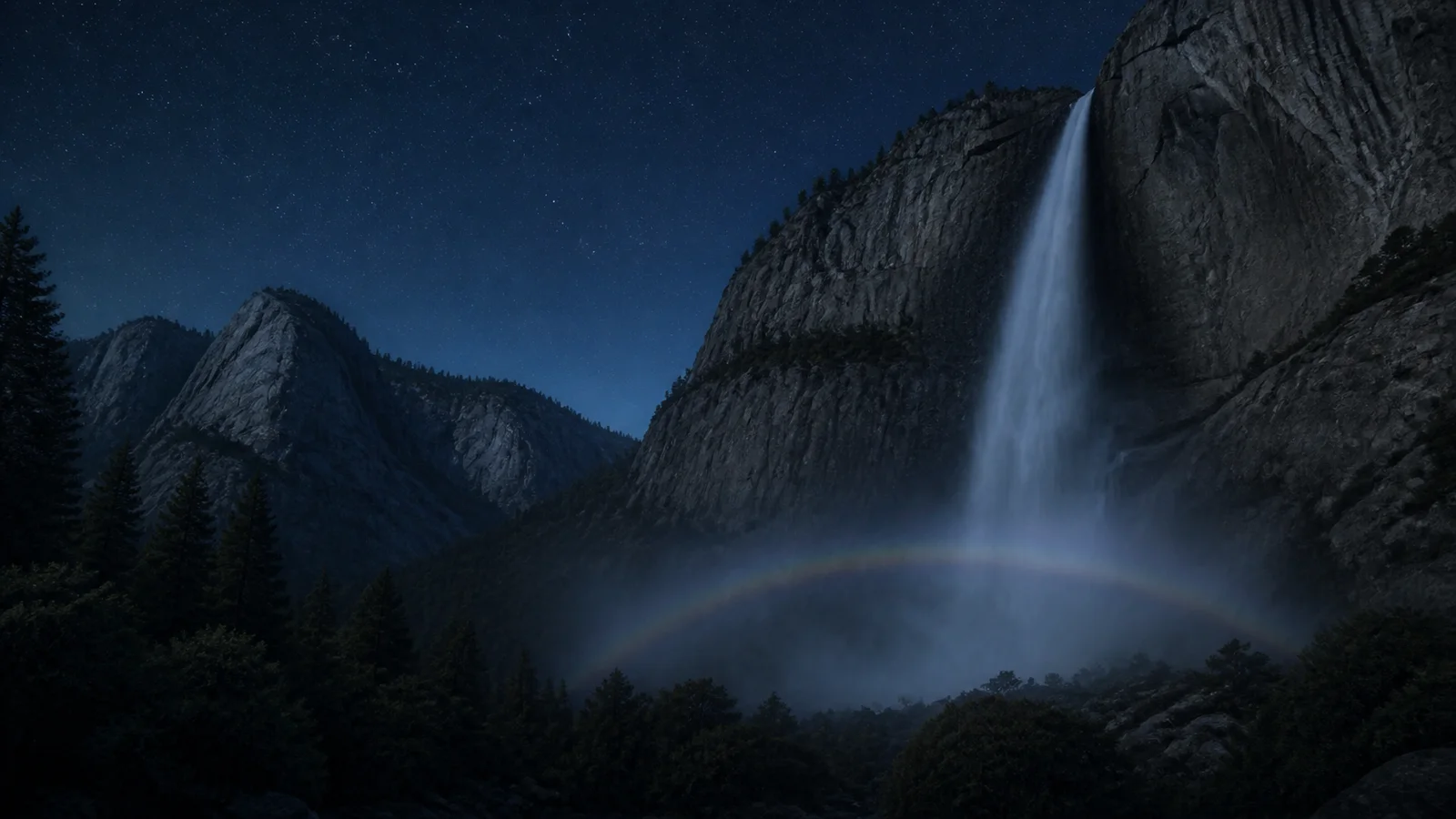
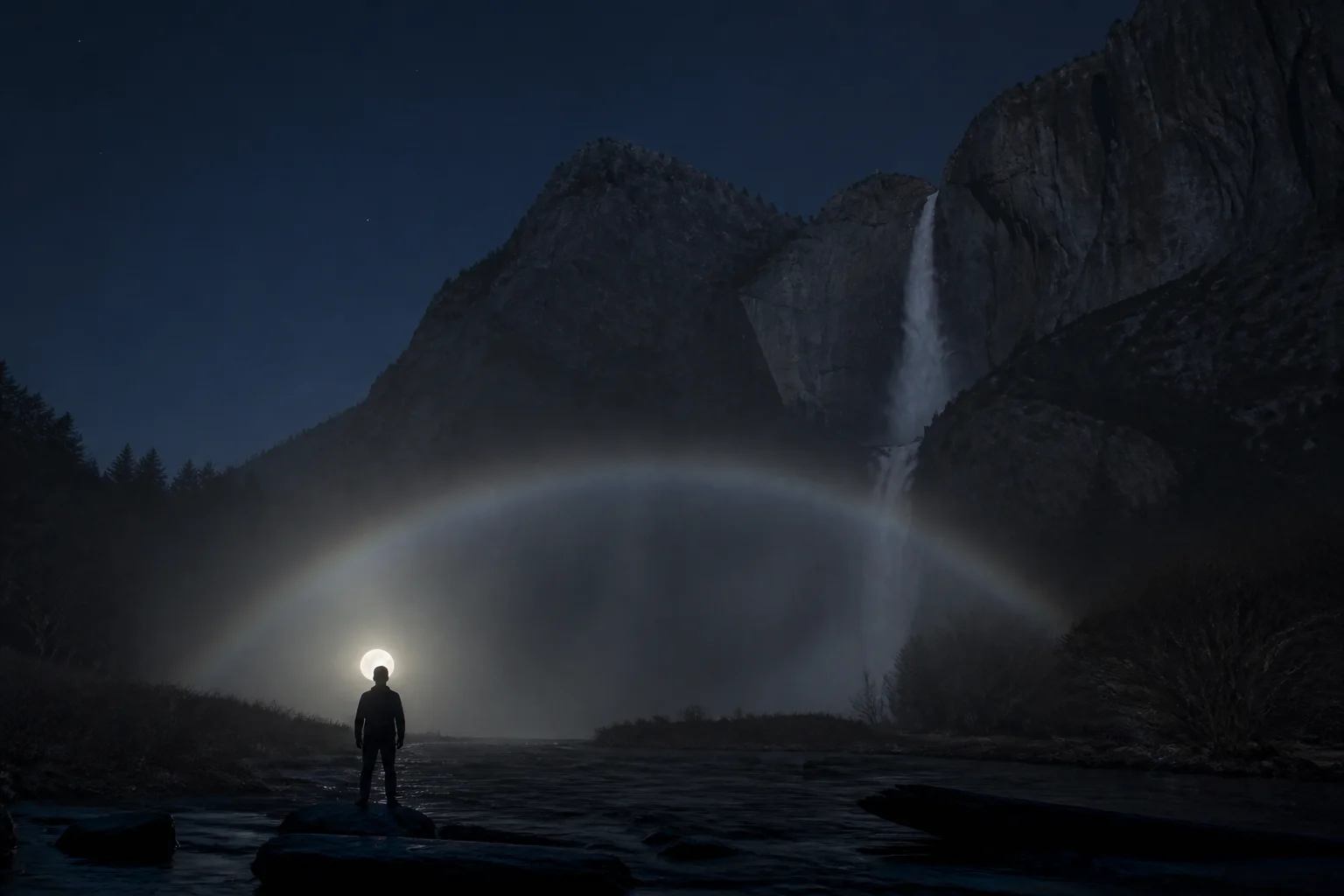
For a few nights in Yosemite’s spring waterfall season, moonlight can draw a rainbow in the spray of Yosemite Falls. The effect is real, and it has an odd visual twist: the National Park Service says Yosemite’s moonbows often look gray to an unaided eye even though photographs can reveal color.
A moonbow is not a second kind of rainbow or a trick of a camera. It is a lunar rainbow: moonlight passes through airborne water droplets, bends as it enters and leaves them, and is reflected inside them. The difference is the light source. Sunlight makes familiar daytime rainbows; far dimmer moonlight can make the same optical geometry visible in waterfall mist.
Editorial illustration: Moonlight and waterfall mist can align to make a faint lunar rainbow.
Why a rainbow appears after dark
NOAA’s explanation of an ordinary rainbow starts with a water droplet. Light bends when it enters the denser water, reflects inside the drop, and bends again as it exits. Because the colors of light bend by slightly different amounts, many droplets together can send a colored arc toward the viewer. A rainbow is therefore an optical effect tied to the viewer’s position, not an object hanging in a fixed spot.
For a moonbow, the waterfall supplies the droplets and the Moon supplies the illumination. The useful alignment is the familiar rainbow arrangement: the light source is behind the viewer and the lit spray is ahead. At Yosemite, the Park Service says that full-moon nights during the peak waterfall season, generally April through June, can produce moonbows in the mist of Upper and Lower Yosemite Falls.
Editorial illustration: The bow is seen in droplets ahead of the viewer, opposite the Moon.
Why the colors can disappear to human eyes
The event is dim because moonlight is reflected sunlight. That does not alter the basic optics, but it changes what a viewer can readily perceive. Yosemite’s National Park Service guidance says the moonbows look gray to the unaided eye while their colors can stand out in photographs. NASA’s Astronomy Picture of the Day makes the same practical point with a waterfall moonbow photographed using a 30-second exposure: a camera can collect weak light over time in a way a quick glance cannot.
That is why a highly saturated image should not be treated as a report of what every visitor sees in the moment. It can be a record of the same phenomenon, but exposure, processing, and the viewer’s own dark adaptation affect how strongly the colors register. The documented fact is the moonbow itself; the apparent intensity is not a universal measure.
A narrow window, not a nightly show
Calling the event a “lunar rainbow” can make it sound routine. The Park Service’s wording is narrower: these are special nights, and their timing is tied to a full moon plus enough waterfall mist. Yosemite Creek is snowmelt-fed and the falls commonly diminish later in the year, so a full moon by itself is not a promise of a moonbow.
Visitors should also separate the natural phenomenon from travel assumptions. The Park Service says Yosemite is open around the clock, but access, water flow, weather, and the Park’s current conditions all matter. A moonbow is best understood as a rare consequence of ordinary things—light, falling water, and a particular viewing angle—briefly lining up after dark.
Editorial illustration: In low light, the arc can appear pale and subdued to a viewer.
Fact, folklore, and photography
Documented fact: Yosemite’s waterfall mist can form moonbows on suitable full-moon nights in spring and early summer.
Not folklore: “moonbow” is simply a name for a lunar rainbow. It does not require unusual lunar activity, a special kind of water, or a camera effect invented after the fact.
Photography note: a colorful long-exposure image can truthfully depict a moonbow while still looking more vivid than the scene appears to an unaided observer. That distinction makes the phenomenon more interesting, not less: the rainbow is physically present, but human vision and a camera do not record dim light in the same way.