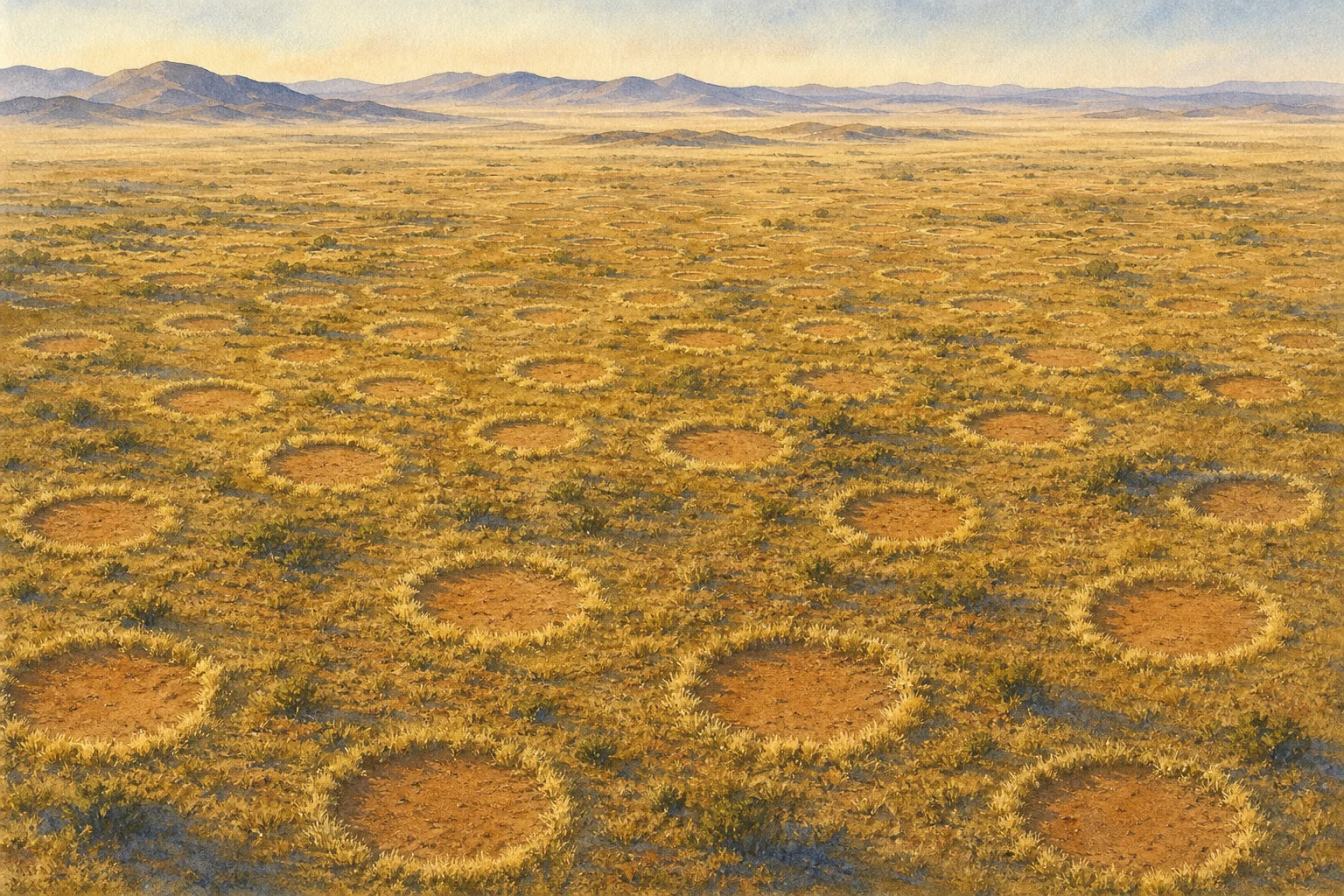
Across the dry grasslands along the eastern edge of the Namib Desert, bare circles repeat across the landscape with an order that looks almost designed. Many have a rim of taller grass. In dense fields, the gaps can settle into a roughly hexagonal spacing, as though the plants—or something beneath them—had agreed on personal boundaries.
They are called fairy circles, but the name is folklore, not an explanation. The circles are real natural features, and scientists have spent decades testing what makes them. The durable weirdness is that the leading explanations still point in different directions.
What is documented
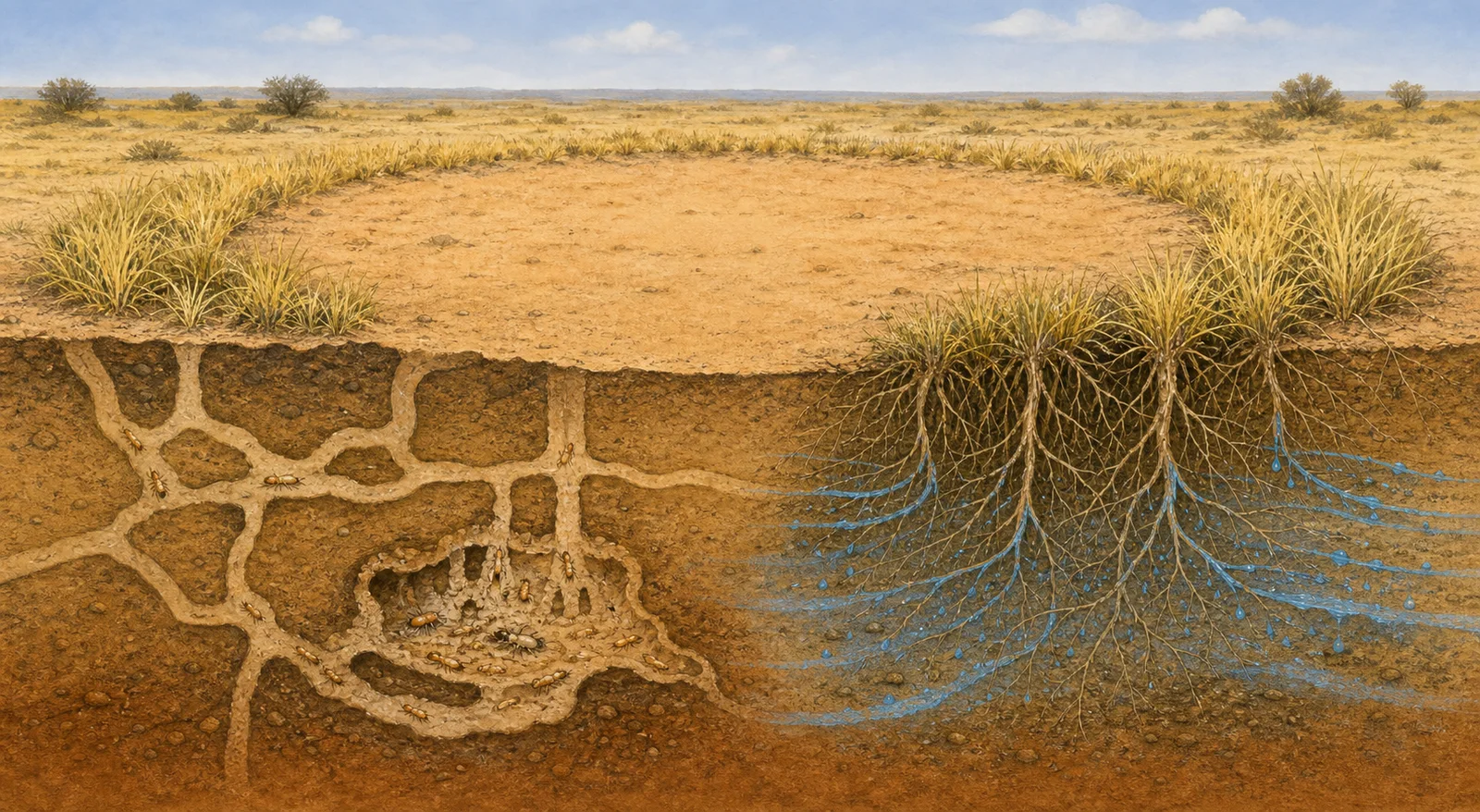
The circles occur in arid, sandy grasslands in southern Africa. A 2013 field and remote-sensing study described millions of barren patches, commonly a few meters across, often surrounded by taller perennial grasses. The researchers also found that soil moisture inside a bare circle decreased toward its grassy edge. That pattern is consistent with roots around the perimeter drawing on water stored beneath the center.
The circles are not simply dead stains. They can appear, persist and eventually fade as vegetation returns. Their repeated spacing is also nonrandom. Any successful explanation therefore has to account for several things at once: why plants disappear from the middle, why taller grass often grows around the rim, and why neighboring circles keep such regular distances.
Explanation one: termites as ecosystem engineers
In a Science paper published in 2013, ecologist Norbert Jürgens argued that the sand termite Psammotermes allocerus creates the circles by removing short-lived vegetation after rain. With fewer plants transpiring from the center, water can remain in the sandy soil. The stored moisture can then support the perennial grass ring and help a termite colony survive long droughts.
Under this interpretation, each bare patch is less a scar than a water-harvesting ecosystem engineered from below. Competition between neighboring termite colonies could also help explain the broad spacing between circles.
That is a scientific hypothesis backed by field observations, not a universally accepted verdict. Other researchers have questioned whether the presence of termites proves they initiate every circle, and whether termite activity alone explains the landscape-scale geometry.
Explanation two: thirsty grass organizes itself
A competing body of research treats the circles as an emergent pattern produced by plants competing for extremely limited water. In this view, grasses close to an established clump benefit from local conditions, while their roots pull water from farther away. The push and pull between short-range cooperation and longer-range competition can generate evenly spaced vegetation patterns without a planner.
The 2013 study by Michael Cramer and Nichole Barger found that circle occurrence and geometry tracked environmental conditions such as water availability and soil properties. A later field study, published in 2022, followed rainfall across Namib sites and reported that new grasses inside circles died from water stress without the root damage expected from termite feeding. Its authors concluded that plant water competition, rather than termite herbivory, caused the observed grass death at their study sites.
A clue the circles are not one giant grass plant
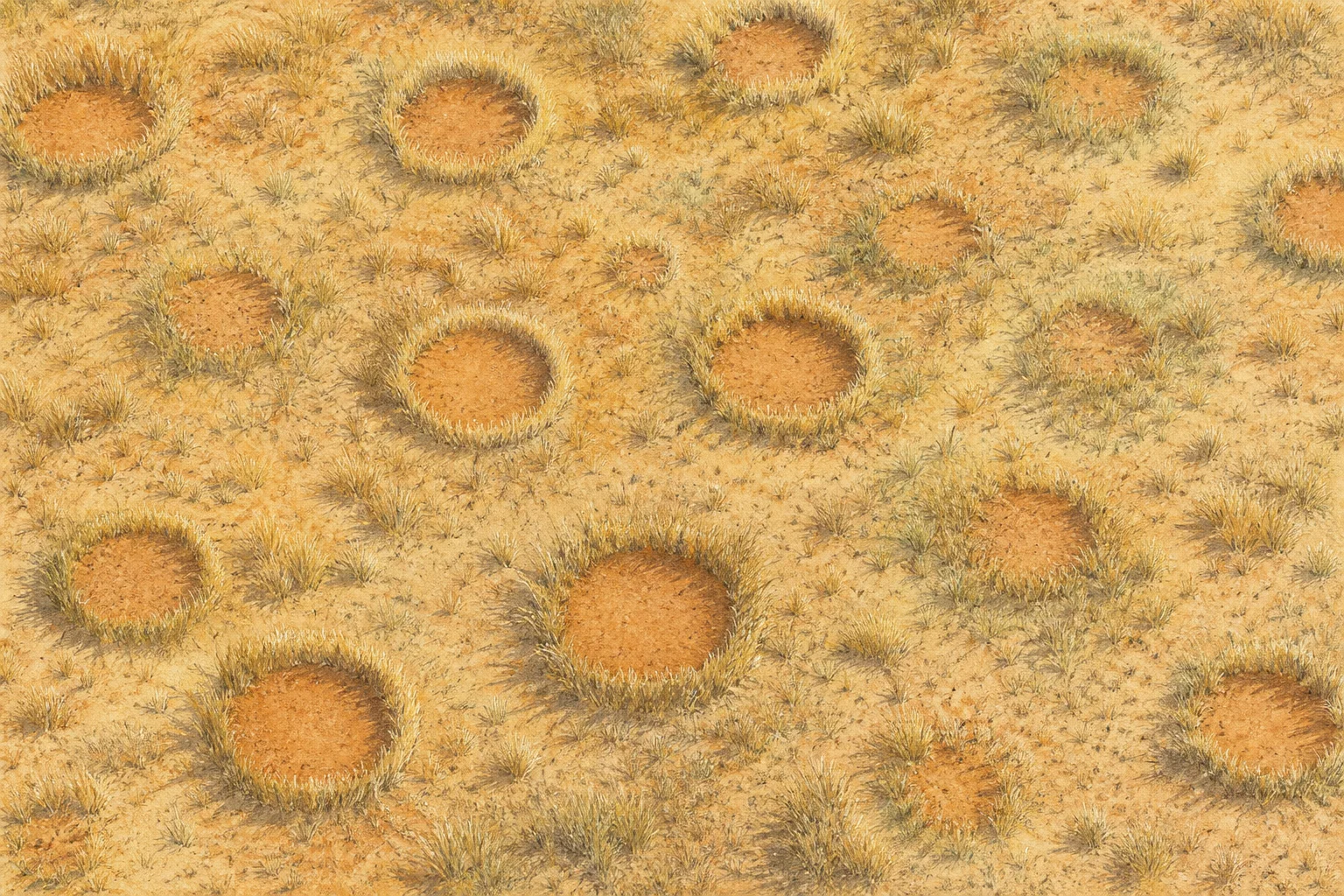
Another possible explanation once proposed that the grass rim could be a single clone expanding outward while dying in the center, similar to some familiar rings of vegetation. Genetic testing published in Communications Biology in 2020 did not support that idea for the Namib circles it sampled. The grasses around almost every tested circle belonged to more than one genetically distinct individual.
That result removed one tidy answer. It also sharpened the real question: how do many separate organisms generate a pattern that lasts much longer than the individual grass plants marking its edge?
Could both mechanisms matter?
Termites and plant competition are not necessarily mutually exclusive at every scale. A 2017 modeling study in Nature found that interactions between vegetation feedbacks and territorial social-insect colonies could reproduce multiple features seen in patterned drylands. Its broader conclusion was that more than one self-organizing mechanism may operate together.
That does not mean “both” is the final answer for every Namibian circle. Different studies examine different sites, rainfall events, time spans and measurements. Evidence that explains freshly dying grass may not by itself explain decades of circle persistence; finding termites beneath a circle does not automatically prove they started it.
The honest answer is more interesting than a premature solution. Namibia’s fairy circles are documented ecology wearing a supernatural nickname. Scientists can measure their soil, map their spacing, identify their grasses and inspect the creatures below—yet the full chain of cause and effect remains under debate.
Sources
- Cramer and Barger, “Are Namibian ‘Fairy Circles’ the Consequence of Self-Organizing Spatial Vegetation Patterning?”, PLOS ONE (2013).
- Jürgens, “The Biological Underpinnings of Namib Desert Fairy Circles”, Science (2013).
- Getzin et al., “Plant Water Stress, Not Termite Herbivory, Causes Namibia’s Fairy Circles”, Perspectives in Plant Ecology, Evolution and Systematics (2022).
- Kappel et al., “Fairy Circles in Namibia Are Assembled from Genetically Distinct Grasses”, Communications Biology (2020).
- Tarnita et al., “A Theoretical Foundation for Multi-Scale Regular Vegetation Patterns”, Nature (2017).
Leave a Reply