Editorial illustration

There are plenty of organs in old churches. One of the strangest is underground in Virginia, where the notes come from formations that took vastly longer to grow than the instrument did to build. At Luray Caverns, the Great Stalacpipe Organ uses selected stalactites as its sounding pieces: press a key at a console, and a rubber-tipped electrical striker taps a tuned piece of stone.
That means the “pipes” are not in the console at all. They are spread through the cavern. The effect is less like a conventional organ installed in a room than a room that has been carefully wired into an instrument.
A tour-guide sound became a three-year project
Luray Caverns says the idea began in 1954, when Leland W. Sprinkle—a Pentagon mathematician and electronics scientist—heard a guide tap a cave formation during a tour. The sound suggested an unlikely possibility: individual stalactites can ring at different pitches, so perhaps a group of them could be organized into a playable scale.
According to the caverns’ account, Sprinkle and helpers spent three years looking across more than three and a half acres of underground chambers. They used 13 English tuning forks to find promising tones, then carefully adjusted selected stalactites to match the pitches needed. The organ was dedicated in 1957.
The unusual part of that story is worth keeping straight. The instrument does not make a cave “sing” by itself. It is a designed system that uses naturally formed limestone as the sound-making material. The choice and tuning of the formations, the strikers, wiring, console, and musical arrangement are human work; the resonant stone is the cave’s contribution.
How a key becomes a note underground
The working principle is satisfyingly direct. Luray describes electronic mallets wired through the caverns to a large four-manual console. A key activates a mechanism that brings a rubber-tipped plunger against its assigned stalactite. The formation vibrates and the chamber carries the sound.
Editorial illustration
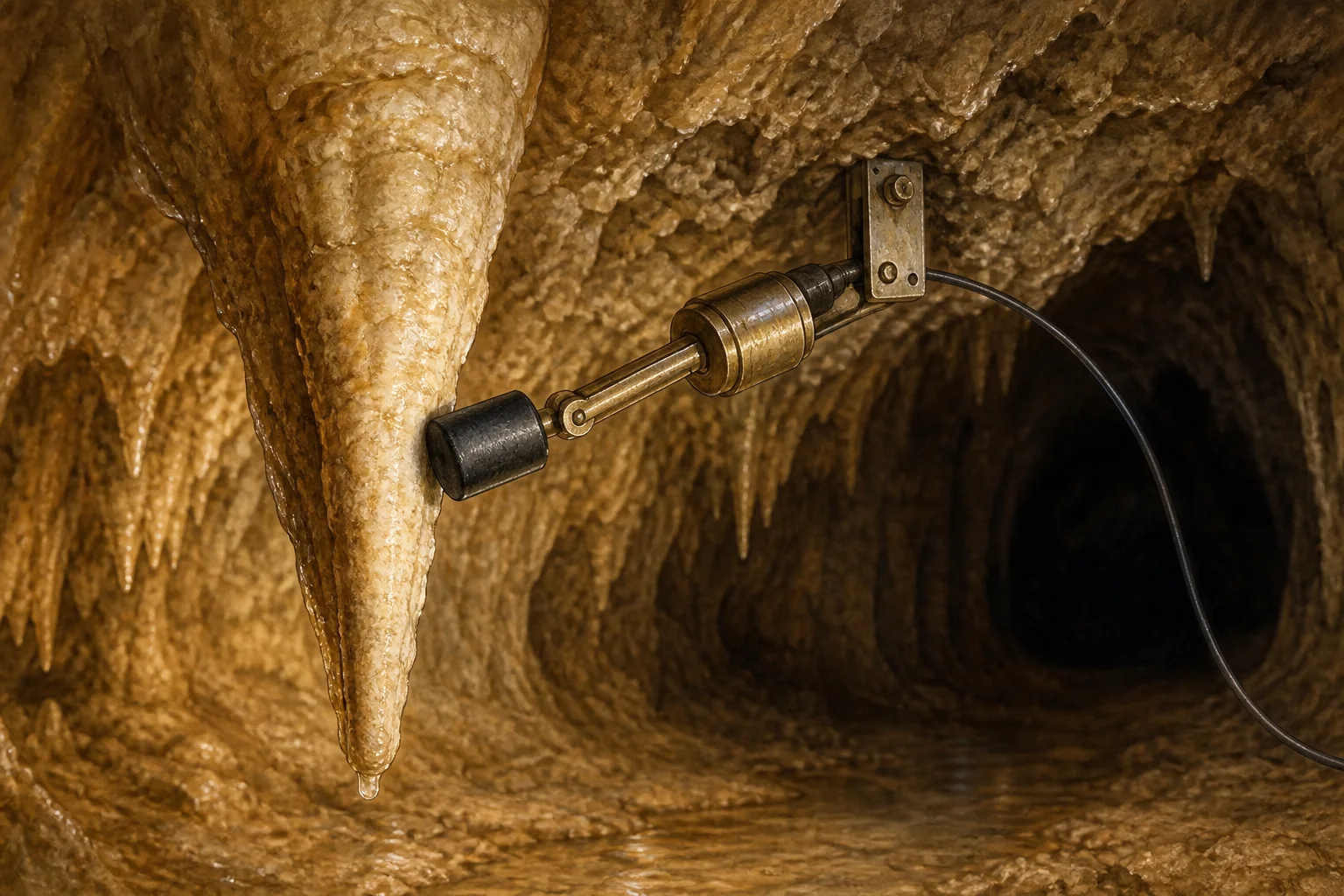
That physical contact is why the name “stalacpipe” fits better than an ordinary organ metaphor. An organ pipe usually makes sound by moving air; here, a chosen piece of limestone is struck. The console coordinates many remote notes, turning a large cave chamber into an improbably distributed percussion instrument.
Luray says the organ can be played manually and that it also operates automatically in a system likened to a child’s music box. The Library of Congress’s 2024 account of Rhapsody in Blue at 100 also identifies musician Otto Pebworth playing the Great Stalacpipe Organ in Luray Caverns—small but useful confirmation that this is more than a frozen tourist curiosity. It remains a working performance instrument.
A cave is a difficult instrument to own
The Great Stalacpipe Organ is especially weird because it reverses the usual relationship between building and instrument. Most musical instruments are built from material brought into a space. This one depends on a particular space first, then adds a musical interface around it. Move the console somewhere else and the instrument would not come with it; the tuned formations are the essential parts.
That also makes the story a reminder that the visual drama of a cave is only part of its character. Stalactites form slowly as mineral-rich water deposits calcite. Their shapes and sizes affect how they respond when struck. Sprinkle’s challenge was not simply to find a dramatic chamber, but to find a set of natural formations whose pitches could be made useful together.
Editorial illustration

Why the idea still lands
It is tempting to describe the Stalacpipe Organ as a novelty and stop there. But the better explanation is more interesting: it is an example of an inventor listening closely to a material already doing something remarkable, then building only enough machinery to make that behavior playable.
Luray calls it the world’s largest musical instrument. That superlative is the caverns’ own description, and the claim is less important than the documented mechanics behind it. A keyboard, miles of distance in miniature, small striking devices, and selected pieces of limestone work together to produce a melody where visitors expect only dripping water and echoes.
Sources
- Luray Caverns, “The Great Stalacpipe Organ” — primary account of its development, console, strikers, and present operation.
- Luray Caverns, “Our Story” — dates the organ’s invention to 1954 and dedication to 1957.
- Library of Congress, “Gershwin’s ‘Rhapsody’ at 100” — identifies an organ performance at Luray Caverns in a 2024 project.
Leave a Reply