Category: Peculiar Inventions

  • Why a Norwegian Town Sends Winter Sunlight Down a Mountain

    Why a Norwegian Town Sends Winter Sunlight Down a Mountain

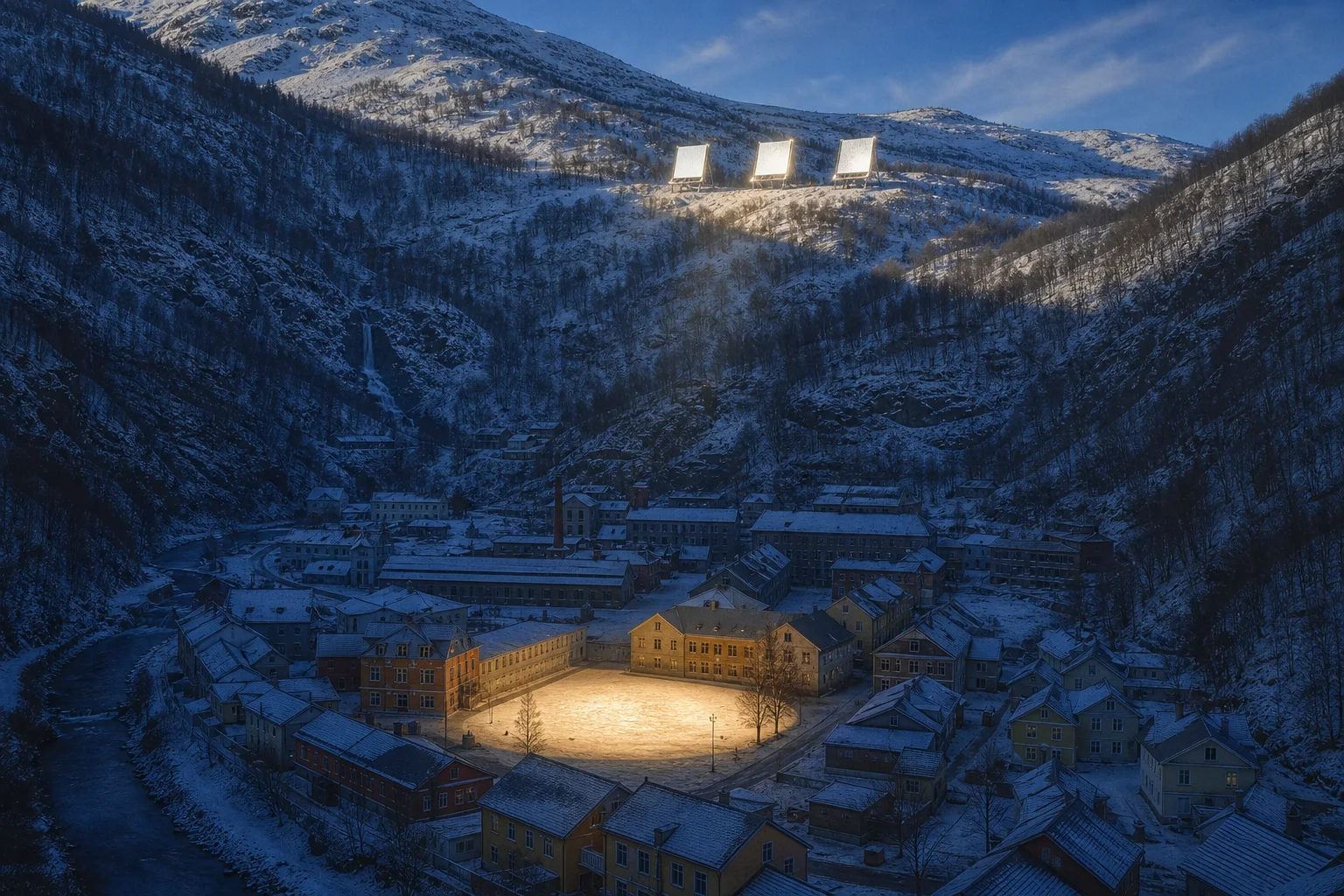
    Editorial illustration of Rjukan’s mountain mirrors reflecting winter sunlight into a shaded Norwegian town square.

    Editorial illustration.

    Rjukan, Norway, has a winter problem that is hard to solve with a lamp: for part of the year, the low sun clears the mountains but not the town itself. The settlement sits deep in the Vestfjord valley, beneath steep walls that leave its center in shadow. So Rjukan put three mirrors on a mountainside and taught them to follow the sun.

    The result is called Solspeilet, or the Sun Mirror. It does not light the whole town, and it does not create a second sun. It redirects a deliberately limited patch of ordinary daylight onto the town square. That modestness is what makes the installation more interesting than the usual “mirrors brighten a town” shorthand: it is a controlled, moving reflection built for one particular valley.

    A light problem created by geography

    Rjukan’s geography is the entire premise. VisitRjukan says the mountains block direct sunlight in the town from October into March. The sun still reaches the high slopes, but the square lies below the ridge line. Before the mirrors, residents could take the Krossobanen cable car uphill to meet the sun; the cable car opened in 1928. The mirrors pursue the opposite idea: send a small piece of the sunlight downhill.

    An idea that waited a century

    The local account traces the proposal to bookkeeper Oscar Kittelsen in 1913, with industrial founder Sam Eyde supporting the idea. The concept was simple enough to describe then, but a working outdoor system needed surfaces and controls that could keep a reflection aimed as the sun moved. Norsk Hydro’s 2013 account describes the installation as the realization of that old Rjukan idea after many decades.

    Artist Martin Andersen revived the proposal in 2005, according to VisitRjukan. The completed installation opened in 2013. It is an unusually literal civic artwork: its visible effect is not a monument or a sign, but an area of light on paving stones.

    Three mirrors, one patch of sun

    The system uses three computer-controlled heliostats—mirrors that change their angle to keep a reflection pointed at a target. VisitRjukan gives the installation’s stated dimensions as 17 square meters per mirror, or 51 square meters together. It places them at 742 meters above sea level, roughly 450 meters above the square, and says their reflected light can cover about 600 square meters there.

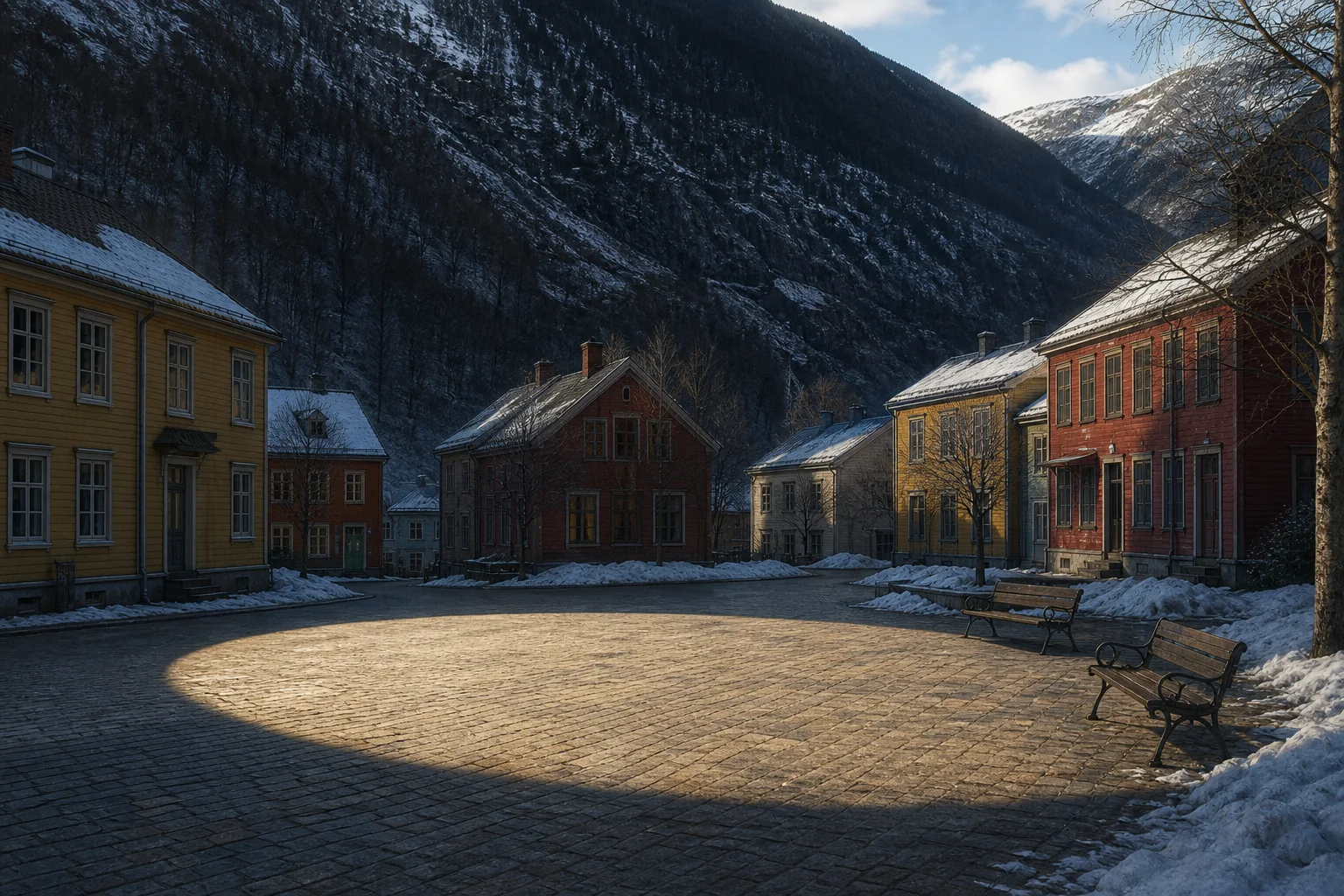
    Those figures describe a target zone, not a town-wide lighting scheme. A person standing in the square can encounter a bright pool of natural daylight while the streets around it remain in mountain shade. Its scale is intentionally legible: the mirrors are far above, and the result below is a patch rather than a blanket.

    Editorial illustration of three heliostat mirrors on a snowy Norwegian mountainside above a valley town.
    Editorial illustration of the three-mirror arrangement.

    It is reflection, not a replacement sun

    A flat mirror sends light away at the same angle at which it arrives. Because the sun’s position changes through the day, a fixed panel would soon throw its reflection somewhere else. Rjukan’s mirrors are computer controlled so their aim can be adjusted as the sun travels across the sky. The mountain location is essential: it receives direct sun even when the valley floor does not.

    That also gives the feature clear limits. The mirrors cannot make sunlight on a cloudy day, extend the day, or deliver direct sun across the whole valley. They redirect available daylight from a sunny slope to a chosen public place. The narrowly bounded effect is a more accurate description than “bringing the sun back” to Rjukan.

    Why the effect feels so strange

    Most public infrastructure hides its mechanism. Here, the mechanism is a mountain installation and the output is a conspicuously sunny square below it. The distance between the two turns a familiar physical rule into something almost theatrical: sunlight appears where the terrain says it should not, but only in the exact shape and place the system is designed to reach.

    Editorial illustration of a Norwegian town square receiving a bounded patch of reflected winter sunlight.
    Editorial illustration of the deliberately limited pool of reflected light.

    The evidence boundary

    Local installation and history sources agree on the 1913 origin story, the 2013 opening, and the use of three computer-controlled mirrors. The elevation, mirror area, and illuminated-area values above are the installation’s stated specifications from VisitRjukan, not independent measurements repeated here. This explainer does not claim that the mirrors brighten all of Rjukan or make health claims about the light; they are a targeted reflection system for the town square.

    Sources

  • Why Big Ben Still Has a Crack

    Why Big Ben Still Has a Crack

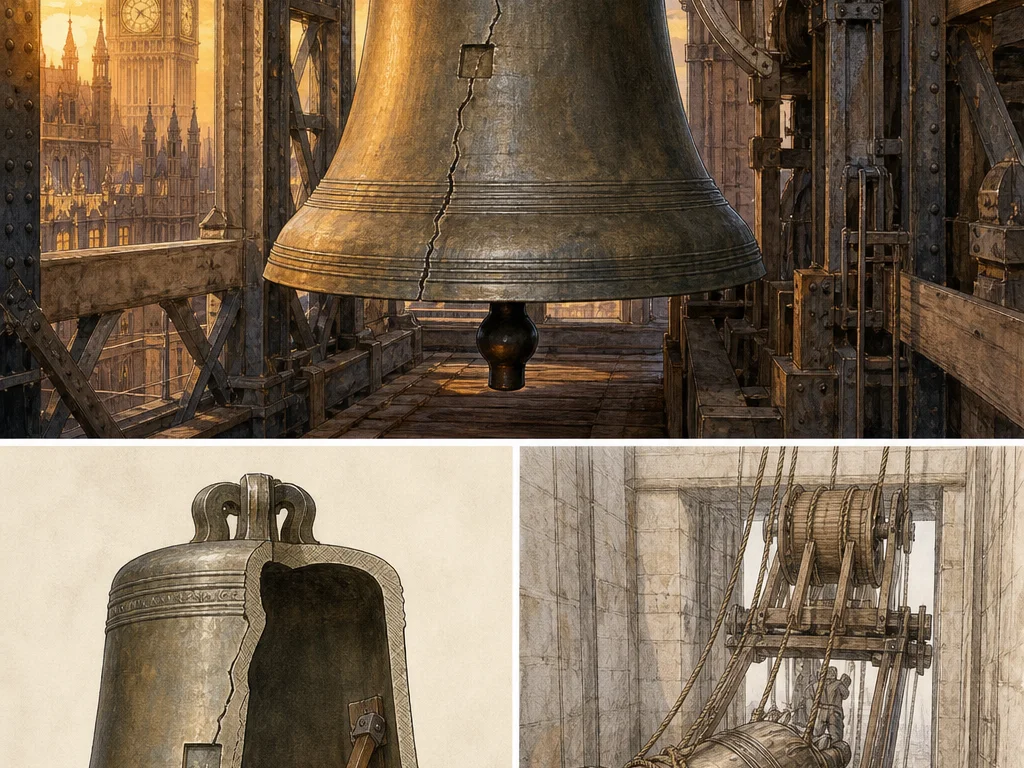
    Editorial illustration of the Great Bell hanging in Elizabeth Tower, with a visible crack in its bronze surface.

    London’s most famous clock sound comes from a bell that once failed twice. The Great Bell of Elizabeth Tower—properly the bell called Big Ben, rather than the tower itself—has a crack that became part of its working design. It is a rare case in which the repair did not make an object look new again. It made the object usable, and left the evidence of the problem in place.

    The first Big Ben never reached the tower

    The story starts with an earlier bell. UK Parliament’s history records that the first Great Bell was cast in 1856 at Warners of Norton, near Stockton-on-Tees. During testing in October 1857, it developed a crack about 1.2 metres long. Parliament attributes the failure to a hammer that was too heavy. The bell was removed and melted down for a replacement.

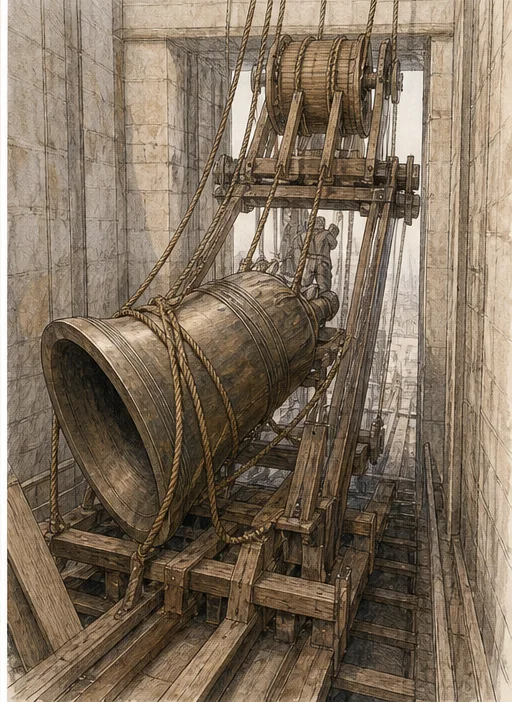
    That replacement is the Big Ben heard today. George Mears cast it at the Whitechapel Bell Foundry on 10 April 1858. At 13.5 tonnes, it was 2.5 tonnes lighter than its predecessor. Getting it into position was an engineering performance of its own: Parliament says the bell had to be turned on its side and winched up the tower’s ventilation shaft, a job that took 30 hours.

    The Great Clock began keeping time on 31 May 1859, and the new Great Bell first struck on 11 July. For a brief moment, the difficult replacement seemed to have solved the problem.

    Then the replacement cracked too

    By September 1859, the second bell had fractured. Big Ben fell silent for four years while the largest quarter bell marked the hours instead. The lasting answer was not to cast another enormous bell. In 1863, the Astronomer Royal, Sir George Airy, proposed changing the way this one was struck.

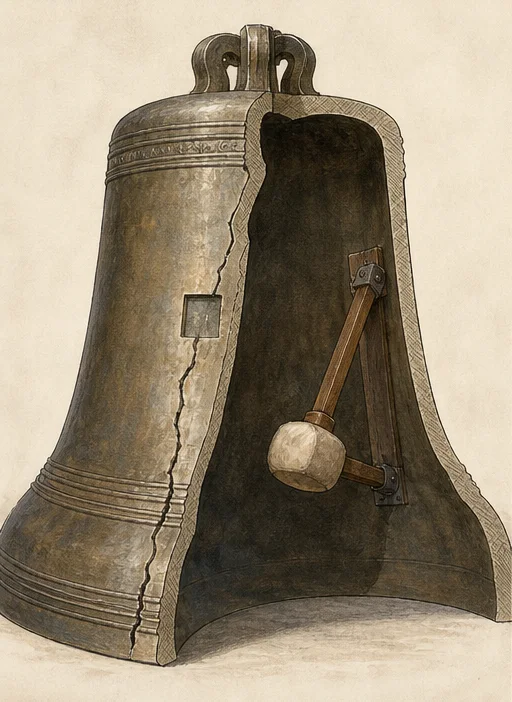
    Parliament’s account describes three linked changes: the bell was turned 90 degrees, a lighter hammer replaced the original one, and a small square was cut at the end of the crack to stop it spreading. The hammer now meets a different part of the bell, rather than repeatedly stressing the damaged area. The old crack and the square relief cut remain visible.

    Editorial cutaway illustration of a bronze bell with a crack, a small square relief cut, and a lighter hammer at a new striking point.

    Editorial illustration: the repair principle that let the Great Bell return to service.

    A repair that changed the sound

    That solution did more than keep the bell from being struck at its worst point. It helped create the distinctive sound people now expect. Parliament says the Great Bell, used with its smaller hammer, strikes an E. A UK Parliament virtual-tour transcript adds an important bit of precision often lost in retellings: the crack does not run all the way through the bell.

    The repair is a useful reminder that a historic landmark need not be returned to an imagined pristine state to remain authentic. Here, the visible flaw records a sequence of choices: an oversized first attempt, a replacement that also failed, and a carefully limited intervention that let a damaged bell keep doing its job.

    Why the story is stranger than the nickname

    “Big Ben” is often used as shorthand for the whole tower and clock, but the nickname belongs to the Great Bell. Even the origin of the name is not completely settled: Parliament says it is believed to have been a playful reference to Sir Benjamin Hall, the tall First Commissioner of Works who oversaw later stages of the tower’s construction. That uncertainty is worth retaining instead of treating the story as a settled fact.

    The documented part is stranger anyway. A bell weighing 13.5 tonnes was raised sideways through a shaft, cracked soon after it began ringing, and was saved by changing its orientation and reducing the blow it received. The resulting imperfection has lasted longer than either early failure, turning a repair decision from 1863 into part of the soundscape of London.

    Editorial illustration of the replacement Great Bell being raised sideways through a tower shaft with ropes and wooden rigging.

    Editorial illustration: a visual interpretation of the 1858 hoist described in Parliament’s history.

    Sources

  • At Luray Caverns, a Pipe Organ Plays the Ceiling

    At Luray Caverns, a Pipe Organ Plays the Ceiling

    Editorial illustration

    Editorial illustration of an organ console in a limestone cavern, connected by cables to stalactites across a large chamber.

    There are plenty of organs in old churches. One of the strangest is underground in Virginia, where the notes come from formations that took vastly longer to grow than the instrument did to build. At Luray Caverns, the Great Stalacpipe Organ uses selected stalactites as its sounding pieces: press a key at a console, and a rubber-tipped electrical striker taps a tuned piece of stone.

    That means the “pipes” are not in the console at all. They are spread through the cavern. The effect is less like a conventional organ installed in a room than a room that has been carefully wired into an instrument.

    A tour-guide sound became a three-year project

    Luray Caverns says the idea began in 1954, when Leland W. Sprinkle—a Pentagon mathematician and electronics scientist—heard a guide tap a cave formation during a tour. The sound suggested an unlikely possibility: individual stalactites can ring at different pitches, so perhaps a group of them could be organized into a playable scale.

    According to the caverns’ account, Sprinkle and helpers spent three years looking across more than three and a half acres of underground chambers. They used 13 English tuning forks to find promising tones, then carefully adjusted selected stalactites to match the pitches needed. The organ was dedicated in 1957.

    The unusual part of that story is worth keeping straight. The instrument does not make a cave “sing” by itself. It is a designed system that uses naturally formed limestone as the sound-making material. The choice and tuning of the formations, the strikers, wiring, console, and musical arrangement are human work; the resonant stone is the cave’s contribution.

    How a key becomes a note underground

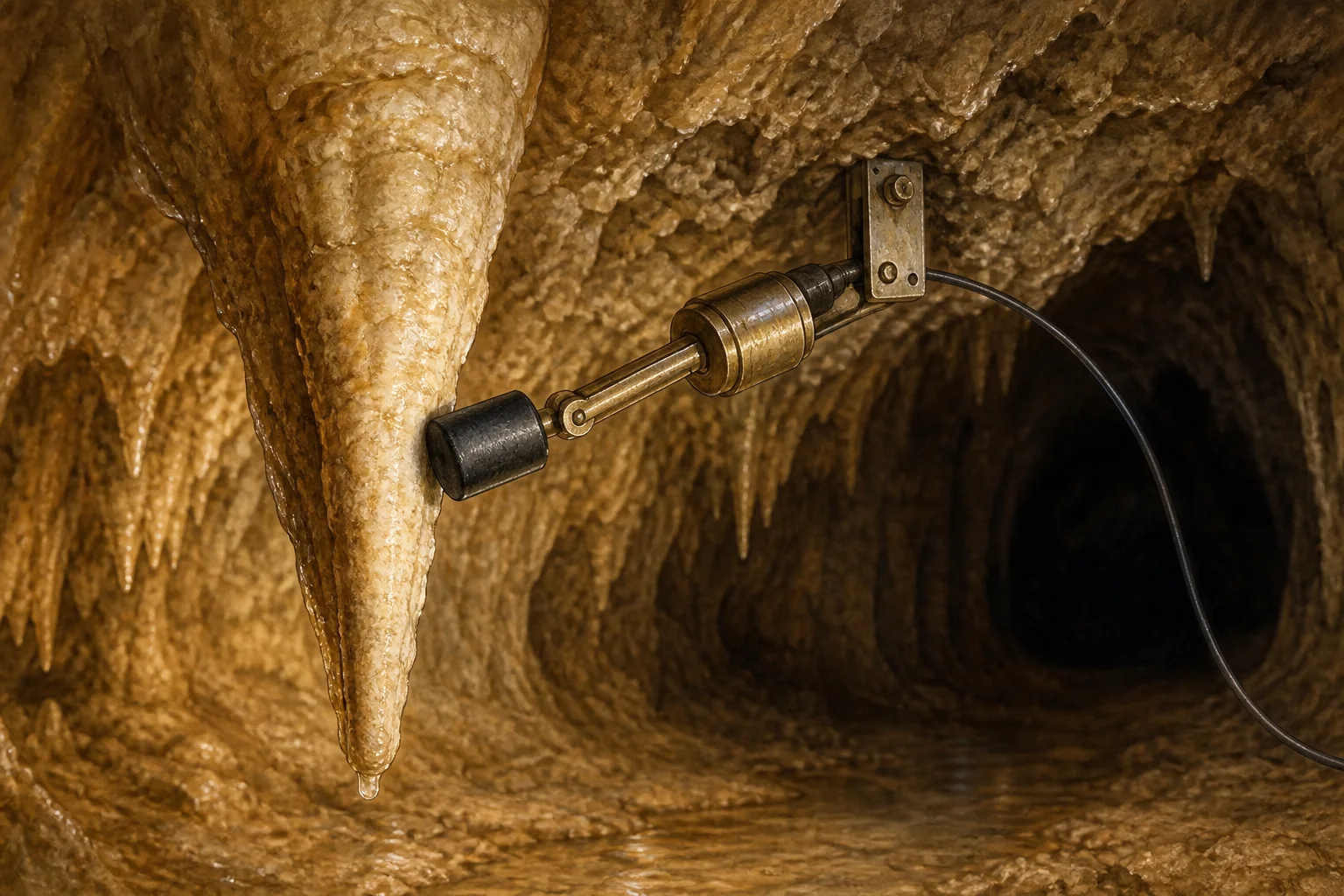
    The working principle is satisfyingly direct. Luray describes electronic mallets wired through the caverns to a large four-manual console. A key activates a mechanism that brings a rubber-tipped plunger against its assigned stalactite. The formation vibrates and the chamber carries the sound.

    Editorial illustration

    Editorial illustration of a rubber-tipped striker mechanism tapping a limestone stalactite inside a cave.

    That physical contact is why the name “stalacpipe” fits better than an ordinary organ metaphor. An organ pipe usually makes sound by moving air; here, a chosen piece of limestone is struck. The console coordinates many remote notes, turning a large cave chamber into an improbably distributed percussion instrument.

    Luray says the organ can be played manually and that it also operates automatically in a system likened to a child’s music box. The Library of Congress’s 2024 account of Rhapsody in Blue at 100 also identifies musician Otto Pebworth playing the Great Stalacpipe Organ in Luray Caverns—small but useful confirmation that this is more than a frozen tourist curiosity. It remains a working performance instrument.

    A cave is a difficult instrument to own

    The Great Stalacpipe Organ is especially weird because it reverses the usual relationship between building and instrument. Most musical instruments are built from material brought into a space. This one depends on a particular space first, then adds a musical interface around it. Move the console somewhere else and the instrument would not come with it; the tuned formations are the essential parts.

    That also makes the story a reminder that the visual drama of a cave is only part of its character. Stalactites form slowly as mineral-rich water deposits calcite. Their shapes and sizes affect how they respond when struck. Sprinkle’s challenge was not simply to find a dramatic chamber, but to find a set of natural formations whose pitches could be made useful together.

    Editorial illustration

    Editorial illustration of a broad limestone cavern with small striker mechanisms and cables connecting selected stalactites to an organ console.

    Why the idea still lands

    It is tempting to describe the Stalacpipe Organ as a novelty and stop there. But the better explanation is more interesting: it is an example of an inventor listening closely to a material already doing something remarkable, then building only enough machinery to make that behavior playable.

    Luray calls it the world’s largest musical instrument. That superlative is the caverns’ own description, and the claim is less important than the documented mechanics behind it. A keyboard, miles of distance in miniature, small striking devices, and selected pieces of limestone work together to produce a melody where visitors expect only dripping water and echoes.

    Sources