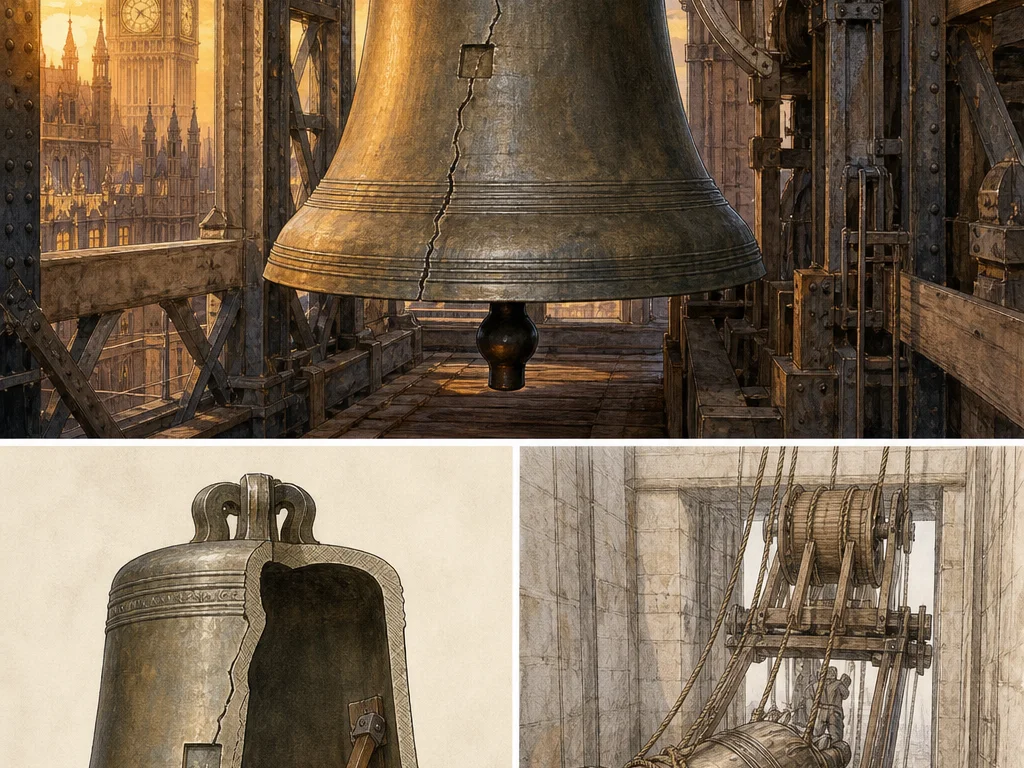
London’s most famous clock sound comes from a bell that once failed twice. The Great Bell of Elizabeth Tower—properly the bell called Big Ben, rather than the tower itself—has a crack that became part of its working design. It is a rare case in which the repair did not make an object look new again. It made the object usable, and left the evidence of the problem in place.
The first Big Ben never reached the tower
The story starts with an earlier bell. UK Parliament’s history records that the first Great Bell was cast in 1856 at Warners of Norton, near Stockton-on-Tees. During testing in October 1857, it developed a crack about 1.2 metres long. Parliament attributes the failure to a hammer that was too heavy. The bell was removed and melted down for a replacement.
That replacement is the Big Ben heard today. George Mears cast it at the Whitechapel Bell Foundry on 10 April 1858. At 13.5 tonnes, it was 2.5 tonnes lighter than its predecessor. Getting it into position was an engineering performance of its own: Parliament says the bell had to be turned on its side and winched up the tower’s ventilation shaft, a job that took 30 hours.
The Great Clock began keeping time on 31 May 1859, and the new Great Bell first struck on 11 July. For a brief moment, the difficult replacement seemed to have solved the problem.
Then the replacement cracked too
By September 1859, the second bell had fractured. Big Ben fell silent for four years while the largest quarter bell marked the hours instead. The lasting answer was not to cast another enormous bell. In 1863, the Astronomer Royal, Sir George Airy, proposed changing the way this one was struck.
Parliament’s account describes three linked changes: the bell was turned 90 degrees, a lighter hammer replaced the original one, and a small square was cut at the end of the crack to stop it spreading. The hammer now meets a different part of the bell, rather than repeatedly stressing the damaged area. The old crack and the square relief cut remain visible.
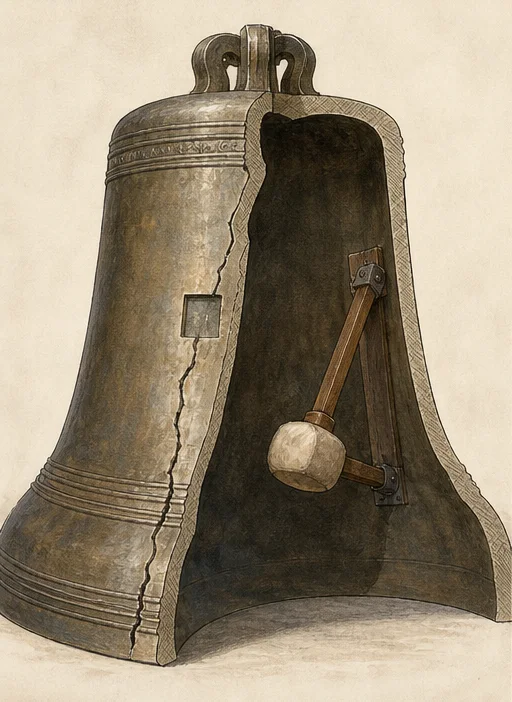
Editorial illustration: the repair principle that let the Great Bell return to service.
A repair that changed the sound
That solution did more than keep the bell from being struck at its worst point. It helped create the distinctive sound people now expect. Parliament says the Great Bell, used with its smaller hammer, strikes an E. A UK Parliament virtual-tour transcript adds an important bit of precision often lost in retellings: the crack does not run all the way through the bell.
The repair is a useful reminder that a historic landmark need not be returned to an imagined pristine state to remain authentic. Here, the visible flaw records a sequence of choices: an oversized first attempt, a replacement that also failed, and a carefully limited intervention that let a damaged bell keep doing its job.
Why the story is stranger than the nickname
“Big Ben” is often used as shorthand for the whole tower and clock, but the nickname belongs to the Great Bell. Even the origin of the name is not completely settled: Parliament says it is believed to have been a playful reference to Sir Benjamin Hall, the tall First Commissioner of Works who oversaw later stages of the tower’s construction. That uncertainty is worth retaining instead of treating the story as a settled fact.
The documented part is stranger anyway. A bell weighing 13.5 tonnes was raised sideways through a shaft, cracked soon after it began ringing, and was saved by changing its orientation and reducing the blow it received. The resulting imperfection has lasted longer than either early failure, turning a repair decision from 1863 into part of the soundscape of London.
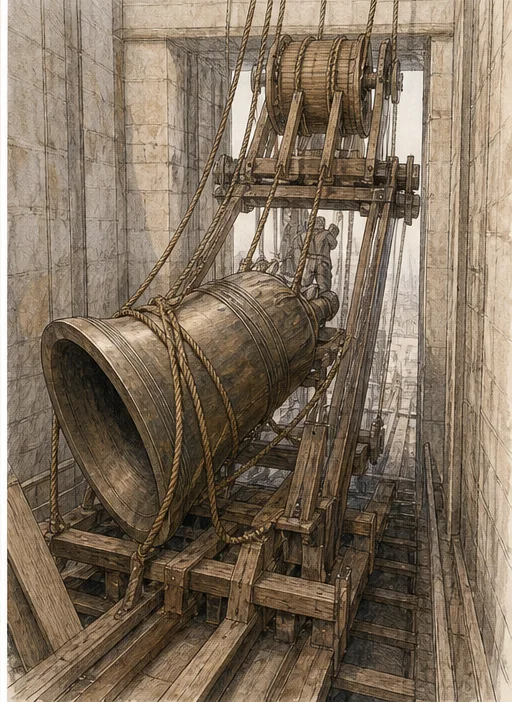
Editorial illustration: a visual interpretation of the 1858 hoist described in Parliament’s history.
Sources
- UK Parliament, “Constructing the most accurate clock in the world” — primary institutional account of the castings, failures, hoist, and 1863 repair.
- UK Parliament, “A brief history of Big Ben and Elizabeth Tower” — timeline for the first and replacement bells.
- UK Parliament, “Audio Transcripts” — notes that the crack does not extend all the way through the bell.
Leave a Reply