Editorial illustration: a reconstructed view of the three-compartment pigeon-guidance apparatus explored in Project Pigeon.
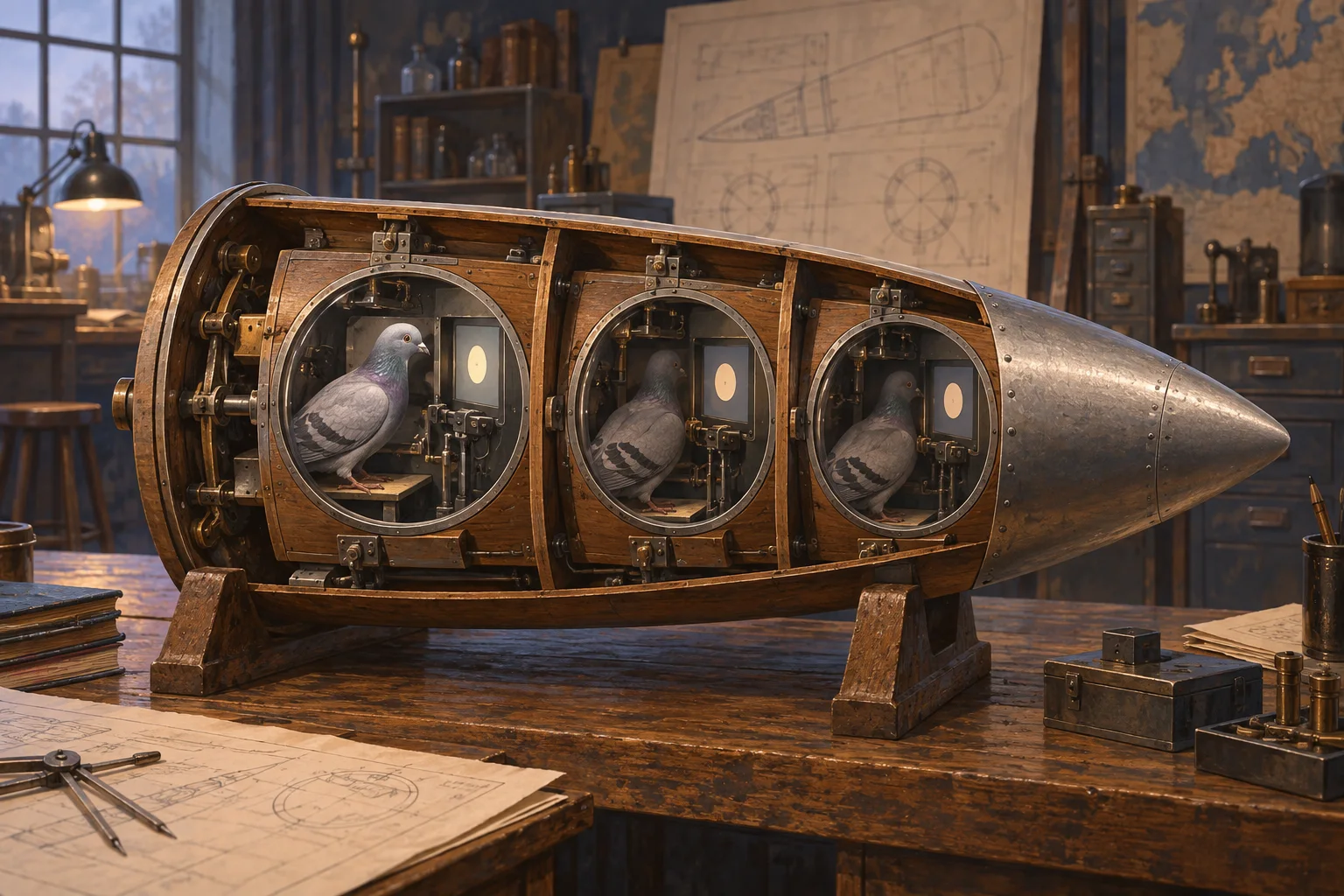
A pigeon is an unexpected figure in the history of early guidance technology. During World War II, psychologist B. F. Skinner and his collaborators explored an experimental idea called Project Pigeon: trained birds would keep a visual target centered on a screen inside a nose cone.
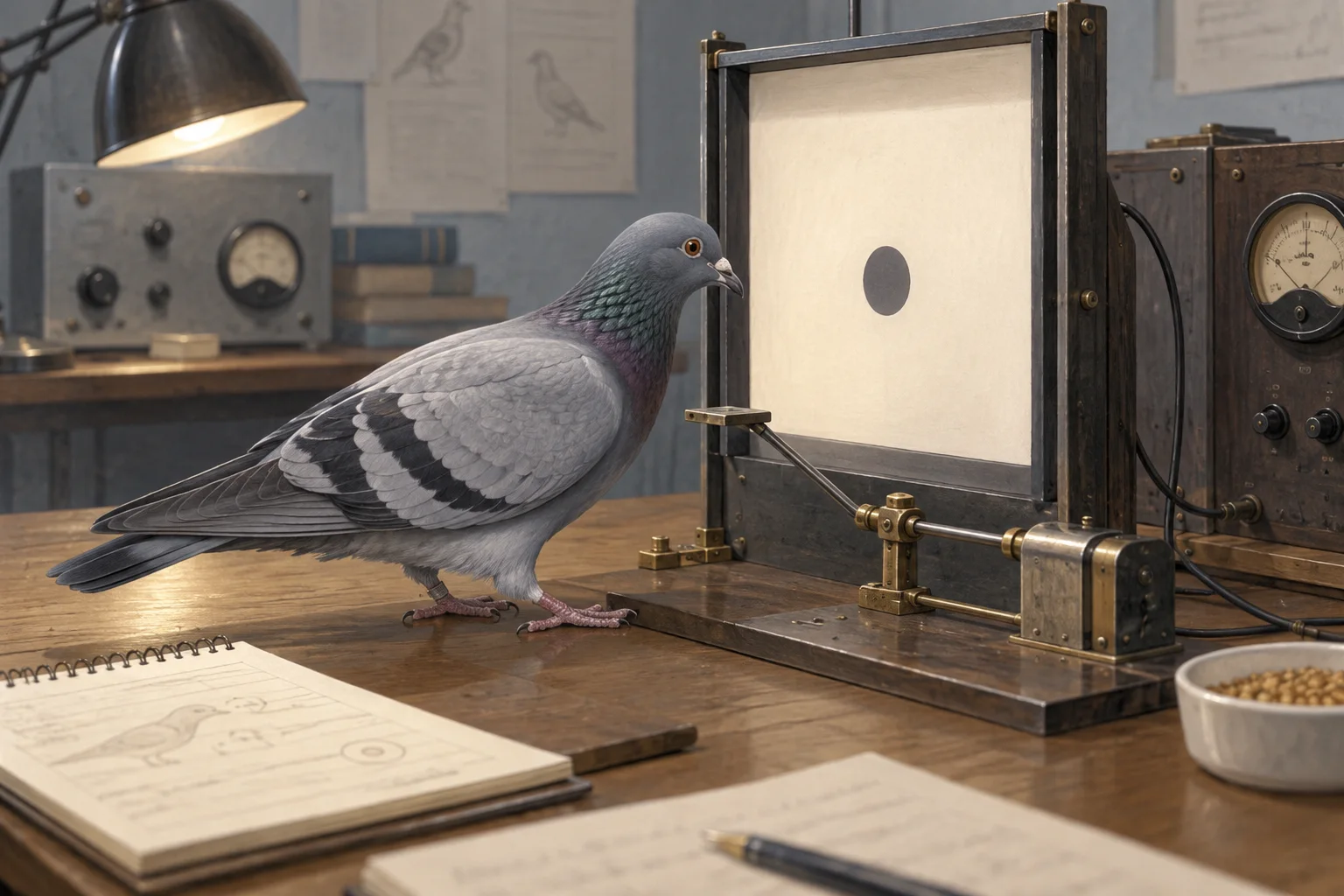
The idea grew from behavior research. A bird could learn to respond to an image on a screen, and the apparatus translated the location of its pecks into control signals. The National Institute of Standards and Technology’s museum account describes a conductive screen and a small electrode attached to a bird’s beak as parts of the demonstration system. The goal was a guided device whose course could respond to what the bird saw.
Three birds, three views
NIST’s account describes how the design developed from one bird to a three-bird unit. Each bird was trained to respond when the target image appeared in its view, and the system used agreement between birds as a reliability check for steering input.
That setup belonged to a period when researchers were testing many competing ways to guide a moving object from far away. Project Pigeon gave animal-learning research an unusually mechanical assignment. It asked a trained bird to make repeated visual judgments in a compact, vibrating instrument.
Editorial illustration: a pigeon training station with a target screen and analog controls.
A real experiment with a long afterlife
Project Pigeon remained an experimental program, yet its story lasted because the team documented the work and demonstrated it to military and scientific visitors. NIST’s account says the demonstrations showed that the birds could provide steering input. Harvard Film Archive holds films from the pigeon experiments within its B. F. Skinner Collection, preserving a rare moving-image record of the project.
The project is also a useful reminder that “guidance” once meant an open field of possibilities. Before compact digital electronics, researchers worked with mechanical linkages, optical displays, analog instruments, and the learned responses of living creatures. The pigeon was part of a serious attempt to connect perception to a machine’s controls.
The B. F. Skinner Foundation describes the birds as trained to peck at an image that resembled a ship as the device approached. That simple action carried the whole premise: keep the image centered, and the control system could correct its course. The apparatus made an odd historical artifact because it brought together a laboratory bird, a screen, and a guidance mechanism in one very small space.
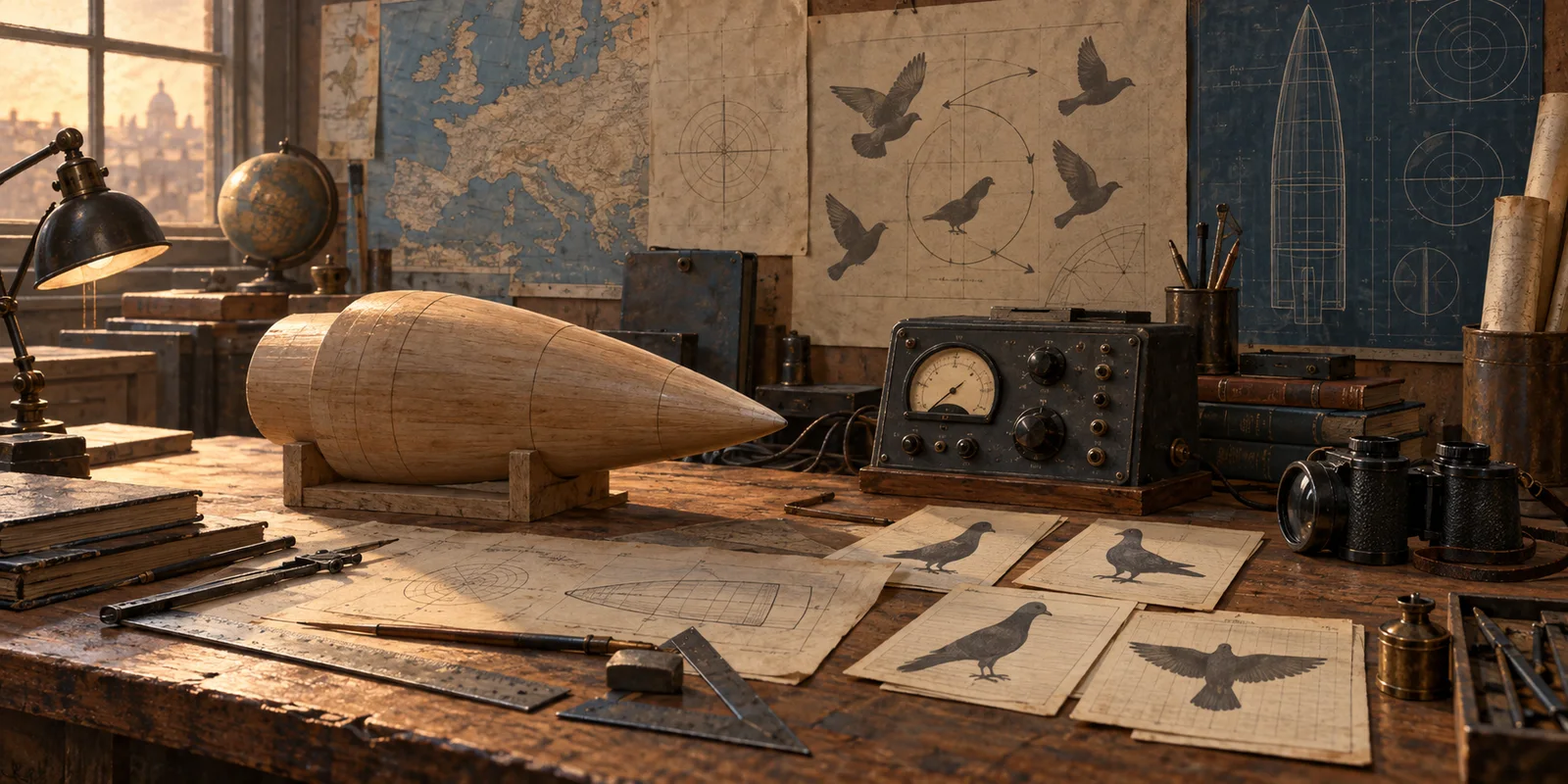
Editorial illustration: a 1940s workbench study of a nose-cone model, analog controls, and pigeon research cards.
Why it still feels strange
Project Pigeon captures a historical moment when trained-animal behavior and engineering were placed in the same prototype. Its physical traces now sit in collections and archives, where they show how inventive people can be when an unsolved technical problem meets an unexpected area of expertise.
For a closer look at the documented record, see NIST’s history of the project, the B. F. Skinner Collection at Harvard Film Archive, and the B. F. Skinner Foundation’s Project Pigeon page.
Leave a Reply