For more than a century, the Voynich Manuscript has invited readers to look closely at its pages and come away with new questions. Its plants twist into unfamiliar shapes, its star charts bloom with symbols, and its lines of writing follow a script scholars have not deciphered. The book is a real medieval object with a traceable history—and a meaning that remains open.
A book built for close looking
Held by Yale University’s Beinecke Rare Book and Manuscript Library as MS 408, the codex was produced in Central Europe around the end of the fifteenth or during the sixteenth century, according to the library’s catalog. Its author is unknown. The manuscript entered wider public awareness in 1912, when Polish-American antiquarian bookseller Wilfrid M. Voynich acquired it.
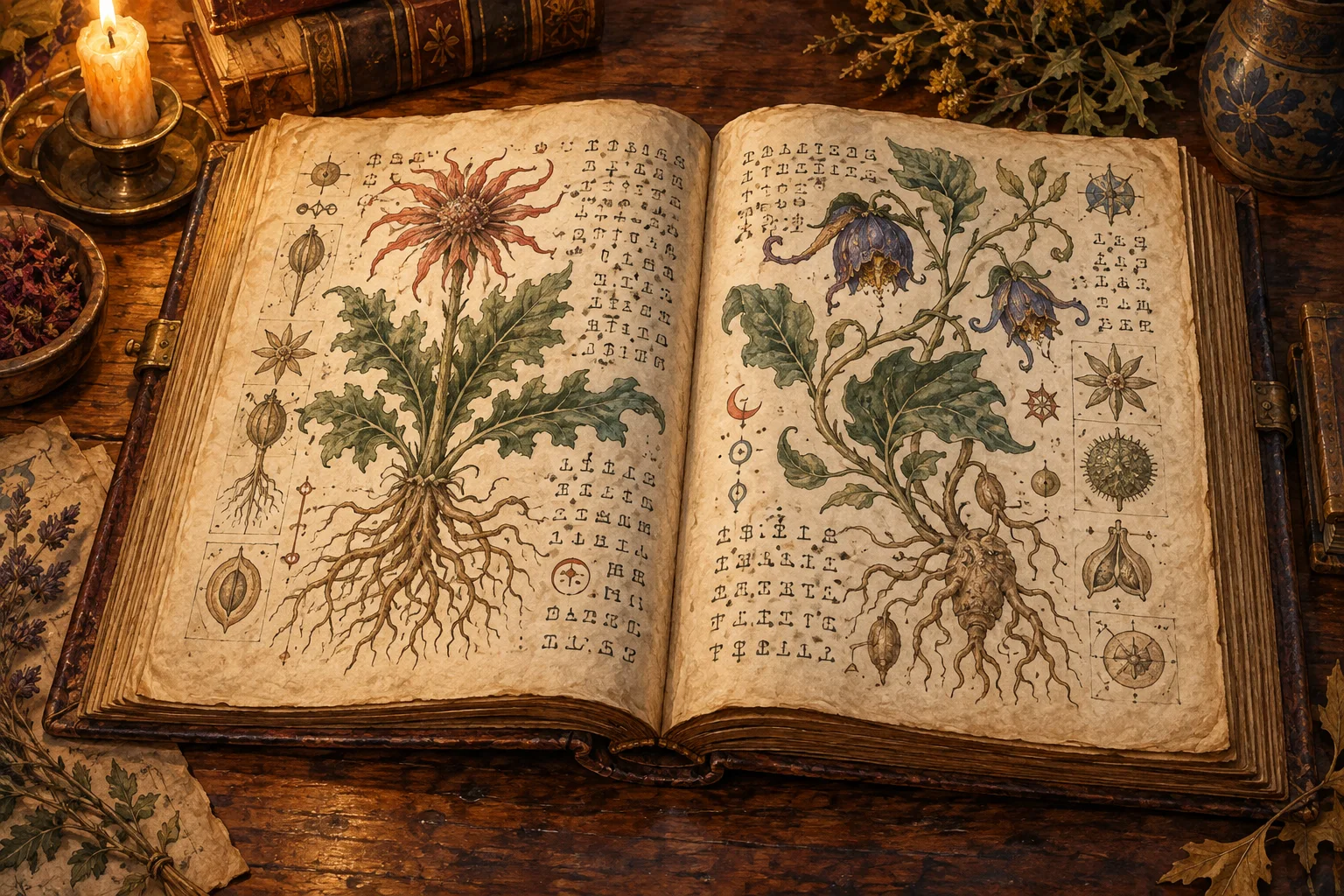
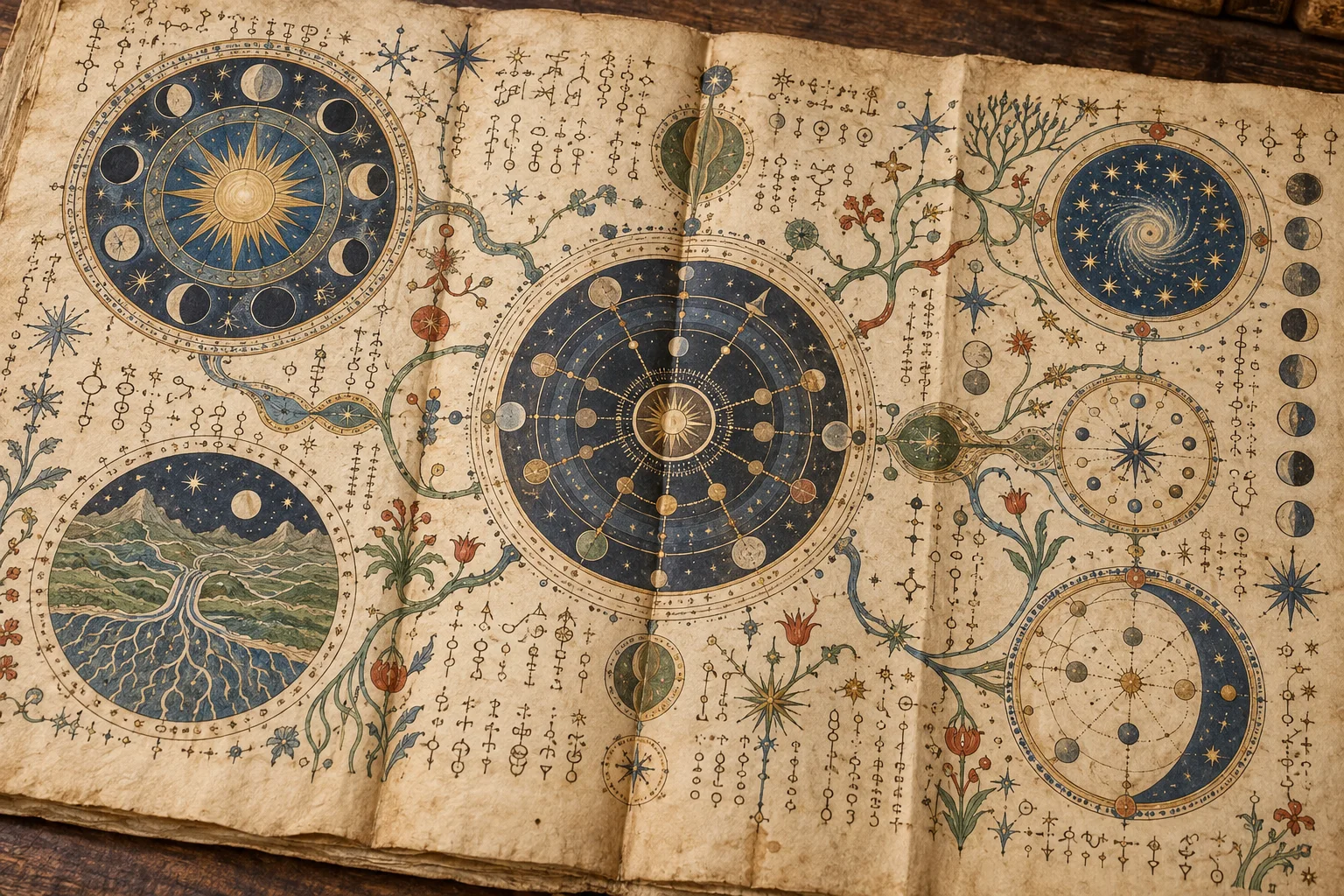
Yale describes six sections in the volume. Some pages show plant specimens; others feature astronomical and astrological drawings, bathing scenes, cosmological medallions, or herbs and roots arranged with pharmaceutical imagery. A final run of text-only pages marks entries with small star-like flowers. Across the sections, images and writing share the page, encouraging readers to compare repeated forms and patterns.
The illustrations offer clues about the book’s subjects, while the script’s meaning remains unsettled. Yale says cryptographic approaches have yet to decipher the writing, if it is encoded. That careful qualification matters: a script can look systematic without its underlying language or purpose being known.
What the parchment can tell us
Scientific work has narrowed some possibilities without supplying a translation. Yale reports that carbon-14 testing at the University of Arizona dated the parchment to the fifteenth century. That result makes an origin in the thirteenth century, once associated with English friar Roger Bacon, a poor fit for the material evidence. Parchment dating helps establish when the writing surface was made; it does not identify the author or reveal what the script says.
The manuscript’s earliest confirmed owner was Holy Roman Emperor Rudolf II, who paid 600 gold ducats for it and believed it was Bacon’s work. Yale identifies that authorship as speculation. The book later passed through the hands of pharmacist Jacobus Horčicky de Tepenec and alchemist Georgius Barschius. In 1666, Johannes Marcus Marci sent it to Jesuit scholar Athanasius Kircher with a letter that remains with the manuscript.
Voynich bought the codex from the Jesuit College at Frascati near Rome in 1912. After his death it passed to his wife, Ethel, then to their friend and assistant Anne Nill. New York bookseller H. P. Kraus acquired it in 1961 and gave it to Yale’s Beinecke Library in 1969. This chain of ownership gives researchers a substantial historical record even as the book’s original purpose stays elusive.
A mystery researchers can inspect
Preservation shapes how people encounter the book today. Because of its fragility, Beinecke limits access to the original, while high-resolution images of every page are available in Yale’s digital library. Since joining the collection, the manuscript has left the library once: for the Folger Shakespeare Library’s 2014–15 exhibition on codes and ciphers.
The scans let readers study the codex directly: the hand, the layout, the changing subjects, and the striking foldouts. Each feature supports new questions, but a convincing interpretation still needs evidence that other researchers can test. For now, the Voynich Manuscript’s lasting appeal lies in that balance: a physical book whose materials and ownership can be investigated, paired with a script that continues to resist a settled reading.
Sources: Beinecke Rare Book and Manuscript Library, The Beinecke Cipher (Voynich) Manuscript; Yale News, “Mysterious Voynich Manuscript reborn in facsimile edition”.
Leave a Reply