Category: Weird History

  • Beneath a Margate Garden, a Chalk Tunnel Became a Shell Mosaic

    Beneath a Margate Garden, a Chalk Tunnel Became a Shell Mosaic

    Beneath a garden in the seaside town of Margate, a winding chalk passage opens into a chamber whose walls carry thousands of shell-made patterns. The Shell Grotto is a real underground landmark; its builders and first purpose remain subjects of careful debate.
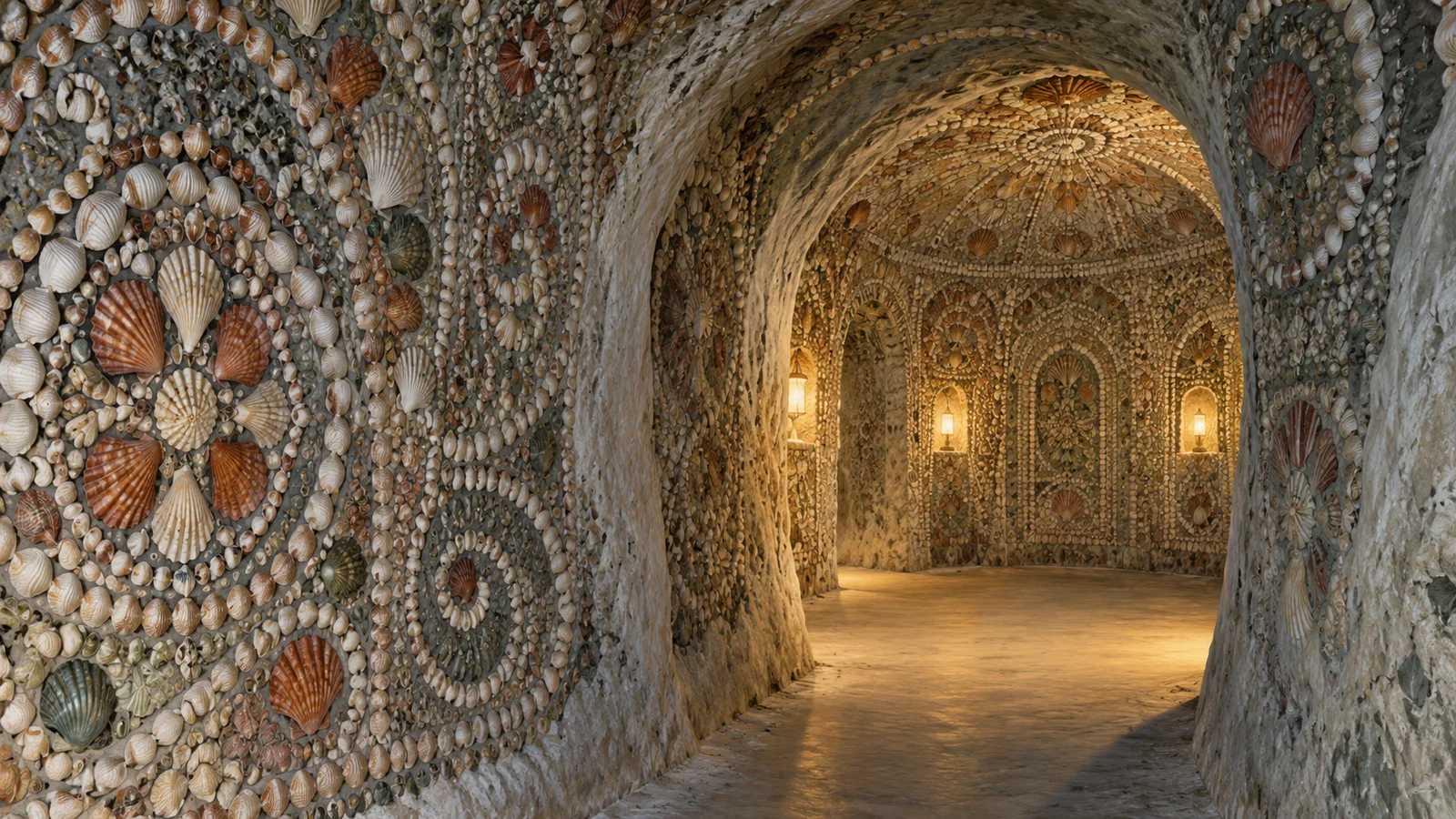
    Editorial illustration of a winding chalk passage and chamber covered in colorful seashell mosaics
    Editorial illustration: a shell-lined passage opening into a softly lit chamber.

    A discovery beneath a house

    The grotto came to wider attention in 1835, when excavation at a Margate property opened into an underground space. The surviving accounts tell the discovery in different ways. A local newspaper report published in 1838 described workmen clearing a large stone during building work at Belle Vue Cottage. A later family recollection, preserved by the grotto’s current stewards, remembers children exploring the passage before their father learned of it. The evidence gives us a vivid discovery story and more than one version of its first moments.

    James Newlove, a schoolmaster who acquired the property, prepared the passages for paying visitors. The earliest surviving newspaper notice announced that the attraction would soon open; the Shell Grotto’s historical account dates its first paying customers to 1838. The discovery and the public opening turned a hidden underground feature into part of Margate’s seaside life.

    A mosaic built from local shells

    The underground route links a curving entrance passage, a rotunda, a central domed shaft, an S-shaped passage and a chamber traditionally called the Altar Room. Across roughly 2,000 square feet of surface, shells form panels, borders and repeating designs. The often-cited estimate is about 4.6 million shells. The grotto’s current shell survey identifies about 40 varieties, with almost all native to Britain; mussels, cockles, whelks, limpets, scallops and oysters are among the kinds used prominently.
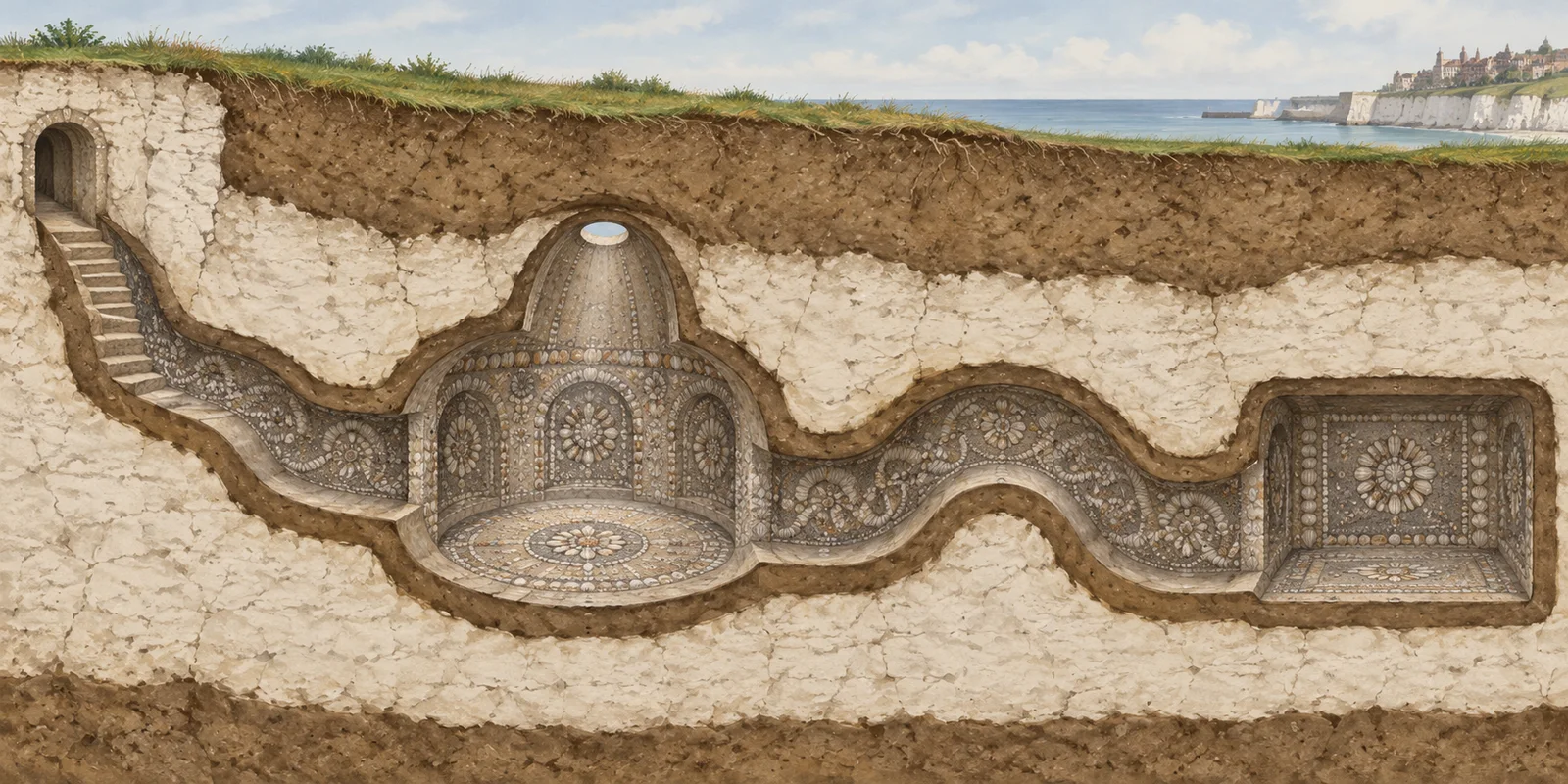
    Editorial illustration of a schematic underground grotto with a curving entrance, circular chamber, central shaft, winding passage and end room
    Editorial illustration: a schematic view of the connected passages and chambers described in the heritage survey.

    The effect comes from repetition and close hand placement. A shell’s curve can become a petal, a border or a small burst of color. The patterns invite interpretation, while the physical work of fitting natural forms across chalk walls is remarkable on its own.
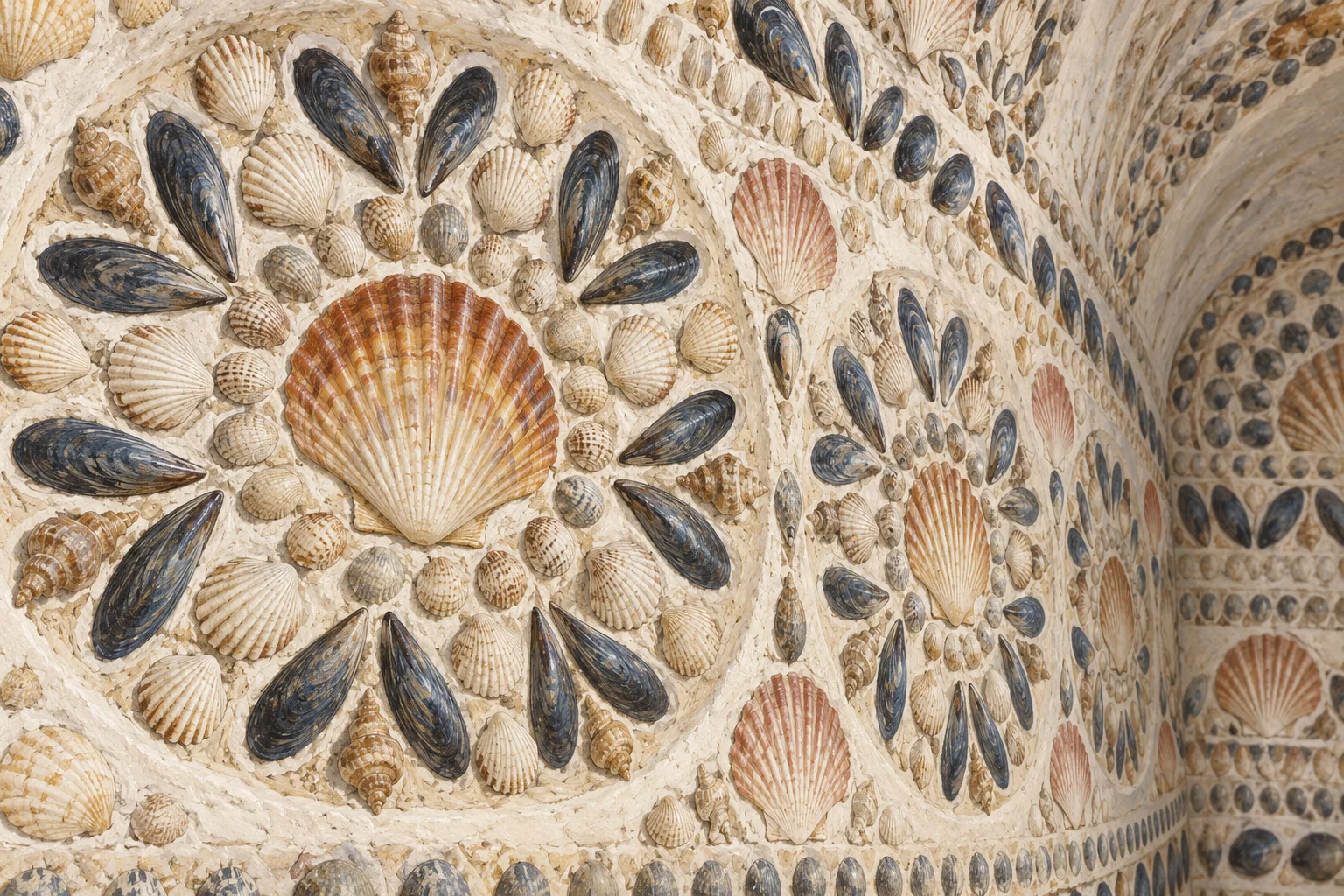
    Editorial illustration of mussel, cockle and scallop shells arranged in repeating mosaic patterns on pale chalk
    Editorial illustration: shell shapes arranged as a repeating mosaic across chalk.

    A history with open questions

    Stories about a Phoenician temple, a Roman sanctuary or a secret meeting place have attached themselves to the grotto’s imagery. The Kent County heritage record describes the grotto as Grade I listed and assesses an early-19th-century date as the likeliest identification. The range of interpretations reflects a site whose decorated walls preserve a remarkable craft tradition alongside questions about its earliest use.

    A 2005 survey discussed by the Kent Archaeological Society compared the central shaft and short passages with regional chalk mines known as deneholes. Its author proposed that an older chalk excavation may have been extended and decorated later. Much of the original chalk surface sits beneath the mosaic, leaving the grotto’s sequence of construction open to archaeological interpretation.

    Margate’s Shell Grotto endures as both a place and an open question: a carefully decorated underground route discovered in the 19th century, with early history explored through archaeology, local records and tradition. Its millions of shells make that layered story visible, one small piece at a time.
    Sources

  • How Project Pigeon Put Trained Birds in a Missile Nose Cone

    How Project Pigeon Put Trained Birds in a Missile Nose Cone

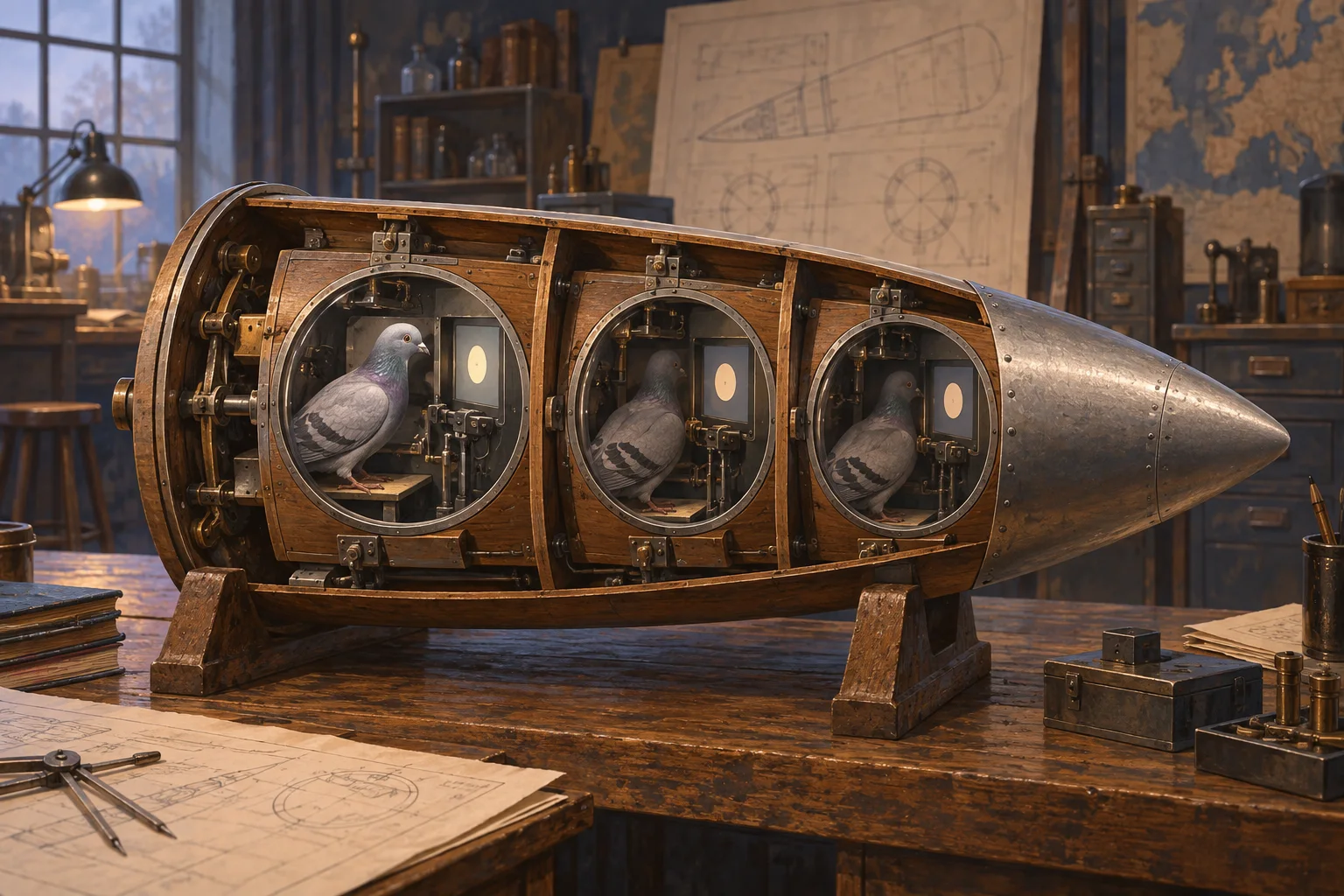
    Editorial illustration: a reconstructed view of the three-compartment pigeon-guidance apparatus explored in Project Pigeon.

    Editorial illustration of a 1940s wooden and metal nose-cone apparatus with three pigeon compartments and target screens.

    A pigeon is an unexpected figure in the history of early guidance technology. During World War II, psychologist B. F. Skinner and his collaborators explored an experimental idea called Project Pigeon: trained birds would keep a visual target centered on a screen inside a nose cone.

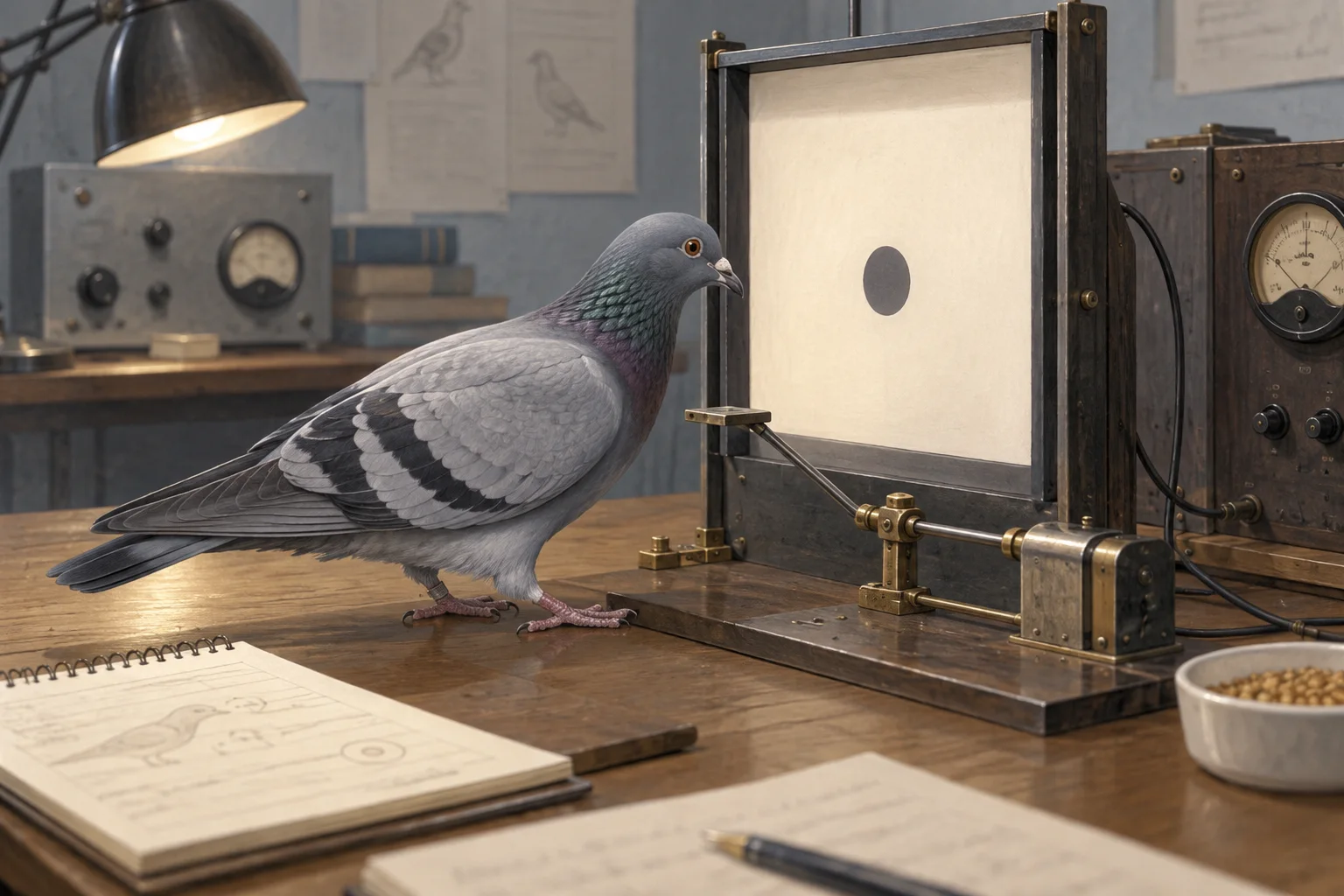
    The idea grew from behavior research. A bird could learn to respond to an image on a screen, and the apparatus translated the location of its pecks into control signals. The National Institute of Standards and Technology’s museum account describes a conductive screen and a small electrode attached to a bird’s beak as parts of the demonstration system. The goal was a guided device whose course could respond to what the bird saw.

    Three birds, three views

    NIST’s account describes how the design developed from one bird to a three-bird unit. Each bird was trained to respond when the target image appeared in its view, and the system used agreement between birds as a reliability check for steering input.

    That setup belonged to a period when researchers were testing many competing ways to guide a moving object from far away. Project Pigeon gave animal-learning research an unusually mechanical assignment. It asked a trained bird to make repeated visual judgments in a compact, vibrating instrument.

    Editorial illustration: a pigeon training station with a target screen and analog controls.

    Editorial illustration of a pigeon beside a target screen and analog research equipment on a 1940s laboratory workbench.

    A real experiment with a long afterlife

    Project Pigeon remained an experimental program, yet its story lasted because the team documented the work and demonstrated it to military and scientific visitors. NIST’s account says the demonstrations showed that the birds could provide steering input. Harvard Film Archive holds films from the pigeon experiments within its B. F. Skinner Collection, preserving a rare moving-image record of the project.

    The project is also a useful reminder that “guidance” once meant an open field of possibilities. Before compact digital electronics, researchers worked with mechanical linkages, optical displays, analog instruments, and the learned responses of living creatures. The pigeon was part of a serious attempt to connect perception to a machine’s controls.

    The B. F. Skinner Foundation describes the birds as trained to peck at an image that resembled a ship as the device approached. That simple action carried the whole premise: keep the image centered, and the control system could correct its course. The apparatus made an odd historical artifact because it brought together a laboratory bird, a screen, and a guidance mechanism in one very small space.

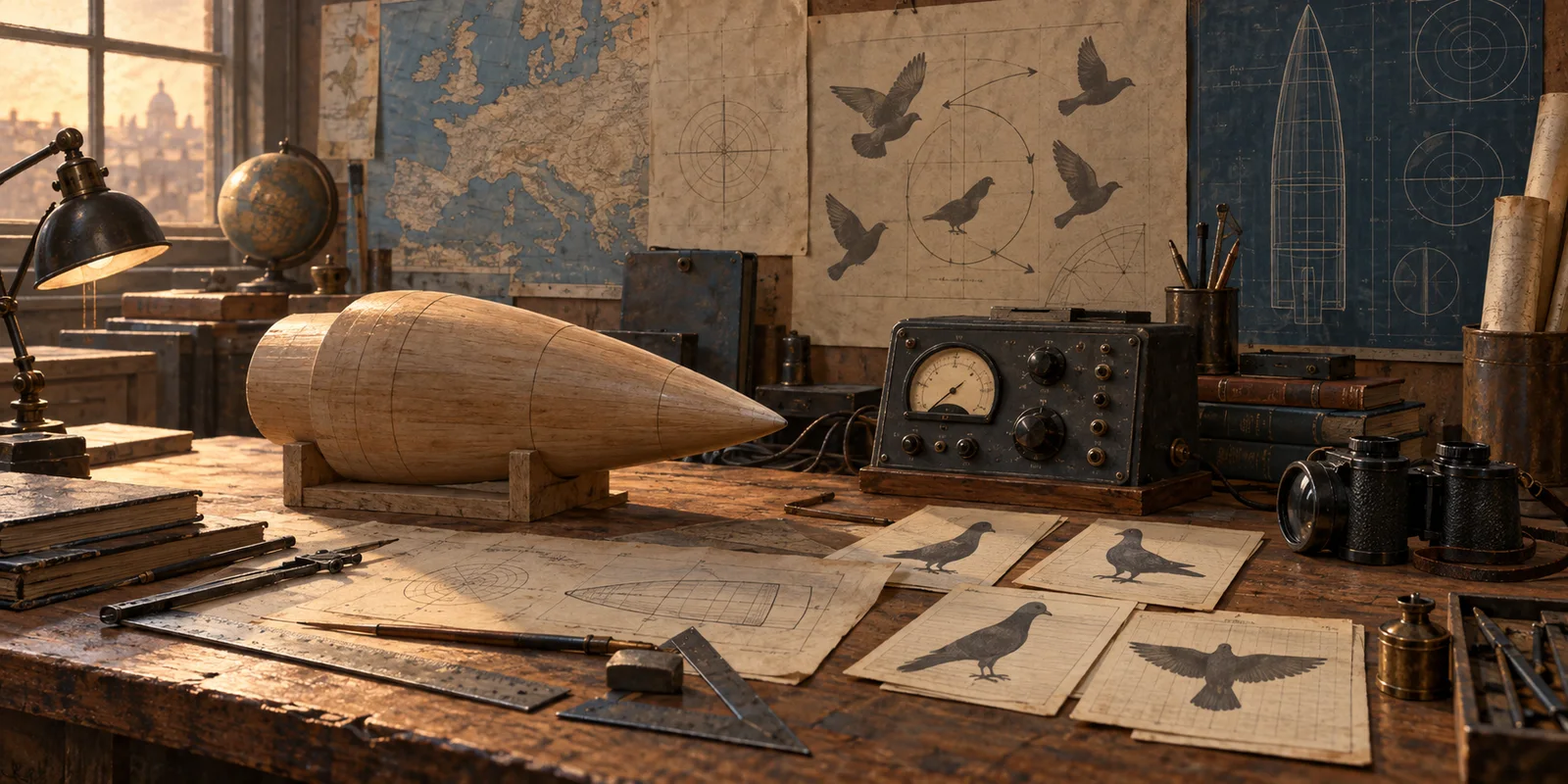
    Editorial illustration: a 1940s workbench study of a nose-cone model, analog controls, and pigeon research cards.

    Editorial illustration of a wooden nose-cone model, analog control panel, drafting tools, and pigeon research cards on a 1940s workbench.

    Why it still feels strange

    Project Pigeon captures a historical moment when trained-animal behavior and engineering were placed in the same prototype. Its physical traces now sit in collections and archives, where they show how inventive people can be when an unsolved technical problem meets an unexpected area of expertise.

    For a closer look at the documented record, see NIST’s history of the project, the B. F. Skinner Collection at Harvard Film Archive, and the B. F. Skinner Foundation’s Project Pigeon page.