
For three months in 1938, Crater Lake rangers kept track of a tall tree stump that drifted upright across the water. Their measurements added up to at least 62.1 miles.
The Old Man of the Lake is a mountain hemlock log that floats vertically in Oregon’s Crater Lake. The National Park Service describes it as about 30 feet long, with roughly three feet showing above the surface. The dark line of wood can be easy to mistake for a buoy or a distant boat, and its slow journeys once offered a practical clue to the lake’s winds.
In 1938, ranger naturalist Wayne E. Kartchner and park naturalist John E. Doerr Jr. recorded its position from July through September. Their article in Crater Lake National Park Nature Notes turned the log into a moving marker for currents that were difficult to observe directly.
A floating instrument for reading the lake
The two naturalists logged 84 locations. At times, the log remained near shore for several days; on other days it traveled quickly enough to cover miles between observations. Measuring straight-line distances between recorded positions, the team calculated a minimum route of 62.1 miles. They noted that the actual distance was certainly longer because each measurement connected only two points.
The Old Man’s location pattern also helped the naturalists infer how wind moved around the caldera. During much of July, August, and early September, it stayed in the north half of the lake. Kartchner and Doerr interpreted that pattern as evidence of prevailing southerly winds, locally redirected by the crater walls into eddies and cross-currents.
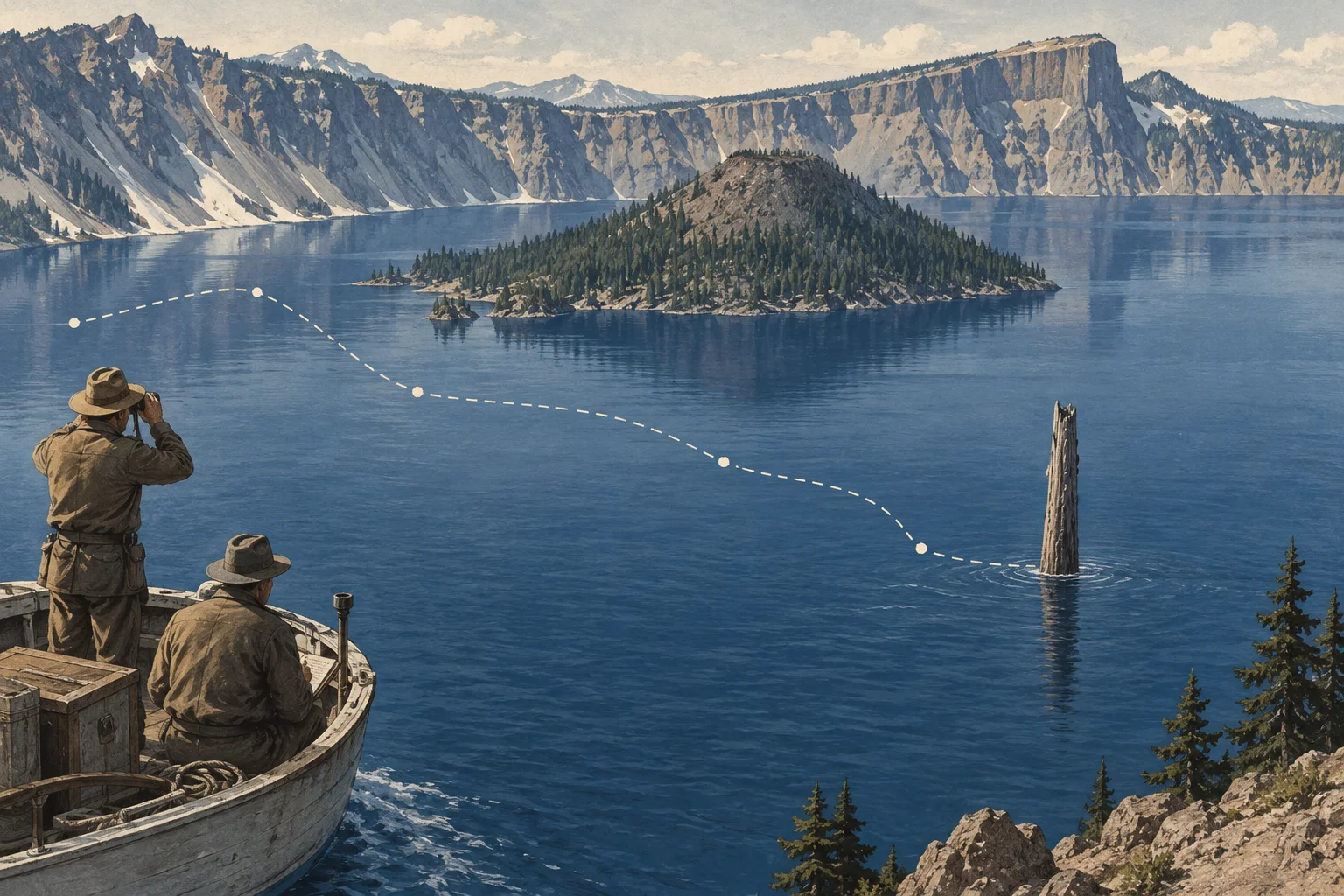
The busiest day in the surviving tally was August 6, when two observations showed a straight-line change of 3.8 miles. The naturalists associated the strongest movements with days of high wind and waves. The observations gave them a way to follow the lake’s surface circulation without putting instruments across its deep water.
Why the log stays upright
The 1938 article offered one explanation for the log’s origin: a rockslide may have broken a tree from the crater wall and carried it into the water with rocks lodged among its roots. The authors described the upright drift as a useful natural record of changing winds.
The Park Service presents two ideas for the log’s unusual balance: long immersion in cold water may have changed the lower wood’s density, or rocks may remain lodged near its base. Both are possibilities rather than a settled explanation. The trunk has also been carbon-dated to more than 450 years old, according to the Park Service.

A log with a local legend
Crater Lake’s Old Man also accumulated a bit of folklore. The Park Service recounts a story that researchers tied it near Wizard Island during a 1988 submersible expedition, then saw storms and August snow arrive. In the telling, they released the log and the weather cleared. The agency presents this as lore, while its scientific account treats the stump as a wind-driven object whose movement can help reveal surface currents.
The 1938 observers left their last recorded position on September 30, when the stump was about half a mile from the south shore. Their careful notes made an odd sight into a field instrument: a weathered tree, drifting through a volcanic lake, tracing wind patterns one observation at a time.
Sources: National Park Service, “The Old Man”; Wayne E. Kartchner and John E. Doerr Jr., “Wind Currents in Crater Lake as Revealed by The Old Man of the Lake,” Crater Lake National Park Nature Notes, September 1938.
Leave a Reply