By Weird News staff
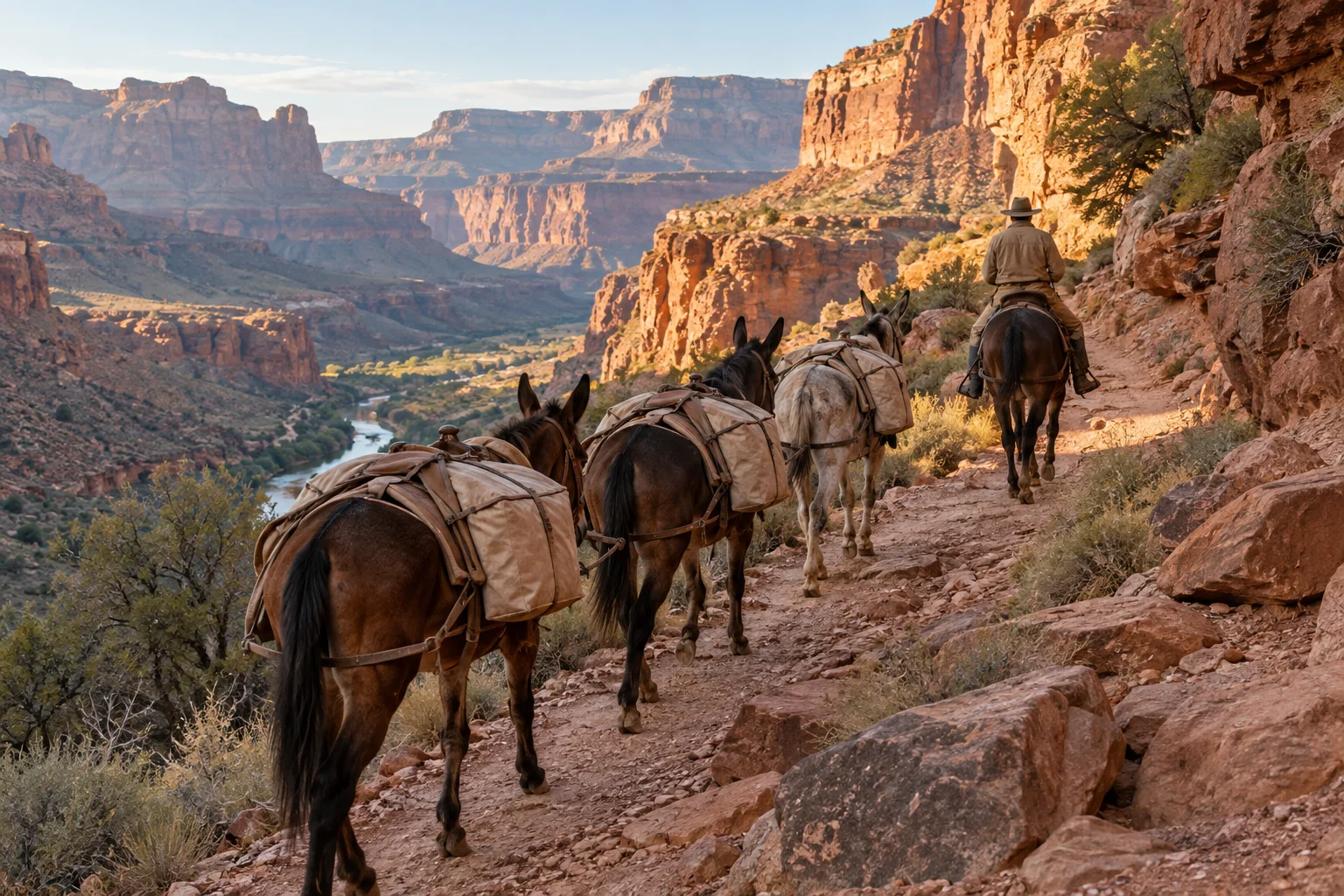
Most mail routes are designed to disappear into the background. A mailbox opens, a letter arrives, and nobody needs to think about the last mile. The route to Supai, Arizona, makes that final stretch impossible to ignore: a working train of mules carries mail and goods down into Havasu Canyon, five days a week.
A post office at the end of a trail
Supai is the principal village of the Havasupai Tribe’s reservation in Havasu Canyon. The National Park Service describes the village as a roadless destination and directs prospective visitors to the Tribe’s official reservation system and visitor rules. The route serves a living community on Tribal land, a context the park’s visitor guidance keeps front and center.
The U.S. Postal Service calls its mule train its most unusual delivery mode. Its current Postal Facts page says that mules have carried mail and goods to the Havasupai people since the 1930s. A daily string of 10 to 22 mules, accompanied by one wrangler on horseback, travels to the Supai Post Office five days a week. USPS describes a nine-mile downhill journey that takes about three hours and a five-hour trip back up.
Confirmed facts: why the loads look so carefully arranged
The route is a working logistics system. USPS says a mule can carry up to 200 pounds, with the load balanced between its two sides. Its Postal Facts page also says the wrangler untethers the mules for the uphill return and that the Supai Post Office has a special Mule Train postmark.
The USPS description of a mule carrying up to 200 pounds, balanced between its two sides, puts the familiar photograph of a pack string in a different light: a pair of panniers is less a costume than a practical way to make a steep, roadless connection work.

A present-day tradition
There is something delightfully out-of-time about receiving a letter on a route powered by hooves. But “old-fashioned” can be a misleading word. The confirmed tradition is the service itself: USPS documents mule delivery here from the 1930s onward. The mules are part of a present-day delivery operation whose routine depends on trained workers, careful loading and a route shaped by the canyon.
The full context matters. The Havasupai Tribe’s official site provides the reservation’s own information about pack mules and visitor reservations. The National Park Service explicitly notes that access to the reservation requires reservations. A striking delivery route serves a community, and visitors follow its reservation process and trail guidance.
Folklore and the postcard version
The idea of a “mule mail carrier” naturally invites tall-tale language: a lone animal heroically delivering letters by itself, or a frozen-in-time cowboy scene. USPS documents a wrangler, a working string of mules, balanced loads and a regular schedule. The mule train is the transport; people run the service.
The official USPS, National Park Service and Tribal sources reviewed for this story focus on current logistics, leaving a specific Havasupai folklore account outside this article. The documented practice stands on its own: a community’s daily logistics carried out with care.
What is still unknown from the public record
Public sources establish that the route operates and describe its routine; details about every operational choice and future schedules remain open. Claims about the mule train’s long-term role or future decisions by USPS and the Havasupai Tribe would require fresh evidence.
There is a simpler, verified observation to hold onto: a regular delivery service has found a way to meet a roadless canyon on its own terms. Rather than erase the hard part of the journey with an app notification, it makes the journey visible—one carefully balanced mule at a time.

Leave a Reply