Editorial illustration
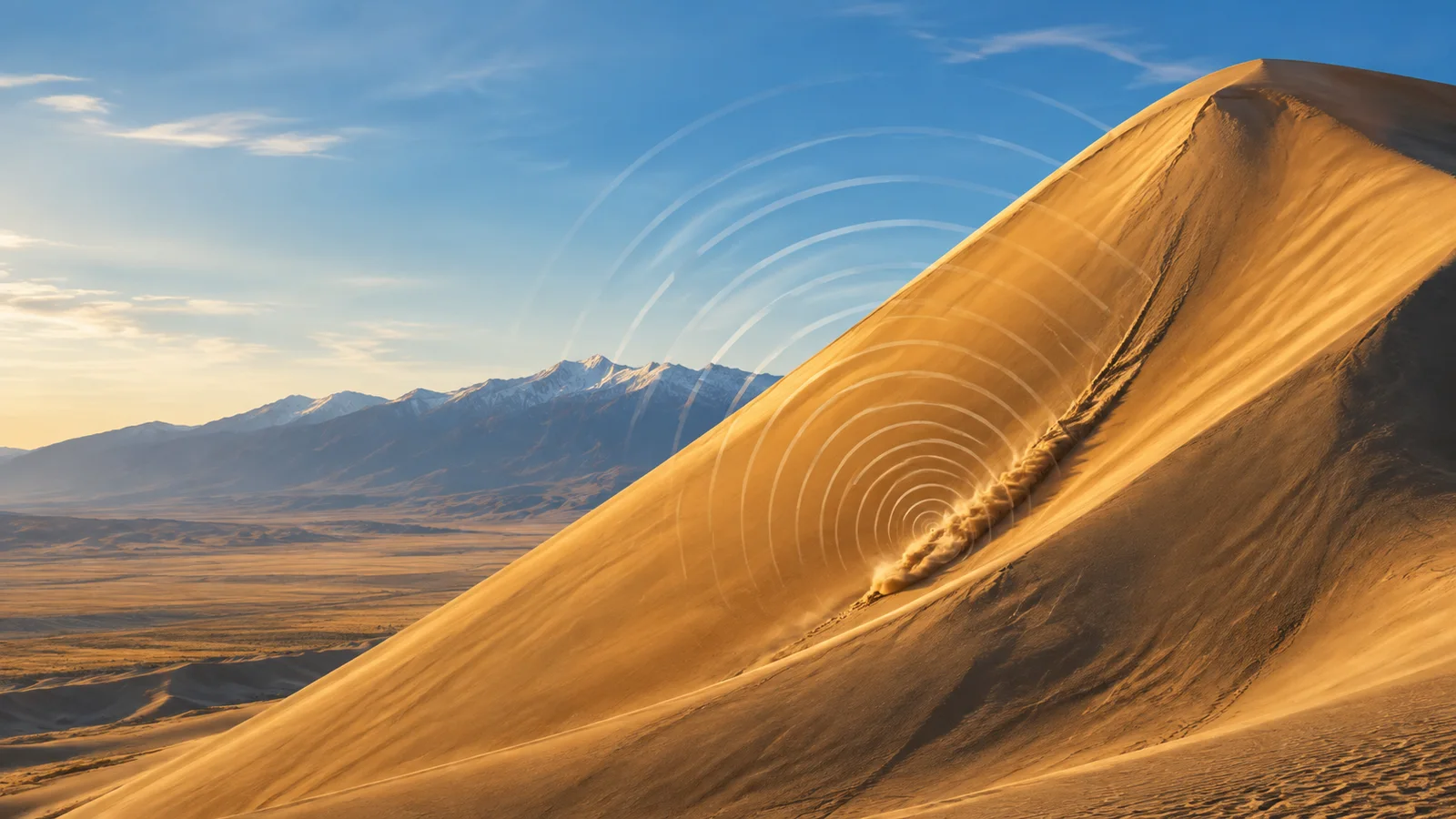
A deep note can roll across a dune in southern Colorado, as if a bass instrument had been buried beneath the sand. At Great Sand Dunes National Park and Preserve, the sound has a physical source: an avalanche of exceptionally dry sand moving down a steep slip face. The National Park Service records the phenomenon as “singing sands,” a rare natural sound that visitors can hear at only a small number of places worldwide.
Confirmed facts: sand can make a sustained tone
The park sits where wind, water, and sediment have spent millennia building a huge dune field against the Sangre de Cristo Mountains. The National Park Service describes the main active dune field as about 30 square miles, shaped by opposing winds and a continuing recycling of sand through the valley’s creeks and sand sheet.
During suitable dry conditions, a slide of sand down a steep face can set up a low, humming or booming tone. A 2007 field study led by researchers at Caltech measured sustained booming at several desert sites. Its principal tones fell between about 70 and 105 hertz, along with higher harmonics. That range helps explain the sound’s startling, musical character: it arrives as a steady low note with a clear dominant pitch.
Dryness matters. The study’s field observations linked sustained booming with an appropriate loose surface layer and steep, avalanching sand. The NPS sound library preserves a recording from Great Sand Dunes, offering a useful reminder that this story begins with a real acoustic event, heard in the open air.

How one leading explanation works
The Caltech team proposed a dune-scale waveguide. In their model, the moving avalanche supplies an acoustic pulse, while a shallow layer of dry, loose sand helps select and reinforce a particular frequency. Constructive interference in that layer can amplify the vibration, and the surface then couples the energy into the air as a powerful audible note.
That account connects several observed ingredients: a broad slip face, a surface avalanche, dry sand, and a tone that lasts longer than the visible surge of grains. It also gives the dune itself an active role. The feature acts as a landscape-sized resonator.
Folklore and familiar names
People have given sound-making sands vivid names for generations. A U.S. Geological Survey guide records “desert thunder,” “booming sands,” and “roaring sands” among the common labels. Explorers and travelers also carried tales of singing or droning dunes across deserts in Asia, Africa, and the Americas.
Those names belong to the human record of listening. They express awe and memory; laboratory evidence supplies a separate account of the mechanism. The word “singing” works as a graceful metaphor for a natural tone produced by moving sand.
What remains speculative
Researchers agree on the central observation: some dunes boom during suitable avalanches. The fine detail of frequency selection remains an active scientific question. A published response to the 2007 waveguide paper argued for a different account based on wave behavior in the surface layer and granular flow. The exchange records competing interpretations of how the dominant frequency is selected.
That exchange offers a healthy distinction. The sound, the avalanche, and the dry-sand setting stand on direct measurements. The exact route from grain motion to one dominant audible pitch carries competing models. Future field measurements can sharpen the picture.
A strange sound with a solid foundation
Great Sand Dunes earns its uncanny reputation through ordinary ingredients arranged in an extraordinary geometry: grains, gravity, dryness, slope, and a layered body of sand. The result feels theatrical, yet the surprise grows from physics unfolding at landscape scale. A dune can hold a note, and that simple fact makes a quiet desert feel briefly musical.
Leave a Reply