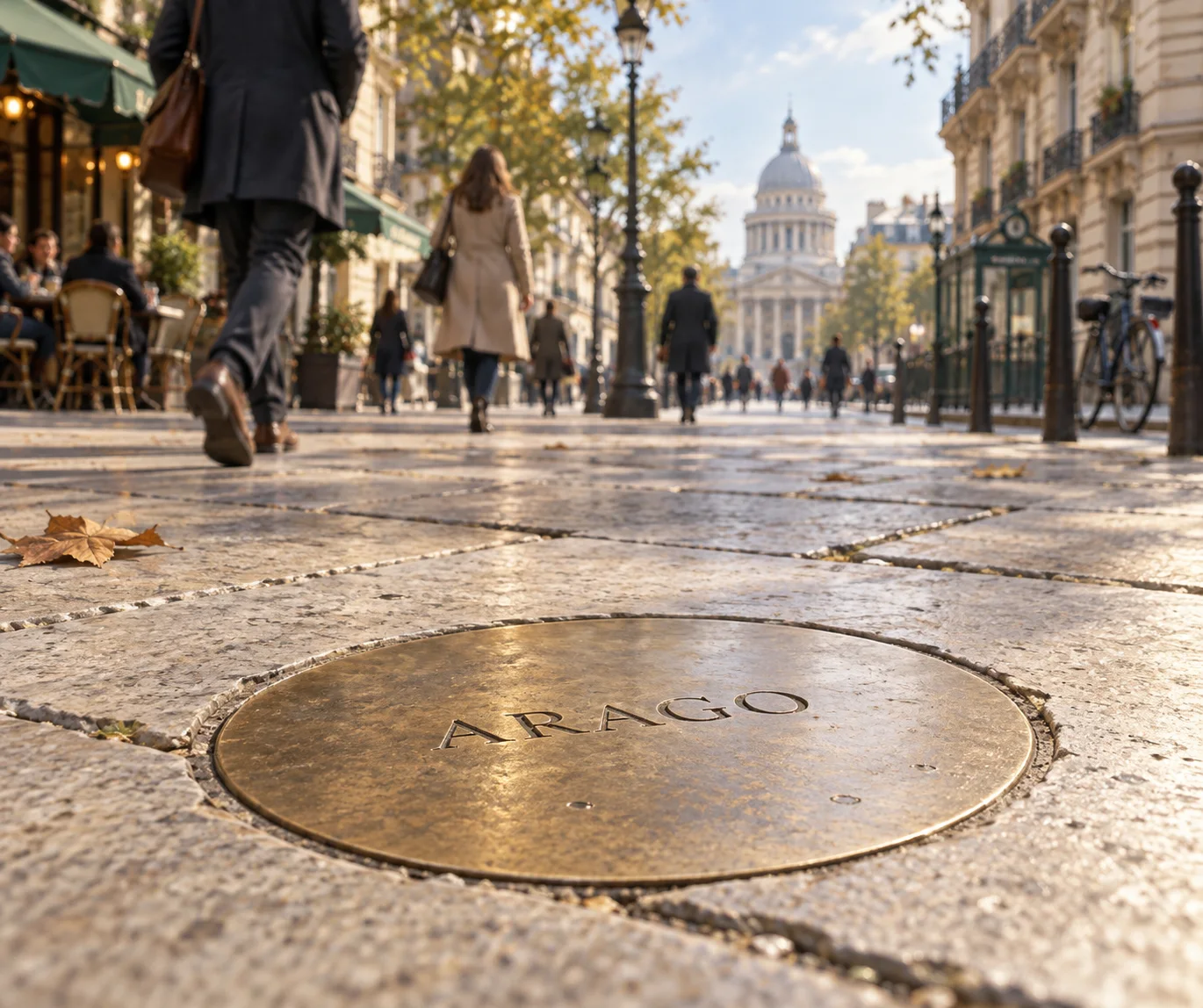
In Paris, a small bronze circle can turn an ordinary walk into a hunt for a line that exists on maps, in astronomy, and beneath the city’s pavement. The Arago medallions—part of Dutch artist Jan Dibbets’ public artwork Hommage à Arago—trace the Paris meridian through streets, courtyards, and gardens.
A memorial spread across the city
The Paris Observatory describes a route of 135 medallions bearing François Arago’s name. In 1994, the city commissioned Dibbets to create an artwork marking the imaginary line of the Paris meridian, turning a tribute to the 19th-century astronomer and geometer into a work people encounter at street level.
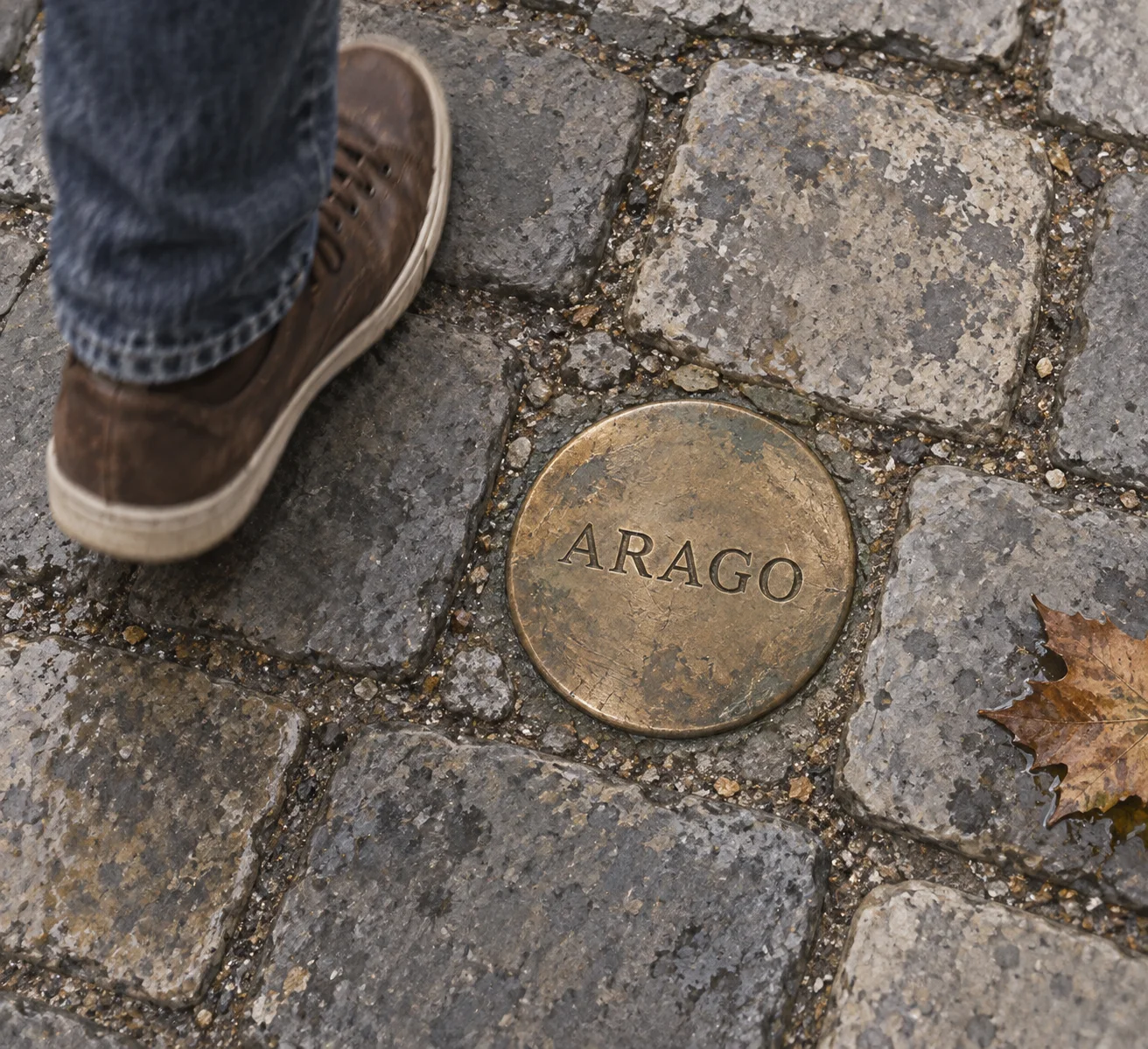
The Musée d’Art Moderne de Paris likewise identifies Dibbets’ Hommage à Arago as a 1994 work made from bronze disks that materialize the Paris meridian. Rather than gather one large statue in a single square, the artwork disperses small markers along the city’s north–south line. Finding them means looking down as well as looking around.
Who was François Arago?
Arago (1786–1853) was an astronomer, physicist, and public figure who worked at the Paris Observatory. The Observatory’s account notes that he helped calculate and map the Paris meridian. The line itself is an abstract north–south reference; Dibbets gave it a physical presence through repeated bronze disks set into paving.
The installation’s scale changes how a memorial works. A monument normally asks a visitor to arrive at one point and look up. These markers invite a longer kind of attention: spot one in a sidewalk, continue through a garden, then find another beside a familiar street or historic building. The Observatory’s guide presents the route as both a city walk and a way to encounter Parisian history.
An artwork you can discover by walking
The medallions make a scientific line part of everyday city life. A map gives the meridian continuity; the small disks give it moments of contact. Each one offers a simple clue—Arago’s name—while the larger artwork unfolds across neighborhoods.
That modest scale is part of the charm. The piece is easy to pass without noticing, yet it rewards anyone curious about the markings underfoot. In Paris, a stroll can double as a search for a scientist’s name stamped into the route of an older measurement.
Leave a Reply