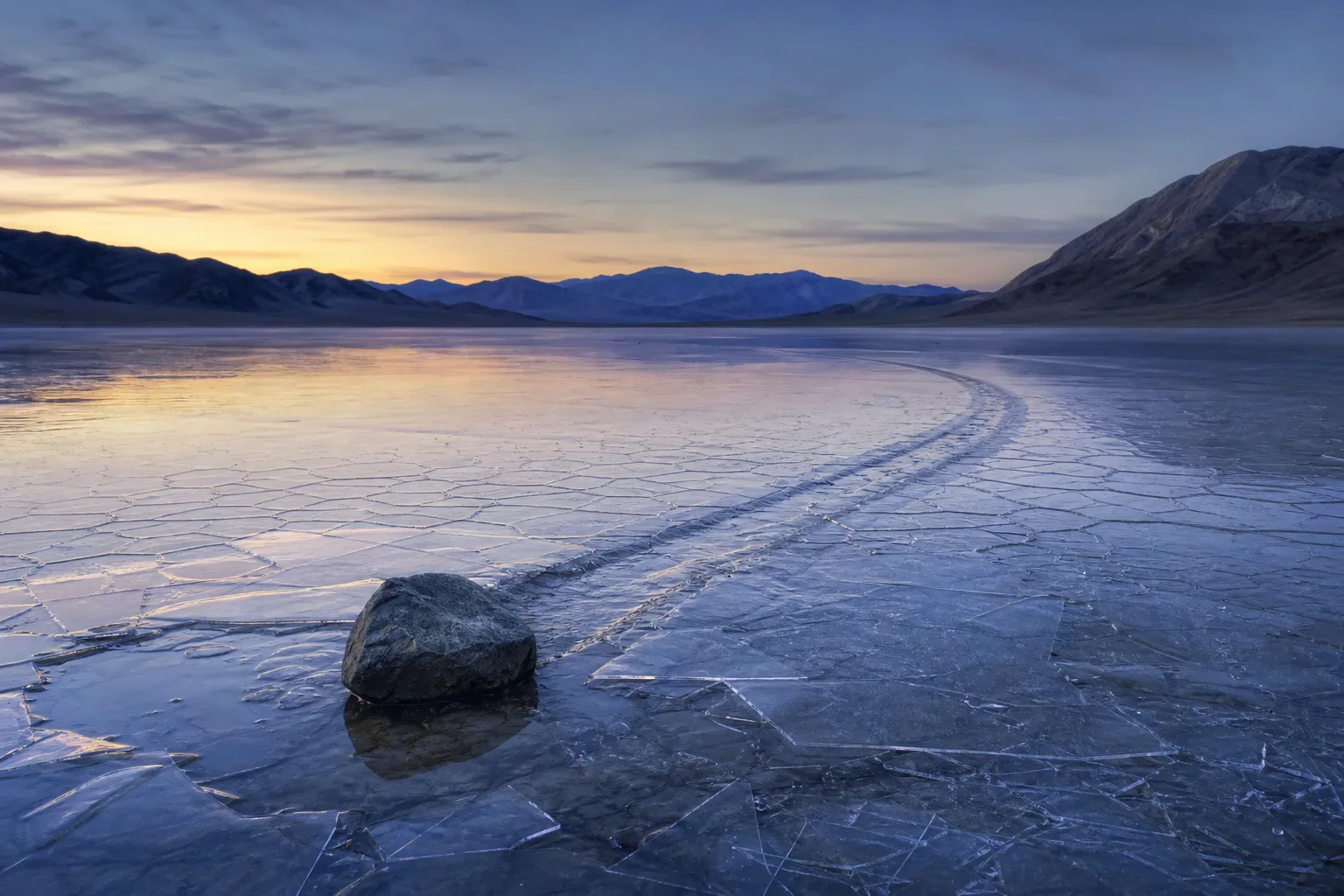
For decades, the tracks on Racetrack Playa looked like evidence of an impossible commute. Stones sat at the ends of long grooves in the mud, yet nobody had watched them travel. Some paths ran nearly parallel; others curved, crossed, or stopped while a nearby stone kept going. The desert offered plenty of suspects—violent wind, slippery algae, thick floating ice—but not a witnessed mechanism.
The first direct scientific observations arrived during the winter of 2013–2014. Researchers had installed a weather station, time-lapse cameras, and 15 specially prepared limestone rocks containing GPS loggers. Then a shallow pond formed on the playa, froze on cold nights, and began breaking apart under the late-morning sun.
The push came from ice—but not the ice people expected
The answer was surprisingly delicate. In a 2014 peer-reviewed study, Richard Norris and colleagues reported that sheets of “windowpane” ice only about 3 to 6 millimeters thick could push stones when three conditions lined up. The playa first needed enough water to create a shallow pond. A cold night had to freeze its surface. Then sunlight and light wind had to arrive together as the ice softened and fractured.
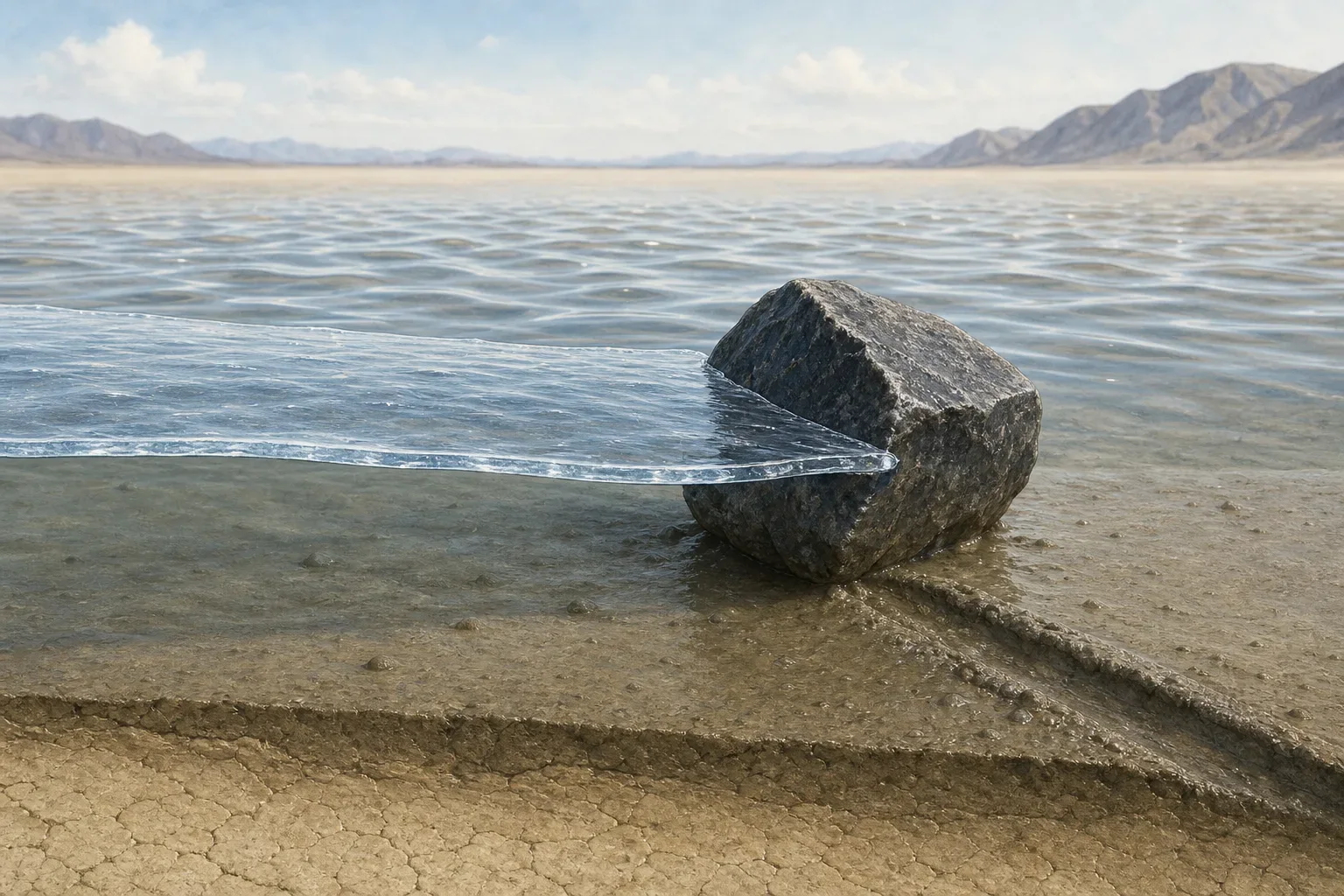
Large floating panels—tens of meters across despite being only millimeters thick—were driven across the pond by light winds and flowing water. When a panel met a rock that projected high enough above the water, the ice pressed against it and nudged it across the wet mud. The moving rock carved the trail that would become obvious after the water and ice disappeared.
This was not a dramatic sprint. The observed stones moved at roughly walking pace or slower, commonly a few meters per minute. One directly watched movement on January 9, 2014 lasted about 18 seconds at around 1 to 2 meters per minute. GPS-equipped stones recorded longer events. Two rocks that started about 153 meters apart began moving within six seconds of each other on December 4, 2013, traveling more than 64 meters in 16 minutes.
Why the mystery lasted so long
Racetrack Playa is remote, and the necessary weather is rare. The National Park Service says the moving-rock phenomenon requires a precise sequence of rain, freezing temperatures, sun, and wind. Years can pass without a suitable event. Even when the stones do move, their slow motion is difficult to notice casually, and their new trails may stay hidden beneath muddy water until the pond is blown or evaporated away.
The thinness of the ice also helped the process evade earlier explanations. Some hypotheses imagined rocks frozen into thick rafts that partly floated them off the lake bed. The observed mechanism did not lift the stones. Instead, broad but fragile ice panels supplied a gentle horizontal push while the wet clay reduced resistance.
That fragility explains why neighboring tracks are not always identical. A panel can split when it strikes a stone or a fixed obstacle, disconnecting rocks that had been moving together. Low stones can be overridden by the ice, while taller ones catch its edge. Water depth, rock profile, ice fractures, wind direction, and the flow beneath the ice all influence which stones move and where they go.
A solved mechanism, not a scheduled show
The science explains how the sailing stones can move; it does not make the event predictable for visitors. The National Park Service warns that the playa surface is extremely fragile. Driving on it is prohibited, and walking on it when muddy leaves scars that can last for years. The rocks themselves should never be moved.
What remains at Racetrack Playa is stranger than a supernatural story because it is so restrained: a temporary pond, a cold night, sunlight, a light breeze, and ice thin enough to look powerless. Given the right geometry and timing, those ordinary ingredients can reorganize stones across a desert floor—and leave the evidence long after the motion has stopped.
Leave a Reply