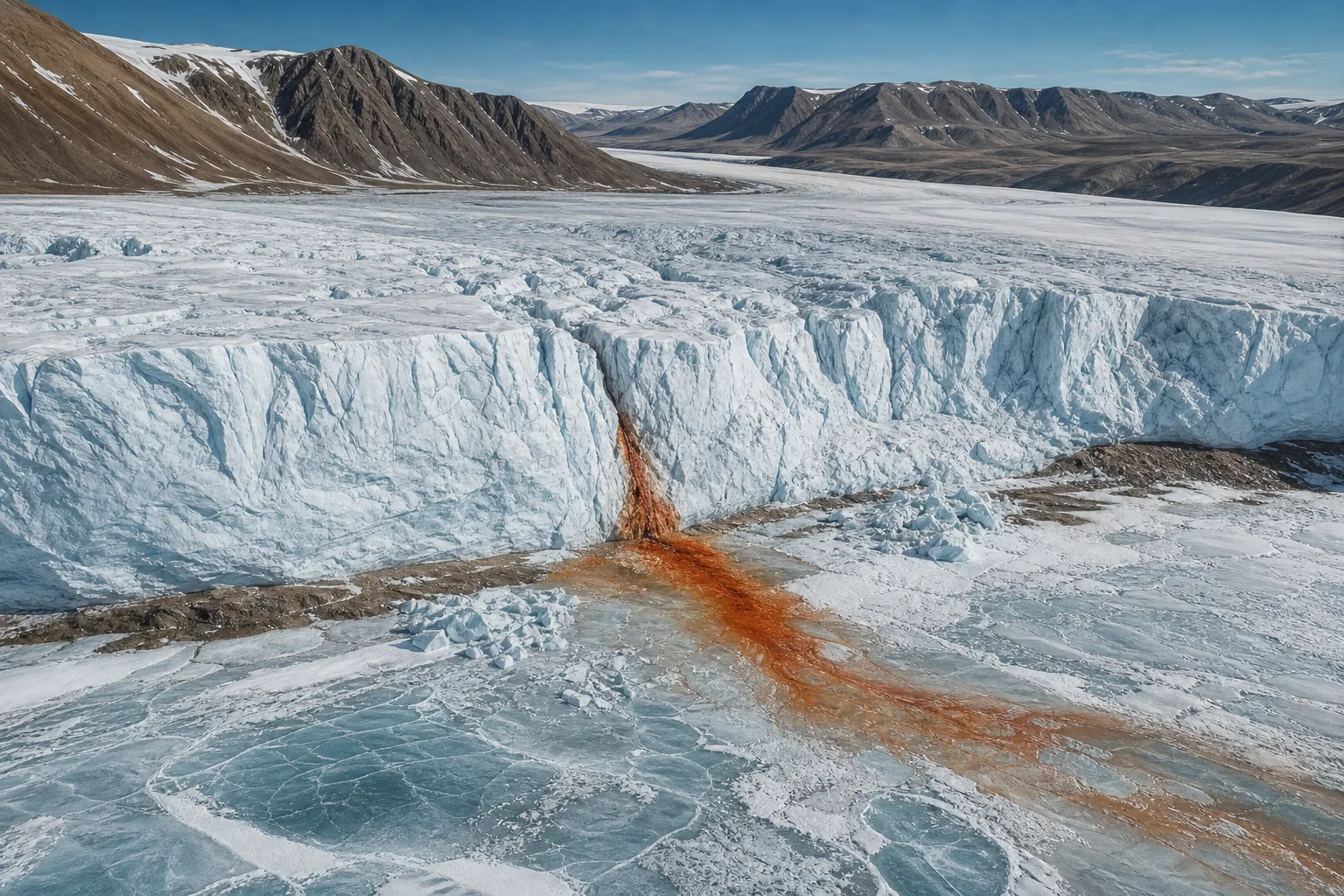
At the end of Antarctica’s Taylor Glacier, a rusty red-orange stain spills across blue-white ice toward Lake Bonney. The feature is called Blood Falls, but its color does not come from blood, and it is not a conventional waterfall. It is the visible outlet of an iron-rich, extremely salty liquid-water system hidden inside and beneath a glacier.
That alone is a puzzle. Taylor Glacier lies in the McMurdo Dry Valleys, one of Earth’s coldest and driest landscapes. A 2017 study described a mean annual air temperature around minus 17 degrees Celsius and limited surface melting. Yet geophysical surveys found a zone of liquid brine within the cold glacier feeding the intermittent discharge.
Salt and freezing help keep the water moving
Researchers used radio-echo sounding to map the brine rather than treating the red surface stain as the whole system. Their observations support a network of basal crevasses through which pressurized subglacial brine is injected into the ice and routed toward the terminus. The system is not an open cavern shaped like a giant underground lake; it is a distributed, salty hydrologic network.
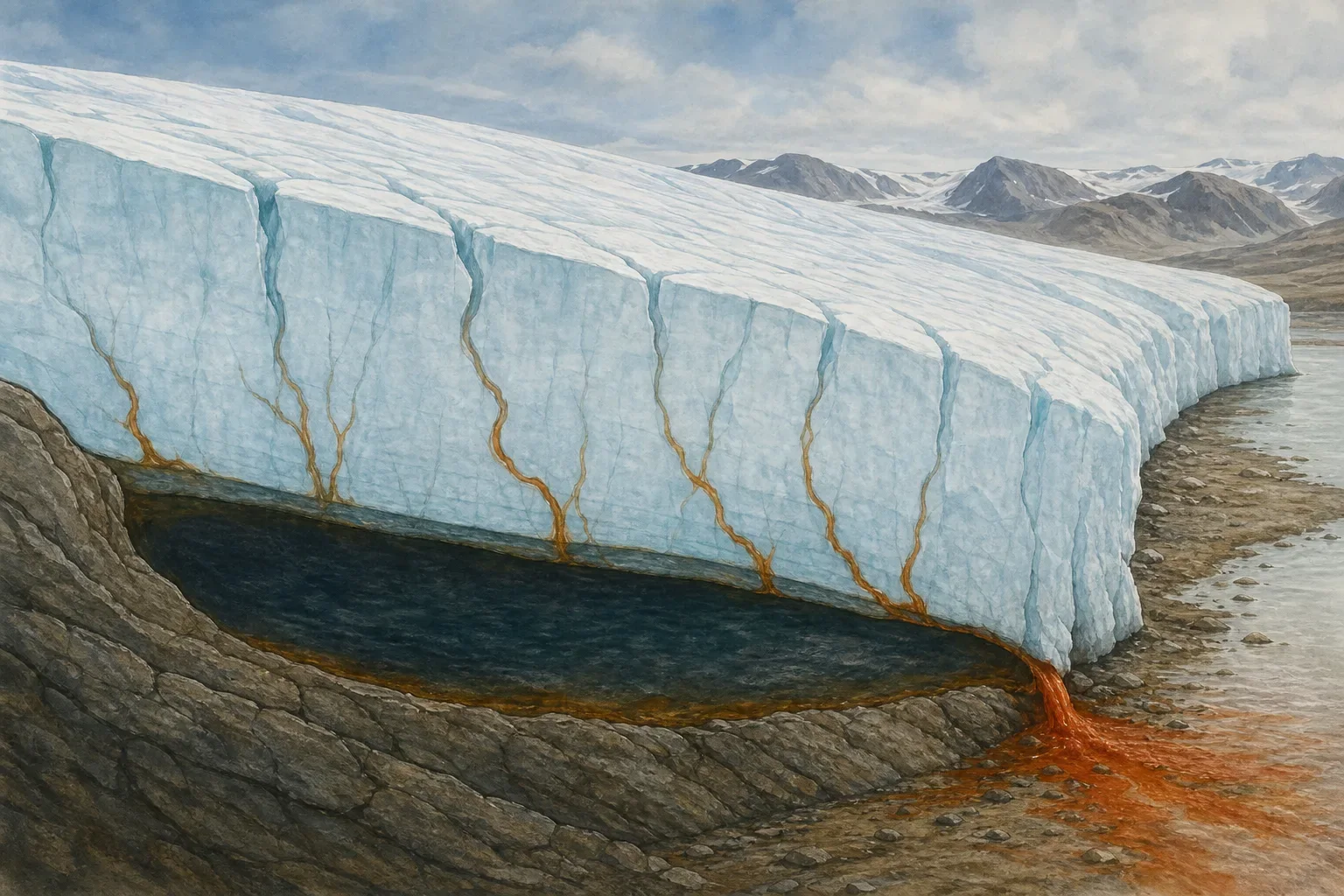
Two physical effects help explain why liquid can persist. Dissolved salts lower water’s freezing point. Freezing also releases latent heat, providing localized warming. The 2017 paper concluded that elevated salinity and latent heat together allow the brine to remain mobile in subglacial and englacial environments even while the surrounding glacier stays cold.
The color develops when iron-rich brine reaches the surface and encounters oxygen. Iron compounds oxidize, producing the red-orange material that stains the ice. The result looks theatrical from a distance, but the chemistry is closer to rusting than bleeding.
A hidden habitat in cold, dark brine
Blood Falls is also important because the outflow has revealed a microbial community adapted to cold, darkness, high salinity, and little oxygen. NASA’s astrobiology reporting describes organisms that survive without sunlight for photosynthesis by using chemical reactions involving sulfur and iron compounds. That makes the site a natural laboratory for asking how life can persist when familiar surface energy sources are absent.
Scientists are careful not to turn that analogy into evidence of extraterrestrial life. Blood Falls does not prove that organisms exist beneath Martian ice or inside the icy moons of the outer Solar System. It shows something narrower and valuable: on Earth, a cold, salty, lightless system can remain liquid and biologically active under conditions once assumed to be inhospitable.
The origin story of the brine has developed as evidence improved. NASA’s Earth Observatory summarized a long-standing interpretation in which ancient seawater or a saltwater lake occupied Taylor Valley before advancing ice trapped and concentrated it. Later studies mapped where brine exists within the glacier and how it can move. Details of the system’s age, geometry, and geochemical history are scientific questions, not reasons to present a single dramatic reconstruction as settled fact.
The visible stain is only the outlet
Blood Falls earns attention because of its color, but the stranger feature is invisible: liquid threading through a glacier that has little surface melt. The surface apron can grow with new discharge and partly degrade during warmer periods, so its appearance changes. What a visitor or satellite sees is a temporary expression of a much larger system.
Seen that way, the name is almost misleading. The remarkable thing is not a glacier “bleeding.” It is the combination of salt, pressure, fractures, phase changes, iron chemistry, and microbial metabolism operating beneath an Antarctic ice mass. The red stain is a window into that hidden machinery—vivid enough to draw the eye, but only the final step of the story.
Leave a Reply