Blog

  • Why U.S. Mail Still Travels by Mule to Supai

    Why U.S. Mail Still Travels by Mule to Supai

    Editorial illustration of a mule train carrying balanced mail sacks and supplies along a rocky canyon trail toward a green oasis.

    Editorial illustration: a working mule train on a canyon route.

    Most mail reaches a post office in a truck. Mail for Supai, Arizona, still has a final stretch that is much older: it goes down a canyon trail on the backs of mules.

    The United States Postal Service says mules have carried mail and goods to the Havasupai people since the 1930s. Its current Postal Facts page describes a weekday delivery using 10 to 22 mules and a wrangler on horseback, travelling nine miles down to the Supai Post Office. The agency says the descent takes about three hours and the return about five.

    A route shaped by geography

    Supai is in Havasu Canyon, a tributary on the south side of the Colorado River. The National Park Service says the village is not accessible by road, and that the Havasupai Tribe administers the reservation outside Grand Canyon National Park’s boundary and jurisdiction. That distinction matters: the canyon’s geography explains the route, but the community and its land are not a park attraction.

    For visitors, the Park Service lists an eight-mile hike from Hualapai Hilltop to Supai. USPS describes its delivery run as nine miles. Rather than turn the small difference into a mystery, this feature keeps each number with the agency that gives it: the Park Service’s visitor route and the Postal Service’s working delivery route are not presented as the same measurement.

    USPS says each mule can carry up to 200 pounds, with weight divided between both sides for balance. The train carries more than letters and packages: the Postal Service also describes it as carrying goods. Outgoing mail travels back up the canyon, so this is a two-way postal link rather than a ceremonial one-way delivery.

    Editorial illustration of a pack mule with evenly balanced canvas loads walking beside a wrangler on a desert canyon trail.

    Editorial illustration: balanced loads on a working pack mule.

    Why the mules are still there

    The oddity is not that a modern post office somehow forgot about roads. It is that the route has a roadless destination. A mule train can use the canyon trail without turning a remote community’s connection to the mail into a reason to build a road through it.

    USPS has called the Supai service its most unusual delivery method. Its postal-history material has also described the route as the nation’s last mule-train delivery. Those are agency characterizations of a real, continuing service—not evidence for a larger frontier myth. The useful verified facts are narrower: there is an operating Supai Post Office, the community lacks road access, and USPS says a mule train carries its mail and goods on the canyon route.

    Fact, folklore, and the limits of the story

    Documented fact: USPS and the National Park Service independently describe the mail service and Supai’s roadless setting. The Postal Service’s current figures for mule count, weekday schedule, travel time, load capacity, and nine-mile delivery run are attributed to USPS rather than treated as independently measured here.

    Folklore and shorthand: Calling the route a living version of the Pony Express can make a tidy headline, but it is only a comparison. The available official sources describe a modern contract delivery service for a present-day community, not a reenactment of a 19th-century system.

    What this feature does not claim: It does not claim that every item destined for Supai arrives only by mule, that the trail is open to casual day visitors, or that the delivery route establishes ownership or jurisdiction over Havasupai land. The verified strange part is enough: a working U.S. post office is still linked to the national mail by a carefully loaded mule train.

    Sources

  • The Capitol Room Where a Whisper Can Travel the Curve

    The Capitol Room Where a Whisper Can Travel the Curve

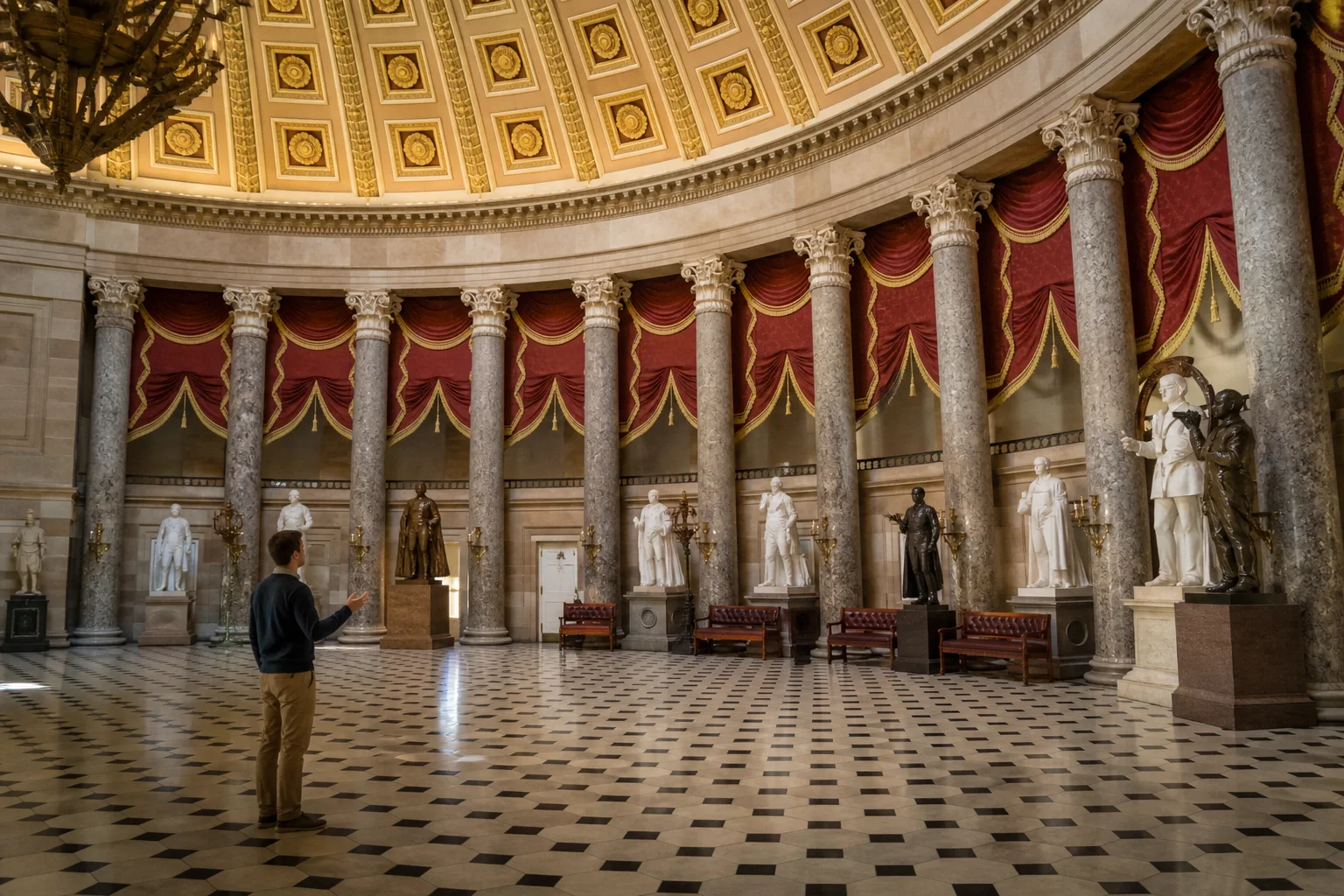
    Editorial illustration of the semicircular National Statuary Hall with a visitor speaking close to its curved wall.

    Editorial illustration.

    In one room of the U.S. Capitol, the most useful seat for hearing a person may not be the nearest one. National Statuary Hall has a half-dome that can carry a voice along its curved surface, creating the unusual effect known as a whispering gallery. In the right spots, the Architect of the Capitol says, a speaker many yards away may be clearer than someone closer at hand.

    The feature is an accident of architecture rather than a secret passage or an electronic trick. The room was built as the House of Representatives’ chamber, and its smooth curved ceiling created so much echo that ordinary debate was difficult. The House eventually moved to a new chamber; the former room became National Statuary Hall, which now displays part of the collection of statues contributed by the states.

    An old House chamber with a new job

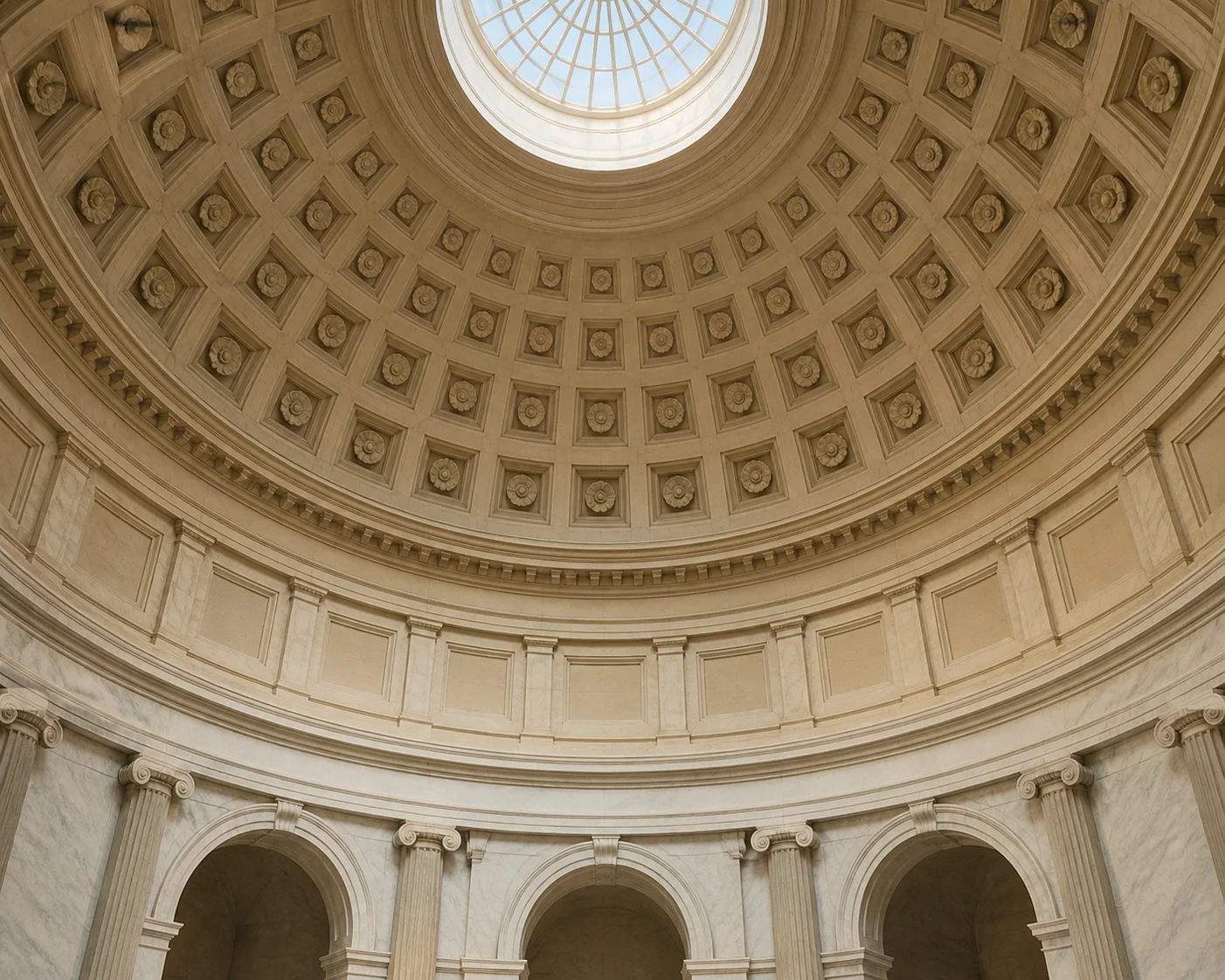
    The present hall was rebuilt after British troops burned the earlier House chamber in 1814. According to the Architect of the Capitol, Benjamin Henry Latrobe and Charles Bulfinch completed the room between 1815 and 1819. It has the shape of an ancient amphitheater, with a half-dome, lofty columns, and a lantern that admits daylight through the ceiling.

    Its original use exposed the room’s acoustic problem. The Architect of the Capitol says that the smooth, curved ceiling promoted annoying echoes; draperies and even a reversed seating arrangement did not solve it. A separate, more functional House chamber was authorized in 1850, and representatives began meeting there in 1857.

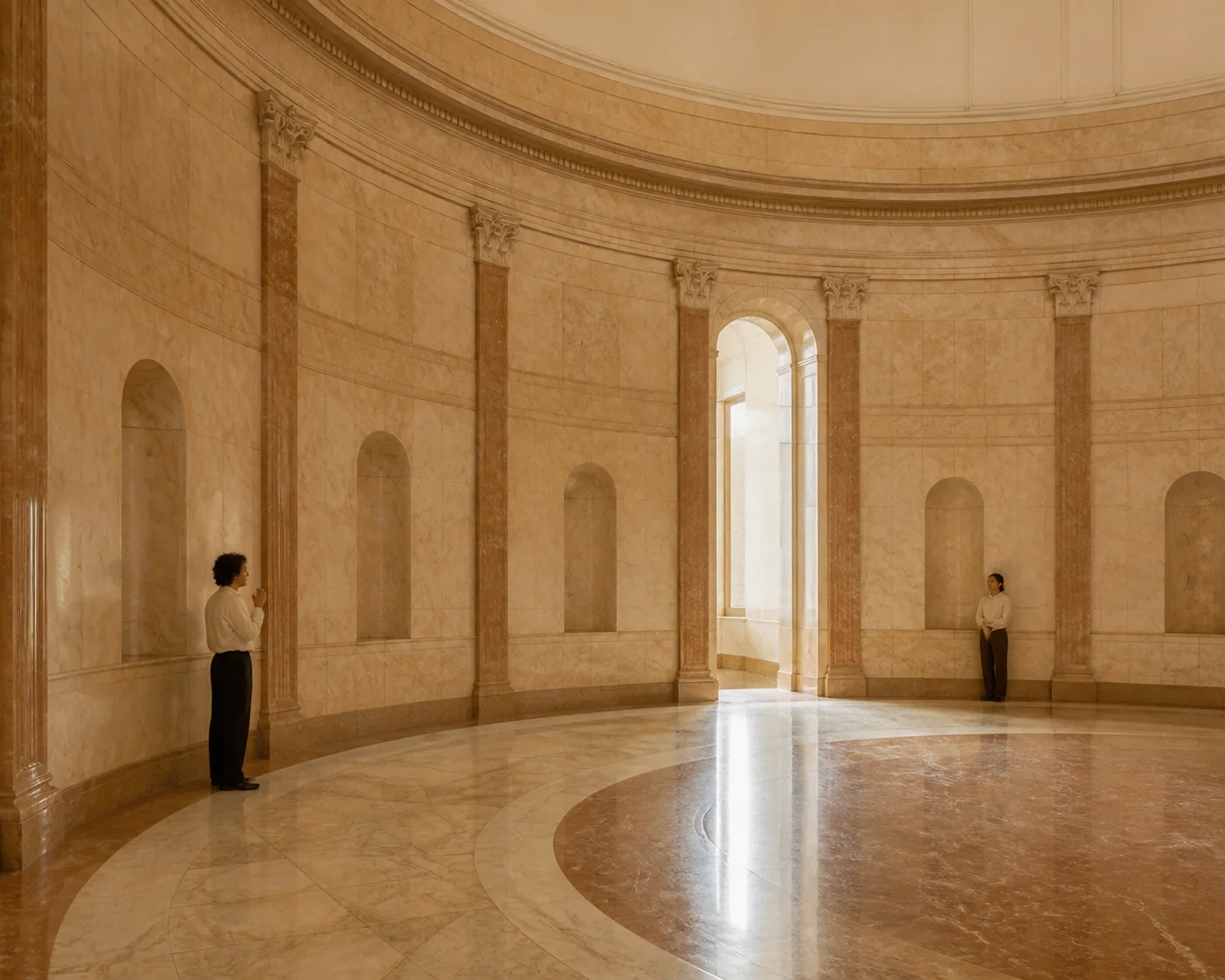
    Editorial illustration showing two visitors at widely separated points along the curved wall of a semicircular hall.
    Editorial illustration of the curved room geometry behind the listening effect.

    How the whispering effect works

    Sound normally spreads outward from its source. A smooth curved surface can redirect some of those sound waves so they travel along the curve instead of dispersing evenly through a room. In National Statuary Hall, that geometry produces the peculiar listening locations documented by the Architect of the Capitol. It is a concentration effect, not a way to make a private conversation universally audible.

    The exact places that work have changed. The Architect of the Capitol notes that the modern echoes occur in different locations than they did in the 19th century because the hall’s floor and ceiling are no longer the same. That is an important limit on the legend: the effect depends on the room’s built surfaces, not on a permanent pair of magical floor tiles.

    A long-lived Capitol curiosity

    Historical visitors noticed the room’s strange acoustics, too. A Library of Congress digitization of an 1890 book, American Court Gossip, describes guides pointing out “whispering stones” in the marble floor and claims that a faint whisper could carry a long way. That is a period account, not a measurement, so it is best read as evidence of the room’s reputation rather than as a precise distance claim.

    Editorial illustration looking up at the coffered half-dome and central lantern of a historic Capitol hall.
    Editorial illustration of the hall’s half-dome and central ceiling lantern.

    Today the room’s awkward old acoustics are part of its appeal. The same half-dome that complicated legislative debate left behind an approachable physics lesson: in a carefully shaped space, where a sound begins can matter as much as how loudly it is made.

    Sources

  • Why a Norwegian Town Sends Winter Sunlight Down a Mountain

    Why a Norwegian Town Sends Winter Sunlight Down a Mountain

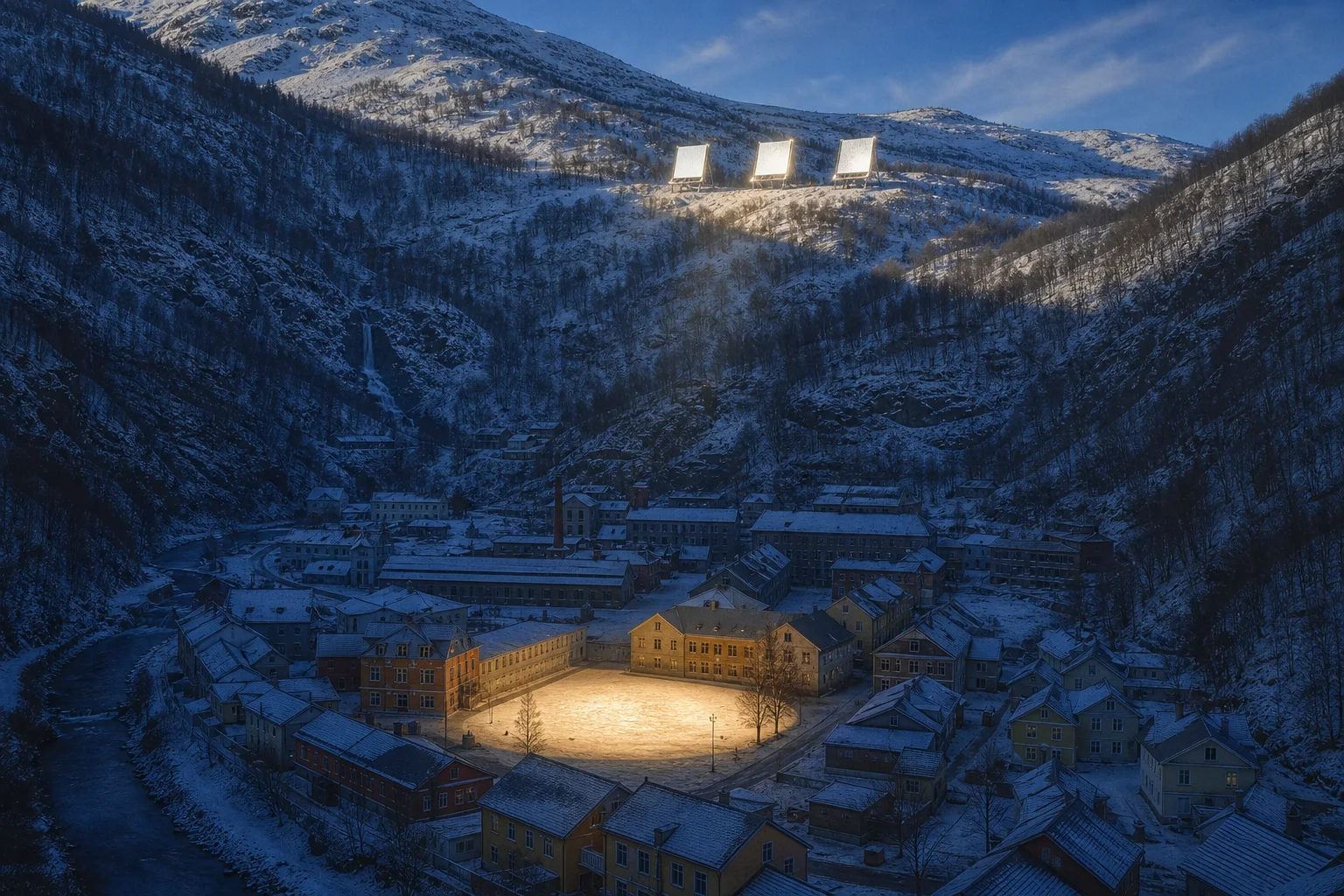
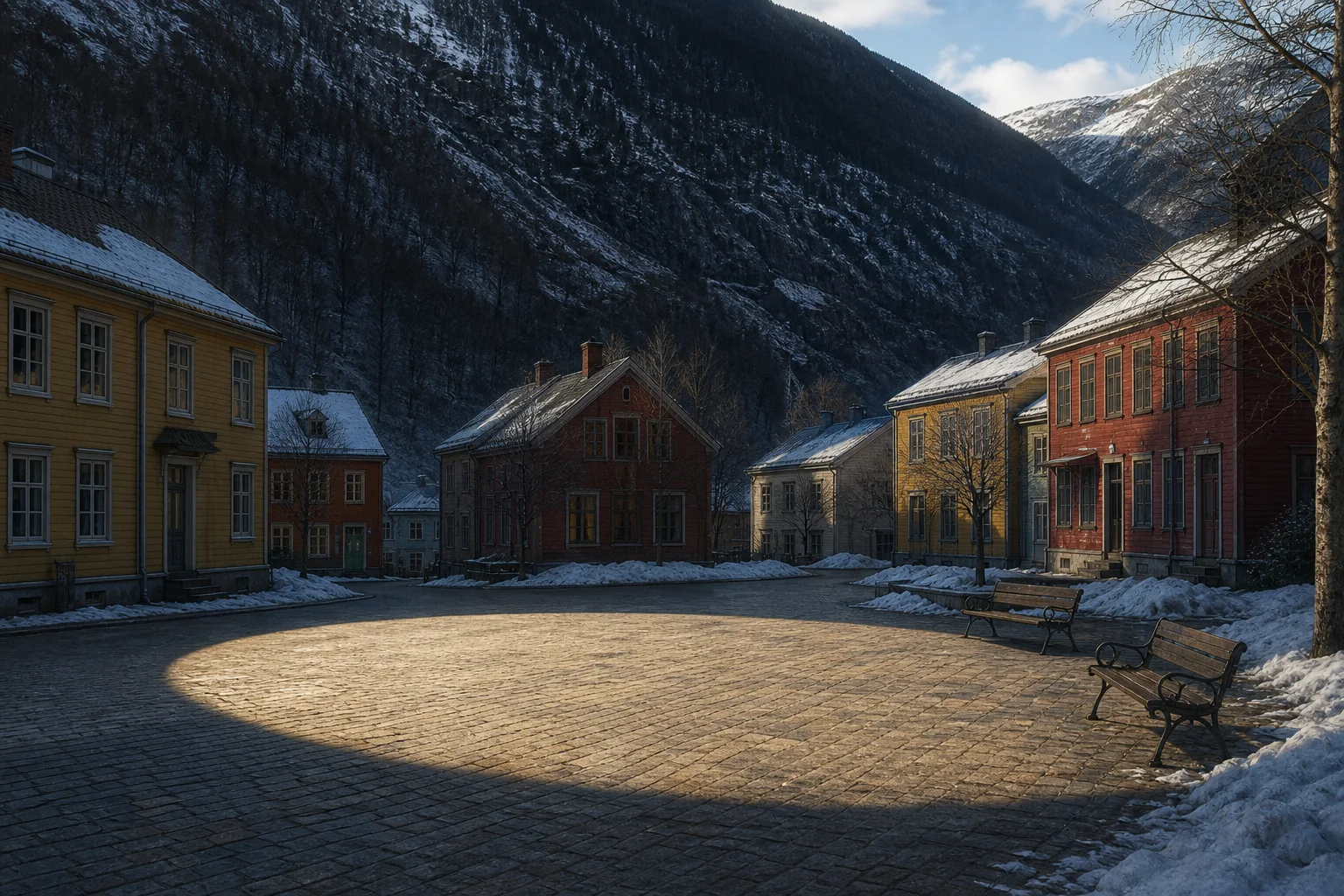
    Editorial illustration of Rjukan’s mountain mirrors reflecting winter sunlight into a shaded Norwegian town square.

    Editorial illustration.

    Rjukan, Norway, has a winter problem that is hard to solve with a lamp: for part of the year, the low sun clears the mountains but not the town itself. The settlement sits deep in the Vestfjord valley, beneath steep walls that leave its center in shadow. So Rjukan put three mirrors on a mountainside and taught them to follow the sun.

    The result is called Solspeilet, or the Sun Mirror. It does not light the whole town, and it does not create a second sun. It redirects a deliberately limited patch of ordinary daylight onto the town square. That modestness is what makes the installation more interesting than the usual “mirrors brighten a town” shorthand: it is a controlled, moving reflection built for one particular valley.

    A light problem created by geography

    Rjukan’s geography is the entire premise. VisitRjukan says the mountains block direct sunlight in the town from October into March. The sun still reaches the high slopes, but the square lies below the ridge line. Before the mirrors, residents could take the Krossobanen cable car uphill to meet the sun; the cable car opened in 1928. The mirrors pursue the opposite idea: send a small piece of the sunlight downhill.

    An idea that waited a century

    The local account traces the proposal to bookkeeper Oscar Kittelsen in 1913, with industrial founder Sam Eyde supporting the idea. The concept was simple enough to describe then, but a working outdoor system needed surfaces and controls that could keep a reflection aimed as the sun moved. Norsk Hydro’s 2013 account describes the installation as the realization of that old Rjukan idea after many decades.

    Artist Martin Andersen revived the proposal in 2005, according to VisitRjukan. The completed installation opened in 2013. It is an unusually literal civic artwork: its visible effect is not a monument or a sign, but an area of light on paving stones.

    Three mirrors, one patch of sun

    The system uses three computer-controlled heliostats—mirrors that change their angle to keep a reflection pointed at a target. VisitRjukan gives the installation’s stated dimensions as 17 square meters per mirror, or 51 square meters together. It places them at 742 meters above sea level, roughly 450 meters above the square, and says their reflected light can cover about 600 square meters there.

    Those figures describe a target zone, not a town-wide lighting scheme. A person standing in the square can encounter a bright pool of natural daylight while the streets around it remain in mountain shade. Its scale is intentionally legible: the mirrors are far above, and the result below is a patch rather than a blanket.

    Editorial illustration of three heliostat mirrors on a snowy Norwegian mountainside above a valley town.
    Editorial illustration of the three-mirror arrangement.

    It is reflection, not a replacement sun

    A flat mirror sends light away at the same angle at which it arrives. Because the sun’s position changes through the day, a fixed panel would soon throw its reflection somewhere else. Rjukan’s mirrors are computer controlled so their aim can be adjusted as the sun travels across the sky. The mountain location is essential: it receives direct sun even when the valley floor does not.

    That also gives the feature clear limits. The mirrors cannot make sunlight on a cloudy day, extend the day, or deliver direct sun across the whole valley. They redirect available daylight from a sunny slope to a chosen public place. The narrowly bounded effect is a more accurate description than “bringing the sun back” to Rjukan.

    Why the effect feels so strange

    Most public infrastructure hides its mechanism. Here, the mechanism is a mountain installation and the output is a conspicuously sunny square below it. The distance between the two turns a familiar physical rule into something almost theatrical: sunlight appears where the terrain says it should not, but only in the exact shape and place the system is designed to reach.

    Editorial illustration of a Norwegian town square receiving a bounded patch of reflected winter sunlight.
    Editorial illustration of the deliberately limited pool of reflected light.

    The evidence boundary

    Local installation and history sources agree on the 1913 origin story, the 2013 opening, and the use of three computer-controlled mirrors. The elevation, mirror area, and illuminated-area values above are the installation’s stated specifications from VisitRjukan, not independent measurements repeated here. This explainer does not claim that the mirrors brighten all of Rjukan or make health claims about the light; they are a targeted reflection system for the town square.

    Sources

  • Why an Octopus May Let a Fish Lead—Then Knock It Away

    Why an Octopus May Let a Fish Lead—Then Knock It Away

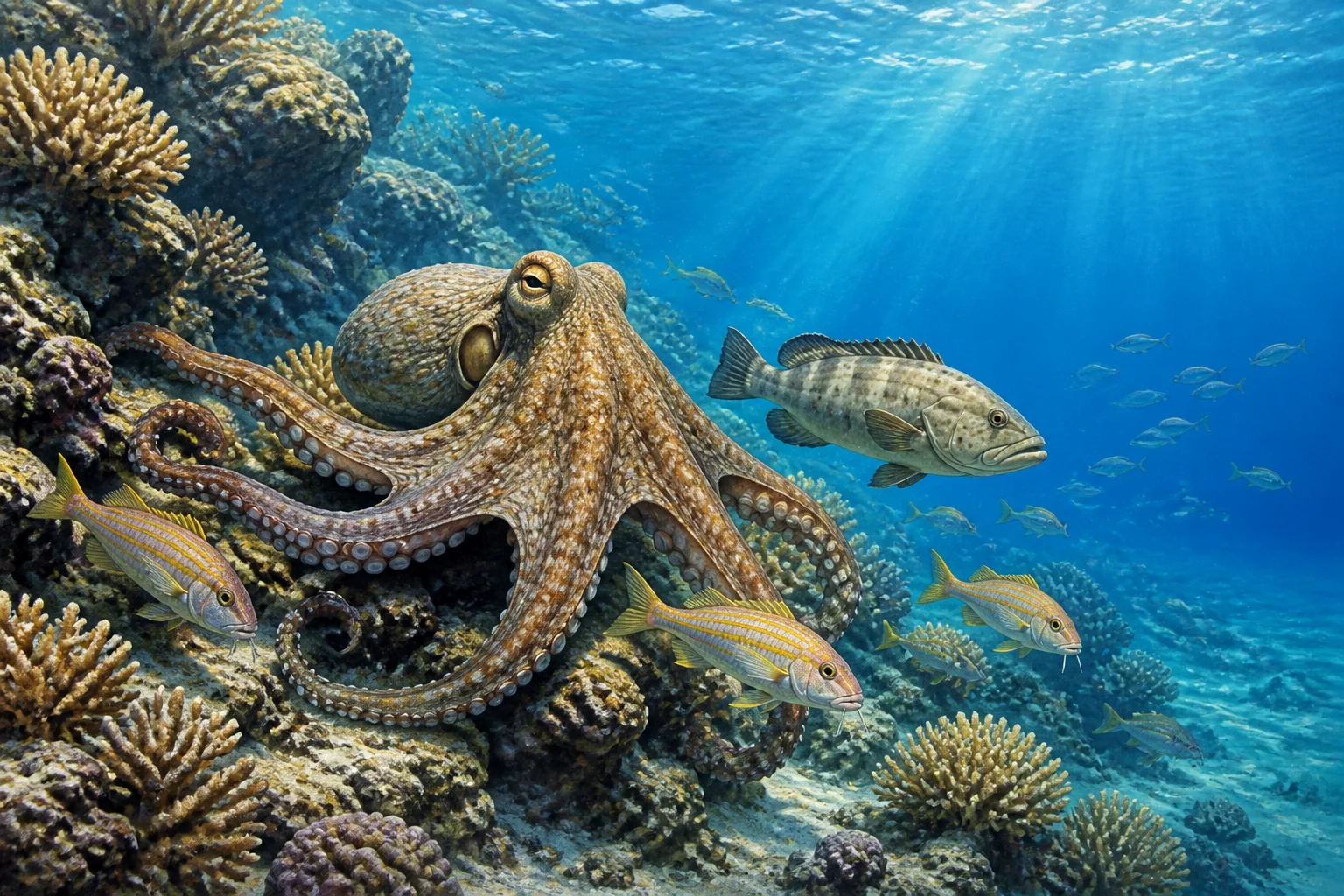
    Editorial illustration of a day octopus travelling with goatfish and a grouper on a coral reef hunt.

    On a coral reef, an octopus can look like the least likely member of a hunting party. Yet day octopuses (Octopus cyanea) have been documented foraging alongside several kinds of fish. The fish search in one set of places, the octopus searches in another, and the group can keep moving for more than an hour. The strangest detail is real: researchers have filmed an octopus using a swift arm movement to knock a particular fish away.

    It is tempting to call that a fishy workplace dispute. The useful version of the story is more interesting. These are mixed-species hunts in which the animals’ different ways of finding prey can fit together—and in which the costs and rewards do not always line up.

    It is a hunt with different jobs

    A 2021 field report described groups in the Red Sea that included a day octopus and several fish species. In those groups, the octopus can search inside rock and coral crevices. Bottom-feeding goatfish work a broader patch of seafloor, while other fishes can occupy the water around the reef. The researchers note that some fish are active partners and that others may simply take advantage of opportunities created by the group.

    That does not make the arrangement a tidy team with fixed ranks. Fish can help locate places worth searching, and octopuses can also follow fish partners toward prey. A later study, published in 2024, used field video, three-dimensional tracking and experiments to examine these groups more closely. Its authors found that influence was divided by task: goatfish were especially important in exploring and setting direction, while the octopus had a stronger role in when the group started moving.

    Editorial illustration of a day octopus at a reef crevice, goatfish searching the seafloor, and a grouper in open water.

    Editorial illustration: a visual interpretation of complementary foraging zones in an octopus–fish hunting group.

    What researchers mean by a “punch”

    The word is descriptive, not a claim that an octopus boxes like a person. In the 2021 report, the authors documented eight events in which an octopus made a fast, explosive motion with one arm toward a specific fish. The action displaced the fish. The observations came from different day octopuses in Eilat, Israel, and El Quseir, Egypt, and involved several kinds of groupers, goatfish and a squirrelfish.

    In some recordings, the octopus immediately searched where the fish had been, a pattern consistent with direct competition for a prey opportunity. In other recordings, it did not. That distinction matters: the paper does not claim that every strike has the same cause, and it calls for closer study of what happens before and after a fish is targeted.

    “Punishment” is a hypothesis, not a translation

    The researchers offered several possible explanations for the events where no immediate prey grab followed. One is that the movement could impose a cost on a fish that is exploiting the hunt. Another is that a short-term cost might influence a partner’s behavior in later interactions. The paper also discusses “spite” in a technical game-theory sense, explicitly without an emotional meaning.

    Those possibilities are not evidence that an octopus is angry, vengeful or running a reef courtroom. They are ways to test how cooperation holds together when unrelated species share an opportunity. The 2024 study strengthens the case that group composition changes how much each animal invests and how successful the hunt can be; it does not turn every arm movement into a proven disciplinary message.

    Why this small reef scene matters

    Octopuses are often described as solitary animals, so a group hunt with fish is already a useful corrective to the usual picture. The odd arm movement adds another lesson: cooperation in nature need not be gentle, equal or simple. A group can contain complementary skills, opportunists and conflicts at the same time.

    The verified weirdness is therefore not that an octopus has discovered human-style office politics. It is that a soft-bodied invertebrate and several kinds of fish can form a moving hunting group, divide influence across different decisions, and occasionally settle a conflict with one very deliberate-looking arm.

    Sources

  • Why Big Ben Still Has a Crack

    Why Big Ben Still Has a Crack

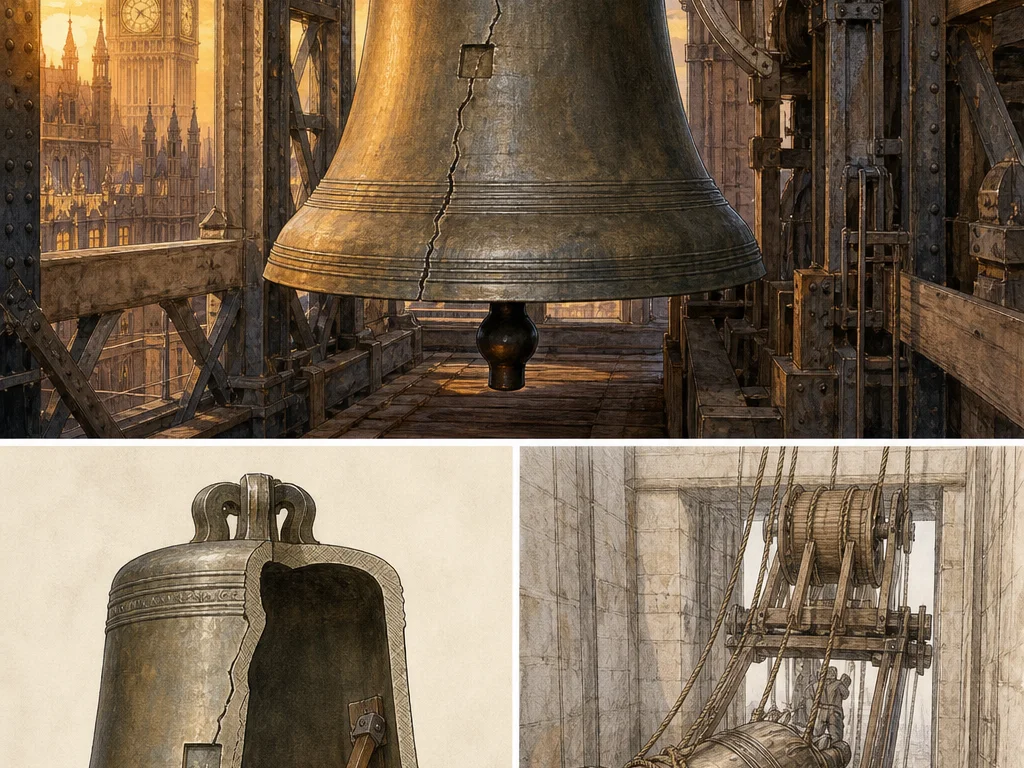
    Editorial illustration of the Great Bell hanging in Elizabeth Tower, with a visible crack in its bronze surface.

    London’s most famous clock sound comes from a bell that once failed twice. The Great Bell of Elizabeth Tower—properly the bell called Big Ben, rather than the tower itself—has a crack that became part of its working design. It is a rare case in which the repair did not make an object look new again. It made the object usable, and left the evidence of the problem in place.

    The first Big Ben never reached the tower

    The story starts with an earlier bell. UK Parliament’s history records that the first Great Bell was cast in 1856 at Warners of Norton, near Stockton-on-Tees. During testing in October 1857, it developed a crack about 1.2 metres long. Parliament attributes the failure to a hammer that was too heavy. The bell was removed and melted down for a replacement.

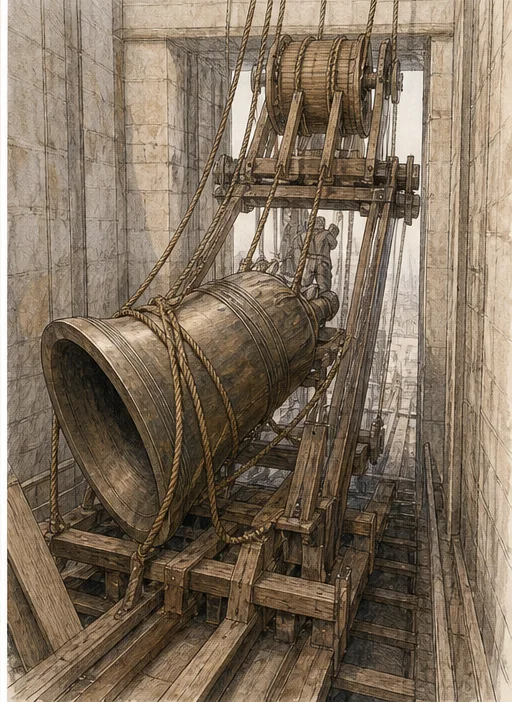
    That replacement is the Big Ben heard today. George Mears cast it at the Whitechapel Bell Foundry on 10 April 1858. At 13.5 tonnes, it was 2.5 tonnes lighter than its predecessor. Getting it into position was an engineering performance of its own: Parliament says the bell had to be turned on its side and winched up the tower’s ventilation shaft, a job that took 30 hours.

    The Great Clock began keeping time on 31 May 1859, and the new Great Bell first struck on 11 July. For a brief moment, the difficult replacement seemed to have solved the problem.

    Then the replacement cracked too

    By September 1859, the second bell had fractured. Big Ben fell silent for four years while the largest quarter bell marked the hours instead. The lasting answer was not to cast another enormous bell. In 1863, the Astronomer Royal, Sir George Airy, proposed changing the way this one was struck.

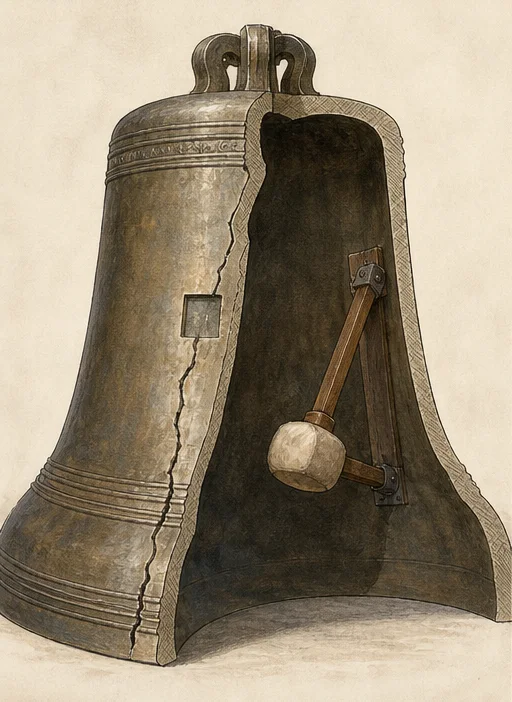
    Parliament’s account describes three linked changes: the bell was turned 90 degrees, a lighter hammer replaced the original one, and a small square was cut at the end of the crack to stop it spreading. The hammer now meets a different part of the bell, rather than repeatedly stressing the damaged area. The old crack and the square relief cut remain visible.

    Editorial cutaway illustration of a bronze bell with a crack, a small square relief cut, and a lighter hammer at a new striking point.

    Editorial illustration: the repair principle that let the Great Bell return to service.

    A repair that changed the sound

    That solution did more than keep the bell from being struck at its worst point. It helped create the distinctive sound people now expect. Parliament says the Great Bell, used with its smaller hammer, strikes an E. A UK Parliament virtual-tour transcript adds an important bit of precision often lost in retellings: the crack does not run all the way through the bell.

    The repair is a useful reminder that a historic landmark need not be returned to an imagined pristine state to remain authentic. Here, the visible flaw records a sequence of choices: an oversized first attempt, a replacement that also failed, and a carefully limited intervention that let a damaged bell keep doing its job.

    Why the story is stranger than the nickname

    “Big Ben” is often used as shorthand for the whole tower and clock, but the nickname belongs to the Great Bell. Even the origin of the name is not completely settled: Parliament says it is believed to have been a playful reference to Sir Benjamin Hall, the tall First Commissioner of Works who oversaw later stages of the tower’s construction. That uncertainty is worth retaining instead of treating the story as a settled fact.

    The documented part is stranger anyway. A bell weighing 13.5 tonnes was raised sideways through a shaft, cracked soon after it began ringing, and was saved by changing its orientation and reducing the blow it received. The resulting imperfection has lasted longer than either early failure, turning a repair decision from 1863 into part of the soundscape of London.

    Editorial illustration of the replacement Great Bell being raised sideways through a tower shaft with ropes and wooden rigging.

    Editorial illustration: a visual interpretation of the 1858 hoist described in Parliament’s history.

    Sources

  • At Luray Caverns, a Pipe Organ Plays the Ceiling

    At Luray Caverns, a Pipe Organ Plays the Ceiling

    Editorial illustration

    Editorial illustration of an organ console in a limestone cavern, connected by cables to stalactites across a large chamber.

    There are plenty of organs in old churches. One of the strangest is underground in Virginia, where the notes come from formations that took vastly longer to grow than the instrument did to build. At Luray Caverns, the Great Stalacpipe Organ uses selected stalactites as its sounding pieces: press a key at a console, and a rubber-tipped electrical striker taps a tuned piece of stone.

    That means the “pipes” are not in the console at all. They are spread through the cavern. The effect is less like a conventional organ installed in a room than a room that has been carefully wired into an instrument.

    A tour-guide sound became a three-year project

    Luray Caverns says the idea began in 1954, when Leland W. Sprinkle—a Pentagon mathematician and electronics scientist—heard a guide tap a cave formation during a tour. The sound suggested an unlikely possibility: individual stalactites can ring at different pitches, so perhaps a group of them could be organized into a playable scale.

    According to the caverns’ account, Sprinkle and helpers spent three years looking across more than three and a half acres of underground chambers. They used 13 English tuning forks to find promising tones, then carefully adjusted selected stalactites to match the pitches needed. The organ was dedicated in 1957.

    The unusual part of that story is worth keeping straight. The instrument does not make a cave “sing” by itself. It is a designed system that uses naturally formed limestone as the sound-making material. The choice and tuning of the formations, the strikers, wiring, console, and musical arrangement are human work; the resonant stone is the cave’s contribution.

    How a key becomes a note underground

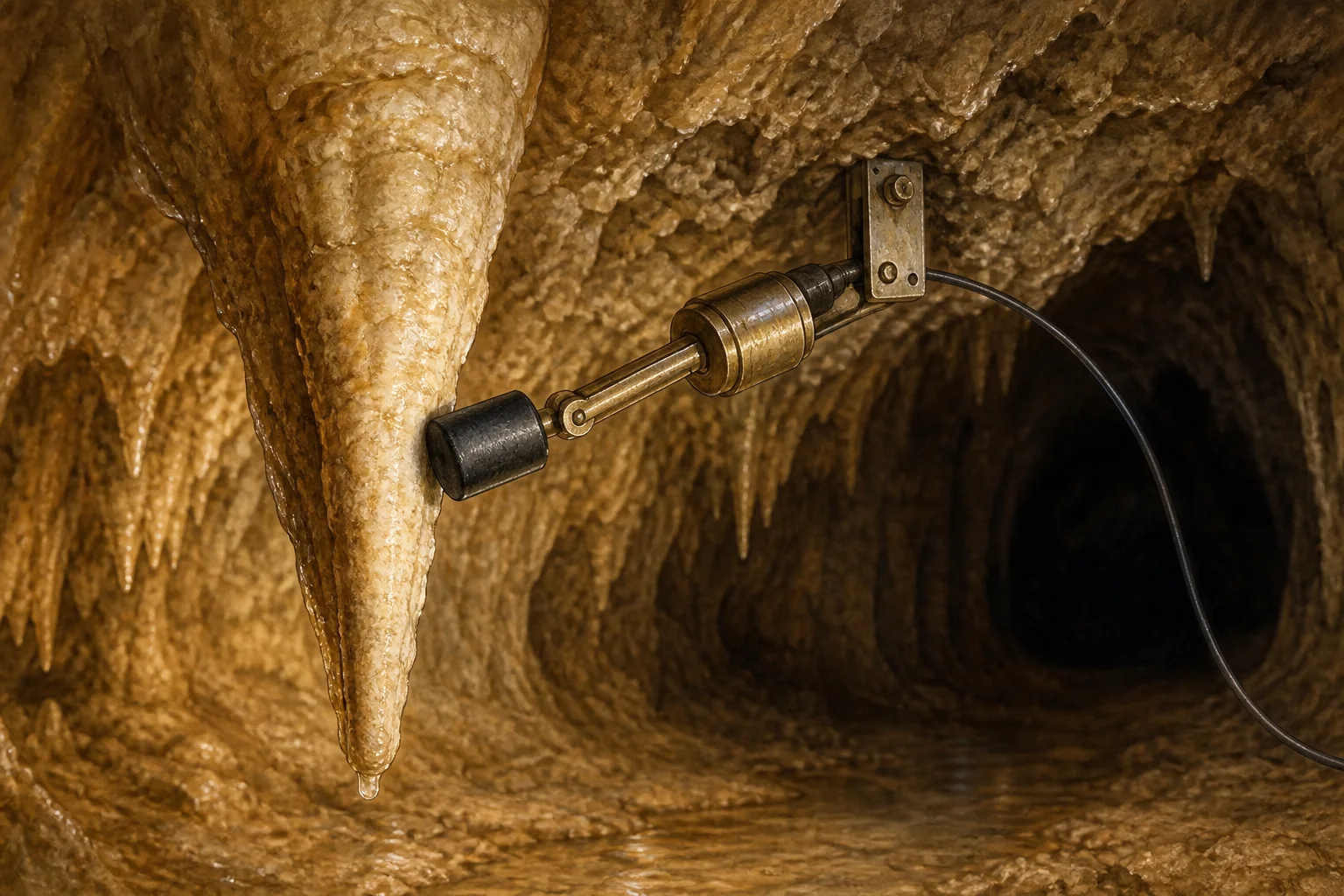
    The working principle is satisfyingly direct. Luray describes electronic mallets wired through the caverns to a large four-manual console. A key activates a mechanism that brings a rubber-tipped plunger against its assigned stalactite. The formation vibrates and the chamber carries the sound.

    Editorial illustration

    Editorial illustration of a rubber-tipped striker mechanism tapping a limestone stalactite inside a cave.

    That physical contact is why the name “stalacpipe” fits better than an ordinary organ metaphor. An organ pipe usually makes sound by moving air; here, a chosen piece of limestone is struck. The console coordinates many remote notes, turning a large cave chamber into an improbably distributed percussion instrument.

    Luray says the organ can be played manually and that it also operates automatically in a system likened to a child’s music box. The Library of Congress’s 2024 account of Rhapsody in Blue at 100 also identifies musician Otto Pebworth playing the Great Stalacpipe Organ in Luray Caverns—small but useful confirmation that this is more than a frozen tourist curiosity. It remains a working performance instrument.

    A cave is a difficult instrument to own

    The Great Stalacpipe Organ is especially weird because it reverses the usual relationship between building and instrument. Most musical instruments are built from material brought into a space. This one depends on a particular space first, then adds a musical interface around it. Move the console somewhere else and the instrument would not come with it; the tuned formations are the essential parts.

    That also makes the story a reminder that the visual drama of a cave is only part of its character. Stalactites form slowly as mineral-rich water deposits calcite. Their shapes and sizes affect how they respond when struck. Sprinkle’s challenge was not simply to find a dramatic chamber, but to find a set of natural formations whose pitches could be made useful together.

    Editorial illustration

    Editorial illustration of a broad limestone cavern with small striker mechanisms and cables connecting selected stalactites to an organ console.

    Why the idea still lands

    It is tempting to describe the Stalacpipe Organ as a novelty and stop there. But the better explanation is more interesting: it is an example of an inventor listening closely to a material already doing something remarkable, then building only enough machinery to make that behavior playable.

    Luray calls it the world’s largest musical instrument. That superlative is the caverns’ own description, and the claim is less important than the documented mechanics behind it. A keyboard, miles of distance in miniature, small striking devices, and selected pieces of limestone work together to produce a melody where visitors expect only dripping water and echoes.

    Sources

  • The 18th-Century Automaton That Wrote With a Quill

    The 18th-Century Automaton That Wrote With a Quill

    Editorial illustration: More than two centuries before “robot” became a familiar word, a child-sized automaton sat at a desk, dipped a quill, and wrote a chosen short message. Known as the Writer, it is one of the Jaquet-Droz automata: a surviving feat of Swiss watchmaking that treated handwriting as a problem of motion, timing, and precision.

    A writer built like a clock

    The Writer was made in the workshop of Pierre Jaquet-Droz, his son Henri-Louis, and Jean-Frédéric Leschot. The Musée d’Art et d’Histoire in Neuchâtel dates the three famous companion automata—the Writer, the Draughtsman, and the Musician—to between 1768 and 1774. They are still central works in the museum’s collection and are demonstrated to visitors.

    The Writer is the unnerving one because its task is so familiar. Its small hand holds a quill over real paper. It does not “understand” a sentence or improvise; it performs a physical sequence designed in advance. But the sequence includes convincing details: a controlled arm, a pause, a pen dip, and a line of handwriting whose movement was choreographed entirely in mechanism.

    Editorial illustration of an eighteenth-century child-sized writing automaton holding a feather quill at a small wooden desk, with brass clockwork visible in an open side panel.
    Editorial illustration

    How a machine becomes handwriting

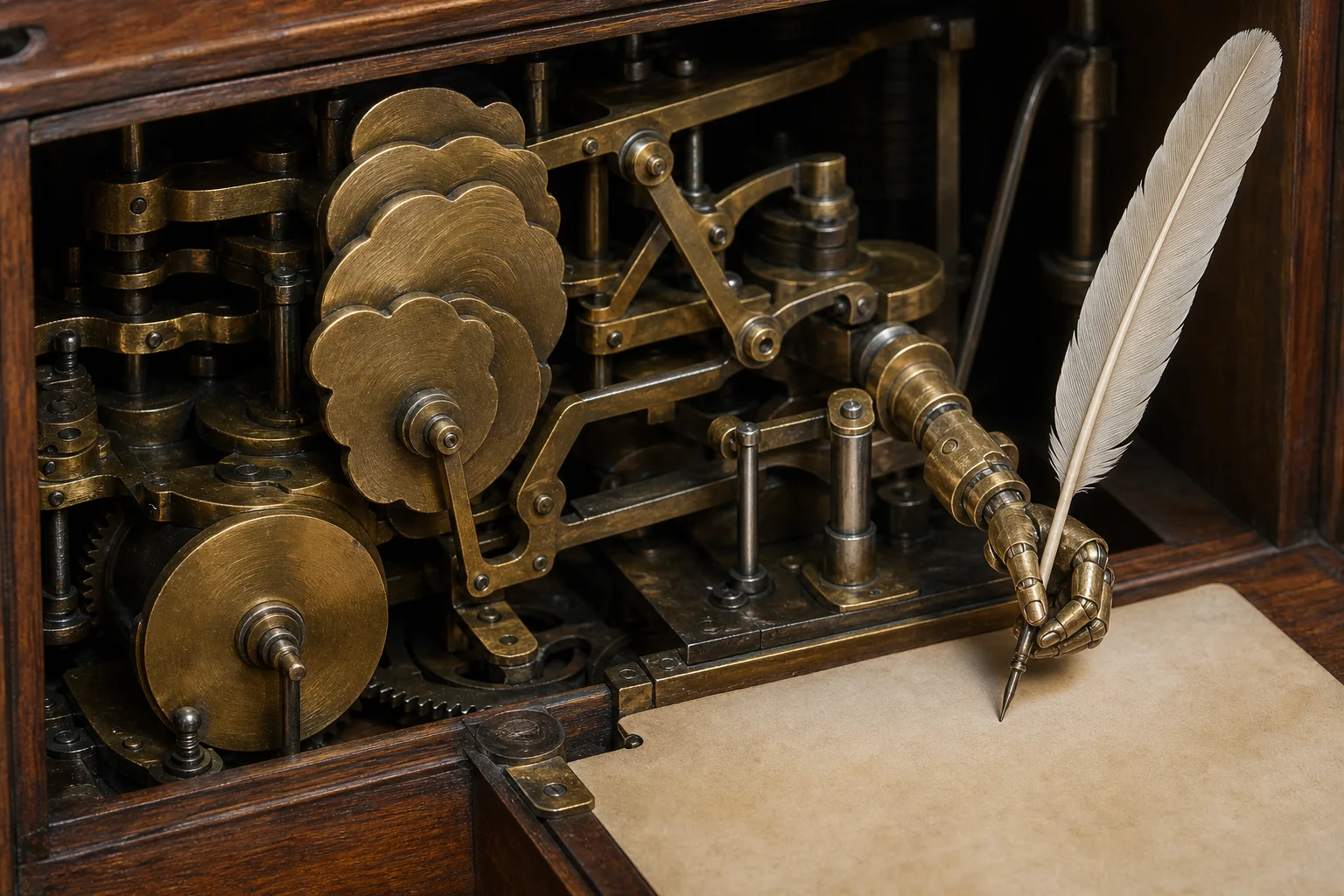
    The apparent magic comes from breaking a gesture into repeatable motions. In eighteenth-century automata, shaped cams and linked levers could turn a steady drive into carefully timed movements. The hand could move side to side and forward and back while the pen rose and fell. The principle is close to a music box or a mechanical clock: the information is embodied in the shape and arrangement of physical parts.

    A 1938 Museum of Modern Art catalogue described the Writer’s mechanism as a system of levers concealed in the figure and noted that the automaton dips its pen, shakes it, positions its hand, and writes with varying strokes. The Metropolitan Museum of Art identifies the Writer as one of the Jaquet-Droz group and records that it could write a sentence of forty letters. That is a restricted but remarkably deliberate form of mechanical “programming.”

    Editorial illustration of brass cams and levers inside an eighteenth-century writing automaton, connected to an articulated hand holding a feather quill over blank paper.
    Editorial illustration

    Not a hidden person, not a modern robot

    Automata sit in an awkward historical space because their lifelike gestures invite the wrong questions. The Writer was not a trick operated by someone inside, and it was not a thinking machine. It was a highly sophisticated object made by watchmakers who could package a sequence of actions into springs, cams, and levers. Its achievement was not artificial consciousness; it was the translation of a human writing gesture into durable mechanics.

    That makes the Writer more interesting than a simple novelty. In an era before electric motors, digital storage, and programmable electronics, the Jaquet-Droz workshop produced an object that could carry out a selected written performance in front of an audience. The action stays strange because it makes a private, expressive act—putting pen to paper—look like a clock’s idea of a person.

    Why it still feels modern

    The Writer is not a direct ancestor of today’s software, and calling it an early computer would overstate the case. Still, it offers a useful historical lesson: instructions do not have to live in code on a screen. They can be cut into material, distributed across moving parts, and replayed with astonishing consistency. The Writer’s quill reminds us that “automation” was already a serious artistic and engineering question in the eighteenth century.

    Sources

  • Why Antarctica’s Blood Falls Looks Like a Glacier Is Rusting

    Why Antarctica’s Blood Falls Looks Like a Glacier Is Rusting

    Editorial illustration: On the face of Antarctica’s Taylor Glacier, a rust-red stain spills across ice. The name is Blood Falls, but the color comes from iron-rich brine meeting the air—not from anything biological in the dramatic sense the name suggests.

    A red streak in a white desert

    Blood Falls appears at the terminus of Taylor Glacier in the McMurdo Dry Valleys, one of Antarctica’s starkest landscapes. It can look uncannily like a small waterfall bleeding through the ice. The visible outflow is real, but it is not an ordinary river and it is not a permanent red torrent. It is an episodic release of extremely salty, iron-rich brine from within and beneath the glacier.

    That distinction matters. The National Science Foundation describes the material as an iron-rich brine seeping from below the glacier. A 2022 study based on time-lapse imagery and seismic data similarly identifies an episodic discharge of hypersaline, iron-rich brine. Researchers observed one release beginning during the Antarctic winter; the exact trigger for these releases remains unresolved.

    Editorial illustration of a narrow rust-red brine outflow emerging from a small crack in a pale blue Antarctic glacier and spreading over frozen ice.
    Editorial illustration

    Why the brine turns red

    The striking color is chemistry. The brine contains dissolved iron. In the oxygen-poor environment below the glacier, much of that iron can remain in a reduced form. Once the fluid emerges and encounters oxygen at the surface, oxidation produces iron-bearing minerals—the same broad family of reactions that gives rust its familiar orange-red and brown colors. The result is a mineral stain that contrasts sharply with blue-white ice.

    “Rusty brine” is more accurate than the waterfall shorthand, but it should not make the process sound simple. The outflow is salty enough to stay liquid in conditions where fresh water would freeze, and it travels through a cold glacial environment whose pathways are difficult to inspect directly. Radar research has identified a body of brine upstream inside Taylor Glacier, while other work describes a broader subglacial or englacial hydrologic system feeding the outflow.

    Editorial illustration of a small glacier fissure releasing a restrained red-brown iron-rich brine fan onto pale frozen Antarctic ice.
    Editorial illustration

    It is also a microbial habitat

    Blood Falls is strange for more than its color. Earlier microbiology research found a diverse bacterial community in the outflow and evidence consistent with iron and sulfur transformations in this isolated, cold environment. That does not mean microbes are simply “making the blood color.” The red appearance is tied to iron chemistry at the surface; the microbes are part of the separate and still fascinating story of how life persists in a dark, salty sub-ice system.

    The glacier therefore gives researchers a natural laboratory for two linked questions: how brine can move through very cold ice, and how microbial communities can endure in such chemically unusual conditions. Those questions are especially useful as scientists consider possible habitats on icy worlds, but Blood Falls itself remains a place on Earth with its own local rules and unanswered details.

    What remains unknown

    The evidence supports the basic explanation: salty, iron-rich brine periodically reaches the surface of Taylor Glacier, where iron oxidation contributes to the red-brown stain. The timing of a specific release is less settled. The 2022 study found no clear burst of the seismic signal it tested before or during a documented winter release, and suggested that small fracture events could be hidden by background seismicity. That is a useful scientific boundary, not a flaw in the story. The color has an evidence-backed explanation; the plumbing and release mechanism are still being worked out.

    Blood Falls earns its weird reputation without any mythmaking. It is a small, intermittent mineral outflow, made visually enormous by the emptiness and brightness of the Antarctic ice around it.

    Sources

  • The Spider That Spins Itself an Air Room Underwater

    The Spider That Spins Itself an Air Room Underwater

    Most spiders use silk to make a web in air. The diving-bell spider uses silk to hold an air room underwater—and then spends nearly its entire life inside the pond.

    Argyroneta aquatica, often called the diving-bell spider or water spider, is a freshwater species found across parts of Eurasia. It still breathes air, but it does not make a routine of living on shore. Instead, it builds a dome-shaped silk web among submerged plants and fills that web with air carried down from the surface. The resulting chamber is its diving bell.

    The design is stranger than a simple storage bubble. Experiments have shown that the bell can take up dissolved oxygen from the surrounding water. That makes it a “physical gill”: an air chamber that exchanges gas across its surface, even though the spider itself has no fish-like gills.

    How the spider moves air below the surface

    The spider begins with a surface trip. Water-repelling hairs on its body help it hold a bubble of air as it dives. It carries that bubble to an underwater sheet of silk, where surface tension keeps air gathered among the web’s fibers. Repeating the trip builds a chamber large enough for the spider to enter from below.

    That chamber does more than give the animal a dry place to pause. Research on the spider’s behavior describes diving bells as sites for feeding, molting, reproduction, and raising young. The air bell is therefore both shelter and respiratory equipment—made by an animal that normally belongs to the land-dwelling branch of the spider family tree.

    Editorial illustration of a diving-bell spider carrying an air bubble from the pond surface to a silk dome among underwater plants.
    Editorial illustration: the spider repeatedly carries surface air to a silk-supported chamber below.

    Why the bubble works like a physical gill

    Air inside the bell and water outside it have different gas concentrations. As the spider uses oxygen in the bell, dissolved oxygen in the water can diffuse inward. Carbon dioxide produced by the spider can diffuse out. The system is not the same as a permanent oxygen generator, and it does not eliminate the need to renew the air. Nitrogen also leaves the bell over time, shrinking the air store.

    But the exchange is meaningful. In a 2011 study, researchers measured the volume and oxygen pressure of diving bells with tiny fiber-optic sensors. Their results showed that a bell could supply a resting spider’s oxygen needs under the experiment’s warm, stagnant-water conditions. Larger spiders built larger bells, which had greater oxygen conductance because they presented more surface area to the water.

    That finding also explains why a diving bell is more capable than a small bubble stuck to a body. A web lets the spider suspend a comparatively large air surface underwater. The bell is external to the animal, but its size and placement make it part of the spider’s breathing strategy.

    The air room has limits

    The phrase “lives underwater” can create the wrong picture of a spider that never returns to the surface. It does. The 2011 experiments found that spiders refreshed the bell’s air when oxygen pressure inside fell sufficiently low, and the authors concluded that renewal is ultimately necessary because nitrogen is lost from the bubble. Under the tested conditions, however, spiders could remain in the bell for more than a day before another surface trip.

    That is not a contradiction. The diving bell is a reservoir and a gas-exchange surface at the same time. Water can add oxygen to it, but the bubble’s changing gas mix and volume mean the spider must maintain it. The animal is not holding its breath for a day; it is tending a tiny underwater room whose air is constantly changing.

    What scientists tested, and what they did not claim

    Editorial illustration of a small diving-bell spider inside a pearl-like air dome held by silk among freshwater pond plants.
    Editorial illustration: a silk web supports the bell’s air chamber among submerged freshwater plants.

    A web that changes the habitat

    Plenty of animals transport air underwater for a short dive. The diving-bell spider goes further by building a structure that changes the space around it. Its silk holds a stable pocket where it can eat, molt, reproduce, and rest. Its repeated visits to the surface keep that pocket usable. And oxygen diffusing through the bubble wall gives the chamber an extra assist from the pond itself.

    It is an elegant example of animal construction with clear boundaries: not a magical sealed aquarium, not a conventional gill, and not simply a bubble. It is a maintained air bell, spun from silk, operating where a spider seems least likely to make a home.


    Sources: Seymour and Hetz, “The diving bell and the spider: the physical gill of Argyroneta aquatica,” Journal of Experimental Biology; Schütz, Taborsky, and Drapela, “Air bells of water spiders are an extended phenotype modified in response to gas composition,” Journal of Experimental Zoology Part A; Seymour, “Physical gills prevent drowning of many wetland insects, spiders and plants,” Journal of Experimental Biology.

  • Why Yosemite’s Moonbows Look Gray to the Eye—and Bright in Photos

    Why Yosemite’s Moonbows Look Gray to the Eye—and Bright in Photos

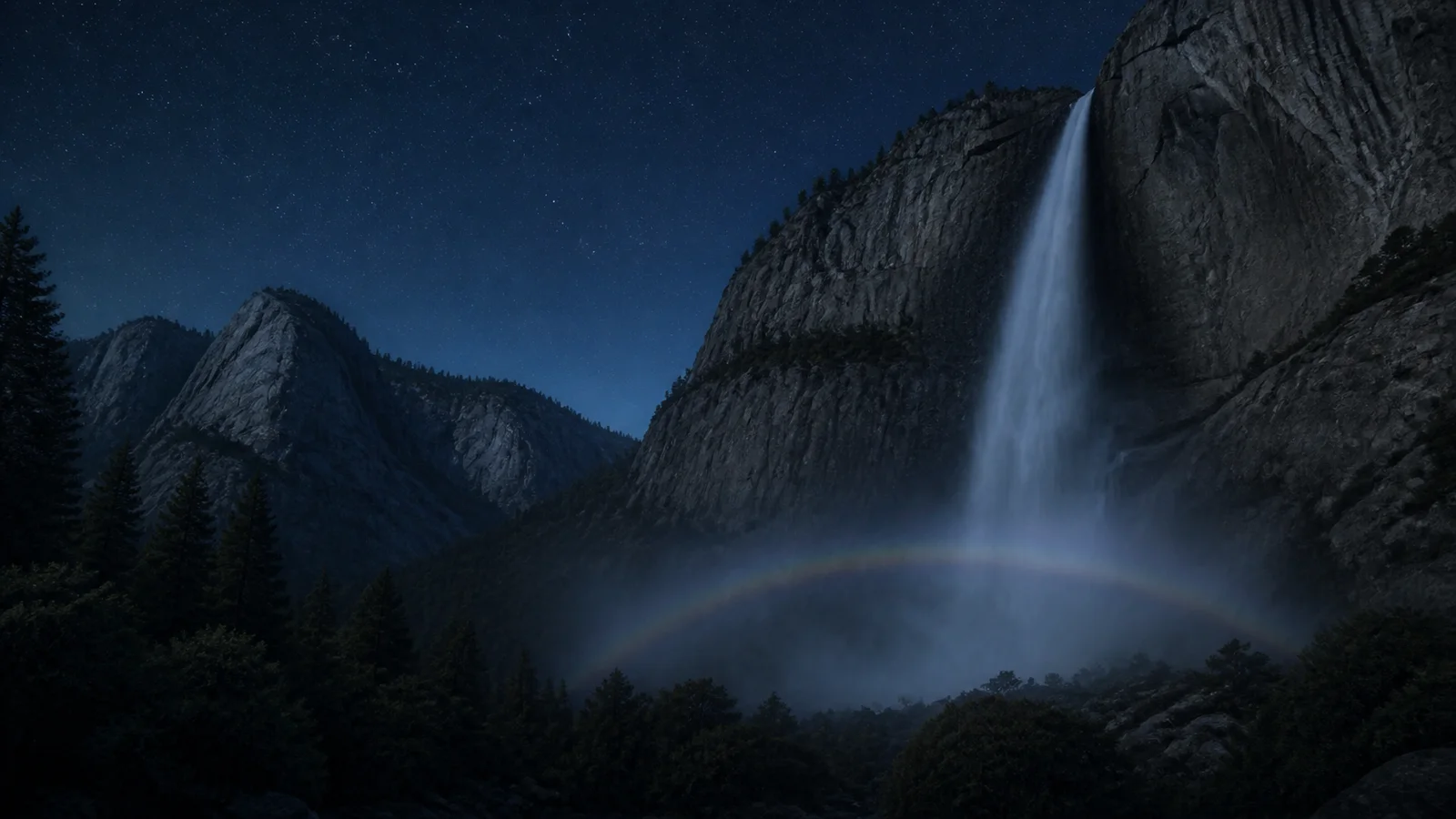
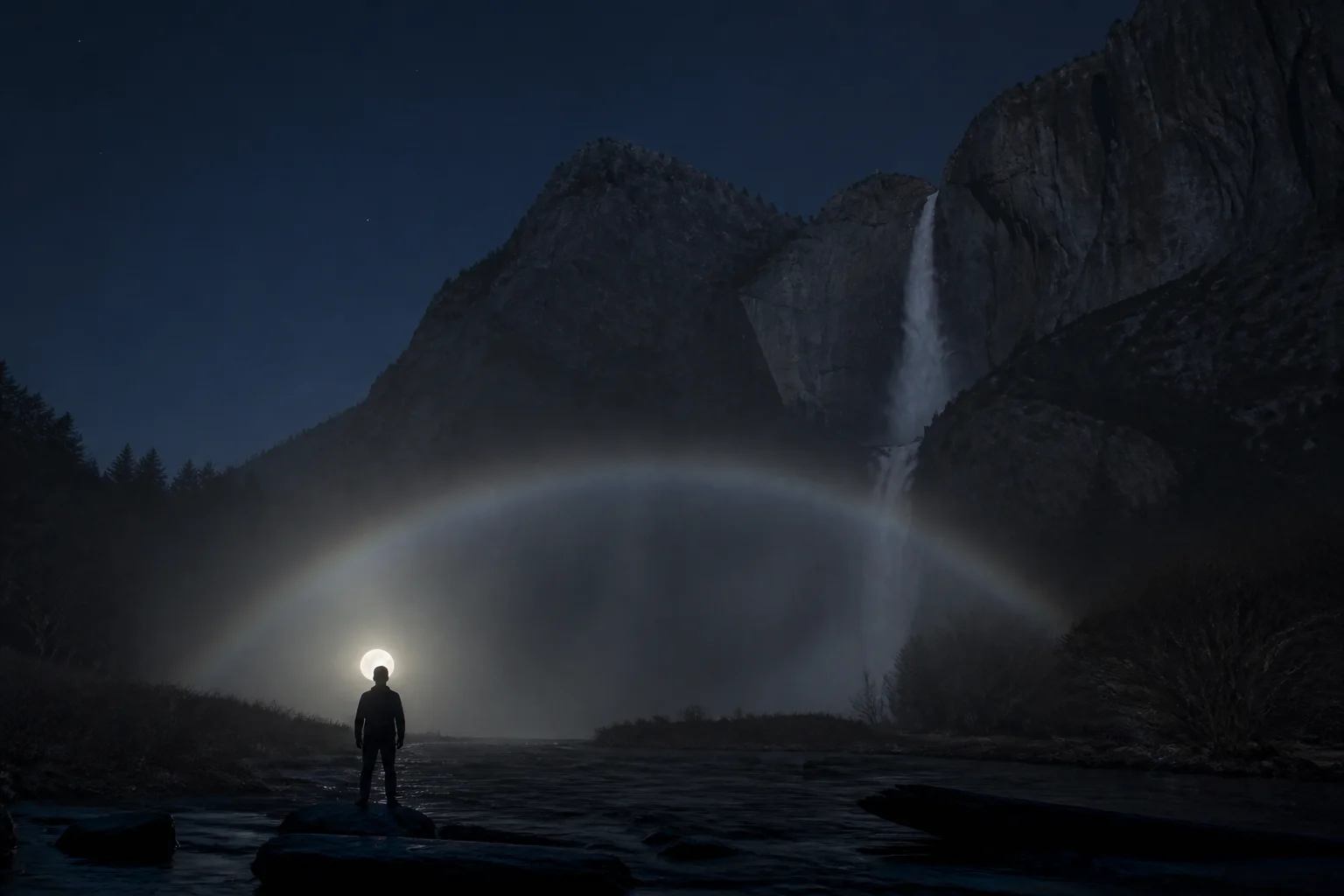
    For a few nights in Yosemite’s spring waterfall season, moonlight can draw a rainbow in the spray of Yosemite Falls. The effect is real, and it has an odd visual twist: the National Park Service says Yosemite’s moonbows often look gray to an unaided eye even though photographs can reveal color.

    A moonbow is not a second kind of rainbow or a trick of a camera. It is a lunar rainbow: moonlight passes through airborne water droplets, bends as it enters and leaves them, and is reflected inside them. The difference is the light source. Sunlight makes familiar daytime rainbows; far dimmer moonlight can make the same optical geometry visible in waterfall mist.

    Editorial illustration of a faint pale moonbow in waterfall mist at Yosemite Falls under a moonlit granite valley.
    Editorial illustration: Moonlight and waterfall mist can align to make a faint lunar rainbow.

    Why a rainbow appears after dark

    NOAA’s explanation of an ordinary rainbow starts with a water droplet. Light bends when it enters the denser water, reflects inside the drop, and bends again as it exits. Because the colors of light bend by slightly different amounts, many droplets together can send a colored arc toward the viewer. A rainbow is therefore an optical effect tied to the viewer’s position, not an object hanging in a fixed spot.

    For a moonbow, the waterfall supplies the droplets and the Moon supplies the illumination. The useful alignment is the familiar rainbow arrangement: the light source is behind the viewer and the lit spray is ahead. At Yosemite, the Park Service says that full-moon nights during the peak waterfall season, generally April through June, can produce moonbows in the mist of Upper and Lower Yosemite Falls.

    Editorial illustration of a silhouetted viewer with a full moon behind them and a pale moonbow forming in waterfall mist ahead.
    Editorial illustration: The bow is seen in droplets ahead of the viewer, opposite the Moon.

    Why the colors can disappear to human eyes

    The event is dim because moonlight is reflected sunlight. That does not alter the basic optics, but it changes what a viewer can readily perceive. Yosemite’s National Park Service guidance says the moonbows look gray to the unaided eye while their colors can stand out in photographs. NASA’s Astronomy Picture of the Day makes the same practical point with a waterfall moonbow photographed using a 30-second exposure: a camera can collect weak light over time in a way a quick glance cannot.

    That is why a highly saturated image should not be treated as a report of what every visitor sees in the moment. It can be a record of the same phenomenon, but exposure, processing, and the viewer’s own dark adaptation affect how strongly the colors register. The documented fact is the moonbow itself; the apparent intensity is not a universal measure.

    A narrow window, not a nightly show

    Calling the event a “lunar rainbow” can make it sound routine. The Park Service’s wording is narrower: these are special nights, and their timing is tied to a full moon plus enough waterfall mist. Yosemite Creek is snowmelt-fed and the falls commonly diminish later in the year, so a full moon by itself is not a promise of a moonbow.

    Visitors should also separate the natural phenomenon from travel assumptions. The Park Service says Yosemite is open around the clock, but access, water flow, weather, and the Park’s current conditions all matter. A moonbow is best understood as a rare consequence of ordinary things—light, falling water, and a particular viewing angle—briefly lining up after dark.

    Editorial illustration of two small visitors quietly viewing a faint moonbow in the mist of Yosemite Falls at night.
    Editorial illustration: In low light, the arc can appear pale and subdued to a viewer.

    Fact, folklore, and photography

    Documented fact: Yosemite’s waterfall mist can form moonbows on suitable full-moon nights in spring and early summer.

    Not folklore: “moonbow” is simply a name for a lunar rainbow. It does not require unusual lunar activity, a special kind of water, or a camera effect invented after the fact.

    Photography note: a colorful long-exposure image can truthfully depict a moonbow while still looking more vivid than the scene appears to an unaided observer. That distinction makes the phenomenon more interesting, not less: the rainbow is physically present, but human vision and a camera do not record dim light in the same way.

    Sources