Blog

  • How a Wombat’s Soft Intestine Manufactures Cubes

    How a Wombat’s Soft Intestine Manufactures Cubes

    Bare-nosed wombats produce one of the animal world’s most geometric calling cards: dry droppings with flat faces and distinct corners. The cubes are not cut after they leave the body, and the wombat does not have a square exit. Research points instead to an unusual manufacturing process inside the last portion of a long, slowly working intestine.

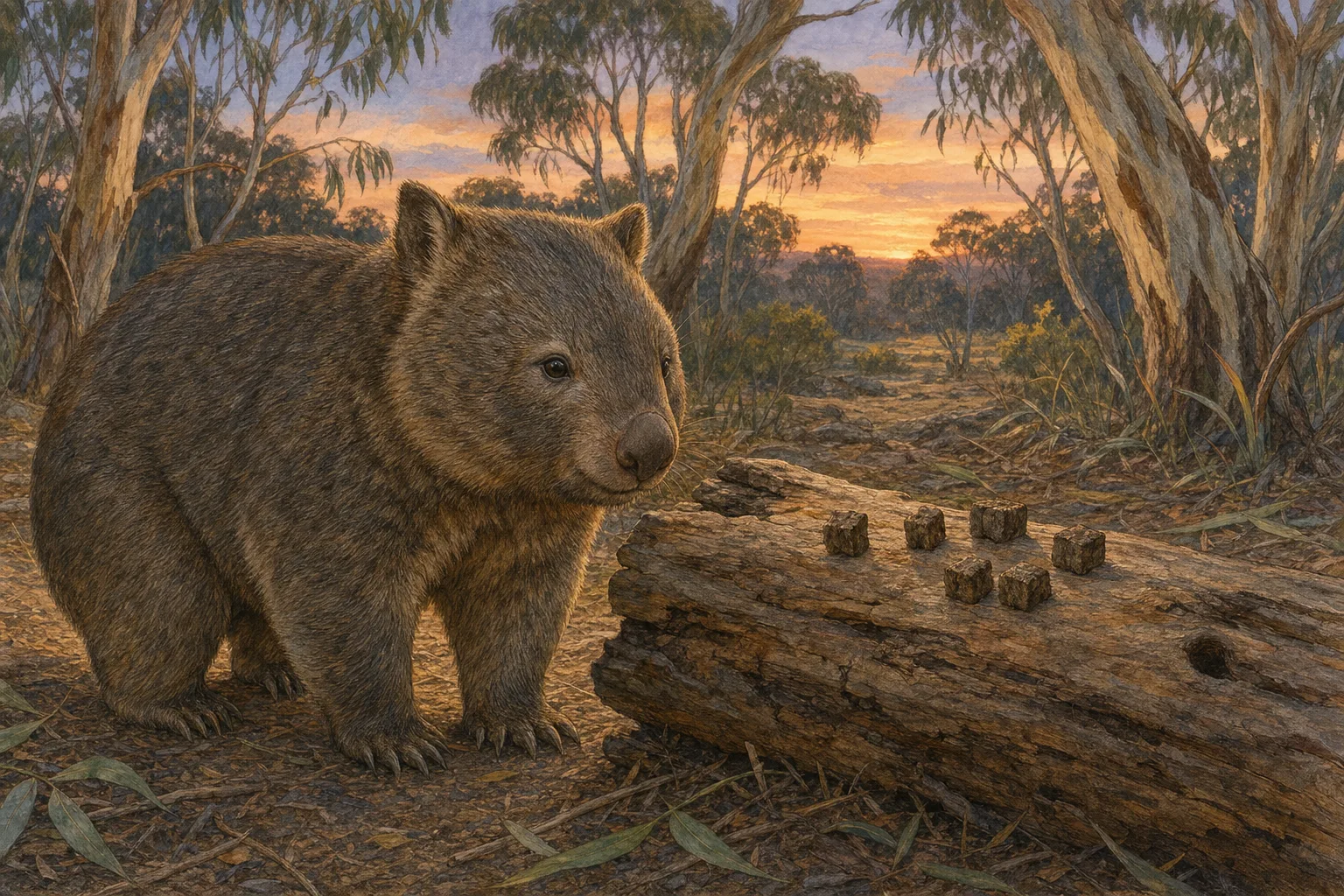
    The shape matters beyond its novelty. Wombats place droppings on prominent objects such as rocks and logs to communicate within their home ranges. A compact, flat-sided piece is less likely to roll away than an ordinary pellet—an appealing explanation for why cubes might be useful. But researchers say the evolutionary reason for the shape is not fully settled, so usefulness should not be confused with proof of why it evolved.

    The corners form before exit

    A 2021 study in the journal Soft Matter combined dissections, tissue measurements, laboratory tests, and mathematical modeling. The team found that cube formation occurs within the final 17 percent of the intestine. That ruled out the once-popular notion that a square sphincter stamps the feces on the way out.
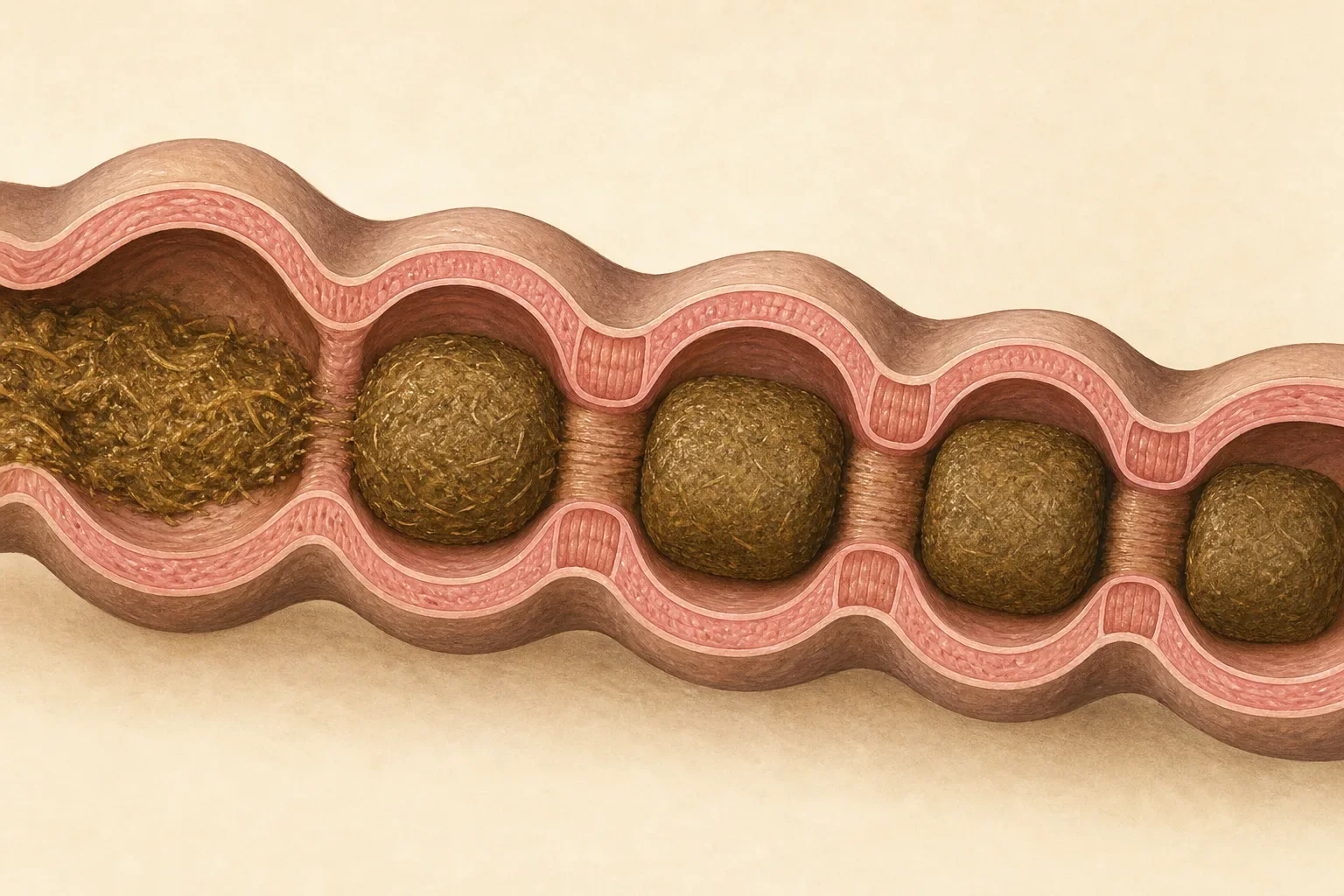
    Tasteful explanatory illustration of rounded cube-like segments being shaped inside a soft intestinal tube
    AI-generated explanatory illustration of the proposed shaping process. It simplifies anatomy and is not a medical or veterinary image.

    The wombat colon is not equally stretchy all the way around. The researchers identified regions of different thickness and stiffness in its cross-section. Their measurements found some regions about twice as thick and roughly four times as stiff as others. When the intestinal wall contracts around drying material, those mechanical differences cause parts of the contents to move and deform at different rates. In the team’s model, that uneven action creates flatter faces and sharper corners.

    This is subtly different from imagining a rigid square mold. The intestine remains soft and flexible. Corners emerge from repeated contractions of an elastic tube with alternating mechanical properties, while the material inside becomes drier and firmer. The study’s simulations produced squarer shapes when the contrast between stiff and soft regions increased under suitable conditions.

    Dryness is part of the geometry

    A wombat’s digestive tract is extraordinarily long relative to its body. University of Tasmania researchers describe an intestine around 10 meters long, about ten times a typical wombat’s body length. Digestion can take several times longer than it does in humans, allowing the animal to extract nutrients and water from tough, fibrous food.

    That extended drying process helps the final pieces hold their shape. The university reported that wombat feces are substantially drier than human feces and can become less sharply cubed in wetter conditions. Shape may therefore offer researchers a noninvasive clue about hydration or health, although a single dropping is not a diagnosis.

    The researchers studied bare-nosed, or common, wombats. It is safest not to assume every wombat species produces identical geometry under every condition. Even in the studied animals, “cube” is a useful description rather than a claim that each piece is a perfect mathematical solid with identical edges.

    A soft-tube manufacturing lesson

    The finding interested physicists and engineers because factories generally make cubes with rigid molds, cutting, or extrusion through a shaped opening. A wombat demonstrates another route: vary the stiffness of a soft tube and coordinate contractions while the material changes consistency.

    The Soft Matter authors suggested potential relevance to manufacturing, clinical pathology, and digestive health. Those are possible applications, not established products or treatments. The immediate achievement was explaining how corners can arise in a damp, deformable biological system without a hard-edged mold.

    That explanation makes the phenomenon more interesting, not less. The cube is the endpoint of anatomy, mechanics, water extraction, and behavior working together. A wombat’s oddest signature is not a novelty stamped at the last second; it is assembled gradually by a soft organ whose uneven flexibility turns an ordinary tube into a remarkably precise shaping machine.
    Sources

  • Antarctica’s Blood Falls Is a Briny Window Into Life Beneath Ice

    Antarctica’s Blood Falls Is a Briny Window Into Life Beneath Ice

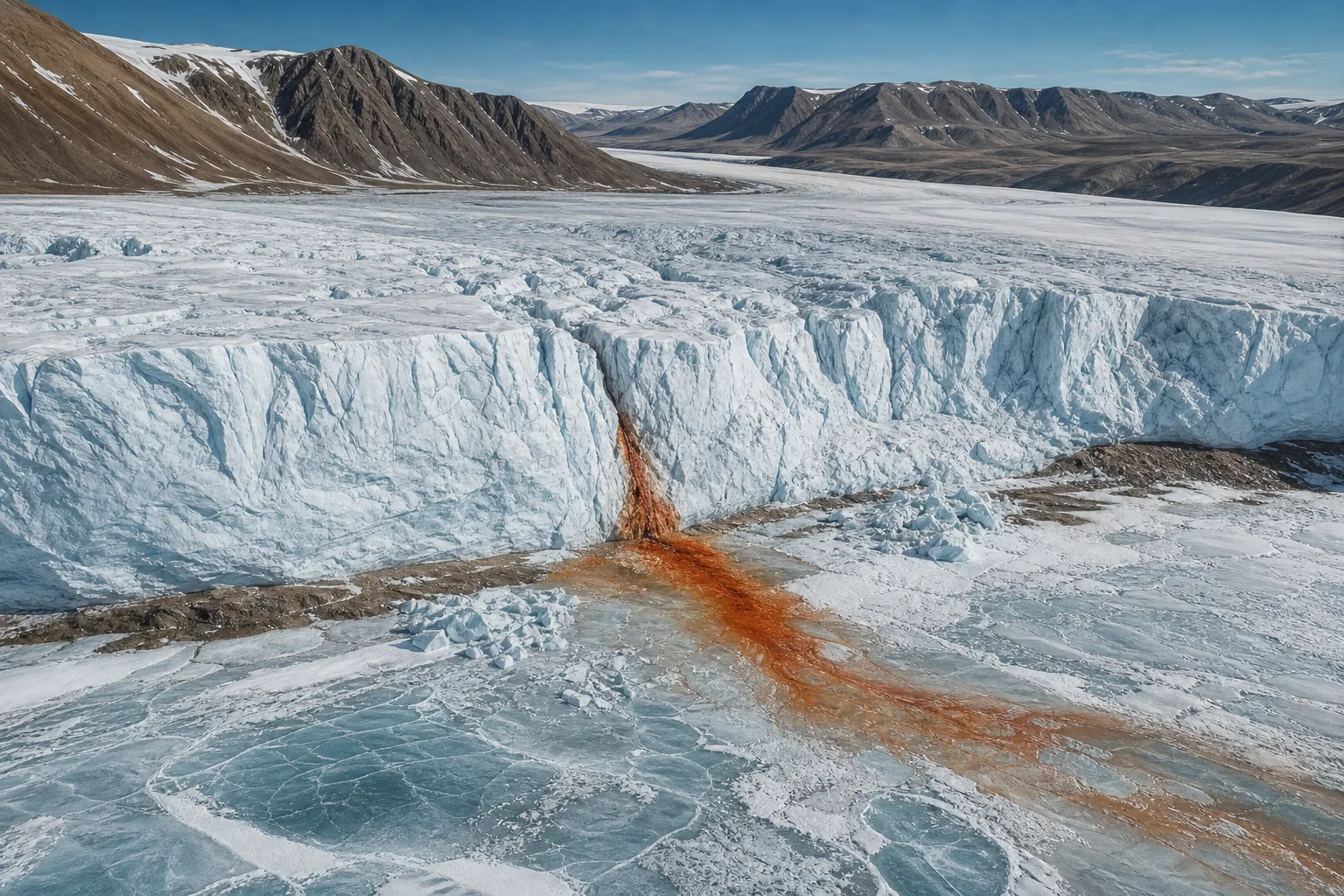
    At the end of Antarctica’s Taylor Glacier, a rusty red-orange stain spills across blue-white ice toward Lake Bonney. The feature is called Blood Falls, but its color does not come from blood, and it is not a conventional waterfall. It is the visible outlet of an iron-rich, extremely salty liquid-water system hidden inside and beneath a glacier.

    That alone is a puzzle. Taylor Glacier lies in the McMurdo Dry Valleys, one of Earth’s coldest and driest landscapes. A 2017 study described a mean annual air temperature around minus 17 degrees Celsius and limited surface melting. Yet geophysical surveys found a zone of liquid brine within the cold glacier feeding the intermittent discharge.

    Salt and freezing help keep the water moving

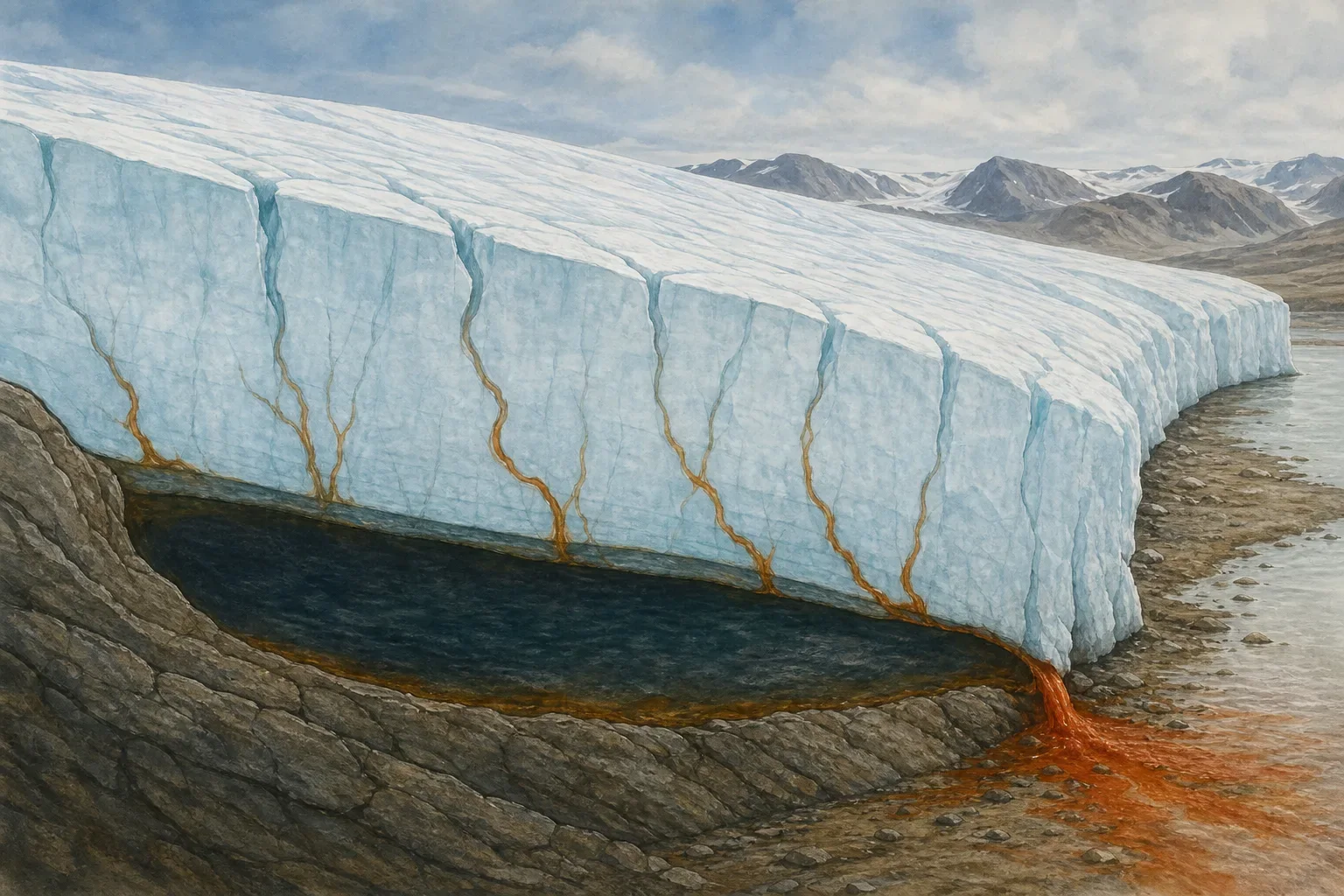
    Researchers used radio-echo sounding to map the brine rather than treating the red surface stain as the whole system. Their observations support a network of basal crevasses through which pressurized subglacial brine is injected into the ice and routed toward the terminus. The system is not an open cavern shaped like a giant underground lake; it is a distributed, salty hydrologic network.

    Illustrated cutaway of dark brine beneath a pale glacier feeding narrow channels toward a rust-colored outlet
    AI-generated conceptual illustration of the proposed brine-routing system. It simplifies the geometry and is not a scientific survey image.

    Two physical effects help explain why liquid can persist. Dissolved salts lower water’s freezing point. Freezing also releases latent heat, providing localized warming. The 2017 paper concluded that elevated salinity and latent heat together allow the brine to remain mobile in subglacial and englacial environments even while the surrounding glacier stays cold.

    The color develops when iron-rich brine reaches the surface and encounters oxygen. Iron compounds oxidize, producing the red-orange material that stains the ice. The result looks theatrical from a distance, but the chemistry is closer to rusting than bleeding.

    A hidden habitat in cold, dark brine

    Blood Falls is also important because the outflow has revealed a microbial community adapted to cold, darkness, high salinity, and little oxygen. NASA’s astrobiology reporting describes organisms that survive without sunlight for photosynthesis by using chemical reactions involving sulfur and iron compounds. That makes the site a natural laboratory for asking how life can persist when familiar surface energy sources are absent.

    Scientists are careful not to turn that analogy into evidence of extraterrestrial life. Blood Falls does not prove that organisms exist beneath Martian ice or inside the icy moons of the outer Solar System. It shows something narrower and valuable: on Earth, a cold, salty, lightless system can remain liquid and biologically active under conditions once assumed to be inhospitable.

    The origin story of the brine has developed as evidence improved. NASA’s Earth Observatory summarized a long-standing interpretation in which ancient seawater or a saltwater lake occupied Taylor Valley before advancing ice trapped and concentrated it. Later studies mapped where brine exists within the glacier and how it can move. Details of the system’s age, geometry, and geochemical history are scientific questions, not reasons to present a single dramatic reconstruction as settled fact.

    The visible stain is only the outlet

    Blood Falls earns attention because of its color, but the stranger feature is invisible: liquid threading through a glacier that has little surface melt. The surface apron can grow with new discharge and partly degrade during warmer periods, so its appearance changes. What a visitor or satellite sees is a temporary expression of a much larger system.

    Seen that way, the name is almost misleading. The remarkable thing is not a glacier “bleeding.” It is the combination of salt, pressure, fractures, phase changes, iron chemistry, and microbial metabolism operating beneath an Antarctic ice mass. The red stain is a window into that hidden machinery—vivid enough to draw the eye, but only the final step of the story.

    Sources

  • Death Valley’s Sailing Stones Move on Rafts of Ice Thin Enough to Miss

    Death Valley’s Sailing Stones Move on Rafts of Ice Thin Enough to Miss

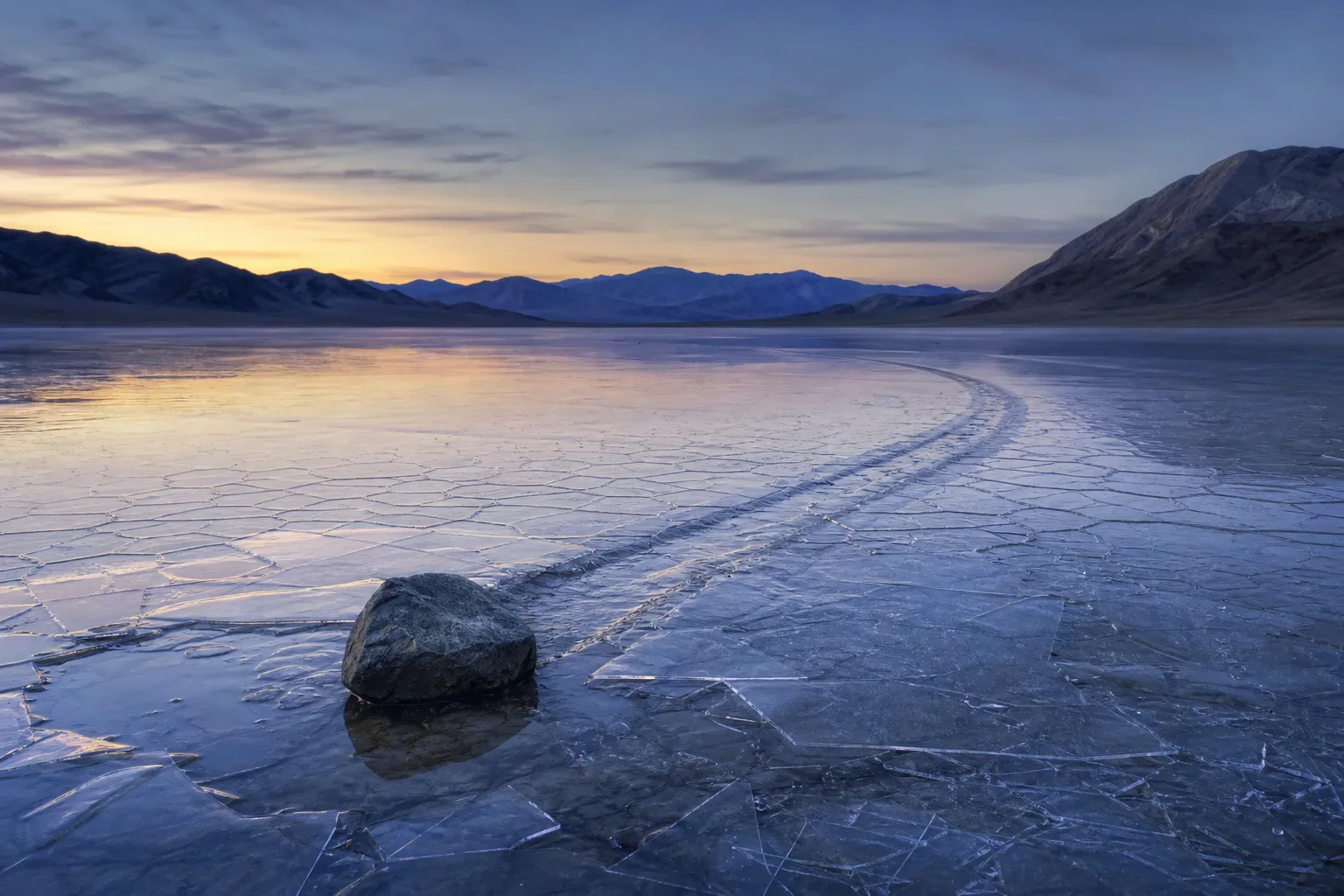
    For decades, the tracks on Racetrack Playa looked like evidence of an impossible commute. Stones sat at the ends of long grooves in the mud, yet nobody had watched them travel. Some paths ran nearly parallel; others curved, crossed, or stopped while a nearby stone kept going. The desert offered plenty of suspects—violent wind, slippery algae, thick floating ice—but not a witnessed mechanism.

    The first direct scientific observations arrived during the winter of 2013–2014. Researchers had installed a weather station, time-lapse cameras, and 15 specially prepared limestone rocks containing GPS loggers. Then a shallow pond formed on the playa, froze on cold nights, and began breaking apart under the late-morning sun.

    The push came from ice—but not the ice people expected

    The answer was surprisingly delicate. In a 2014 peer-reviewed study, Richard Norris and colleagues reported that sheets of “windowpane” ice only about 3 to 6 millimeters thick could push stones when three conditions lined up. The playa first needed enough water to create a shallow pond. A cold night had to freeze its surface. Then sunlight and light wind had to arrive together as the ice softened and fractured.

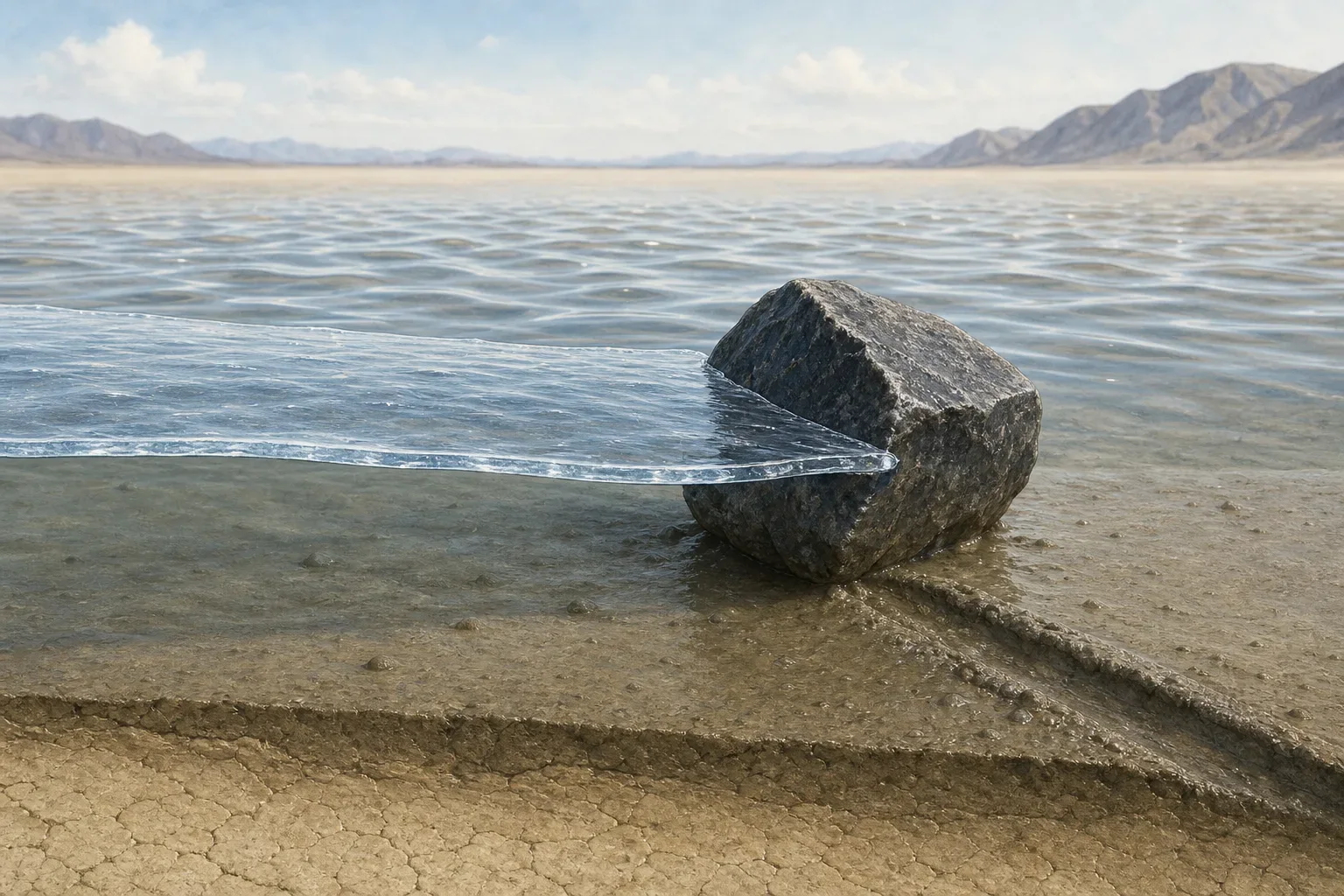
    Illustration of a thin floating ice panel pressing against a stone in shallow water on a desert playa
    AI-generated explanatory illustration: thin floating ice, driven by light wind and moving water, can press against a stone on the slick playa surface. It is not observational evidence.

    Large floating panels—tens of meters across despite being only millimeters thick—were driven across the pond by light winds and flowing water. When a panel met a rock that projected high enough above the water, the ice pressed against it and nudged it across the wet mud. The moving rock carved the trail that would become obvious after the water and ice disappeared.

    This was not a dramatic sprint. The observed stones moved at roughly walking pace or slower, commonly a few meters per minute. One directly watched movement on January 9, 2014 lasted about 18 seconds at around 1 to 2 meters per minute. GPS-equipped stones recorded longer events. Two rocks that started about 153 meters apart began moving within six seconds of each other on December 4, 2013, traveling more than 64 meters in 16 minutes.

    Why the mystery lasted so long

    Racetrack Playa is remote, and the necessary weather is rare. The National Park Service says the moving-rock phenomenon requires a precise sequence of rain, freezing temperatures, sun, and wind. Years can pass without a suitable event. Even when the stones do move, their slow motion is difficult to notice casually, and their new trails may stay hidden beneath muddy water until the pond is blown or evaporated away.

    The thinness of the ice also helped the process evade earlier explanations. Some hypotheses imagined rocks frozen into thick rafts that partly floated them off the lake bed. The observed mechanism did not lift the stones. Instead, broad but fragile ice panels supplied a gentle horizontal push while the wet clay reduced resistance.

    That fragility explains why neighboring tracks are not always identical. A panel can split when it strikes a stone or a fixed obstacle, disconnecting rocks that had been moving together. Low stones can be overridden by the ice, while taller ones catch its edge. Water depth, rock profile, ice fractures, wind direction, and the flow beneath the ice all influence which stones move and where they go.

    A solved mechanism, not a scheduled show

    The science explains how the sailing stones can move; it does not make the event predictable for visitors. The National Park Service warns that the playa surface is extremely fragile. Driving on it is prohibited, and walking on it when muddy leaves scars that can last for years. The rocks themselves should never be moved.

    What remains at Racetrack Playa is stranger than a supernatural story because it is so restrained: a temporary pond, a cold night, sunlight, a light breeze, and ice thin enough to look powerless. Given the right geometry and timing, those ordinary ingredients can reorganize stones across a desert floor—and leave the evidence long after the motion has stopped.

    Sources