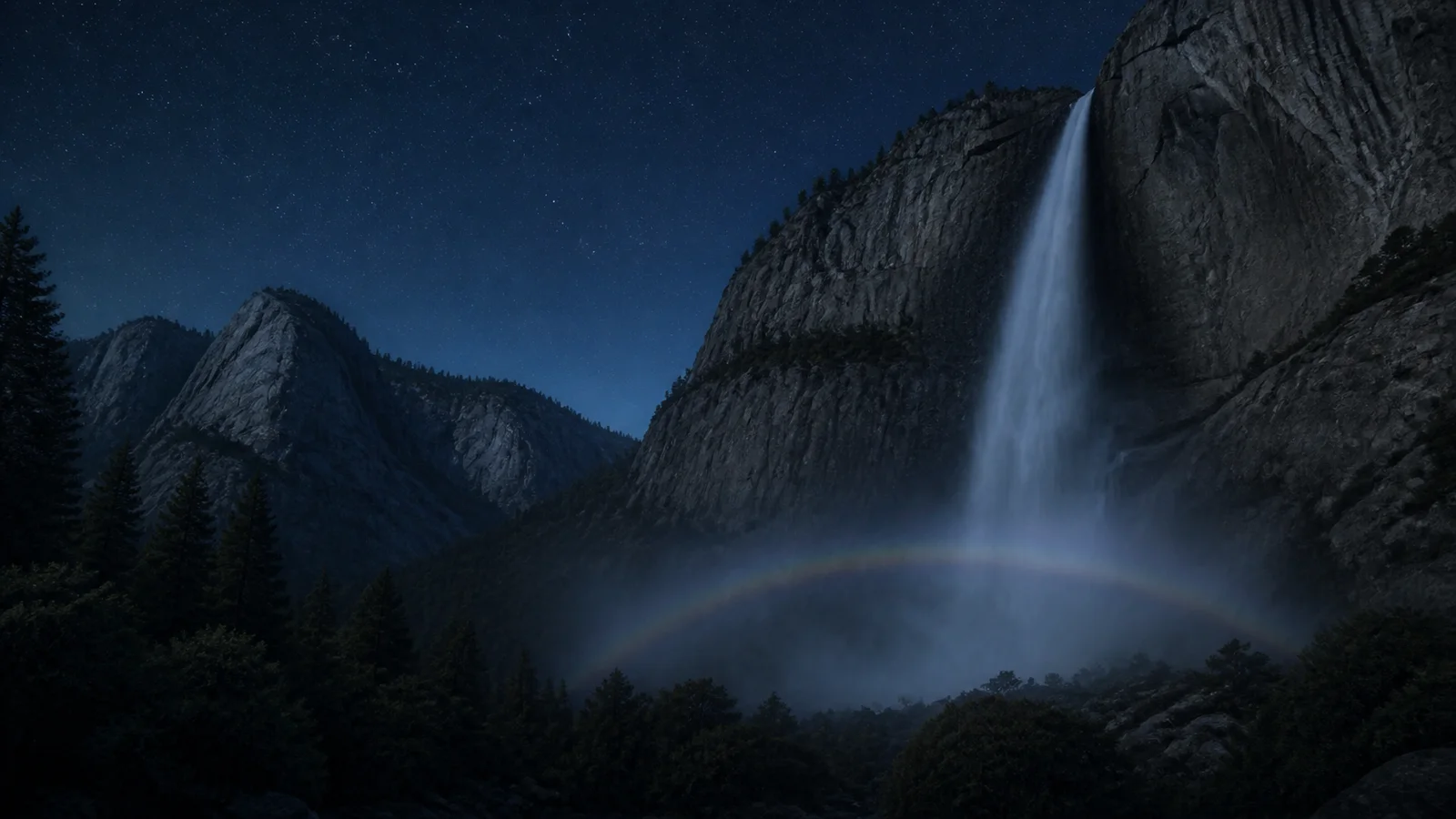
For a few nights in Yosemite’s spring waterfall season, moonlight can draw a rainbow in the spray of Yosemite Falls. The effect is real, and it has an odd visual twist: the National Park Service says Yosemite’s moonbows often look gray to an unaided eye even though photographs can reveal color.
A moonbow is not a second kind of rainbow or a trick of a camera. It is a lunar rainbow: moonlight passes through airborne water droplets, bends as it enters and leaves them, and is reflected inside them. The difference is the light source. Sunlight makes familiar daytime rainbows; far dimmer moonlight can make the same optical geometry visible in waterfall mist.
Why a rainbow appears after dark
NOAA’s explanation of an ordinary rainbow starts with a water droplet. Light bends when it enters the denser water, reflects inside the drop, and bends again as it exits. Because the colors of light bend by slightly different amounts, many droplets together can send a colored arc toward the viewer. A rainbow is therefore an optical effect tied to the viewer’s position, not an object hanging in a fixed spot.
For a moonbow, the waterfall supplies the droplets and the Moon supplies the illumination. The useful alignment is the familiar rainbow arrangement: the light source is behind the viewer and the lit spray is ahead. At Yosemite, the Park Service says that full-moon nights during the peak waterfall season, generally April through June, can produce moonbows in the mist of Upper and Lower Yosemite Falls.
Why the colors can disappear to human eyes
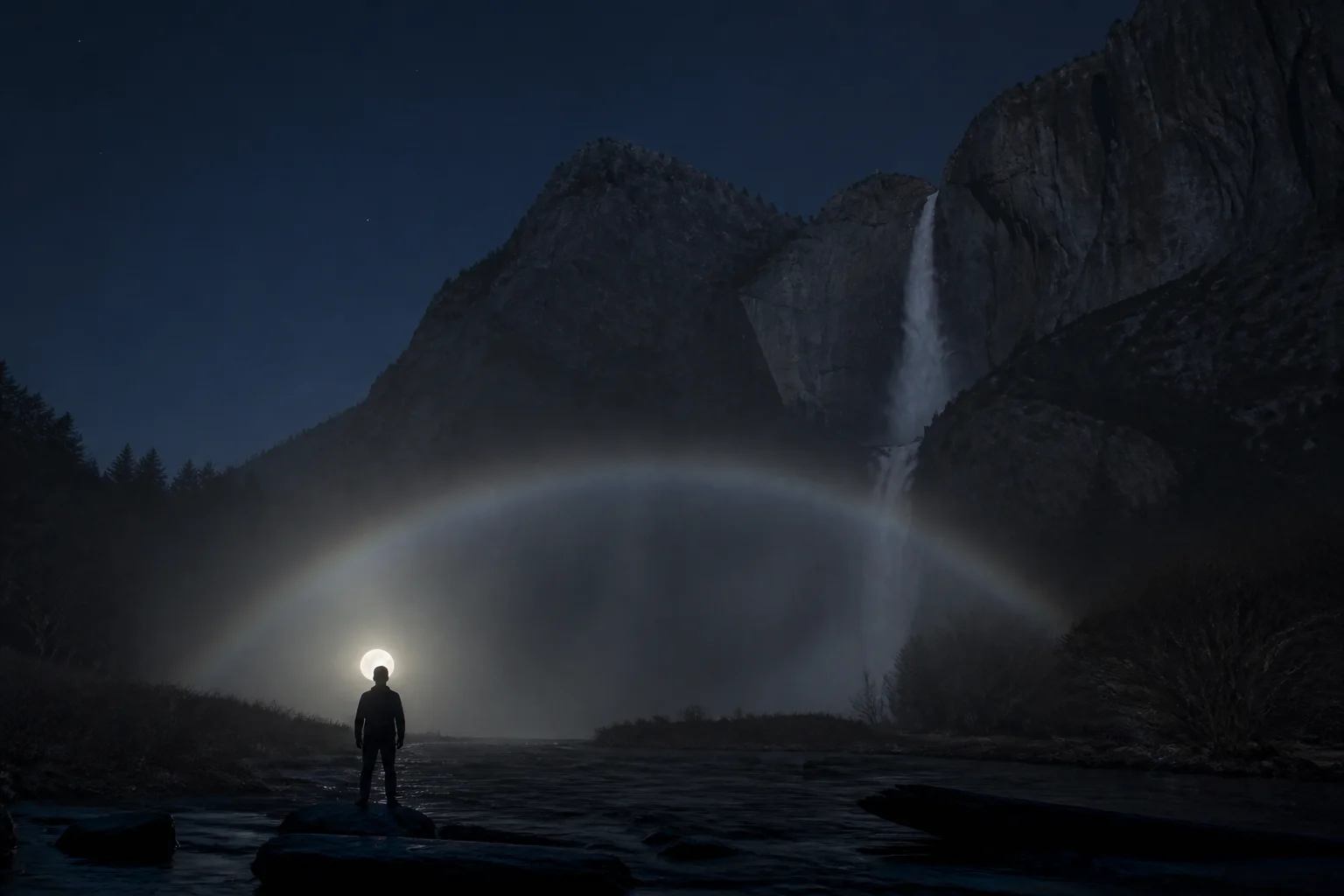
The event is dim because moonlight is reflected sunlight. That does not alter the basic optics, but it changes what a viewer can readily perceive. Yosemite’s National Park Service guidance says the moonbows look gray to the unaided eye while their colors can stand out in photographs. NASA’s Astronomy Picture of the Day makes the same practical point with a waterfall moonbow photographed using a 30-second exposure: a camera can collect weak light over time in a way a quick glance cannot.
That is why a highly saturated image should not be treated as a report of what every visitor sees in the moment. It can be a record of the same phenomenon, but exposure, processing, and the viewer’s own dark adaptation affect how strongly the colors register. The documented fact is the moonbow itself; the apparent intensity is not a universal measure.
A narrow window, not a nightly show
Calling the event a “lunar rainbow” can make it sound routine. The Park Service’s wording is narrower: these are special nights, and their timing is tied to a full moon plus enough waterfall mist. Yosemite Creek is snowmelt-fed and the falls commonly diminish later in the year, so a full moon by itself is not a promise of a moonbow.
Visitors should also separate the natural phenomenon from travel assumptions. The Park Service says Yosemite is open around the clock, but access, water flow, weather, and the Park’s current conditions all matter. A moonbow is best understood as a rare consequence of ordinary things—light, falling water, and a particular viewing angle—briefly lining up after dark.

Fact, folklore, and photography
Documented fact: Yosemite’s waterfall mist can form moonbows on suitable full-moon nights in spring and early summer.
Not folklore: “moonbow” is simply a name for a lunar rainbow. It does not require unusual lunar activity, a special kind of water, or a camera effect invented after the fact.
Photography note: a colorful long-exposure image can truthfully depict a moonbow while still looking more vivid than the scene appears to an unaided observer. That distinction makes the phenomenon more interesting, not less: the rainbow is physically present, but human vision and a camera do not record dim light in the same way.
Sources
- National Park Service, “Stargazing,” Yosemite National Park — Yosemite moonbow timing, locations, and the difference between unaided viewing and photographs.
- NOAA NESDIS, “What Causes a Rainbow?” — refraction, internal reflection, color separation, and viewing geometry.
- NASA Astronomy Picture of the Day, “Moonbow with Sailboats” — NASA’s explanation of moonbows and a documented long-exposure example.
Leave a Reply