Editorial illustration
Across a flat dry lakebed in Death Valley, heavy stones leave long grooves in clay. Field observations, ice, shallow water, and a light wind supply the strange-but-true explanation.

A rock trail on Racetrack Playa can look freshly drawn: one stone at its head, a narrow groove curling over pale clay behind it. The setting sits in Death Valley National Park, where the National Park Service describes a dry lakebed known for moving rocks. Some stones have traveled as far as 1,500 feet, according to the park’s visitor guide.
Confirmed facts: a stone can travel across the playa
Researchers directly observed the movement during the winter of 2013–14. Their cameras, GPS-equipped stones, and weather station captured shallow water covering the playa, thin sheets of ice forming overnight, and sunlight breaking those sheets into floating panels. Light winds pushed panels across the water and the panels pressed stones through soft mud. A single observed event involved more than 60 moving rocks, and instrumented stones traveled as far as 224 meters across several events.
The pace remains wonderfully subtle. The research team measured speeds of roughly 2 to 5 meters per minute. From a distance, a visitor could easily see a quiet lakebed and a landscape full of tracks, while the actual motion unfolds during a short weather window.
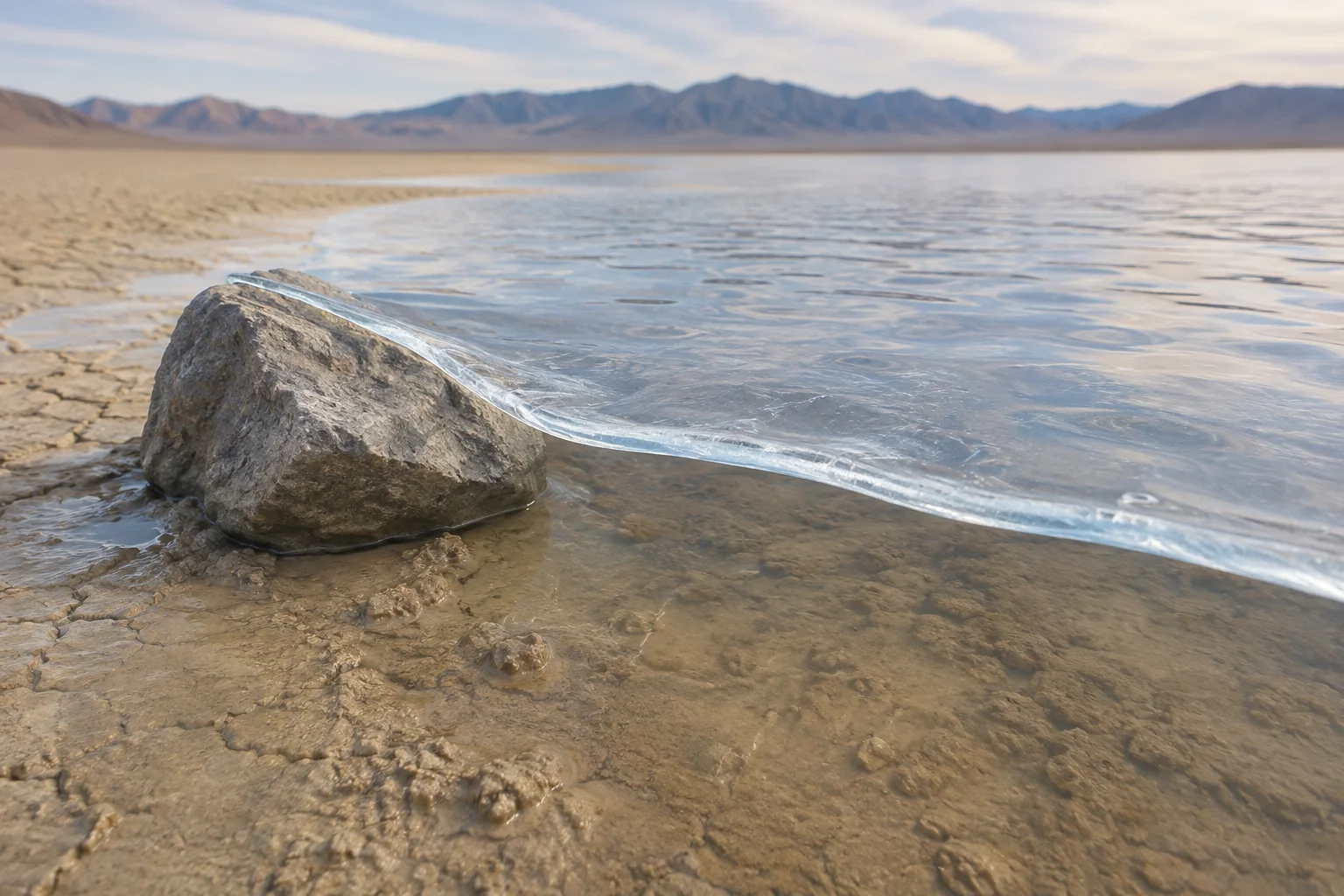
Folklore and popular lore: a name built for a mystery
“Sailing stones” gives the landscape a story-sized name. The phrase belongs to popular desert lore: stones appear to travel under their own power, then pause beside a signature trail. Earlier scientific discussion also gathered several possible mechanisms, including powerful wind, liquid water, ice, and ice flotation. Those ideas form the history of the mystery, while the 2013–14 field record supplies a measured account of one sequence.
Speculation: each trail carries its own weather story
The direct observation explains a powerful route for motion, yet every trail reflects local conditions at a particular moment. Wind direction, water depth, ice-panel shape, stone size, and the clay surface can shape a path. The research paper describes trajectories guided by wind and flowing water beneath the ice. That leaves room for careful study of how individual trails gain their curves, parallel lines, turns, and varied widths.
Why the evidence matters
Racetrack Playa offers a useful lesson in wonder. The tracks were always real physical records. Patient observation turned a dramatic sight into a sequence of ordinary materials acting together: rain or snowmelt, freezing air, thin ice, sunlight, breeze, stone, and mud. The result still feels theatrical because the stage is so vast and the action is so quiet.
The park asks visitors to protect that stage. Stay on established roads, keep vehicles off the playa, and treat the fragile surface with care. A trail can preserve a rare weather event; a fresh footprint or tire mark can reshape the view for years.
Sources
- National Park Service: The Racetrack, Death Valley National Park
- Norris et al., “Sliding Rocks on Racetrack Playa, Death Valley National Park: First Observation of Rocks in Motion,” PLOS ONE
- Scripps Institution of Oceanography: How Rocks Move
- U.S. Geological Survey: Terrain analysis of the Racetrack Basin and sliding rocks of Death Valley
Leave a Reply