WEIRD, BUT TRUE
The Rocks That Take a Walk Across Death Valley
At Racetrack Playa, visitors find stones at the ends of long trails. The trick behind the “sailing stones” is real, rare, and wonderfully ordinary: a little water, a little ice, and a little wind.
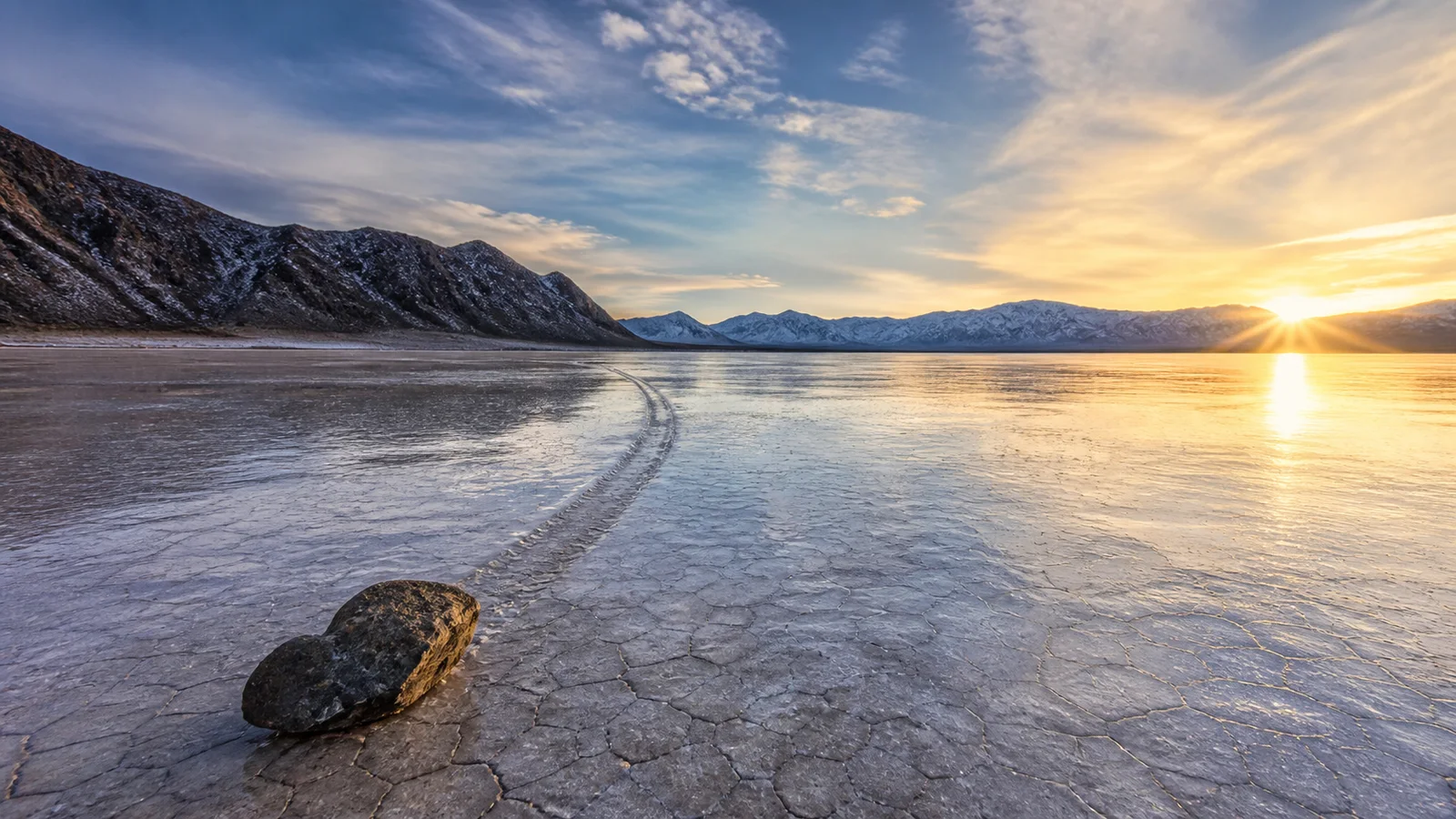
Imagine arriving at a dry lakebed and discovering that a rock has apparently gone for a stroll. There are no footprints around it, no tire tracks, and no helpful witness pointing toward the culprit. Only a long groove in the mud, sometimes bending gently across the pale floor.
That is the signature oddity of Racetrack Playa, a nearly level dry lake in a remote part of California’s Death Valley National Park. Stones scattered across the playa leave tracks that can run for hundreds of meters. The National Park Service says some rocks have traveled as far as 1,500 feet, while the stones themselves can weigh hundreds of pounds.
The fact: the rocks really move
For decades, the movement was inferred from the trails rather than watched. The playa is so remote, and the right weather so infrequent, that a person could spend a long time waiting for a performance that lasts only minutes.
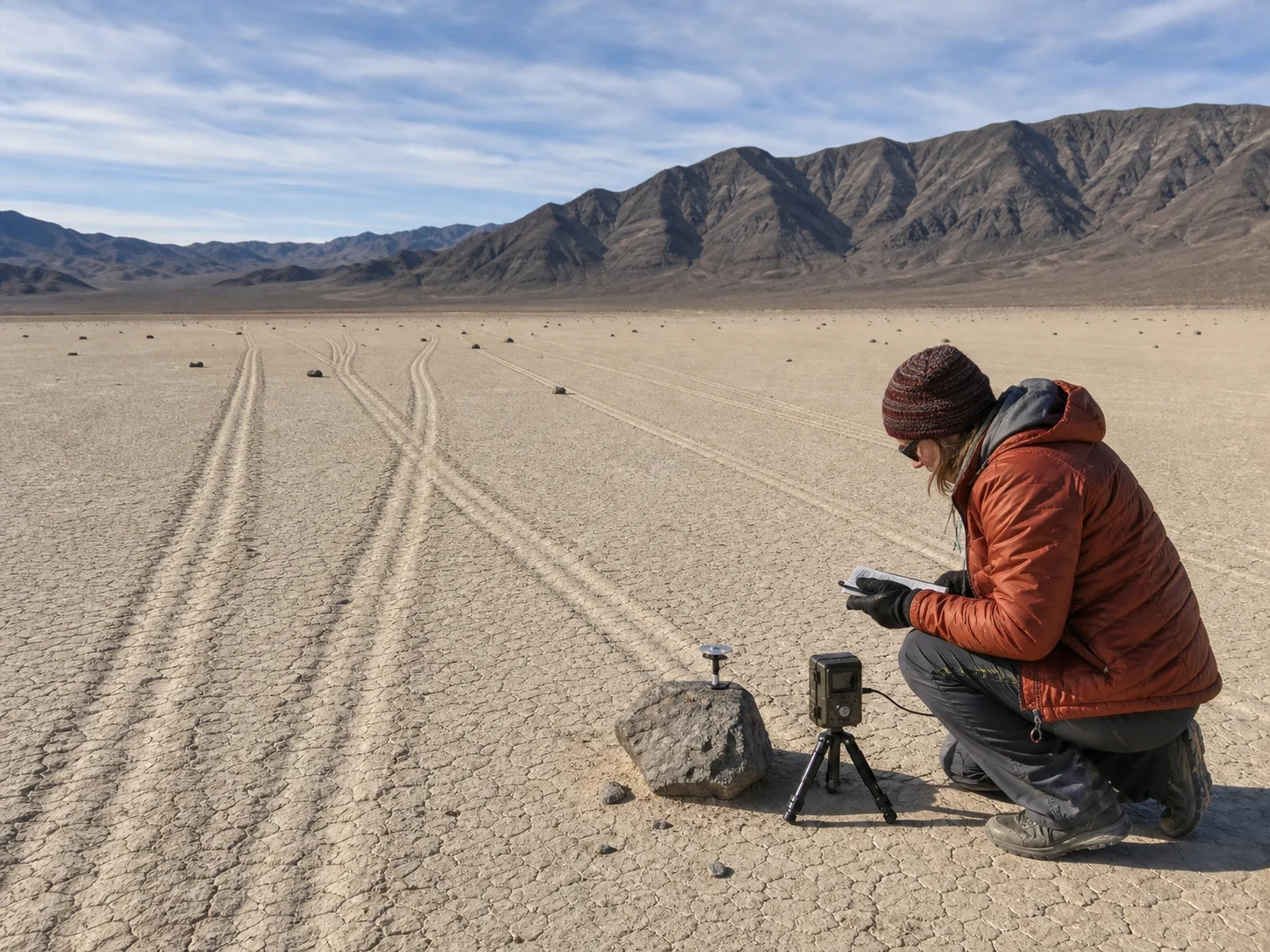
That changed during a field project in the winter of 2013–14. Researchers Richard and James Norris, Ralph Lorenz, Jib Ray, and Brian Jackson placed GPS units on selected stones, set up time-lapse cameras, and monitored the weather. Their open-access study reports a largest observed event involving more than 60 rocks. Some instrumented rocks moved as far as 224 meters over several events.
The movement was slow enough to be easy to miss at a distance: roughly 2–5 meters per minute in the observed events. The rocks did not leap, roll dramatically, or glide through a supernatural force field. They were pushed along the wet surface by broad panels of floating ice.
The mechanism: a desert’s tiny winter pond
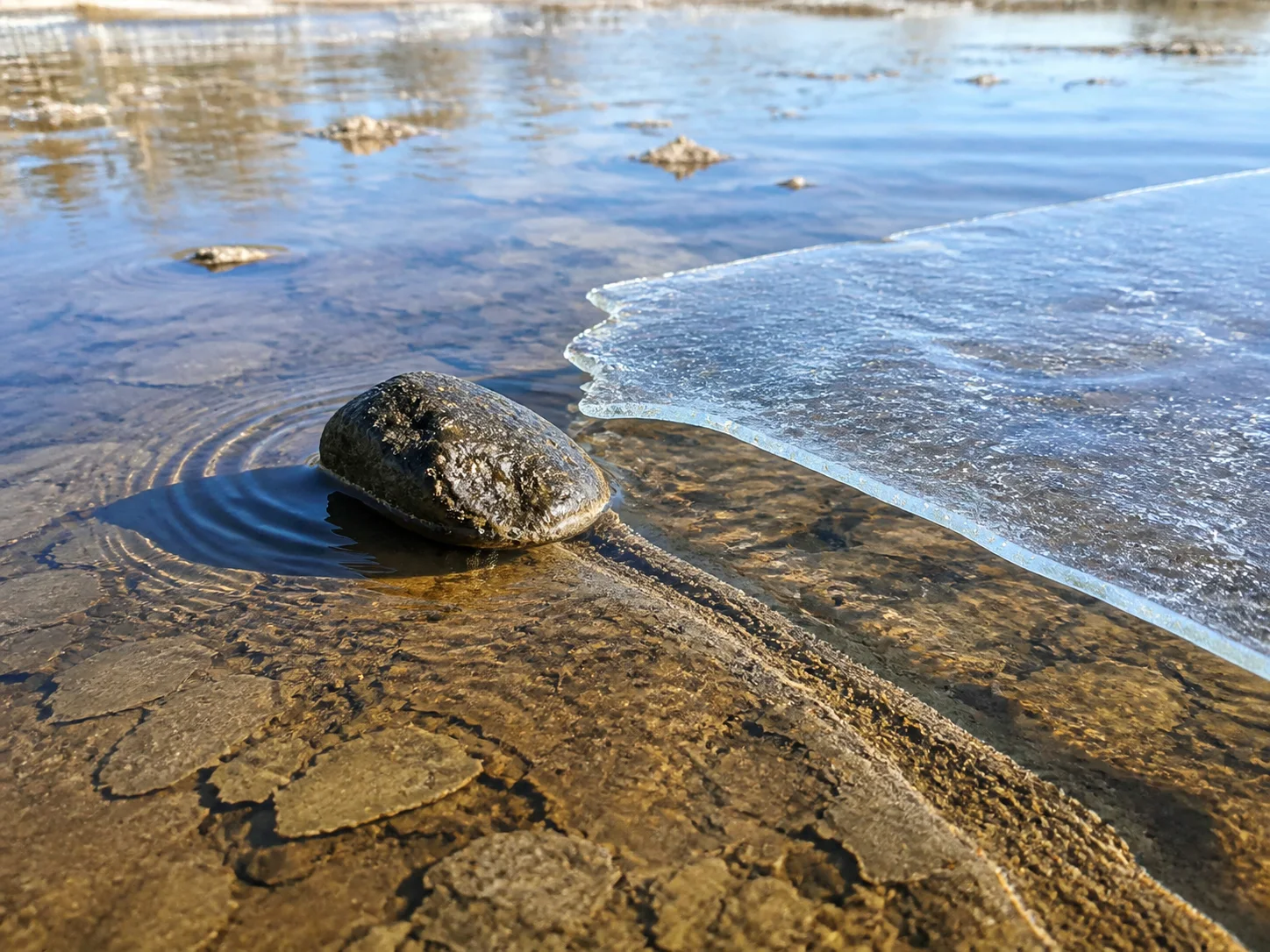
Racetrack Playa is usually dry, but winter rain or snow can briefly create a shallow pond. When night temperatures fall, the water can freeze into a sheet only a few millimeters thick. The study describes this as “windowpane” ice: thin, broad, and strong enough to form panels when it breaks up.
As sunlight warms the pond, the ice fractures. Light winds then move the floating panels across the water. When a panel meets a stone, it can push that stone over the soft, slick mud below. The water reduces friction; the ice supplies a broad surface for the wind to push. A track remains when the pond drains and the mud dries.
This explains why neighboring rocks can draw parallel lines and why some stones move while others stay put. Position, shape, water depth, ice breakup, and wind direction all matter. The researchers observed panels tens of meters wide moving rocks in winds of only about 4–5 meters per second—far gentler than the hurricane-force gusts once proposed.
The folklore: curses, aliens, and invisible helpers
Before anyone caught the process on camera, the trails invited stories. People proposed powerful winds, thick ice, slippery algae, seismic vibrations, and other explanations. Modern visitors sometimes add extraterrestrials or a desert curse to the list. Those are folklore and speculation: engaging ways to narrate a mystery, but not evidence for what moves the stones.
The more satisfying story is the documented one. A remote place made observation difficult; patient researchers brought instruments; and a rare combination of winter conditions finally supplied the missing scene. Mystery did not vanish so much as change shape. The question became less “Who dragged the rock?” and more “How often does this exact little weather machine switch on?”
A phenomenon worth leaving alone
The National Park Service warns that the Racetrack is remote, roads can be rough, and there is no cell service. More importantly, the playa surface is fragile. Driving across it or walking on wet mud can leave scars that last for years, and the rocks are protected natural resources. The best way to meet a sailing stone is to let its trail do the talking.
So, if you ever stand at the edge of this enormous, quiet floor and see a stone at the end of a fresh-looking groove, you can enjoy both halves of the experience. The track is genuinely strange. The explanation is genuinely true. And somewhere under the right winter sky, a paper-thin sheet of ice may be preparing to give another rock a very slow ride.
Sources
- National Park Service, “The Racetrack” — park geography, trail lengths, visitor guidance, and the observed ice-and-wind explanation.
- Norris et al., “Sliding rocks on Racetrack Playa, Death Valley National Park: first observation of rocks in motion,” PLOS ONE (2014) — GPS, time-lapse, weather observations, movement distances, speeds, and ice-panel mechanism.
- Open-access article DOI: 10.1371/journal.pone.0105948 — full study and methods.
All images in this feature are original editorial illustrations generated for WeirdNews.org.
Leave a Reply