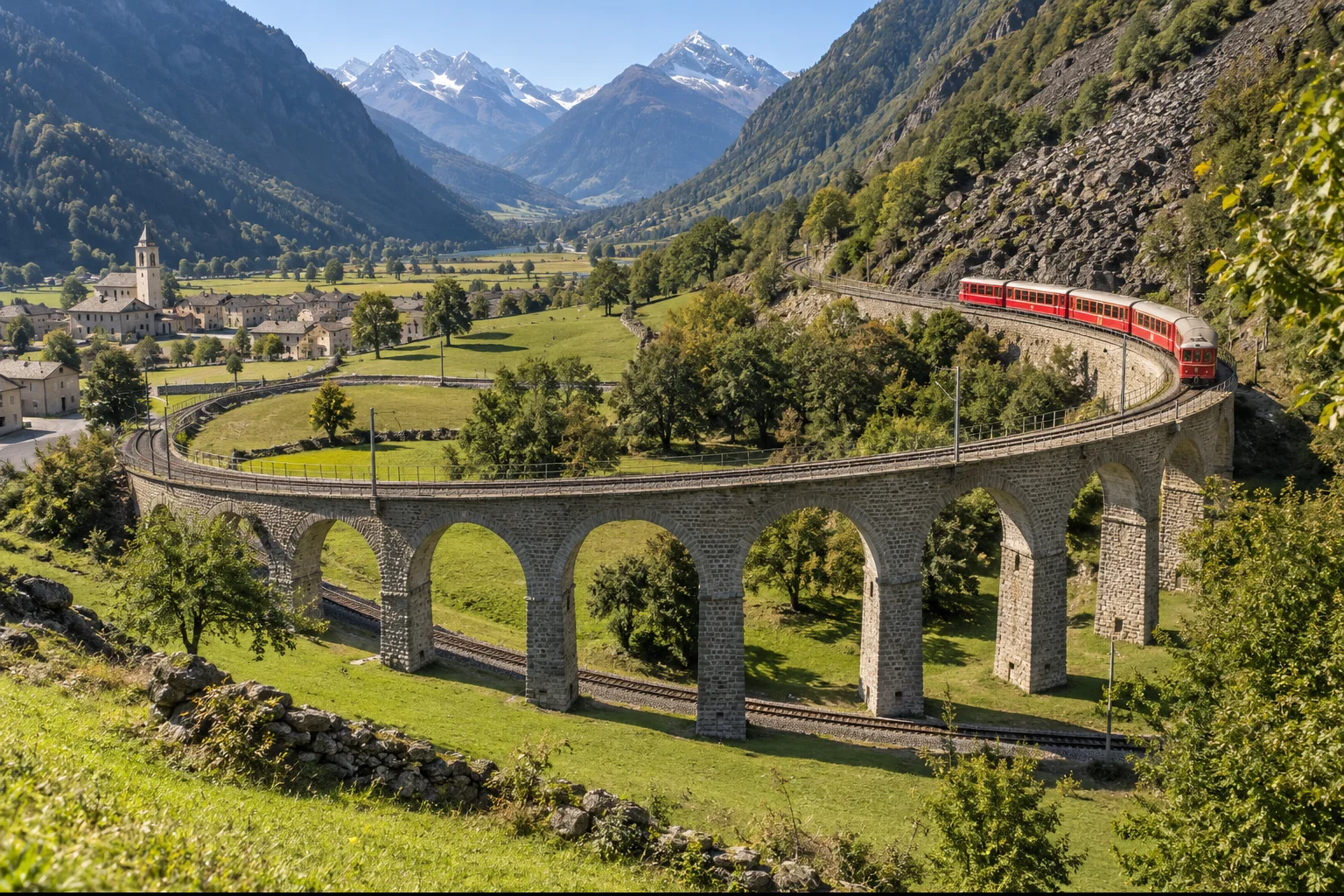
A train near Brusio, Switzerland, takes a route that looks like a railway trick: it curves around in a full loop, climbs over its own track, and continues through the Alps. The stone viaduct makes the Bernina Railway’s ingenious answer to steep terrain visible in a single view.
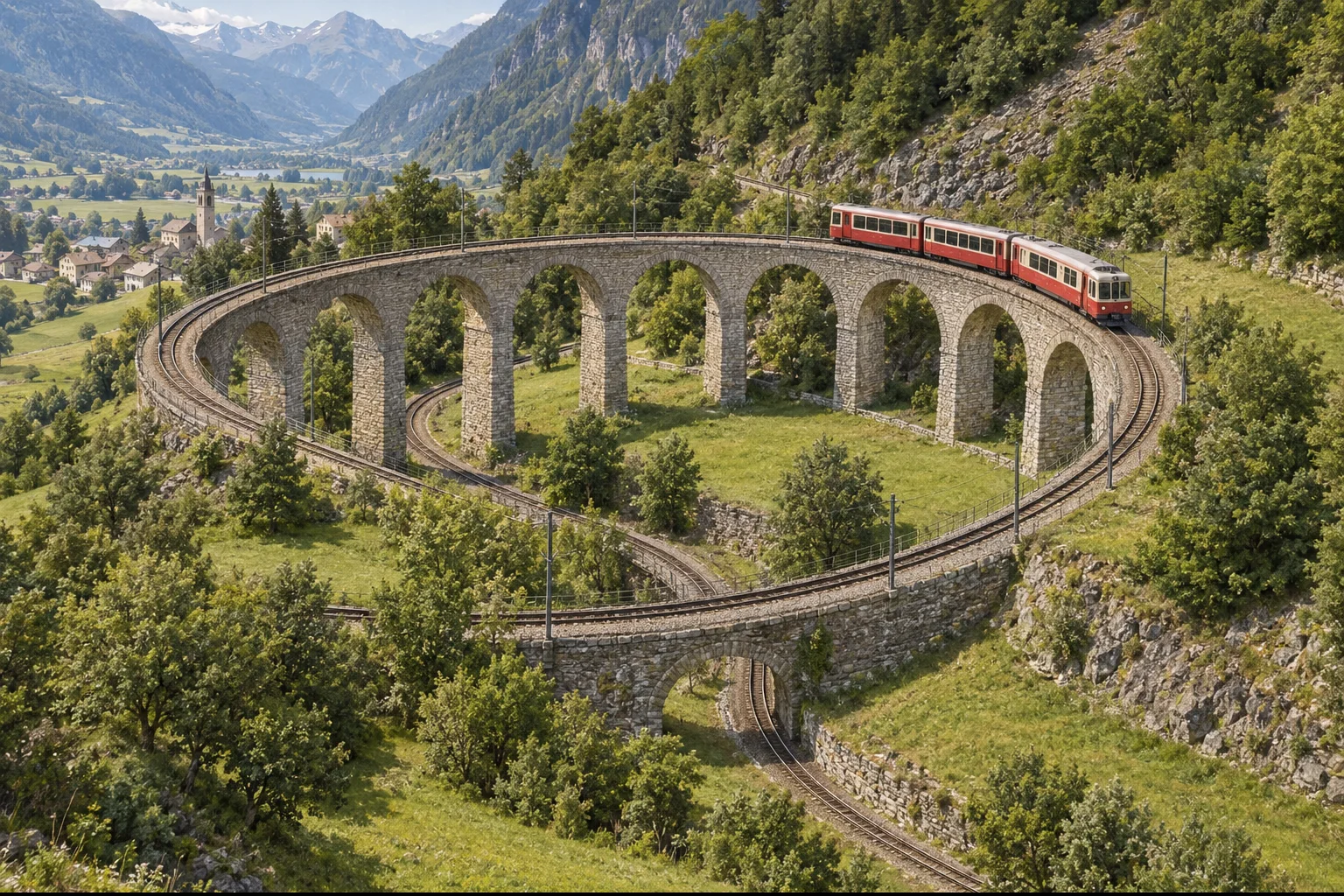
The Brusio circular viaduct stands on the Bernina line of the Rhaetian Railway. Its nine stone arches carry the train around a 360-degree turn, with one level passing above another. From the carriage, passengers can look down at the track they crossed moments earlier. From the valley, the railway draws a clear circle across the hillside.
The municipality of Brusio describes the train slipping beneath one of the arches as it completes the loop. Graubünden Tourism maps a 1.9-kilometre walk from the station to the viaduct and back through the village centre, with an estimated route time of 35 minutes. It is a small bridge with a big visual payoff: the railway seems to fold back on itself in open air.
A loop turns a steep climb into a longer route
The Bernina Railway connects Tirano, Italy, with St. Moritz, Switzerland, crossing the Bernina Pass. The Brusio municipal account describes the route’s early engineering challenge: designers had to gain height across short distances while keeping the line’s scenic character in view. The railway uses tunnels for some difficult turns; at Brusio, the hillside allowed an open-air spiral instead.
That geometry gives the train more track over which to climb. Rather than rising sharply in one short stretch, it follows a curve around the valley and reaches a higher level gradually. The line crosses over itself at the viaduct, and a train can continue its journey without a rack railway. The municipality highlights that the Bernina line crosses the Alps without a base tunnel or a high-level summit tunnel, making its visible mountain route part of the engineering story.
The viaduct is one expressive detail in a larger railway landscape. Brusio’s municipal heritage page places it among the Bernina Railway’s major attractions and identifies the railway as part of UNESCO’s World Heritage. Across the Alps, the line brings villages and mountain regions into the same journey.
Built for the journey, admired from the valley
The municipality describes the engineering challenges around Brusio during 1908–1910, when the Bernina Railway’s builders worked across steep terrain and tight elevation changes. Their solution at Brusio remains easy to read from the valley: stone arches carry the track around the hillside and back above itself.
Visitors can experience the curve from both perspectives. On the train, the track passes beneath the carriage as the line completes its turn. On foot, a short circular route from Brusio station reaches the viaduct and returns through the village. Switzerland Tourism describes the walk as a roughly 30-to-40-minute outing, with views of the railway and the surrounding Valposchiavo.
The loop is memorable because its purpose and spectacle are the same thing. A tight turn solves a practical problem of mountain travel, while the open arches let everyone nearby see how the solution works. As the train rounds the curve, the railway becomes its own moving diagram: one track below, another above, and the Alps all around.
Sources: Comune di Brusio, “Viadotto di Brusio”; Switzerland Tourism, “Brusio Spiral Viaduct”.
Leave a Reply