
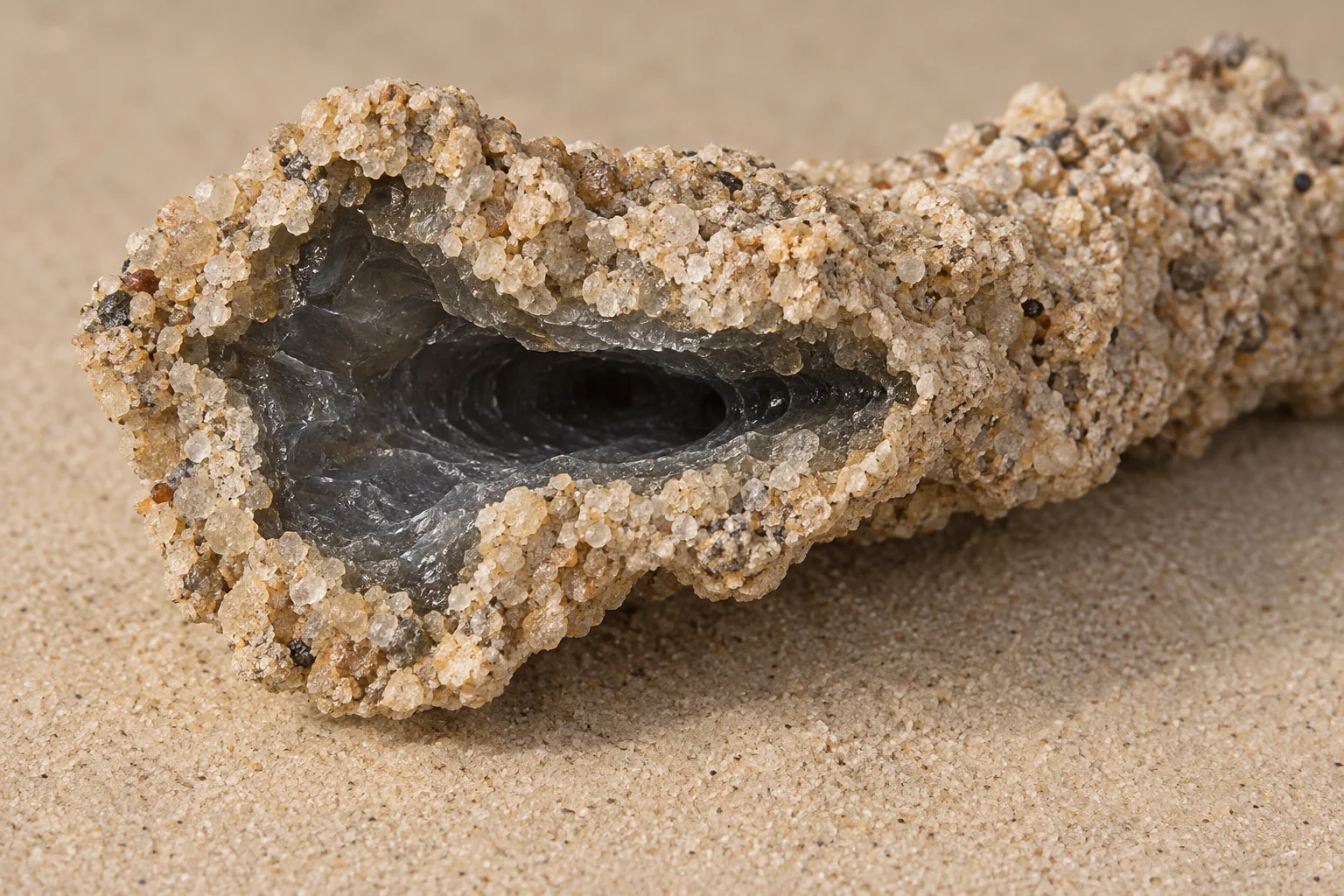
After a thunderstorm, a beach or dune can hold a surprisingly delicate record of a lightning strike: a hollow tube made from the sand itself. These natural glass forms are called fulgurites, a name derived from the Latin word for lightning. They are strange-looking enough to resemble roots, coral, or broken pottery, yet their story is written in ordinary grains of sand.
Fulgurites are geological objects created when lightning heats and fuses material underground. In silica-rich sand, that transformation can leave a glass-lined tube with a coarse, sandy exterior. The Geological Society of America describes lechatelierite as a natural silica glass; ground composition and moisture shape each fulgurite’s form and chemistry.
A flash-made structure
The remarkable thing about a fulgurite is its contrast of textures. The outer surface can retain loose-looking grains and bumps. Inside, the melted material can form a smoother, darker lining around a void. The University of Nevada, Reno notes that silica sand melts at roughly 1,800 degrees Celsius, which helps explain why the objects need such an intense event to form.
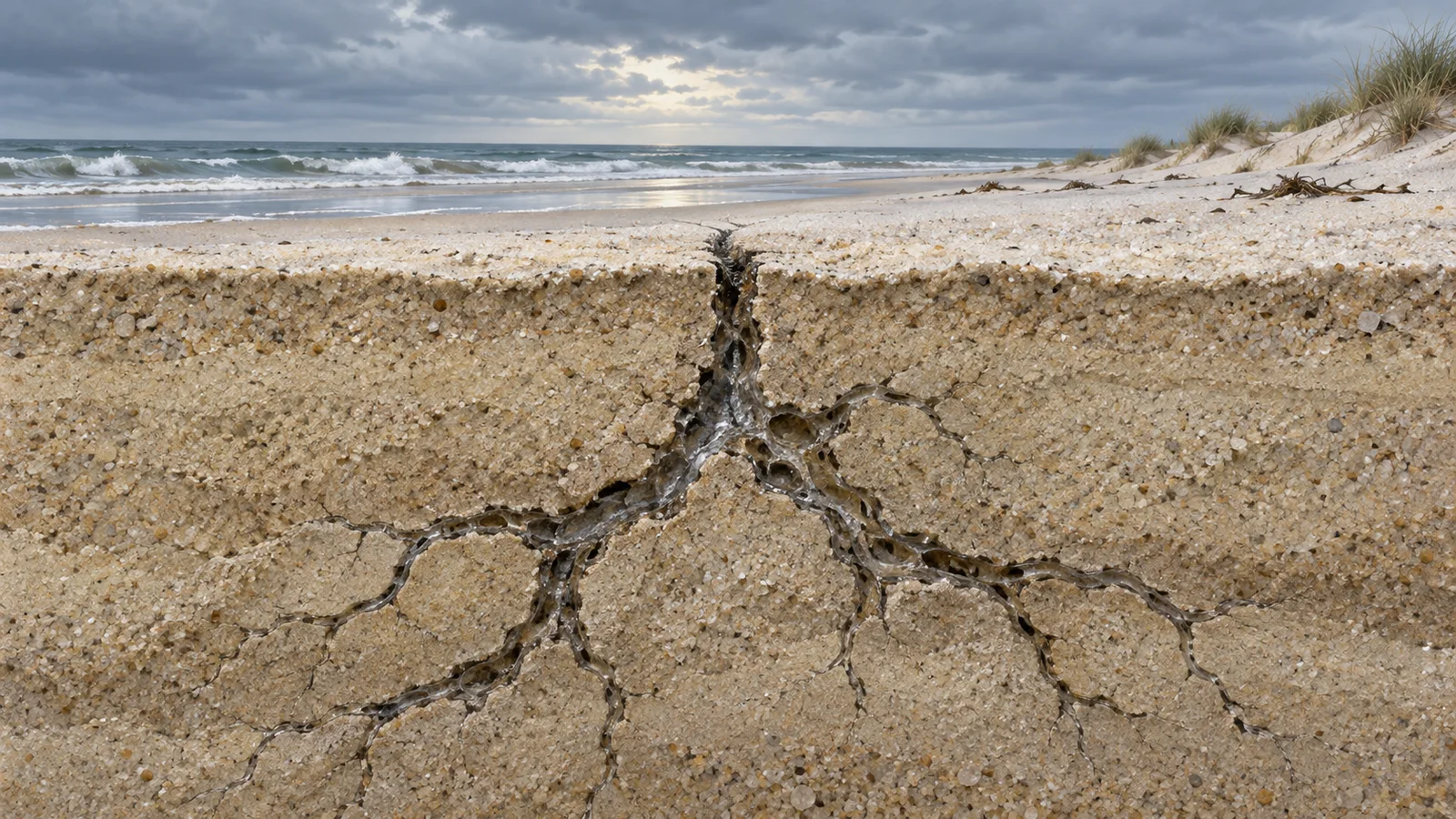
They often branch because a lightning discharge can take several paths through the ground. The tubes can be thin and fragile, so careful excavation helps keep them intact.
Sand is only one possible setting
The word fulgurite is often associated with sand, but lightning can alter other ground materials too. A 2023 University of South Florida report describes electric discharge moving through nearby rock, soil, and sand around a lightning strike. The ground’s composition and moisture shape the form of the resulting material.
A 2023 University of South Florida report offers another example of why these objects interest researchers. After lightning struck near New Port Richey, Florida, scientists studied a fulgurite and identified a previously unknown phosphorus material in the sample. Such studies look beyond the object’s dramatic shape: a fulgurite can preserve evidence of an extremely brief, high-energy interaction among electricity, minerals, soil, and organic material.
A fragile geological archive
Fulgurites have inspired the nickname “petrified lightning,” a vivid metaphor for ground material transformed by a strike’s heat and electrical energy. Their branching form can evoke a lightning bolt because both reflect the path that energy took through a changing environment.
Their fragility matters. In a 1997 University of Florida account of a long fulgurite excavated at its lightning research facility, the researchers emphasized careful digging because ordinary handling could destroy the structure. A responsible encounter is therefore mostly an observational one: document the place, avoid digging at an active storm site, and check local rules before disturbing natural material.
That combination of fleeting cause and delicate result gives fulgurites their lasting appeal. A thunderstorm lasts minutes; the glassy trace can remain in sand or rock long enough to become a museum specimen or a research sample. In a small, branching tube, the atmosphere and the ground have made a shared object.
Leave a Reply