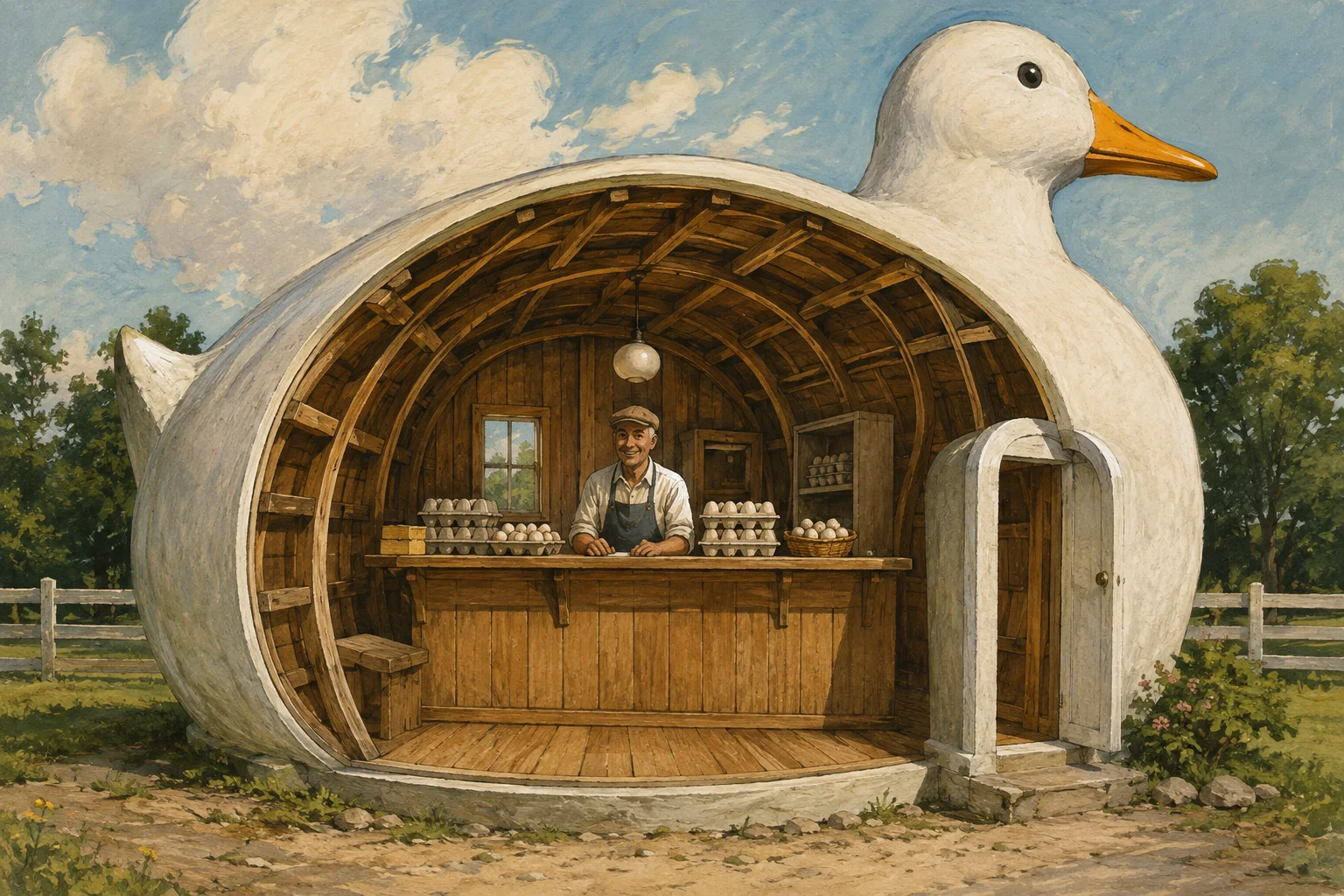
Weird, but true: On eastern Long Island, a small shop was built as a giant white duck. Its eyes came from Ford Model T taillights, its doorway sat in the bird’s chest, and its compact interior once served a working duck farm.
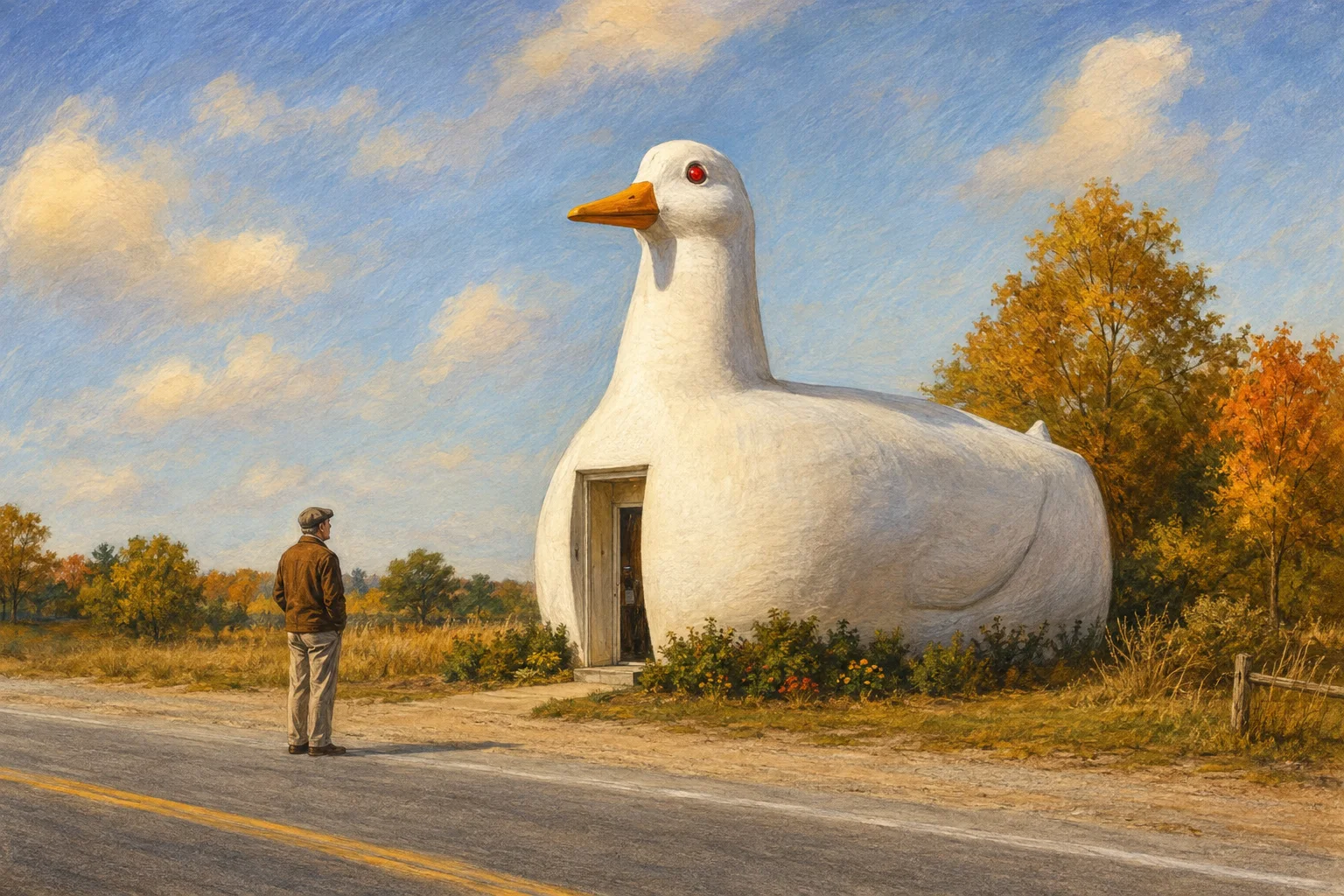
A roadside building can advertise with a sign, a window display, or a bright awning. Martin Maurer’s answer in 1930–31 was more direct: make the store itself into a Peking duck. The result, called the Big Duck, was built on West Main Street in Riverhead, New York, as a retail poultry shop. For people driving east, the message arrived before they had time to read a word.
A duck with a room inside
The National Park Service describes the building as a wood-frame structure covered with wire mesh and concrete. It measured about 15 feet across the front, 30 feet from breast to tail, and 20 feet to the top of its head. The shop inside measured roughly 11 by 15 feet. Those measurements make the joke more impressive: a building that looks oversized from the road still held a room sized for an everyday transaction.
Its red eyes have a particularly practical origin. They are Ford Model T taillights. A detail from an ordinary car became a pair of eyes for a very large bird, an economical piece of theater for a farm business.
The documented history
Several dates in the Big Duck’s life are unusually well anchored. The National Park Service records its construction in 1930–31 and says Maurer moved it about four miles southeast to Flanders in 1937, near his new ranch, duck barns, and marshes. The building closed in 1984 and moved to Sears-Bellows Pond County Park in 1988. The National Register listed the Big Duck in 1997; the larger Big Duck Ranch historic district followed in 2008.
That record matters because a giant roadside bird can invite a loose retelling. The verified version is already plenty strange: a working agricultural business used a three-dimensional duck as its salesroom, then the building gained a second life as a preserved landmark.
Folklore, shorthand, and an architectural idea
The Big Duck has gathered a powerful bit of architectural shorthand. In Learning from Las Vegas, Robert Venturi, Denise Scott Brown, and Steven Izenour used “duck” for a building whose overall form carries the message. The Library of Congress connects that term directly to the Long Island Duck. In this sense, a “duck” means a building that speaks through its silhouette.
That label is a later architectural reading, while the 1930–31 store and its moves are documented historical facts. Popular stories can make a landmark sound like the sole beginning of every whimsical roadside structure. The surviving record supports a narrower, more satisfying claim: this particular duck became a durable example that architects used to explain a design idea.
What remains an inference
The National Park Service calls this kind of design “literalism in advertising,” and the route to the Hamptons gave Maurer’s building a prominent audience. It is reasonable to read the white bird, orange bill, and glowing eyes as a way to catch a motorist’s attention. That is an interpretation of the design’s public effect. Maurer’s exact private reasoning belongs to history’s quieter corners, so this feature leaves it as an inference.
For a visitor, the Big Duck offers a small lesson in scale. From the road, it is a duck. At the door, it is a room. In the archive, it is a farm business, a preservation project, and an architectural vocabulary word—all gathered under a pair of old taillights.
Leave a Reply