Some desert dunes do something that sounds impossible until you hear the recording: they boom. At certain places, when a sheet of dry sand slides down a steep slope, the dune can produce a deep, sustained note—more like a distant aircraft or a giant bass speaker than a pile of loose grains.
The sound is documented at a small number of dune fields. The National Park Service lists Kelso Dunes in California’s Mojave National Preserve among them, and says only seven known sand-dune fields in North America produce the booming effect. At Great Sand Dunes National Park and Preserve in Colorado, the agency invites visitors to listen for “singing sands,” a natural sound made during an avalanche of sand.
The concert begins with an avalanche
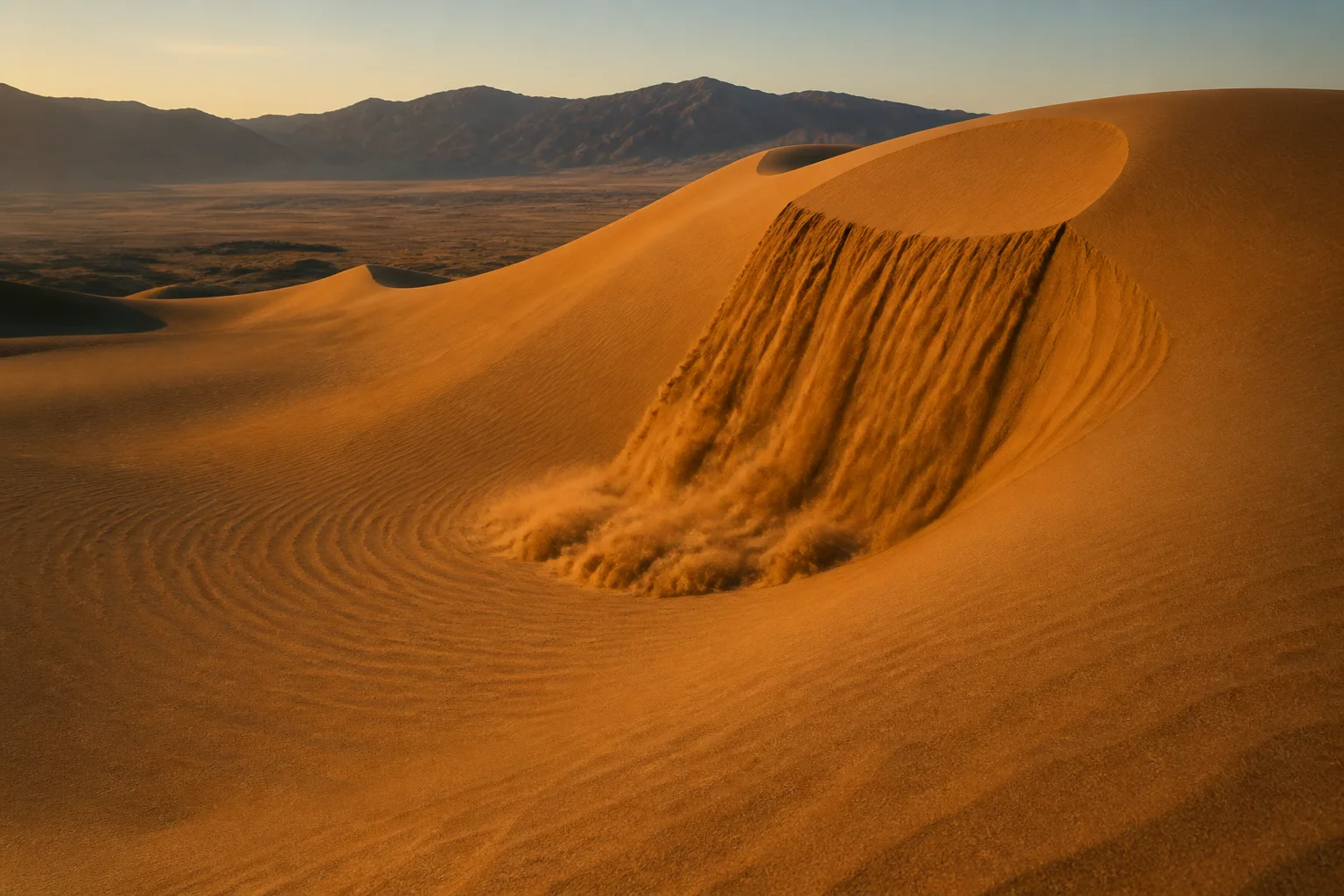
A booming dune is not singing because wind is blowing across its crest like air across a bottle. The trigger is a granular avalanche: a layer of sand loses its footing and flows down the dune’s steep “slip face.” The National Park Service describes the sound at Great Sand Dunes as a deep hum produced as air is pushed through millions of tumbling grains.
That description helps explain why the effect is so selective. A dune needs a particular combination of material and conditions. Research on singing sand has found that the grains are typically dry and fairly well sorted, so a large population of similarly sized grains can move together. Dampness, mixed grain sizes, or an avalanche that is too small or too disorganized can leave the slope silent.
The result can be surprisingly low. A field study of booming dunes reported a dominant audible frequency in roughly the 70-to-105-hertz range, accompanied by higher harmonics. That is bass territory: low enough to feel as a vibration in the body as well as hear as a tone.
What the experiments actually show
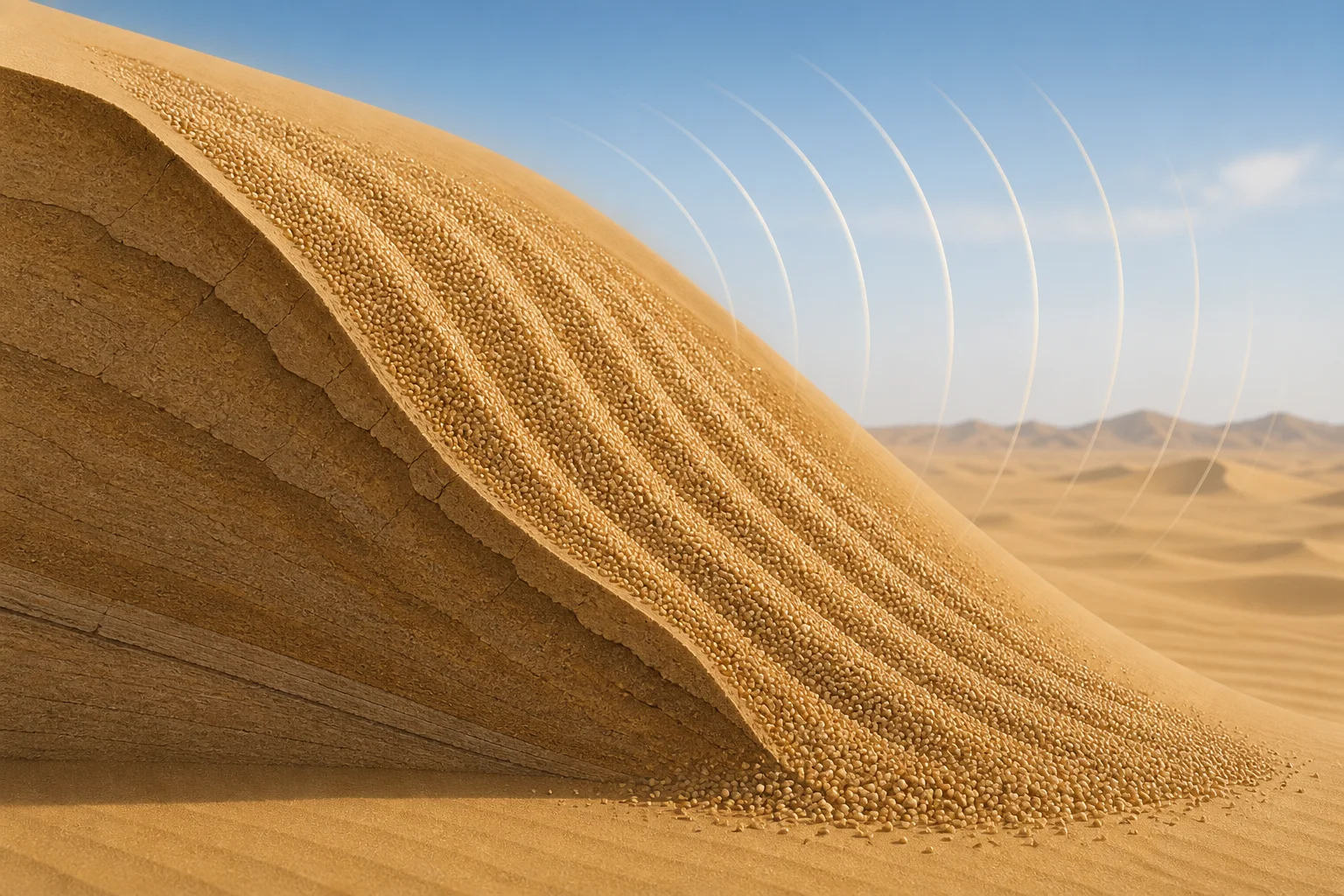
One influential 2006 study compared several booming dunes with controlled avalanches in the laboratory and field. Its authors concluded that the sound’s frequency matches the relative motion of the grains, and that the moving grains can synchronize their motion. In that picture, millions of tiny contacts cooperate long enough to produce one audible note instead of a heap of unrelated clicks.
That does not mean every sand grain is acting like a miniature tuning fork. The important behavior is collective. As grains slide, collide, and shear past one another, their movement can lock into a repeating pattern. The avalanche becomes a self-organized source of vibration, with the surrounding air carrying that vibration to a listener.
But “the grains synchronize” is not the end of the story. A 2012 study in Geophysical Research Letters tested singing-dune sand in laboratory avalanches over a hard plate. The researchers found that the sand could sing without a dune underneath it—and therefore without the dune’s internal layers acting as a required resonator. They also found that well-sorted grains produced a clearer frequency than polydisperse sand.
A real phenomenon with an unfinished explanation
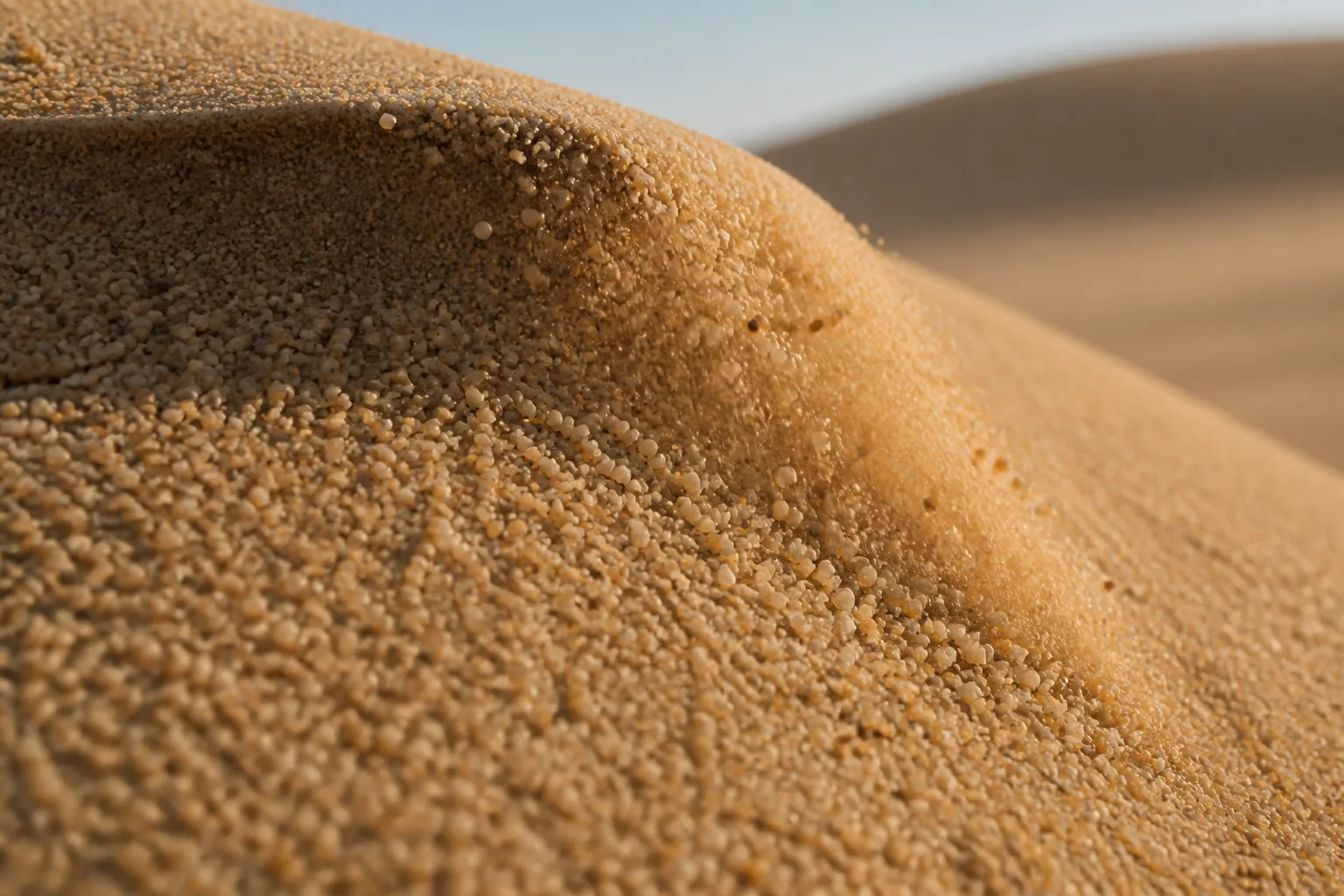
Another field study reached a different emphasis. It proposed that a thin layer of dry, loose sand near the surface can act as a natural waveguide, helping set the booming frequency as vibrations reflect through the dune. This does not erase the evidence for grain-scale synchronization; it highlights a different part of the system that may shape the sound people hear.
The careful conclusion is therefore narrower—and more interesting—than “scientists solved the singing dune.” Researchers agree on the observable sequence: suitable dry grains, a flowing avalanche, and a loud, sustained sound with a recognizable frequency. They continue to debate exactly how the moving grains, the shallow surface layer, and the surrounding dune couple together to produce and amplify that note.
That uncertainty is not a weakness in the evidence. It is a reminder that a familiar material can behave like a complicated instrument when enough of it moves together. The dune does not contain a hidden organ, and it is not making music in the human sense. It is a landscape-scale granular flow that briefly finds a rhythm.
Listen carefully, leave the sand where it is
The National Park Service describes booming or singing sand as a natural sound worth listening for, and warns visitors to respect the dune environment. Dune fields are protected landscapes with fragile surfaces and specialized plants and insects. The safest way to experience the phenomenon is to follow the preserve’s current guidance, avoid dangerous slopes and hot conditions, and treat the sound as a rare event rather than a performance that must be forced.
When the conditions line up, the desert can seem to have found a single enormous note. The strange part is not that sand can move. It is that grains with no instrument, strings, or voice box can move together closely enough for the whole slope to hum.
Sources
- National Park Service, “Kelso Dunes” — identifies Kelso as one of the known North American booming dune fields and describes the low-frequency rumble.
- National Park Service, “Geology — Great Sand Dunes National Park & Preserve” — describes the singing-sand phenomenon and its avalanche setting.
- Douady et al., “Song of the dunes as a self-synchronized instrument,” Physical Review Letters (2006) — primary research on synchronized grain motion and the sound frequency.
- Dagois-Bohy, Courrech du Pont & Douady, “Singing-sand avalanches without dunes,” Geophysical Research Letters (2012) — primary laboratory and field tests of the dune-independent avalanche sound.
- Vriend et al., “Solving the mystery of booming sand dunes,” Geophysical Research Letters (2007) — primary field study proposing a surface-layer waveguide model.
Leave a Reply