As a young student in Madison, John Muir designed an alarm with a memorable way of making sure its owner got up. At a set hour, a clock released a support beneath the foot of his bed, tipping the frame into a slope. The idea joined a clock, a wooden bed and a few mechanical links into an early-rising machine.

A student who liked to build things
Muir arrived at the University of Wisconsin in 1860, when he was 22. He studied a wide range of subjects while supporting himself with odd jobs, and his interest in invention followed him to campus. The Wisconsin Alumni Association records that he brought an “early rising machine”—a combined bunk and clock—to the Madison State Fair that year.
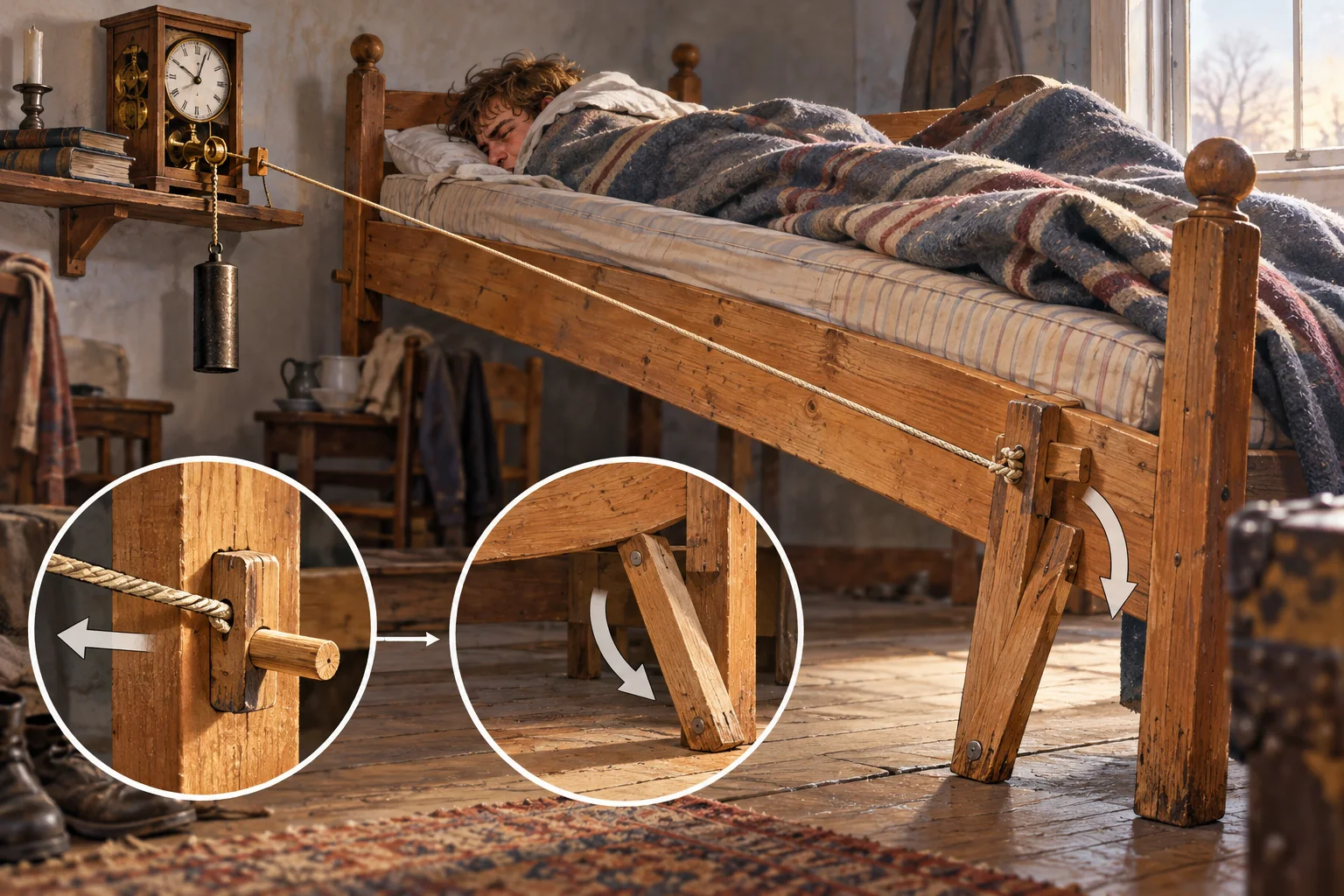
The bed’s unusual design appears in a 1915 reminiscence by Charles E. Vroman, a former roommate. Preserved by the University of the Pacific’s Holt-Atherton Special Collections, Vroman’s account describes a pine bed raised on pivots near its head and supported at the foot by a hinged brace. A peg held the brace straight, keeping the bed level for sleeping.
A clock, a cord and a falling support
Vroman recalled that a cord connected the peg to a clock’s escapement. At the chosen hour—usually five o’clock, he wrote—the clock released a weighted line, which pulled the peg from the brace. The bed’s foot then dropped, leaving the frame at a steep angle and sending its occupant into the day. Vroman also remembered a set of levers near a fluid lamp; as the bed moved, the mechanism lit it.
That description gives the invention a lively physical logic. The clock set the timing, the cord carried the motion and the peg held the bed in its overnight position. A small release transformed the whole frame into an alarm the sleeper could feel.
What the old accounts tell us
The National Park Service describes Muir’s alarm-clock bed as a device that tipped him onto the floor. Vroman’s 1915 recollection supplies more detail about the frame and its clock-triggered release, while the Wisconsin Alumni Association connects the machine to Muir’s student years and the 1860 State Fair. Read together, these accounts show why the invention has stayed memorable: Muir turned a familiar problem into a piece of practical mechanical theater.
The surviving story is a window into Muir’s early curiosity, years before his best-known work as a naturalist and conservationist. His device made timekeeping tangible: a clock did more than sound an alarm; it changed the furniture around its sleeping inventor.
Leave a Reply