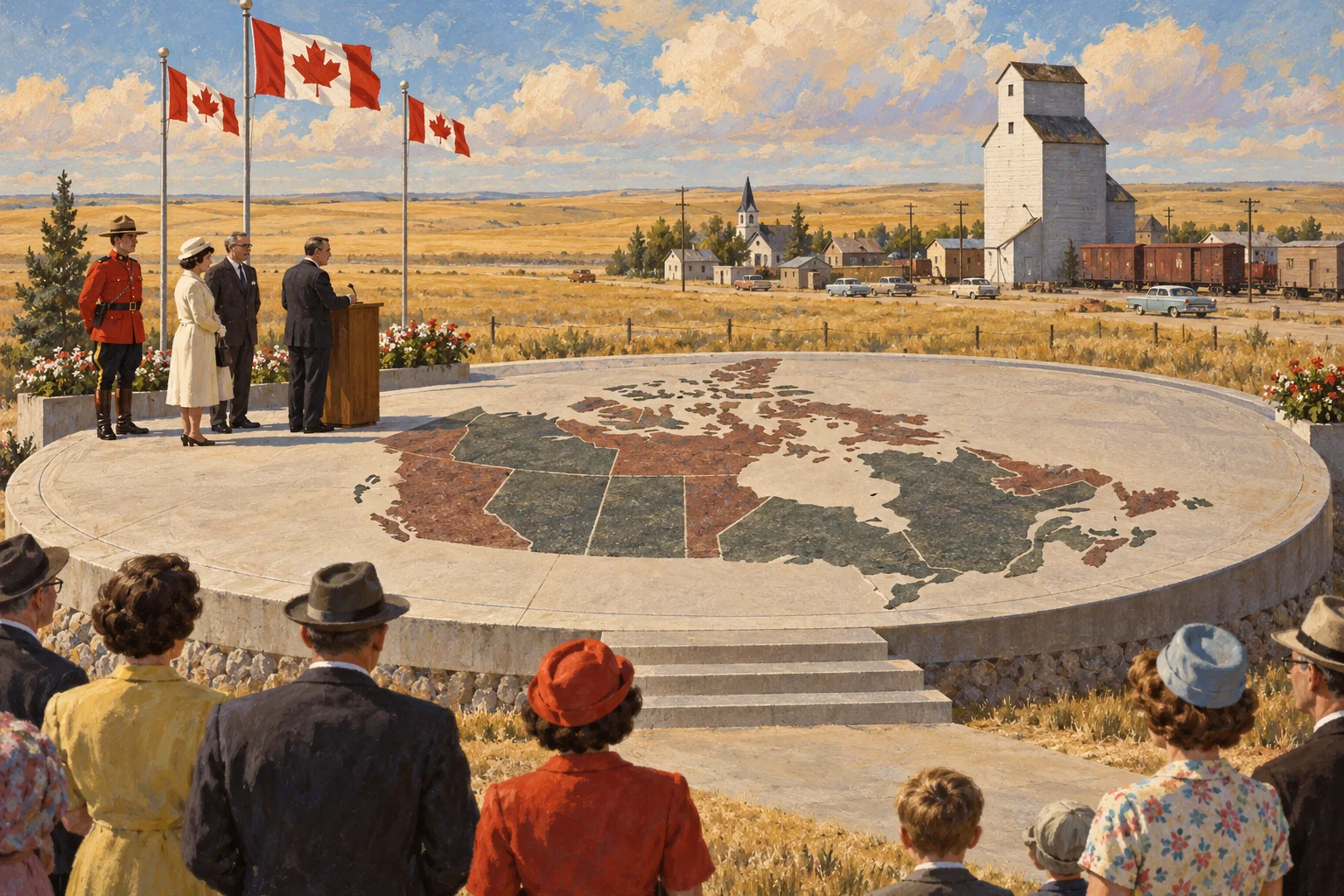
A prairie town welcomed Canada’s centennial with an invitation aimed at the stars: a raised concrete landing pad for visiting flying saucers. St. Paul, Alberta, turned the 1967 project into a lasting landmark—and a snapshot of the community’s inventive centennial spirit.
The pad stands beside the recreation grounds in St. Paul, northeast of Edmonton. The Town of St. Paul dates its opening to June 3, 1967, and says the occasion also brought the title “Centennial Capital of Canada.” The municipal history calls it the world’s first UFO landing pad; the St. Paul Museum places it among a much larger set of local projects created for Canada’s 100th birthday.
A town makes a hundred centennial projects
St. Paul’s centennial work began years before the anniversary. The museum’s historical record says the community started preparing in 1964, with its Chamber of Commerce leading a program that eventually grew to 100 projects. The collection ranged from a recreation building and student exchanges to local arts, farm machinery, Ukrainian folk dancing and a community time capsule.
The landing pad had its own place in that catalog: project 65. Its neighbors in the list hint at a whole town leaning into the cosmic theme. Project 66 was a landing-pad float, project 67 offered flying-saucer tokens, and a later entry promised “Martian Hairdos.” The pad was both a playful attraction and one piece of an ambitious civic celebration.
An engineer gave the invitation a shape
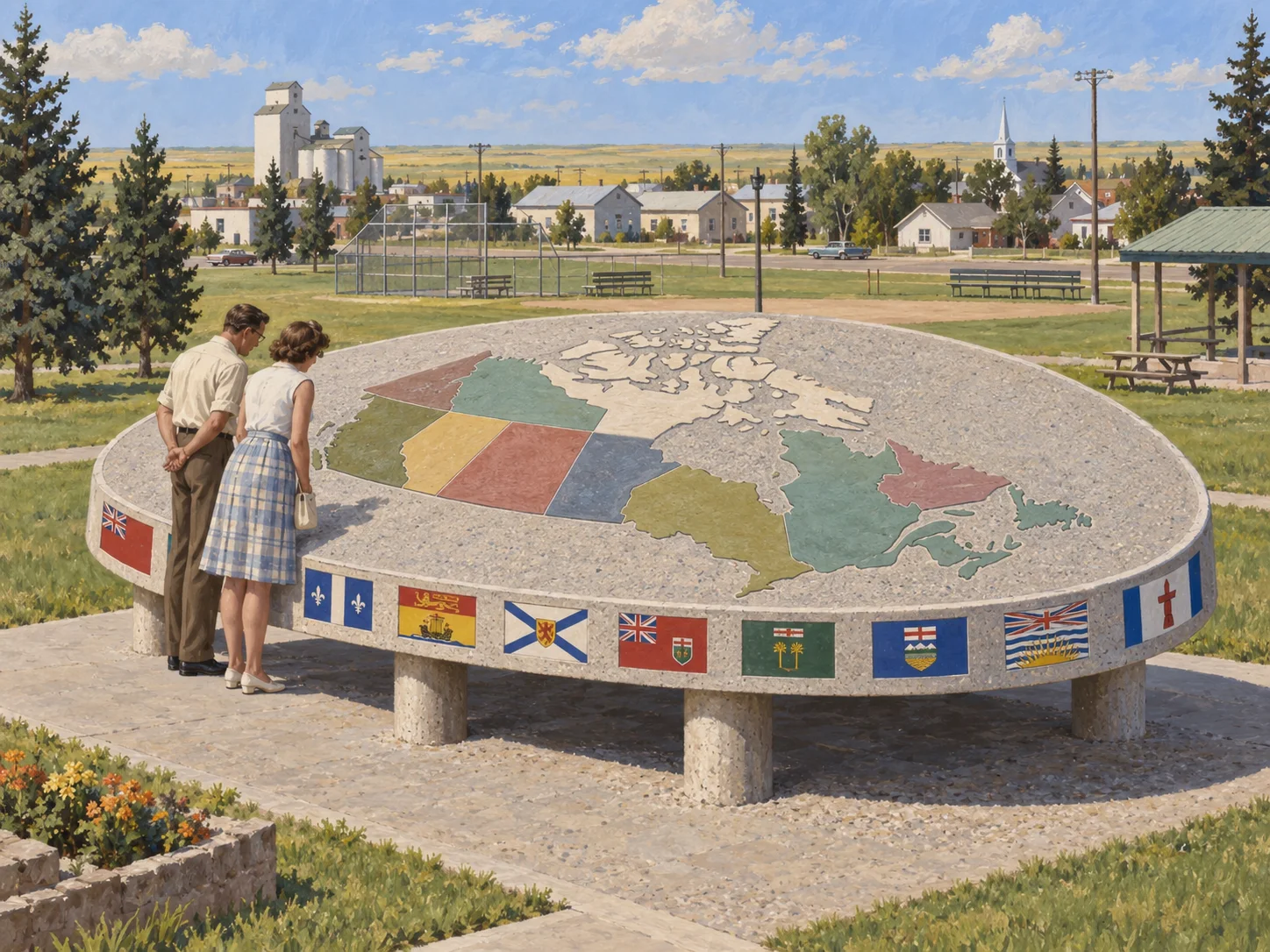
Alberta’s engineering association identifies Edmonton civil engineer Alex Mair as the pad’s designer. Its account describes an oval platform raised above the ground, with a large map of Canada and blinking lights intended to guide visitors. The association gives the structure’s weight as 130 tonnes, a substantial piece of civic engineering for an idea delivered with a wink.
The municipal site places the pad’s opening on June 3, 1967. Its present-day description connects the attraction with a tourist information centre and a welcome for visitors. In the 1990s, the Town says, Mayor Paul Langevin opened an adjacent centre. The site now describes that visitor hub as home to a boutique representing more than 50 local artisans.
More than a landing strip
The pad’s design made the joke visible from the road, while its map and flags framed it as a place for the whole country. That combination fits the broader centennial record preserved by the museum: practical buildings, cultural projects, ambitious community plans and a few ideas meant to make people smile.
St. Paul’s landmark still offers a compact way to meet that history. It is a piece of concrete engineering, a tourist stop and a surviving artifact of the town’s 1967 celebration. The invitation remains legible in the monument itself: a small Alberta community made room on the map for anyone curious enough to stop.
Sources: Town of St. Paul, “The Landing Pad”; St. Paul Museum, “Centennial Projects”; APEGA, “Calling All Flying Saucers: Free Parking in St. Paul”.
Leave a Reply