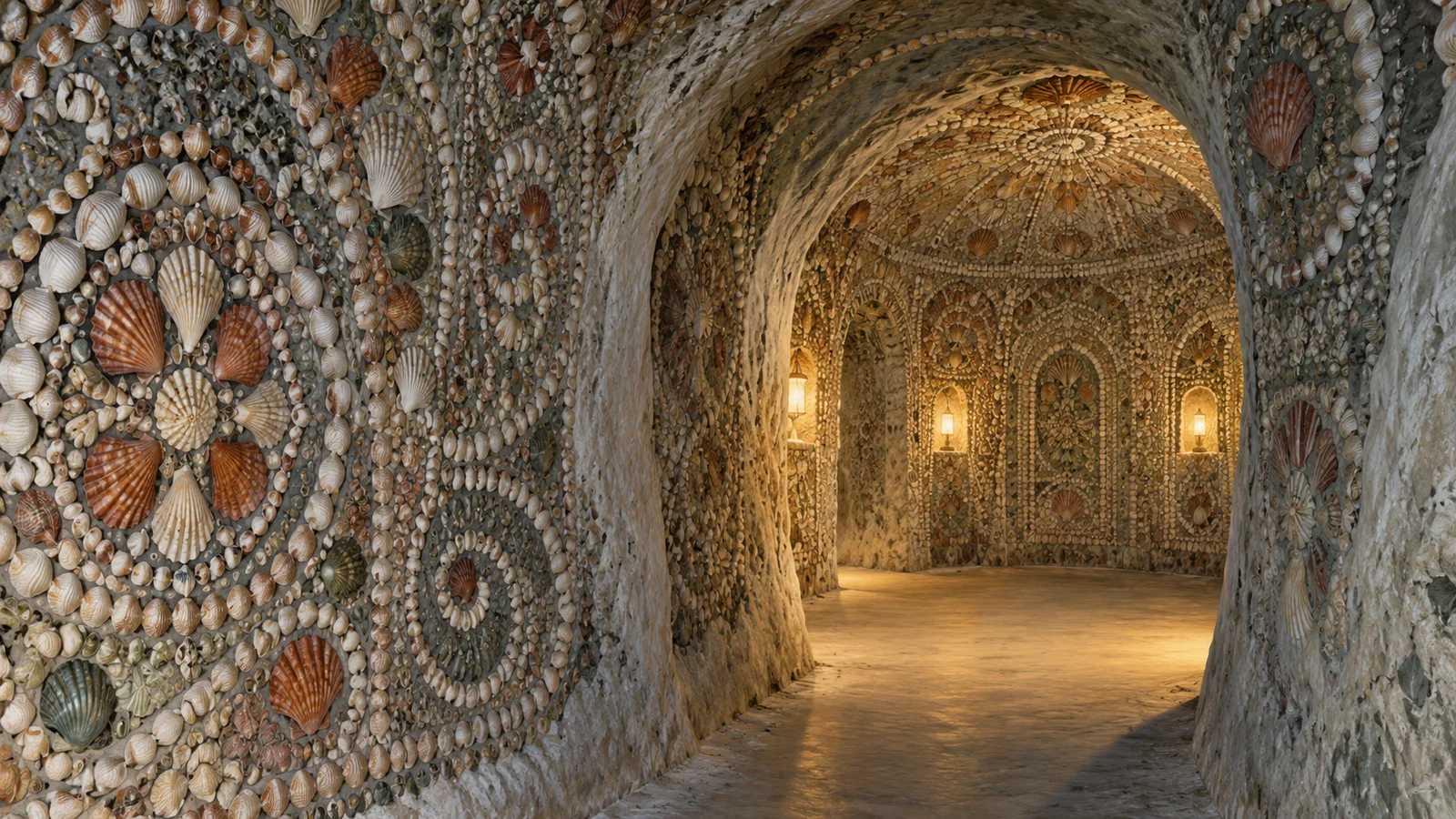
Beneath a garden in the seaside town of Margate, a winding chalk passage opens into a chamber whose walls carry thousands of shell-made patterns. The Shell Grotto is a real underground landmark; its builders and first purpose remain subjects of careful debate.
A discovery beneath a house
The grotto came to wider attention in 1835, when excavation at a Margate property opened into an underground space. The surviving accounts tell the discovery in different ways. A local newspaper report published in 1838 described workmen clearing a large stone during building work at Belle Vue Cottage. A later family recollection, preserved by the grotto’s current stewards, remembers children exploring the passage before their father learned of it. The evidence gives us a vivid discovery story and more than one version of its first moments.
James Newlove, a schoolmaster who acquired the property, prepared the passages for paying visitors. The earliest surviving newspaper notice announced that the attraction would soon open; the Shell Grotto’s historical account dates its first paying customers to 1838. The discovery and the public opening turned a hidden underground feature into part of Margate’s seaside life.
A mosaic built from local shells
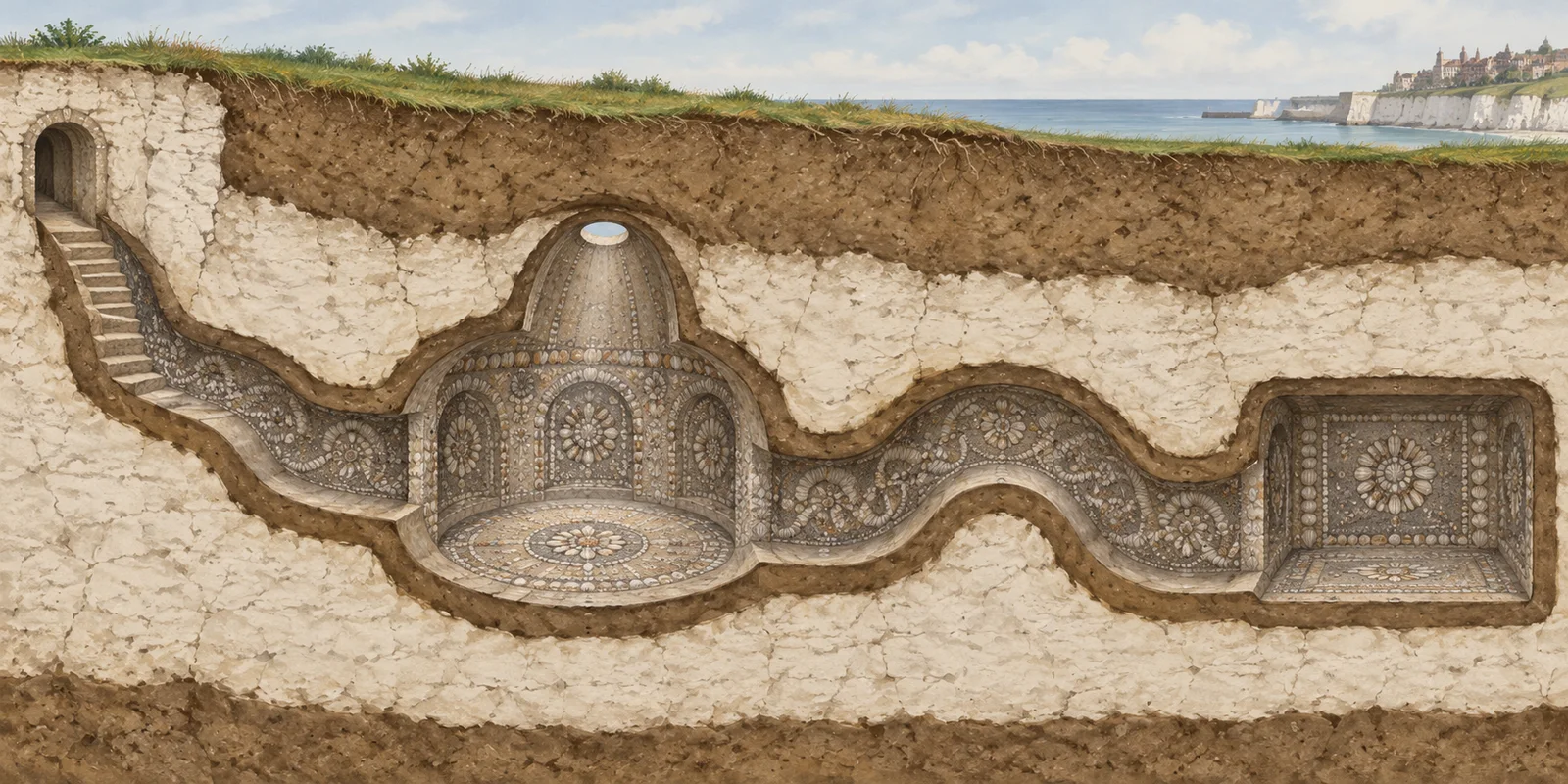
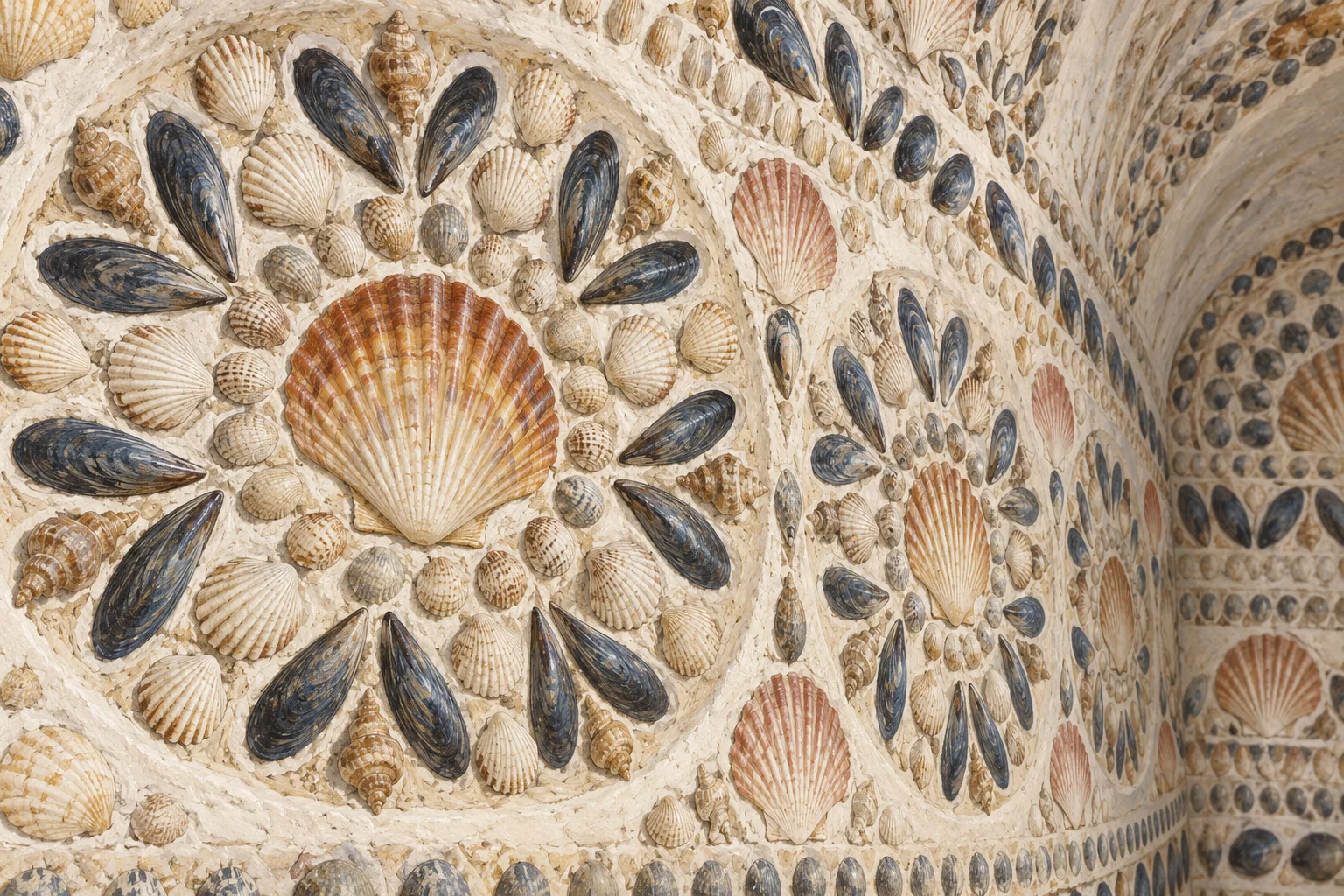
The underground route links a curving entrance passage, a rotunda, a central domed shaft, an S-shaped passage and a chamber traditionally called the Altar Room. Across roughly 2,000 square feet of surface, shells form panels, borders and repeating designs. The often-cited estimate is about 4.6 million shells. The grotto’s current shell survey identifies about 40 varieties, with almost all native to Britain; mussels, cockles, whelks, limpets, scallops and oysters are among the kinds used prominently.
The effect comes from repetition and close hand placement. A shell’s curve can become a petal, a border or a small burst of color. The patterns invite interpretation, while the physical work of fitting natural forms across chalk walls is remarkable on its own.
A history with open questions
Stories about a Phoenician temple, a Roman sanctuary or a secret meeting place have attached themselves to the grotto’s imagery. The Kent County heritage record describes the grotto as Grade I listed and assesses an early-19th-century date as the likeliest identification. The range of interpretations reflects a site whose decorated walls preserve a remarkable craft tradition alongside questions about its earliest use.
A 2005 survey discussed by the Kent Archaeological Society compared the central shaft and short passages with regional chalk mines known as deneholes. Its author proposed that an older chalk excavation may have been extended and decorated later. Much of the original chalk surface sits beneath the mosaic, leaving the grotto’s sequence of construction open to archaeological interpretation.
Margate’s Shell Grotto endures as both a place and an open question: a carefully decorated underground route discovered in the 19th century, with early history explored through archaeology, local records and tradition. Its millions of shells make that layered story visible, one small piece at a time.
Leave a Reply