Deep in the Pacific, a small fish carries a clear dome over its head. Its green tubular eyes usually point upward, then rotate forward when dinner arrives.
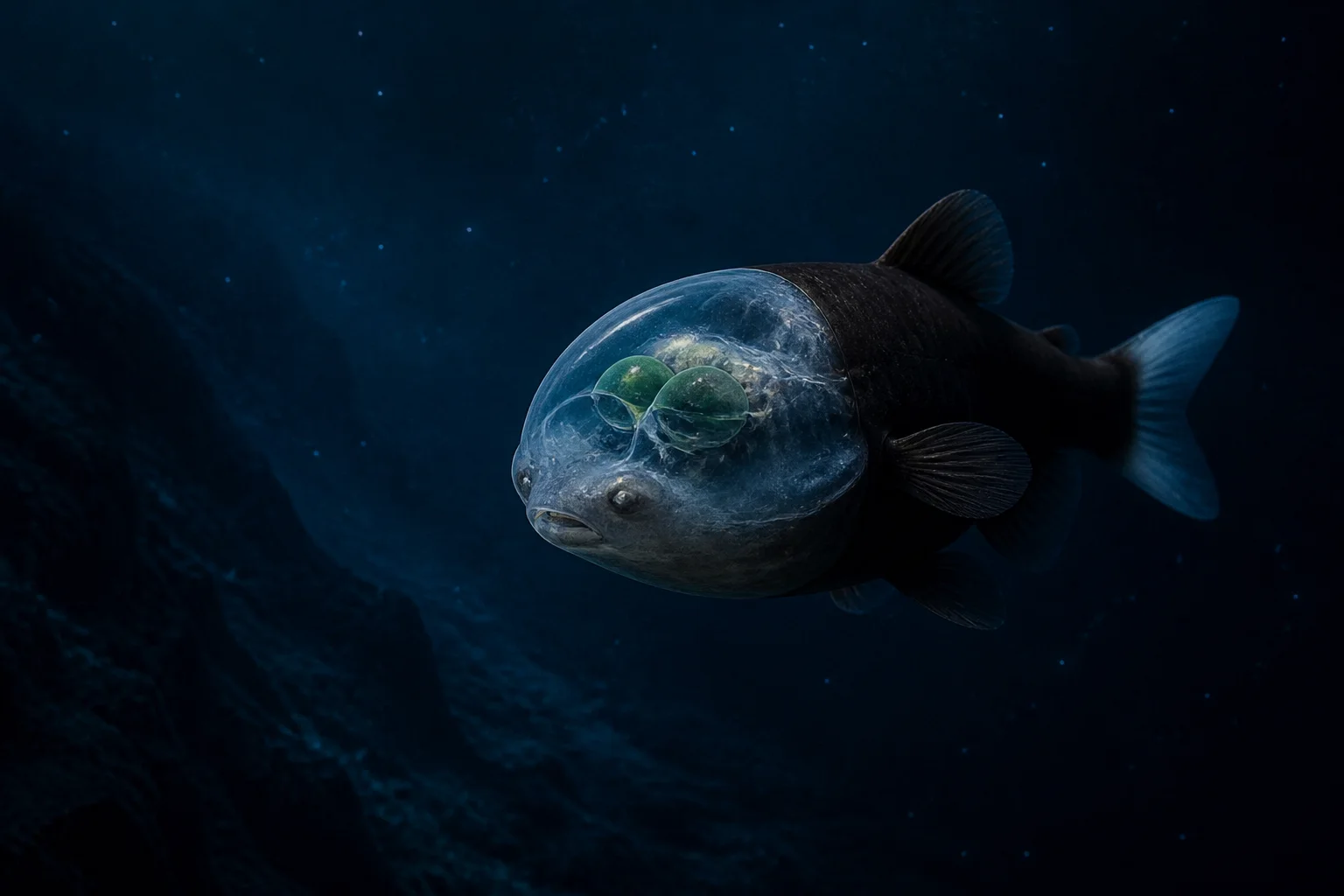
At first glance, the barreleye looks as if someone put a glass helmet on a fish. The resemblance is real enough to be useful: Macropinna microstoma has a transparent, fluid-filled dome over the top of its head, and its bright green, tubular eyes can be seen inside it.
The fish lives in the ocean’s twilight zone, generally between about 2,000 and 2,600 feet (600 to 800 metres) in the northeastern Pacific, according to the Monterey Bay Aquarium. At that depth, sunlight has faded to a thin suggestion. A fish that wants to find food needs a very different visual strategy from one cruising near the surface.
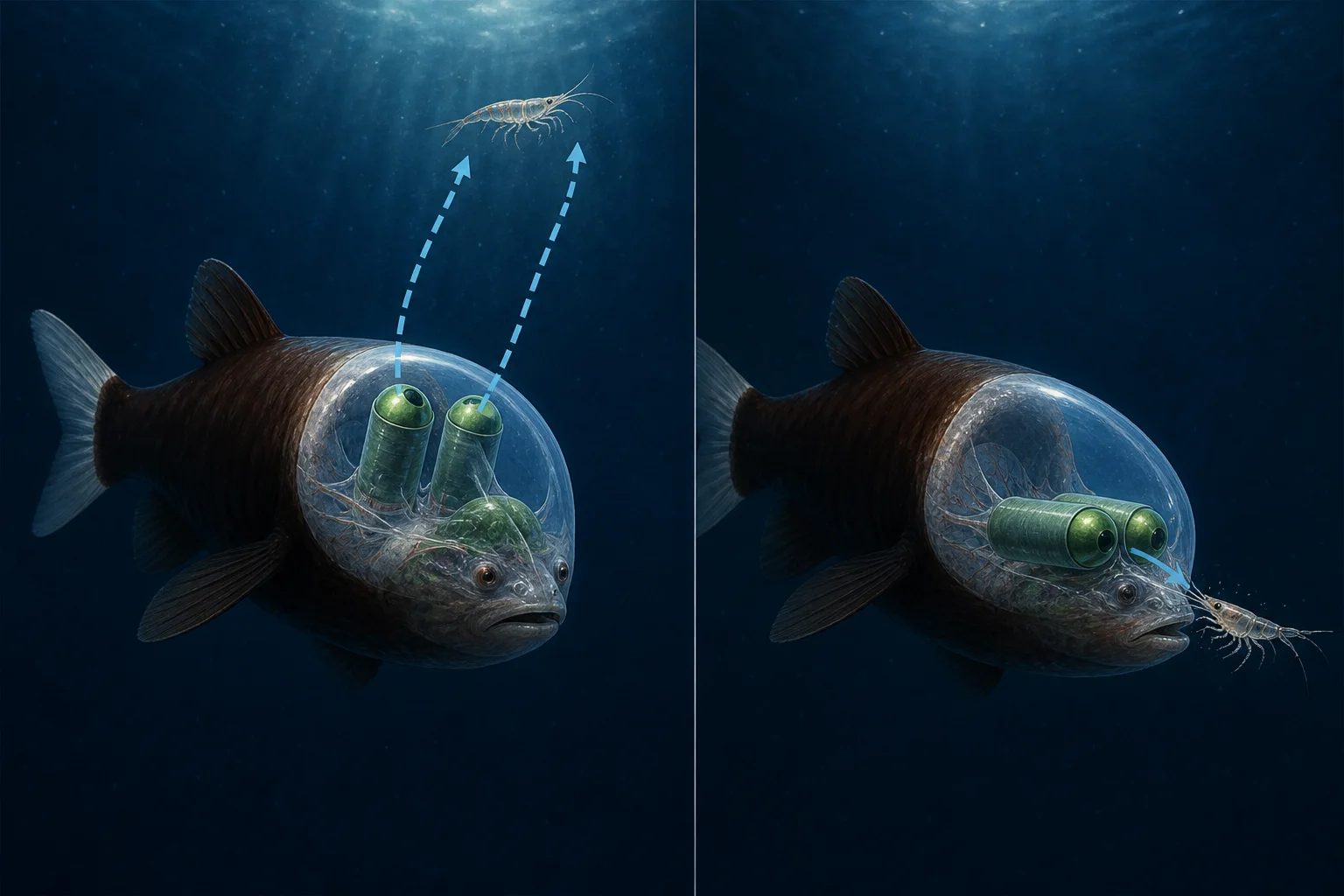
The barreleye’s strategy begins with looking up. Its sensitive eyes point toward the water above, where the silhouettes of small animals can stand out against the faint light filtering down from the surface. The transparent dome lets those eyes work inside a protected space rather than sitting exposed on the outside of the head.
The eyes turn toward the meal
For years, scientists observing barreleyes thought the eyes were fixed in an upward position. That created an obvious puzzle: if the fish spotted a possible meal overhead, how could it see the meal once it turned to feed?
In 2009, researchers at the Monterey Bay Aquarium Research Institute used video from remotely operated vehicles to document the answer. The fish can rotate its tubular eyes from their usual upward position toward the front of the head. A fish that spends much of its time scanning the ceiling of the ocean can therefore shift its view when it brings food close.
That movement is easy to describe but strange to picture. Imagine walking through a dark room while looking at the ceiling, then swivelling your eyes forward without turning your head when you reach for a snack. The barreleye’s transparent head is part of the same arrangement: it gives the eyes room to move while keeping their delicate surfaces shielded.
A rare fish made visible by patient machines
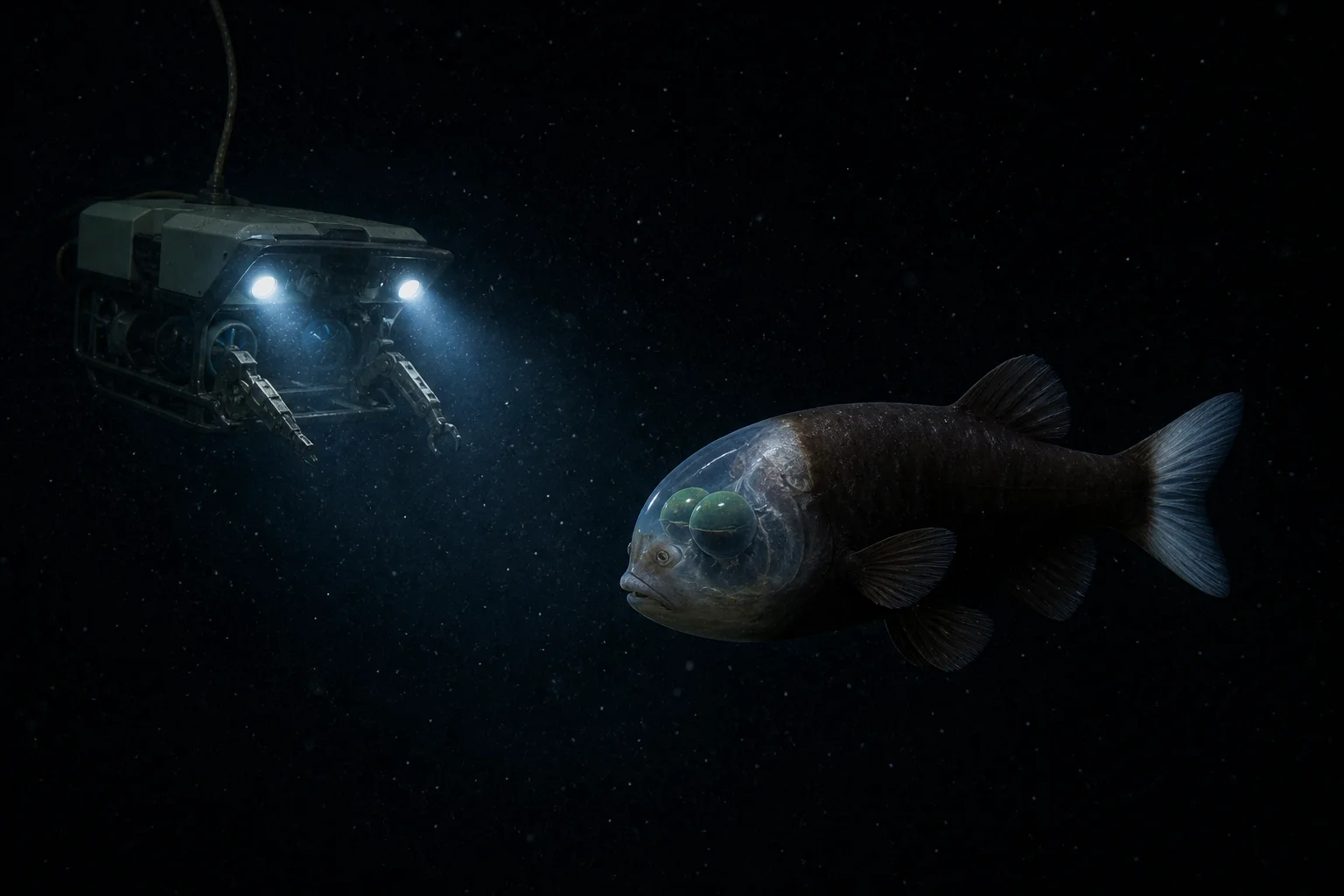
Barreleyes are rare sights, even for researchers who spend years sending cameras into the deep. The Monterey Bay Aquarium says MBARI remotely operated vehicles logged more than 5,600 dives over more than three decades, yet had encountered the fish only nine times as of 2022.
That scarcity helps explain why a familiar-looking fish can still hold a scientific surprise. Early observations gave researchers an incomplete picture because the animals were seen only briefly, far below the surface and under artificial lights. Repeated expeditions and better video made it possible to connect the fish’s odd anatomy with its behavior.
The ROV does more than make a dramatic picture. It allows scientists to watch an animal without bringing it into a tank, where pressure, light and the surrounding water would be radically different. The aquarium describes its deep-sea encounters as video observations of animals in their habitat, adding movement and context to what specimens alone can show.
Inside the clear dome
The dome is a transparent, fluid-filled structure that covers the eyes and upper part of the head. The visible green tubes are the eyes; the small spots on the front of the fish’s face are its nostrils, or nares.
The fish’s appearance also comes with an important limit on what researchers can say. Scientists know the barreleye’s upward gaze helps it detect prey above and that its eyes rotate forward for feeding. They have proposed additional advantages, including protection from stinging siphonophore tentacles, but the aquarium presents those ideas as hypotheses rather than settled facts.
That distinction is part of the animal’s appeal. The barreleye’s transparent head, periscope-like eyes and daily view of a dark water column make it extraordinary on their own. A camera lowered into that darkness revealed a fish whose strangest feature is also a carefully tuned solution to life where almost no light reaches.
For a human observer, the fish seems built backward. For the barreleye, the arrangement is practical: watch the ceiling, track a meal, turn the eyes, eat, and return to the dark. The clear head is a working adaptation for life in a place where looking up is the difference between finding food and missing it.
Sources: Monterey Bay Aquarium, Barreleye; Monterey Bay Aquarium, Searching in the dark; Monterey Bay Aquarium, The midwater; NOAA Ocean Exploration, Barreleye Fish.
Leave a Reply