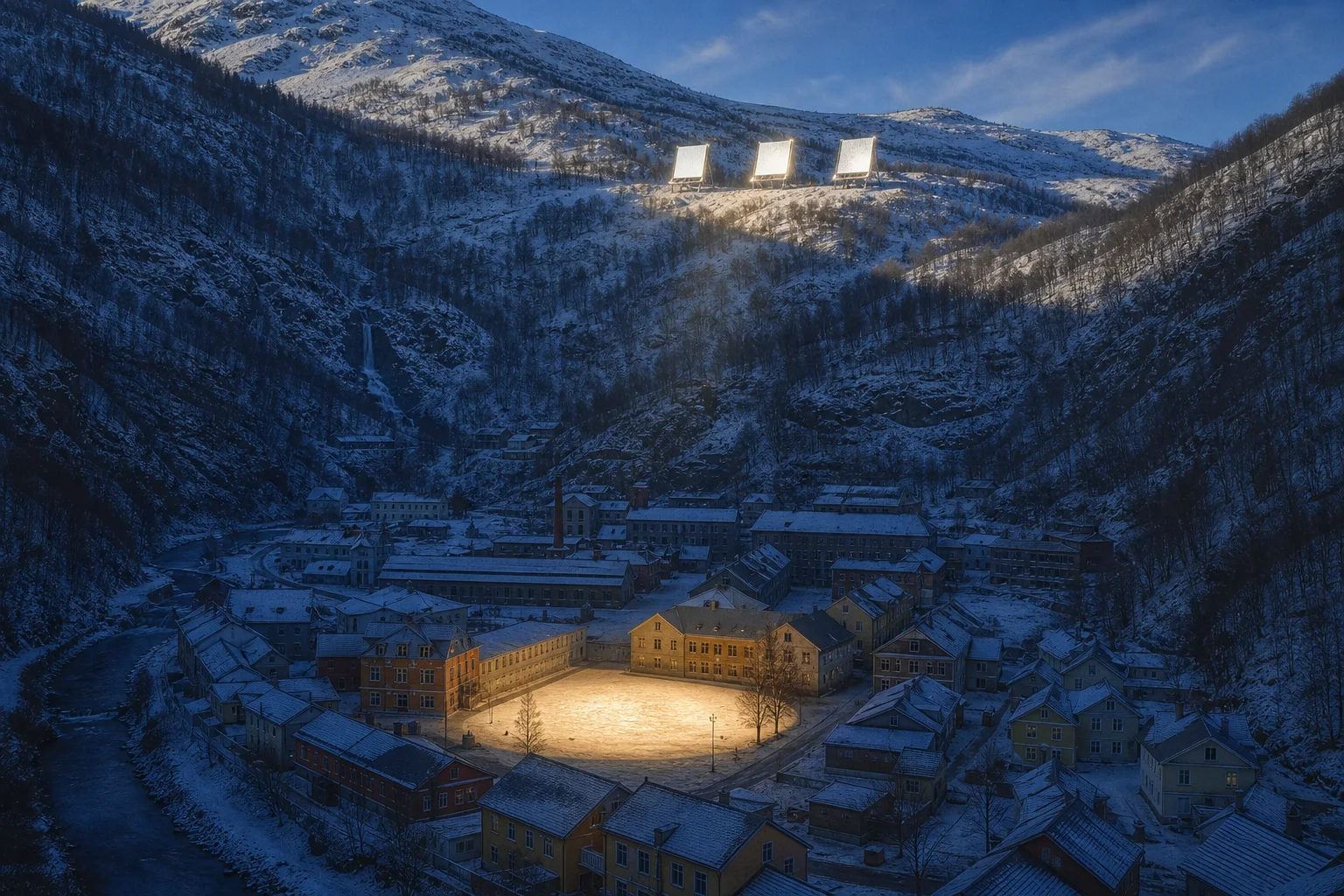
Editorial illustration.
Rjukan, Norway, has a winter problem that is hard to solve with a lamp: for part of the year, the low sun clears the mountains but not the town itself. The settlement sits deep in the Vestfjord valley, beneath steep walls that leave its center in shadow. So Rjukan put three mirrors on a mountainside and taught them to follow the sun.
The result is called Solspeilet, or the Sun Mirror. It does not light the whole town, and it does not create a second sun. It redirects a deliberately limited patch of ordinary daylight onto the town square. That modestness is what makes the installation more interesting than the usual “mirrors brighten a town” shorthand: it is a controlled, moving reflection built for one particular valley.
A light problem created by geography
Rjukan’s geography is the entire premise. VisitRjukan says the mountains block direct sunlight in the town from October into March. The sun still reaches the high slopes, but the square lies below the ridge line. Before the mirrors, residents could take the Krossobanen cable car uphill to meet the sun; the cable car opened in 1928. The mirrors pursue the opposite idea: send a small piece of the sunlight downhill.
An idea that waited a century
The local account traces the proposal to bookkeeper Oscar Kittelsen in 1913, with industrial founder Sam Eyde supporting the idea. The concept was simple enough to describe then, but a working outdoor system needed surfaces and controls that could keep a reflection aimed as the sun moved. Norsk Hydro’s 2013 account describes the installation as the realization of that old Rjukan idea after many decades.
Artist Martin Andersen revived the proposal in 2005, according to VisitRjukan. The completed installation opened in 2013. It is an unusually literal civic artwork: its visible effect is not a monument or a sign, but an area of light on paving stones.
Three mirrors, one patch of sun
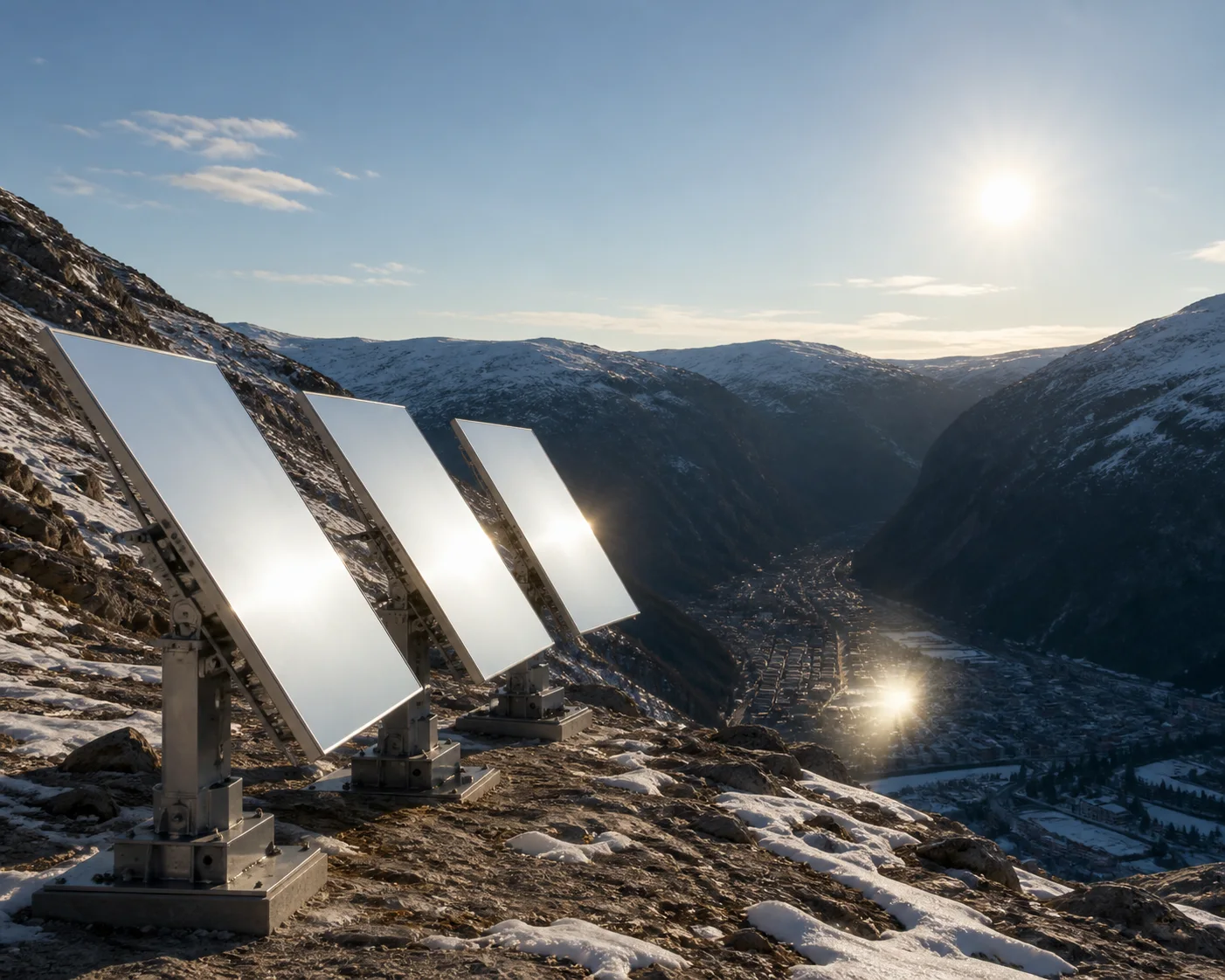
The system uses three computer-controlled heliostats—mirrors that change their angle to keep a reflection pointed at a target. VisitRjukan gives the installation’s stated dimensions as 17 square meters per mirror, or 51 square meters together. It places them at 742 meters above sea level, roughly 450 meters above the square, and says their reflected light can cover about 600 square meters there.
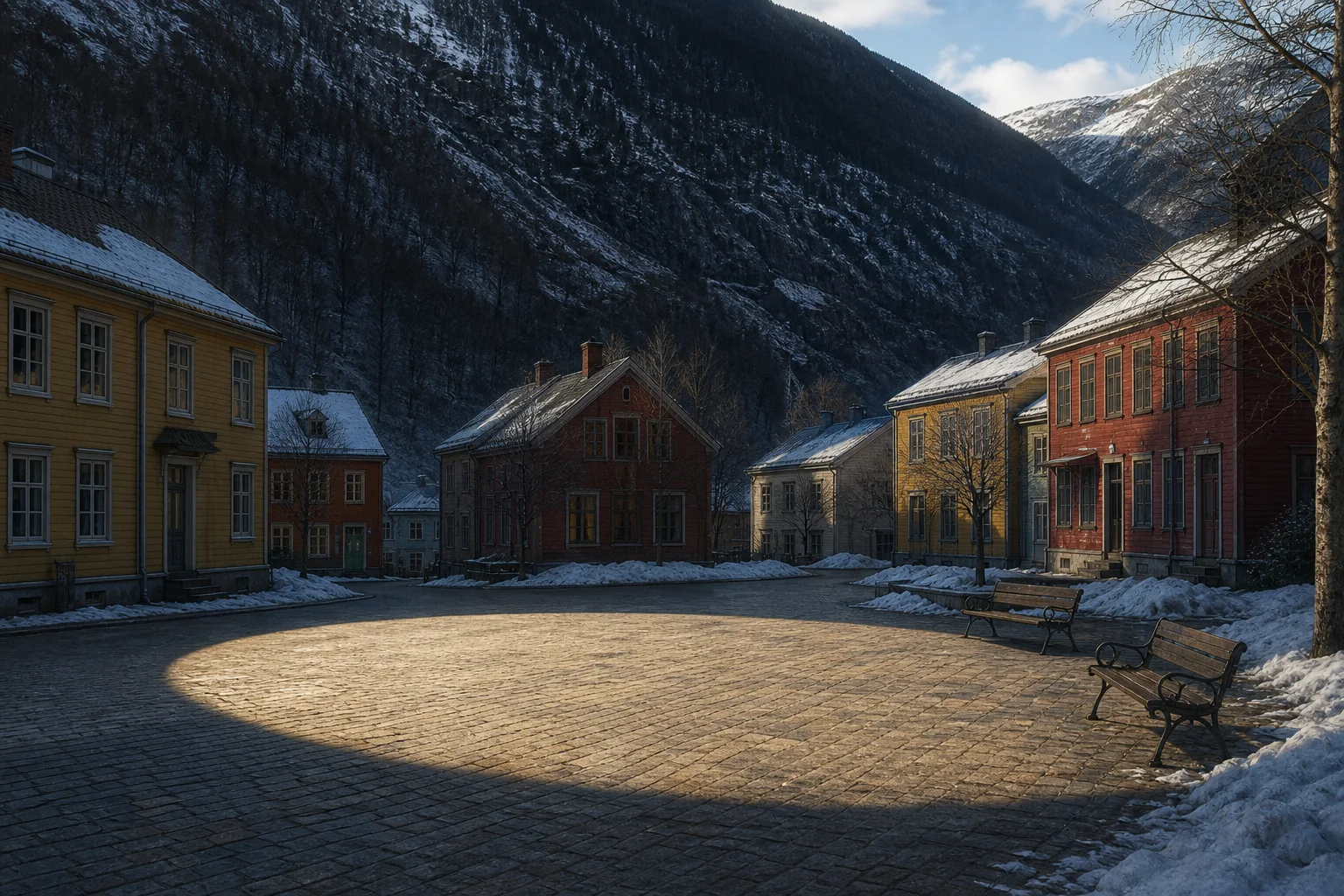
Those figures describe a target zone, not a town-wide lighting scheme. A person standing in the square can encounter a bright pool of natural daylight while the streets around it remain in mountain shade. Its scale is intentionally legible: the mirrors are far above, and the result below is a patch rather than a blanket.
It is reflection, not a replacement sun
A flat mirror sends light away at the same angle at which it arrives. Because the sun’s position changes through the day, a fixed panel would soon throw its reflection somewhere else. Rjukan’s mirrors are computer controlled so their aim can be adjusted as the sun travels across the sky. The mountain location is essential: it receives direct sun even when the valley floor does not.
That also gives the feature clear limits. The mirrors cannot make sunlight on a cloudy day, extend the day, or deliver direct sun across the whole valley. They redirect available daylight from a sunny slope to a chosen public place. The narrowly bounded effect is a more accurate description than “bringing the sun back” to Rjukan.
Why the effect feels so strange
Most public infrastructure hides its mechanism. Here, the mechanism is a mountain installation and the output is a conspicuously sunny square below it. The distance between the two turns a familiar physical rule into something almost theatrical: sunlight appears where the terrain says it should not, but only in the exact shape and place the system is designed to reach.
The evidence boundary
Local installation and history sources agree on the 1913 origin story, the 2013 opening, and the use of three computer-controlled mirrors. The elevation, mirror area, and illuminated-area values above are the installation’s stated specifications from VisitRjukan, not independent measurements repeated here. This explainer does not claim that the mirrors brighten all of Rjukan or make health claims about the light; they are a targeted reflection system for the town square.
Sources
- VisitRjukan, “The Sun Mirror” — local installation history and stated technical specifications.
- Norsk Hydro, “In Rjukan, all eyes on the sun” — 2013 historical account of the project’s opening.
- Krossobanen, “Solspeilet” — local historical corroboration of the 1913 idea and three-heliostat installation.
Leave a Reply