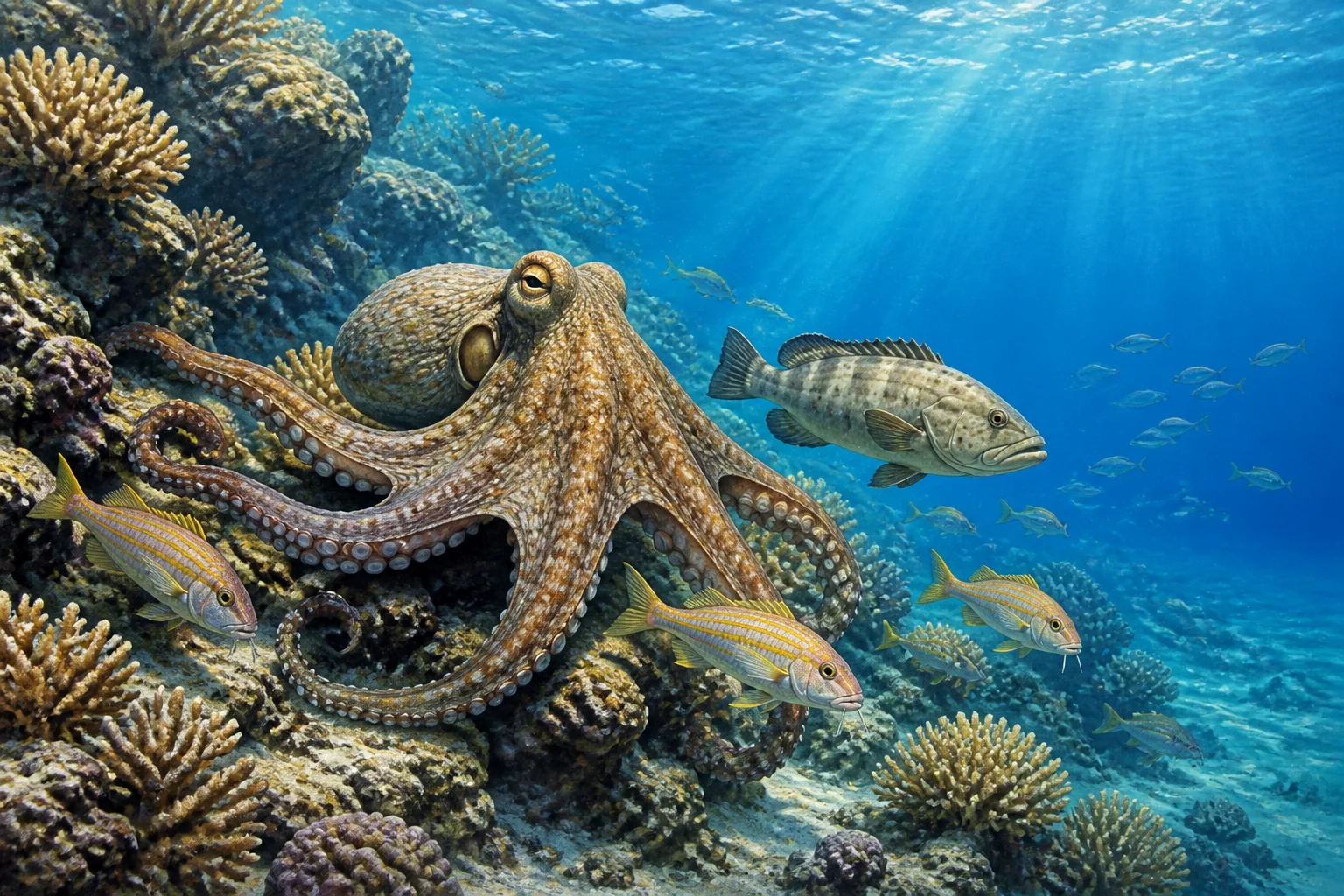
On a coral reef, an octopus can look like the least likely member of a hunting party. Yet day octopuses (Octopus cyanea) have been documented foraging alongside several kinds of fish. The fish search in one set of places, the octopus searches in another, and the group can keep moving for more than an hour. The strangest detail is real: researchers have filmed an octopus using a swift arm movement to knock a particular fish away.
It is tempting to call that a fishy workplace dispute. The useful version of the story is more interesting. These are mixed-species hunts in which the animals’ different ways of finding prey can fit together—and in which the costs and rewards do not always line up.
It is a hunt with different jobs
A 2021 field report described groups in the Red Sea that included a day octopus and several fish species. In those groups, the octopus can search inside rock and coral crevices. Bottom-feeding goatfish work a broader patch of seafloor, while other fishes can occupy the water around the reef. The researchers note that some fish are active partners and that others may simply take advantage of opportunities created by the group.
That does not make the arrangement a tidy team with fixed ranks. Fish can help locate places worth searching, and octopuses can also follow fish partners toward prey. A later study, published in 2024, used field video, three-dimensional tracking and experiments to examine these groups more closely. Its authors found that influence was divided by task: goatfish were especially important in exploring and setting direction, while the octopus had a stronger role in when the group started moving.
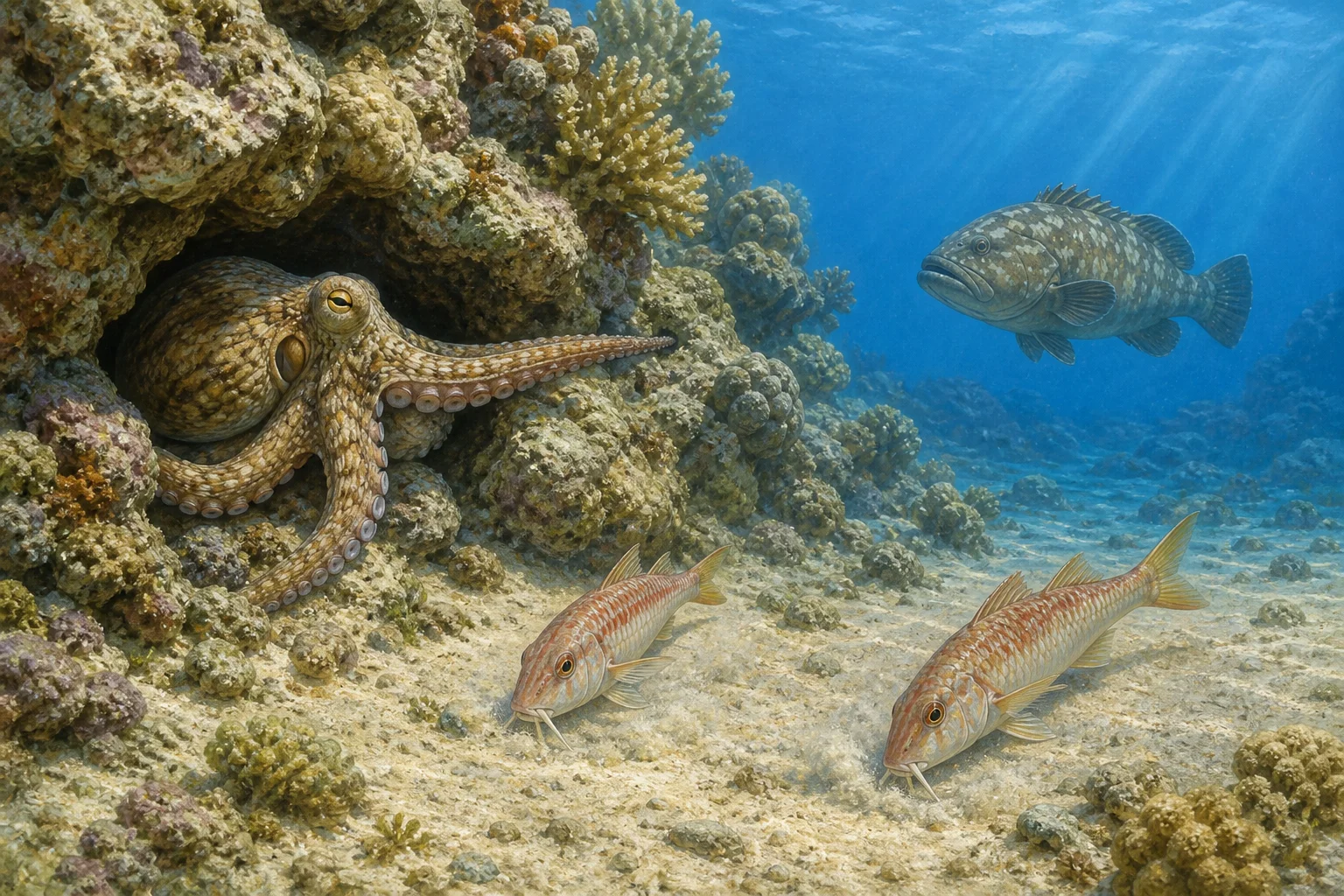
Editorial illustration: a visual interpretation of complementary foraging zones in an octopus–fish hunting group.
What researchers mean by a “punch”
The word is descriptive, not a claim that an octopus boxes like a person. In the 2021 report, the authors documented eight events in which an octopus made a fast, explosive motion with one arm toward a specific fish. The action displaced the fish. The observations came from different day octopuses in Eilat, Israel, and El Quseir, Egypt, and involved several kinds of groupers, goatfish and a squirrelfish.
In some recordings, the octopus immediately searched where the fish had been, a pattern consistent with direct competition for a prey opportunity. In other recordings, it did not. That distinction matters: the paper does not claim that every strike has the same cause, and it calls for closer study of what happens before and after a fish is targeted.
“Punishment” is a hypothesis, not a translation
The researchers offered several possible explanations for the events where no immediate prey grab followed. One is that the movement could impose a cost on a fish that is exploiting the hunt. Another is that a short-term cost might influence a partner’s behavior in later interactions. The paper also discusses “spite” in a technical game-theory sense, explicitly without an emotional meaning.
Those possibilities are not evidence that an octopus is angry, vengeful or running a reef courtroom. They are ways to test how cooperation holds together when unrelated species share an opportunity. The 2024 study strengthens the case that group composition changes how much each animal invests and how successful the hunt can be; it does not turn every arm movement into a proven disciplinary message.
Why this small reef scene matters
Octopuses are often described as solitary animals, so a group hunt with fish is already a useful corrective to the usual picture. The odd arm movement adds another lesson: cooperation in nature need not be gentle, equal or simple. A group can contain complementary skills, opportunists and conflicts at the same time.
The verified weirdness is therefore not that an octopus has discovered human-style office politics. It is that a soft-bodied invertebrate and several kinds of fish can form a moving hunting group, divide influence across different decisions, and occasionally settle a conflict with one very deliberate-looking arm.
Sources
- Sampaio, Seco, Rosa and Gingins, “Octopuses punch fishes during collaborative interspecific hunting events,” Ecology (2021) — original field report documenting the arm-displacement events and its limits.
- Sampaio et al., “Multidimensional social influence drives leadership and composition-dependent success in octopus–fish hunting groups,” Nature Ecology & Evolution (2024) — primary research on leadership, group composition and collective hunting.
- Max Planck Institute of Animal Behavior, “Unlocking the secrets of multispecies hunting” — institutional summary of the 2024 study’s field-video and tracking methods.
Leave a Reply