Editorial illustration
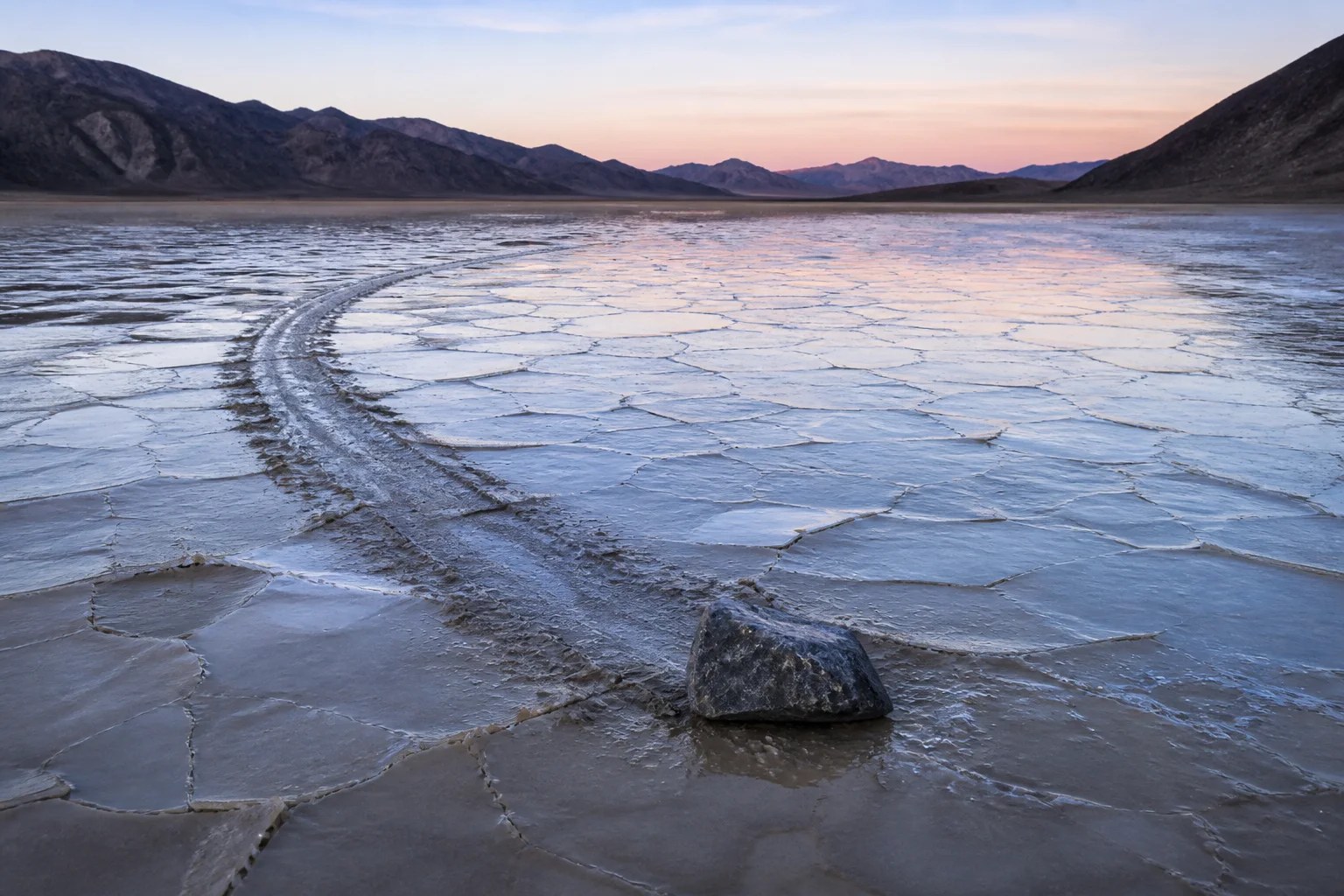
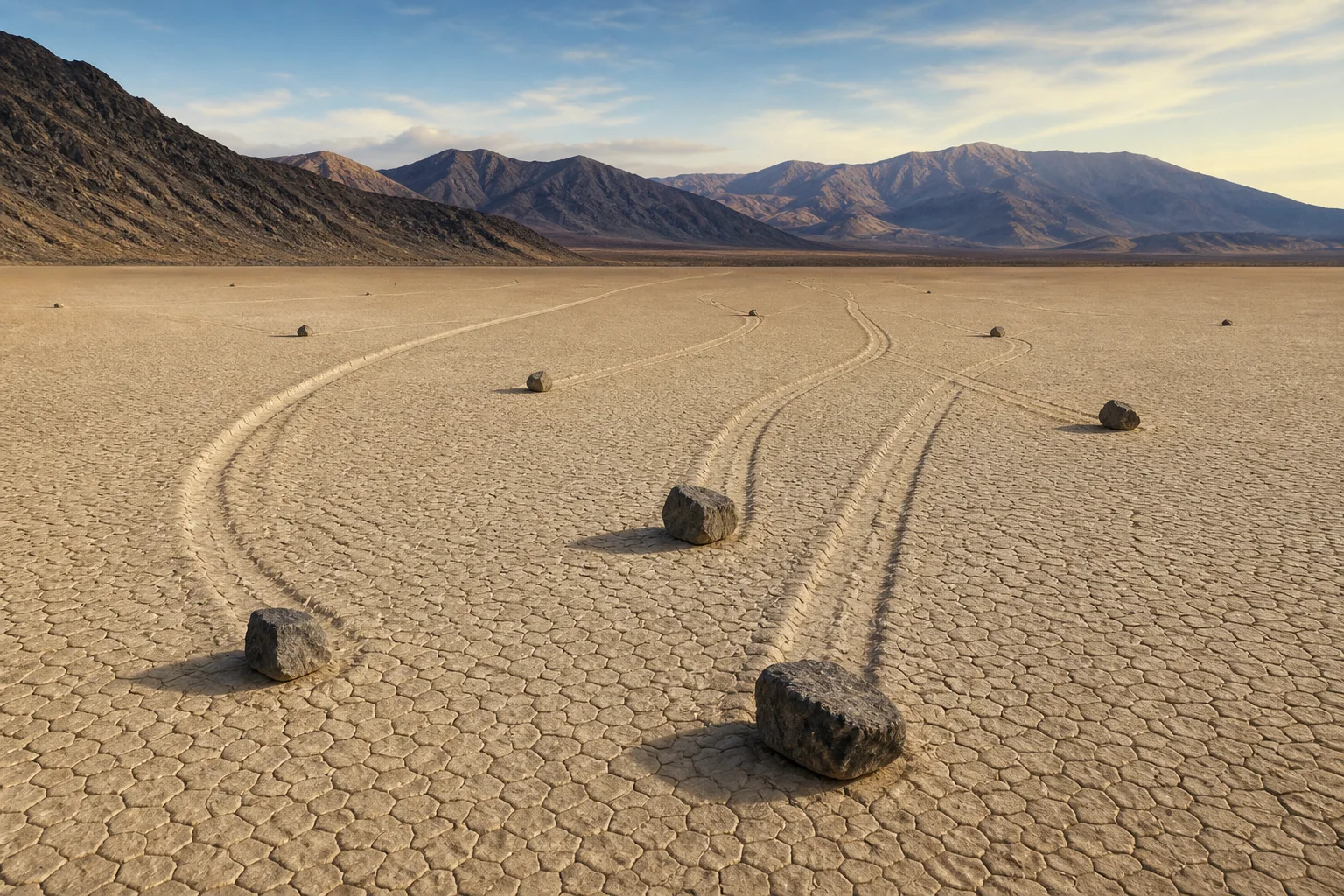
At Racetrack Playa in Death Valley National Park, dark rocks have left long, ruled-looking trails across a nearly level dry lakebed. The sight is genuinely odd. It is also not a trick of photography, a prank, or a supernatural claim: field researchers directly watched rocks move there in December 2013 and January 2014.
Confirmed facts
The Racetrack is a playa, or dry lakebed, in a remote part of Death Valley National Park. Rocks fall from the surrounding terrain onto its surface, and some later slide across the flat mud, leaving furrows behind. The National Park Service says some rocks weigh as much as 320 kilograms (700 pounds) and that trails can extend for hundreds of meters.
For decades, the important missing piece was an eyewitness record of the process. A team led by Scripps Institution of Oceanography installed a weather station, time-lapse cameras, and GPS-equipped substitute rocks with park permission. During a rare shallow winter pond, they observed the motion itself.
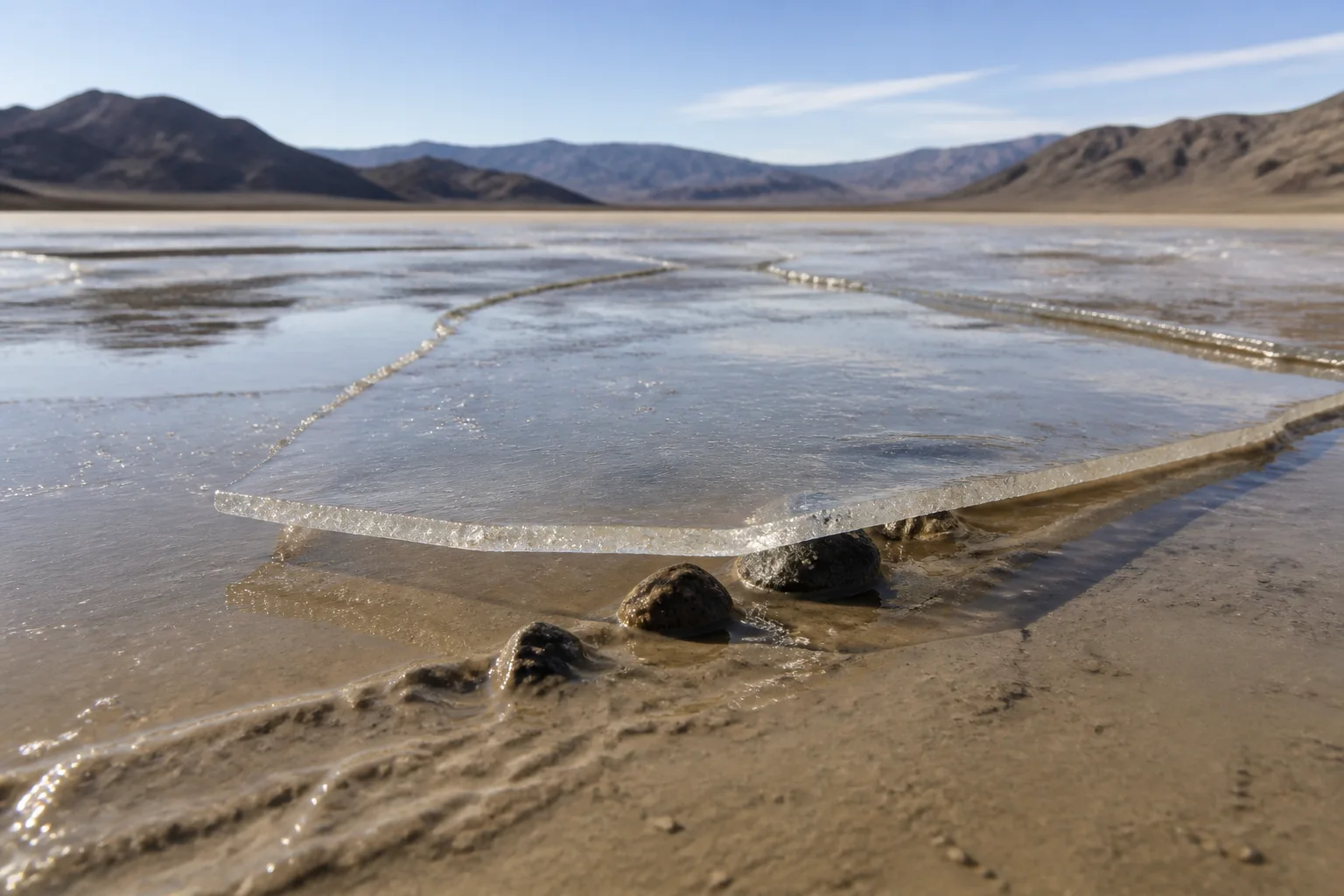
The sequence was surprisingly gentle. Cold nights formed a thin, 3-to-6-millimeter sheet of “windowpane” ice over the water. Late-morning sun broke that sheet into floating panels. Light winds, measured at roughly 4 to 5 meters per second, pushed the panels; the panels in turn nudged rocks over slick mud. The rocks moved slowly—about 2 to 5 meters per minute—and more than 60 moved during one observed event. That is why a visitor standing far away could easily miss the action.
What was once speculation
Before those observations, the trails were real but the mechanism was unobserved. Researchers considered powerful wind, liquid water, thick ice, and ice flotation. The 2014 observations did not support the dramatic version in which thick ice lifts a boulder and a gale carries it away. Instead, thin moving ice panels plus modest wind supplied the push.
That result should not be stretched beyond the evidence. It documents a mechanism for the events the team witnessed; it does not prove that every trail ever made at the Racetrack followed an identical sequence. The Park Service also notes that the researchers had not watched the biggest rocks move. The best-supported conclusion is specific and strange enough on its own: under a rare combination of shallow water, freezing nights, breaking ice, soft mud, and wind, rocks can slide.
Folklore, mystery language, and the record
The “mysterious moving rocks” label is part of the place’s public story, and the Park Service itself uses that phrase. But mystery language is not evidence of a documented local legend. The Park Service, USGS, and the peer-reviewed study describe a long scientific puzzle rather than an established folklore tradition of spirits, aliens, magnets, or secret machinery. Such explanations circulate as modern speculation; this feature does not present them as local history.
There is a smaller, practical lesson in the solved mystery. Tracks and the playa surface are fragile. The Park Service asks visitors not to move or remove rocks, drive on the playa, or walk on muddy areas, where footprints can remain for years. The strange part of the Racetrack needs no embellishment—and it needs careful treatment to remain visible.
Leave a Reply